
The end of seats
On April 14, 2026, Netlify's CEO published a post titled "The end of seats: pricing Netlify for 3 billion builders," and removed per-seat pricing from the Pro plan.
Before: Pro was $20 for one seat, with every additional team member or Git contributor adding another $20 a month.
After: $20 total, unlimited owners, developers, Git contributors, reviewers and billing admins. Reviewers who don't push code are free on every plan, including Free.
The competitive context makes this sharper than it sounds. Vercel charges $20 per developer seat plus usage metering. A five-person team starts at $100 a month on Vercel before serving a single request, and $20 on Netlify.
For agencies, open-source projects and anyone with more reviewers than committers, that's a straightforwardly better deal.
The same month, credits got more expensive
The seat change didn't arrive alone. Around April 17, 2026, Netlify repriced the credit meters:
| Meter | Was | Now |
|---|
| Bandwidth | 10 credits/GB | 20 credits/GB |
| Compute | 5 credits/GB-hour | 10 credits/GB-hour |
| Web requests | — | 2 credits/10K (new) |
| Production deploys | 15 credits | 15 credits |
| Form submissions | 1 credit | Free |
Same 300-credit free allowance. Each credit buying roughly half as much bandwidth and compute.
So the honest summary of April 2026: unlimited seats, halved credit value. Whether that's a win depends entirely on your shape. A ten-person team on a low-traffic site came out far ahead. A two-person team serving heavy media came out behind.
Since July 2026 the Pro card also carries a tier selector — the $20 base still includes 3,000 credits, and teams can step up to 5,000, 10,000, 15,000 or 20,000 credits a month at higher prices.
The free tier has a hard stop
This deserves its own warning, because it doesn't work the way free tiers usually do.
Exceed 300 credits on Free and Netlify doesn't throttle you and doesn't offer a grace period. Your sites go offline until the first of next month.
There's no auto-recharge on Free — that's a paid-plan feature, and even there it's disabled by default and requires a Team Owner to turn on.
How easily does this happen? A documentation site with search indexing and image optimisation in the deploy pipeline, merging frequently and previewing changes, can hit the cap within two weeks. Nothing about that behaviour is excessive; it's how modern teams work. Deploys at 15 credits each add up faster than people expect when every pull request triggers a preview.
If a site needs to stay up, Personal at $9 buys 1,000 credits and the ability to auto-recharge. That's cheap insurance against a Tuesday outage caused by a merge.
One currency instead of eight meters
The structural argument for Netlify in 2026 is legibility.
Five meters — deploys, bandwidth, compute, web requests, AI inference — all drawing from a single credit pool you can watch in one place. Vercel exposes roughly eight separate dimensions with different rates, included tiers and regional variation.
Netlify's model is easier to reason about and easier to explain to whoever approves the budget. It's also less precisely aligned to actual infrastructure cost, which is the trade Vercel made in the other direction.
Neither is wrong. But if you've ever tried to forecast a hosting bill and given up, the single-currency version is the one that makes that possible.
The AI-native positioning
Netlify has repositioned around AI development rather than just frontend hosting.
Agent Runners run AI coding agents — Claude Code, Codex CLI, Gemini CLI — against your project, consuming compute credits at 10 per GB-hour. AI Gateway lets teams and agents call major LLMs without managing credentials or separate billing, at model-dependent rates. Netlify Database adds serverless Postgres with zero-config provisioning and Git-integrated branching.
Whether this is a durable differentiator or a positioning exercise is genuinely open. The Agent Runners concept fits where development is heading, and the credit consumption is worth watching — agentic workflows are compute-hungry, and compute got twice as expensive in April.
Where it doesn't fit
High-bandwidth sites. At 20 credits per GB, media-heavy delivery burns allowances fast and triggers continuous overage. A CDN-first provider suits better.
Next.js-specific work. Vercel builds the framework. New Next.js features work there on day one, and that gap is real.
Spiky, unpredictable traffic. Auto-recharge packs can fire repeatedly in one cycle, stacking charges. Monitoring matters.
Anyone assuming the free tier degrades gracefully. It doesn't. It stops.
Netlify vs the alternatives
Against Vercel: Vercel is $20 per seat plus eight metered dimensions; Netlify is $20 flat with unlimited members and one pool. For teams, Netlify is usually cheaper and always easier to forecast. For Next.js applications, Vercel's first-party integration is worth the premium — the framework's newest features simply work there first.
Against Cloudflare Pages: better bandwidth economics and a larger edge network, weaker build and preview workflow. High-traffic static sites should price it.
Against Render: offers traditional web services and managed Postgres starting around $7 a month, which Netlify's model doesn't cover. Different shape of application entirely.
Against Supabase: Supabase is the backend most Netlify projects pair with, though Netlify Database now overlaps. Complementary rather than competing for most teams.
Against Bolt.new: Bolt generates applications and deploys them to Netlify among others — one of the routes Bolt projects take to production.
Pricing 2026
| Plan | Price | Credits | Notes |
|---|
| Free | $0 | 300/mo | Commercial use allowed; hard stop, no auto-recharge |
| Personal | $9/mo | 1,000/mo | Auto-recharge $5 per 500 credits |
| Pro | $20/mo | 3,000/mo base | Unlimited members; tiers up to 20,000 credits; recharge $10 per 1,500 |
| Enterprise | From ~$500/mo | Custom | Contracted |
Credit rates: deploys 15 each · bandwidth 20/GB · compute 10/GB-hour · web requests 2 per 10K · AI inference model-dependent · forms free.
Checked August 2026. Netlify removed per-seat pricing from Pro on April 14, 2026, and repriced credits days later — bandwidth doubled from 10 to 20 credits per GB and compute from 5 to 10 per GB-hour, while form submissions became free. A Pro credit-tier selector appeared in July 2026. Accounts created before September 2025 remain on the legacy 100 GB bandwidth plus 300 build minutes model. Confirm on netlify.com/pricing before budgeting.
If you have three or more people, this is cheaper than Vercel. That's the headline calculation and it usually decides the matter.
Enable auto-recharge if uptime matters — and set alerts. It's off by default, and packs can stack in a single cycle.
Model bandwidth at 20 credits per GB. 3,000 Pro credits is 150 GB if you spend it all on transfer. Media-heavy sites should do this sum before migrating.
Watch preview deploys. At 15 credits each, an active repository with previews on every PR consumes more than teams anticipate.
Our testing
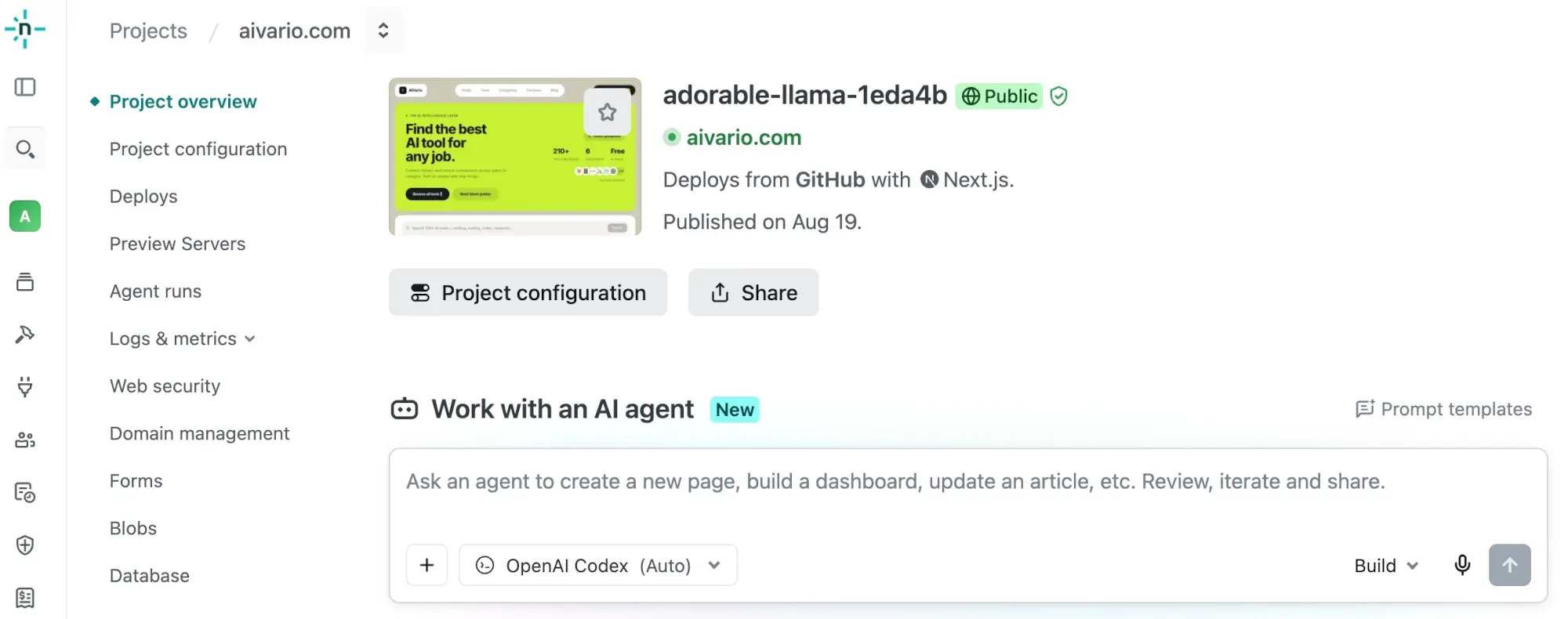
We launched Aivario on Netlify smoothly and without any issues whatsoever.
Everything is super intuitive, and you can even start out completely free on the free tier.
Later, once our audience started growing, we switched over to the paid
plan - and that brought some solid bonuses like more frequent updates.
Excellent tool for the money.From me: Honestly, Netlify + Aivario is one of those
combos that just works. If you’re tired of complicated setups and want something that
feels almost too easy, this is worth checking out.
Our Verdict
Netlify made the more interesting pricing decision of 2026, and it made it in the customer's favour. Removing per-seat charges from Pro — unlimited owners, developers, Git contributors and reviewers on one $20 subscription — puts real distance between it and Vercel for any team above two people, and free reviewer seats on every plan including Free are a genuinely generous touch. The single credit pool across deploys, bandwidth, compute and requests is far easier to forecast than eight separate meters, and free commercial use on the free tier is something Vercel's Hobby licence doesn't allow.
The same month brought the counterweight. Bandwidth doubled from 10 to 20 credits per GB and compute from 5 to 10, so the 300-credit free allowance now buys half of what it did. And the free tier's hard stop is unusually unforgiving: no throttling, no grace period, sites offline until the next cycle — reachable within a fortnight by a documentation site doing nothing unusual.
The AI-native repositioning around Agent Runners and AI Gateway is plausible rather than proven, and worth watching mainly because agentic workflows consume compute that just became twice as expensive.
For teams of three or more on moderate traffic, recommend at Pro — the seat maths alone justifies it. For solo developers on Next.js, or anyone serving heavy media, price Vercel and a CDN-first provider before deciding.
Note: Netlify does not currently have an affiliate program with AIVario. We earn no commission, and this rating carries no commercial incentive.
Best for: Teams of three or more, agencies with many reviewers, projects wanting one predictable bill, small commercial sites on a free tier that permits them
Not ideal for: High-bandwidth and media-heavy delivery, Next.js-specific workflows, spiky unpredictable traffic, anyone expecting graceful degradation on the free plan
Bottom line: Unlimited team members for $20 flat is the best structural pricing move in hosting this year — just check the credit maths, because each credit now buys half what it used to.
- Vercel — better Next.js integration, per-seat pricing and eight meters
- Supabase — the backend layer most Netlify projects still reach for
- Bolt.new — generates apps that deploy here in a click
- Lovable — another builder whose output needs somewhere to live
- Cursor — where the code gets written before it reaches either platform
Frequently Asked Questions about Netlify
How much does Netlify cost in 2026?
Free at $0 with 300 monthly credits, Personal at $9 with 1,000 credits, Pro at $20 with 3,000 credits and unlimited team members, and Enterprise custom from around $500 a month. Since July 2026 the Pro card also carries a tier selector letting teams step up to 5,000, 10,000, 15,000 or 20,000 credits a month at higher prices. All usage runs through one credit pool rather than separate meters.
Did Netlify really remove per-seat pricing?
Yes, on April 14, 2026, announced by CEO Mathias Biilmann in a post titled 'The end of seats'. Before the change, Pro cost $20 for one seat with every additional team member or Git contributor adding another $20 a month. Now unlimited owners, developers, Git contributors, reviewers and billing admins are included in the single $20 subscription, and reviewers who don't push code are free on every plan including Free.
What do credits actually buy?
Five meters draw from one pool: production deploys at 15 credits each, bandwidth at 20 credits per GB, compute at 10 credits per GB-hour covering serverless functions, Preview Servers and Agent Runners, web requests at 2 credits per 10,000, and AI inference at model-dependent rates. The single-currency approach is genuinely easier to track than multi-dimension metering — the catch is that the rates changed in April, with bandwidth doubling from 10 to 20 credits per GB and compute from 5 to 10.
What happens when I run out of credits?
It depends on your plan, and the free tier's behaviour is harsh. Paid plans auto-recharge in small batches — $5 for 500 credits on Personal, $10 for 1,500 on Pro — with auto-recharge disabled by default and requiring a Team Owner to enable it. On Free there's no throttling and no grace period: your sites pause until the first of the next month. A documentation site with search indexing and image optimisation in the pipeline can hit the cap in a fortnight and freeze production.
Is Netlify cheaper than Vercel?
For teams, usually yes, and the gap widened in 2026. Vercel charges $20 per developer seat plus metering across roughly eight dimensions; Netlify charges $20 flat with unlimited members and one credit pool. A five-person team starts at $100 on Vercel before any usage and $20 on Netlify. Where Vercel wins is Next.js integration, which for Next.js-heavy teams is frequently worth more than the price difference.
What are Agent Runners?
Netlify's infrastructure for running AI coding agents — Claude Code, Codex CLI and Gemini CLI among them — against your project, positioned as part of an AI-native platform pitch. They consume compute credits at 10 per GB-hour like other compute. Alongside them, the Netlify AI Gateway lets teams and agents call major LLMs without managing credentials separately, billed at model-dependent rates with no fixed per-unit price.
Does the free tier allow commercial use?
Yes, and that's a meaningful difference from Vercel, whose Hobby plan is explicitly personal and non-commercial. A small revenue-generating site can legitimately run on Netlify's free tier within the credit allowance. The practical constraint isn't licensing, it's the 300-credit ceiling and the hard stop when you cross it — for anything that must stay online, Personal at $9 buys both headroom and auto-recharge.
What did legacy accounts keep?
Accounts created before September 2025 retain the old model of 100 GB bandwidth plus 300 build minutes rather than the credit system. If you've been on Netlify for a while and the credit discussion doesn't match your dashboard, that's why. It also means comparison articles can accurately describe two entirely different Netlify pricing models depending on which account they were written against.