What is Supabase?
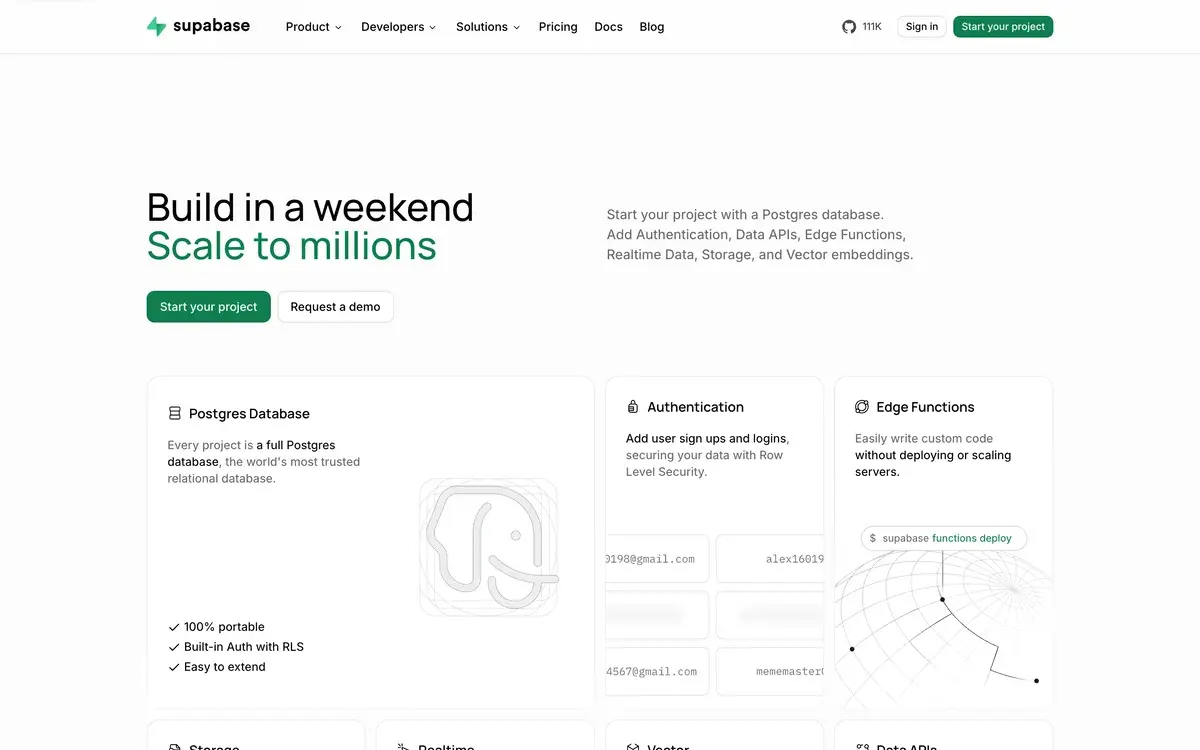
Supabase is an open-source backend-as-a-service platform built on Postgres. Provides everything modern web applications need on the backend: SQL database, authentication, file storage, real-time subscriptions, serverless functions, and vector embeddings for AI applications. Founded in 2020 as the open-source Firebase alternative, Supabase has grown into a serious competitor with its own distinctive identity and substantial production usage.
The platform's core thesis: developers should have access to powerful backend infrastructure without committing to proprietary databases or vendor lock-in. Postgres is the world's most respected open-source relational database; Supabase makes Postgres consumption-ready with all surrounding services that backend applications need. Open-source weights mean the entire stack can be self-hosted if needed.
Supabase has evolved substantially through 2023-2026 from "Firebase alternative" positioning into a comprehensive platform. Vector embeddings support (via pgvector) made it relevant for AI applications. Edge Functions added serverless compute. The dashboard and developer experience matured significantly. As of 2026, Supabase is the default backend platform recommendation for developers who prefer SQL and open-source over Google's Firebase ecosystem.
Who is it for?
Supabase fits modern web application developers who want comprehensive backend services without managing servers. The SQL-first approach appeals to developers familiar with relational databases. The open-source nature reduces vendor lock-in concerns. Specific user types where Supabase makes sense:
- Indie hackers and bootstrapped startup teams building web applications who want production-grade backend without DevOps overhead.
- Frontend developers building full-stack applications who need backend services without becoming backend specialists.
- AI application developers using vector embeddings for RAG, semantic search, or recommendation features. pgvector integration replaces specialized vector databases.
- JAMstack and modern web teams pairing Vercel/Netlify frontend with Supabase backend.
- Mobile app developers using Supabase as backend for iOS/Android apps with auth, database, and file storage.
- Teams wanting open-source stack for vendor lock-in avoidance, regulatory compliance, or self-hosting flexibility.
- Database-heavy applications where SQL queries and relationships matter more than NoSQL flexibility.
User types where Supabase may not fit:
- Teams already deep in Firebase with Firestore data models and Firebase-specific features. Migration cost may not justify benefits.
- Applications needing very specific NoSQL features that Firestore or DynamoDB excel at. Postgres can do most things but not optimally everything.
- High-throughput real-time applications at extreme scale where dedicated solutions (Redis, ScyllaDB) outperform Supabase real-time.
- Enterprise contexts with strict legacy database requirements (Oracle, SQL Server). Supabase only supports Postgres.
- Organizations preferring fully-managed AWS/GCP services through Amplify, Firebase, or similar.
Key Features
The Supabase feature set covers most backend needs that modern web applications require. The features below drive most adoption decisions.
Postgres database is Supabase's foundation. Full PostgreSQL with all standard features — joins, transactions, indexes, constraints, full-text search, JSON columns, extensions. Familiar to any SQL-experienced developer. Significantly more capable than Firestore for complex queries and relational data.
Row Level Security (RLS) enforces authorization at the database level. Define policies that automatically filter data based on user context. Combined with auth, RLS provides robust security model that's harder to misconfigure than application-level authorization. Essential for multi-tenant applications.
Authentication handles email/password, OAuth providers (Google, GitHub, Discord, Apple, Twitter, more), magic links, phone auth (SMS), and custom JWT integrations. SDKs for major frameworks include auth helpers. Replaces the need for Auth0, Clerk, or custom auth implementations for most use cases.
Storage provides S3-compatible file storage with image transformations, access control via RLS, and CDN-backed delivery. Suitable for user avatars, document uploads, image galleries, and other file storage needs without separate S3 setup.
Realtime subscriptions push database changes to connected clients via WebSocket. Useful for live dashboards, collaborative editing, chat applications, and any feature requiring real-time updates. Built on Postgres logical replication.
Edge Functions are serverless functions running on Deno at edge locations globally. Handles webhooks, API endpoints, third-party integrations, and custom backend logic. Stronger than Firebase Cloud Functions in some ways (TypeScript native, fast cold starts), weaker in others (less mature ecosystem).
Vector embeddings (pgvector) stores and queries vector embeddings within Postgres. Critical for AI applications using RAG, semantic search, or recommendation systems. Combines relational data and vector data in single database, simplifying architecture vs separate vector database.
Database functions and triggers enable complex backend logic at the database level. PL/pgSQL or other PostgreSQL extension languages. Useful for data validation, automatic updates, audit logs, and computed fields.
REST and GraphQL APIs auto-generated from database schema. PostgREST provides instant REST API. pg_graphql provides GraphQL API. Modify schema, APIs update automatically. Significantly reduces boilerplate API code.
Database management dashboard for browsing data, running queries, managing schema, and monitoring performance. Comparable quality to dedicated database GUIs (TablePlus, DBeaver) without separate tool.
Self-hostable completely. Open-source codebase supports self-hosted deployments for organizations with specific requirements. Most teams use hosted Supabase for convenience.
Supabase vs Competitors 2026
| Tool | Strength | Pricing | Best For |
|---|
| Supabase | Postgres + open-source + comprehensive | Free / $25 / $599 | Modern web apps, SQL preference, AI applications |
| Firebase | Google ecosystem + mature platform | Free / Pay-as-you-go | NoSQL apps, mobile, Google-invested teams |
| AWS Amplify | AWS service integration | Pay-as-you-go | Teams committed to AWS |
| Convex | Real-time first design | Free / $25+ | Real-time-heavy applications |
| PlanetScale | Pure database (MySQL) | $39+ | Database-only needs, scale |
| Neon | Pure database (Postgres serverless) | Free / $19+ | Postgres without auth/storage |
| Pocketbase | Self-hosted SQLite + admin | Free | Single-server simple apps |
| Self-hosted Postgres | Full control | $5-50+ /mo VPS | Cost-sensitive, DevOps-capable teams |
Pricing verified April 2026.
Supabase vs Firebase. The headline comparison and most consequential choice. Firebase has stronger mobile SDKs, more mature ecosystem, and Google's infrastructure backing. Supabase has SQL (familiar to most developers), open-source nature, and arguably better developer experience for typical web applications. For new projects in 2026, Supabase is the more popular choice among indie/startup developers; Firebase remains strong in mobile-first contexts and teams already invested in Google ecosystem.
Supabase vs AWS Amplify. Amplify integrates deeper with AWS services (DynamoDB, AppSync, Cognito). Supabase is simpler with cohesive single-platform experience. For teams already on AWS, Amplify makes sense. For new projects, Supabase's simplicity often wins.
Supabase vs Convex. Convex emphasizes real-time subscriptions and reactive data model. Supabase has broader feature scope (storage, vector embeddings, edge functions). Both compete for similar audiences. Convex for highly reactive applications; Supabase for broader platform needs.
Supabase vs PlanetScale/Neon. These are pure database platforms — just databases without auth, storage, or other services. Supabase bundles everything; PlanetScale/Neon focus on database excellence. For teams wanting comprehensive platform, Supabase. For teams using best-of-breed services, PlanetScale + Auth0 + S3 + Stripe might fit better despite multi-vendor complexity.
Supabase vs self-hosted Postgres. Self-hosting Postgres on a VPS costs $5-50/mo and provides complete control. Supabase costs more but eliminates DevOps work (backups, replication, scaling, monitoring). Trade-off: cost vs operational burden. Most indie teams choose Supabase; teams with strong DevOps capability or extreme scale needs may self-host.
Pricing 2026
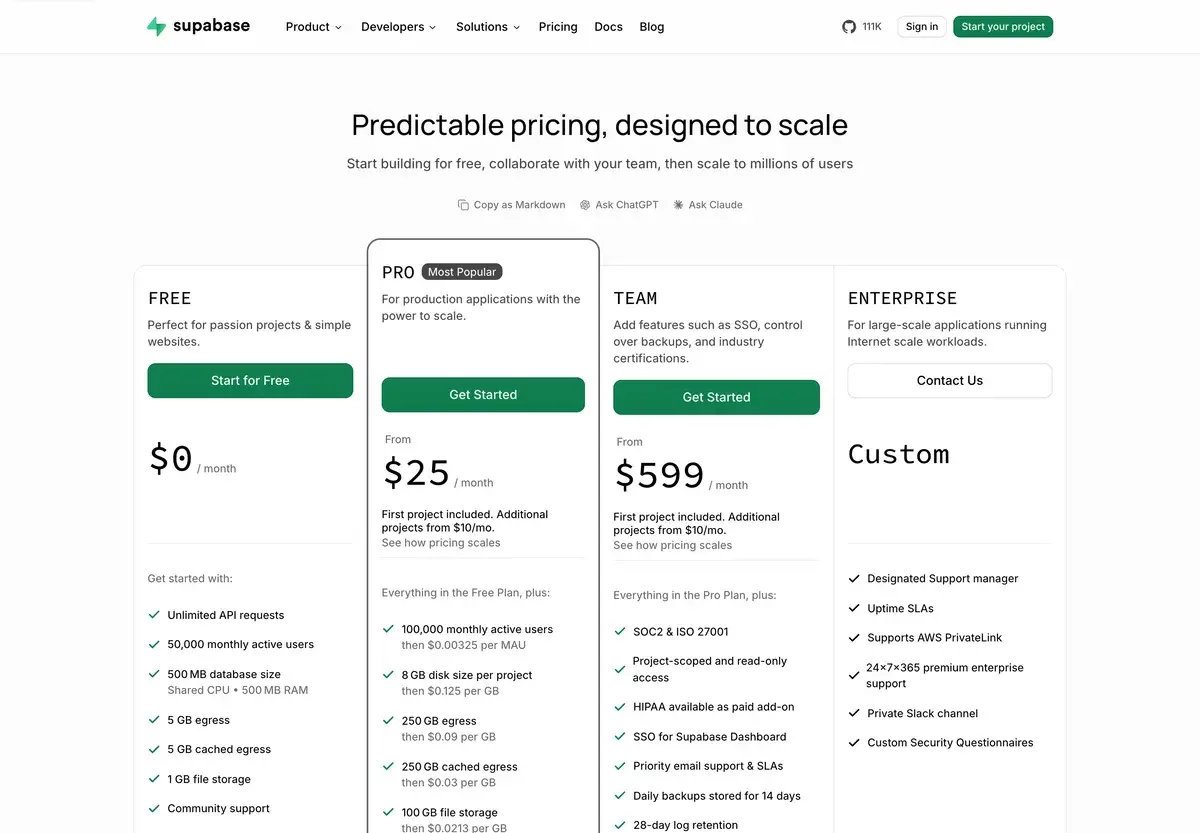
| Plan | Monthly Cost | Database | Best For |
|---|
| Free | $0 | 500MB, paused after 7 days inactivity | Personal projects, learning |
| Pro | $25/mo | 8GB, always-on, branching, daily backups | Most professional projects |
| Team | $599/mo | 100GB, advanced features, SSO, SLA | Larger teams, established products |
| Enterprise | Custom | Custom limits, dedicated support, advanced security | Large organizations |
Pricing verified April 2026 from supabase.com/pricing.
The Free tier is genuinely useful for evaluation, learning, and small projects. The 500MB database covers many use cases at small scale. The pause-after-7-days behavior is the major restriction — projects without traffic for a week pause until reactivated. For active projects, free works indefinitely.
Pro at $25/mo is the practical entry point for production projects. Always-on database, 8GB database, daily backups, branching for safer schema changes. Most indie hackers and startups settle here. Reasonable price for the functionality provided.
Team at $599/mo is significantly higher and serves established products with team needs (SSO, SLA, advanced features). Most projects don't need Team tier — Pro covers requirements adequately. Team makes sense when collaboration features and enterprise-grade SLA matter.
Enterprise pricing is custom for large organizations with specific compliance, security, or scale needs.
The pricing structure is fair for typical use cases. The jump from Pro ($25) to Team ($599) is substantial, but most projects don't outgrow Pro for years. Function execution and bandwidth scale separately at usage-based rates.
What I think about Supabase
I evaluated Supabase for AIVario backend needs. Currently AIVario uses MDX file-based content rather than database, but Supabase is the obvious choice if/when we move to database-backed content (likely Q3-Q4 2026 per the strategic context).
What works well: the developer experience is consistently strong. Setting up a new Supabase project takes minutes. The dashboard for browsing data, running queries, and managing schema is genuinely useful (I've used it for prototyping non-AIVario projects). The auth integration with Next.js is clean. The Row Level Security model is powerful and prevents authorization bugs.
The vector embeddings support is particularly valuable for AI applications. Combining relational data and vector data in one database simplifies architecture significantly. Many AI applications can avoid setting up separate vector databases by using Supabase pgvector.
What I would honestly flag: the free tier's pause-after-7-days behavior is friction during early development. Projects in inactive periods (vacation, hiatus) require manual reactivation. This isn't a deal-breaker but creates occasional annoyance. Pro at $25/mo solves this.
The Team tier pricing at $599/mo creates a significant gap above Pro. Some teams hit Pro limits before they're ready for Team pricing. The pricing curve isn't linear like some competitors.
Real-time features work well for typical use cases but not at extreme scale. Applications expecting hundreds of thousands of concurrent WebSocket connections may need dedicated real-time infrastructure beyond Supabase's defaults.
For AIVario specifically: when we migrate from MDX to database (likely with growth above 300+ tools), Supabase is the obvious choice. The Postgres foundation, integrated auth, and Vercel pairing fit our stack. Free tier sufficient for prototyping migration; Pro at $25/mo when we go live.
For someone evaluating today: try Supabase free for a small project to assess fit. The free tier removes evaluation friction. Most developers who try Supabase for one project end up using it for subsequent projects. The platform earns adoption through experience rather than marketing claims.
Use Cases
Indie hacker building Next.js SaaS product. Pro at $25/mo. Supabase provides auth, Postgres database with RLS for multi-tenant security, file storage for user uploads, and real-time updates for collaborative features. Pairs with Vercel hosting. Total backend cost: $45/mo (Vercel Pro $20 + Supabase Pro $25). Replaces traditional VPS + custom infrastructure.
AI application using RAG architecture. Pro at $25/mo. pgvector stores document embeddings; Postgres stores related metadata; same database serves both. Edge Functions handle Claude/GPT API calls. Replaces Pinecone + separate Postgres + separate auth + separate storage.
Mobile application backend. Pro at $25/mo. iOS and Android apps use Supabase SDKs for auth, database queries, file uploads, and real-time updates. Replaces Firebase for teams preferring SQL approach. Comparable feature parity for mobile-first use cases.
B2B SaaS with team accounts. Team at $599/mo. Multi-tenant database with RLS enforcing tenant isolation. Auth handles team invitations and role management. SSO support meets enterprise customer requirements. SLA guarantees suit professional B2B context.
Personal portfolio with comments/likes. Free tier indefinitely. Postgres stores comment data; auth handles user accounts; pause behavior doesn't matter for personal site with traffic. Sufficient for indie portfolio projects without monetization.
My Verdict
Supabase is the right backend platform recommendation for modern web applications in 2026, particularly for teams preferring SQL and open-source. The combination of Postgres foundation, comprehensive feature set, fair pricing, and active development trajectory makes it the default choice for most new projects.
The strongest fit cases are bootstrapped startups, indie hackers, and small-team projects where comprehensive backend without DevOps overhead matters most. The Vercel + Supabase + Next.js stack has emerged as the dominant modern web application architecture for these audiences.
For AI applications specifically, Supabase's pgvector support eliminates the need for separate vector databases in many cases. This architectural simplification is meaningful — fewer services, lower complexity, single source of truth for related data and embeddings.
The honest limitations are pricing curve (large jump from Pro to Team), pause-after-7-days on free tier, and not being optimal for every workload (extreme scale real-time, mobile-first ecosystem features, specific enterprise legacy requirements). For these contexts, alternatives may fit better despite Supabase's general strength.
For most developers building modern web applications, Supabase is the right choice or at least a strong contender for evaluation. The free tier removes evaluation friction completely, and Pro at $25/mo is reasonable for production use.
Note: Supabase does not currently have an affiliate program for AIVario. We earn no commission from Supabase subscriptions. Our rating reflects evaluation based on platform usage and competitive positioning.
Best for: Modern web applications with React/Next.js, indie hackers and bootstrapped startups, AI applications using vector embeddings, teams preferring SQL and open-source, mobile application backends, B2B SaaS with multi-tenant requirements, JAMstack/Vercel pairings
Not ideal for: Teams deep in Firebase ecosystem, applications requiring specific NoSQL features, extreme-scale real-time applications, enterprise contexts with legacy database requirements, organizations preferring fully-managed AWS/GCP-only infrastructure
Bottom line: The dominant Postgres-based backend platform for modern web development. Comprehensive features, fair pricing, and open-source flexibility make it the default backend recommendation for new projects in 2026.
Related Tools
- Netlify — frontend hosting that pairs with Supabase backend
- Bubble — no-code alternative for non-developers
- Cursor — AI code editor for building Supabase applications
- Bolt.new — AI app builder using Supabase patterns
- Lovable — AI app builder, often deploys to Supabase backend
Frequently Asked Questions about Supabase
Is Supabase free?
Yes, the Free tier includes 500MB database, 1GB file storage, 50MB asset storage, 50,000 monthly active users, and 5GB bandwidth. Generous enough for personal projects, side projects, and MVPs. Production projects with revenue typically need Pro at $25/mo, which provides 8GB database, more storage, and removes paused-after-7-days behavior on free tier.
How does Supabase compare to Firebase?
Supabase is the open-source SQL alternative to Firebase's NoSQL approach. Supabase uses Postgres (full SQL), Firebase uses Firestore (document database). Both offer authentication, file storage, real-time subscriptions, and serverless functions. Developers preferring SQL and open-source choose Supabase. Developers in Google ecosystem or wanting Firebase-specific features (FCM push notifications, ML kit) choose Firebase.
Can Supabase host vector embeddings for AI applications?
Yes. Supabase added pgvector support, making the Postgres database capable of storing and querying vector embeddings natively. For AI applications using RAG (Retrieval-Augmented Generation), Supabase replaces specialized vector databases (Pinecone, Weaviate) for many use cases. Same database for relational and vector data simplifies architecture significantly.
Does Supabase work with Vercel and Next.js?
Yes, this combination is among the most common modern stack pairings. Vercel hosts the Next.js frontend and serverless functions; Supabase provides backend (database, auth, storage). Official Supabase Next.js library handles authentication, server-side data fetching, and Server Components patterns. Many bootstrapped SaaS startups use this exact stack.
Is Supabase production-ready?
Yes. Supabase serves billions of API requests monthly across customer base. Used by significant production applications including Vercel itself, Mozilla, and many startups. The underlying Postgres is battle-tested database technology. Free tier projects pause after 7 days inactivity (mitigation: Pro plan keeps projects always-on). For serious production use, Pro at $25/mo is the minimum tier.
How is Supabase authentication?
Supabase Auth handles email/password, OAuth providers (Google, GitHub, Discord, Apple, etc.), magic links, phone auth, and custom JWT setups. Row Level Security (RLS) policies in Postgres enforce authorization at the database level. The combination is typically more secure than rolling your own auth and similar in capability to Auth0 or Clerk for most use cases.
Can I self-host Supabase?
Yes. Supabase is fully open-source and self-hostable. Most teams choose hosted Supabase for convenience, but self-hosting is supported for organizations with strict data residency requirements, cost optimization at extreme scale, or specific infrastructure constraints. Self-hosting requires more DevOps work than using hosted Supabase but provides complete control.