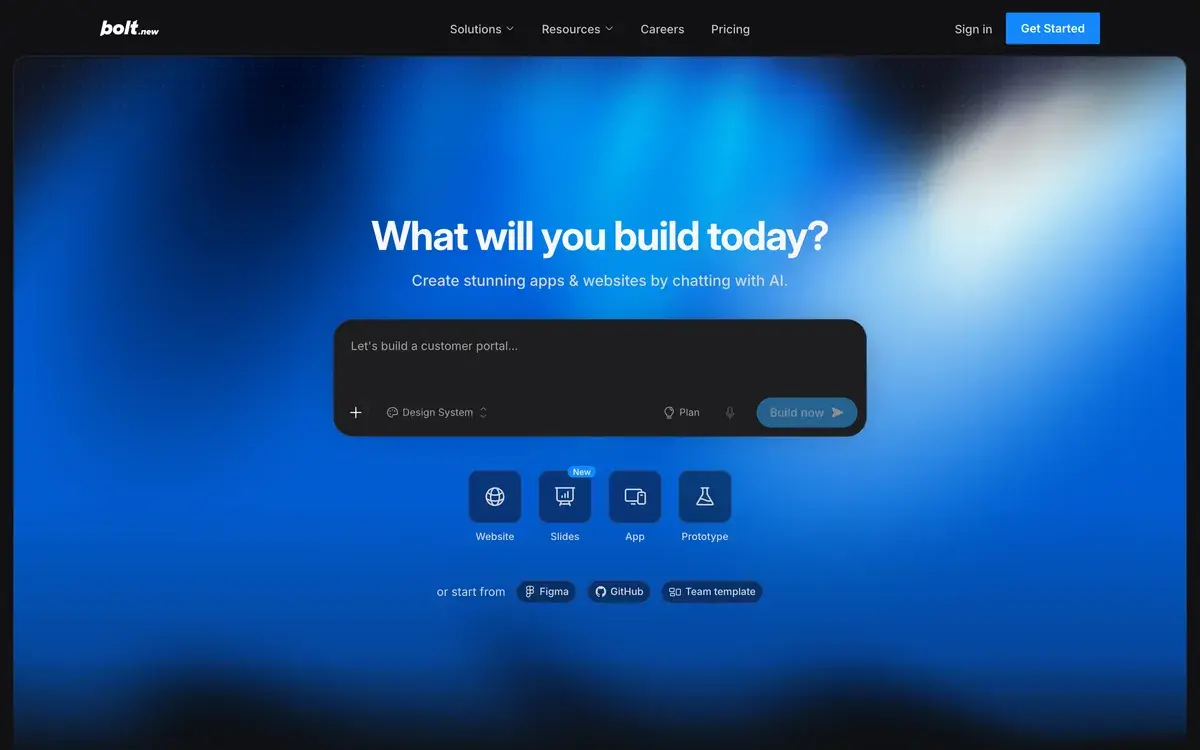
What is Bolt.new?
Bolt.new is an AI-powered web application builder that runs entirely in your browser, built by StackBlitz using their WebContainers technology. Launched in late 2024, Bolt.new quickly became one of the leading AI app builders, distinguished by its in-browser development environment, full-stack capability, and support for multiple frameworks. The platform's core innovation is running Node.js in the browser rather than on remote servers, enabling fast execution and instant feedback that traditional cloud IDEs struggle to match.
The platform's distinguishing characteristic is the combination of AI generation with full-stack execution. Most AI UI tools (v0) generate code; most no-code builders (Bubble) host the runtime. Bolt.new combines AI generation with browser-based development environment that runs full applications, including backends, in the user's browser. This architectural choice creates genuinely different workflow than alternatives.
Bolt.new evolved through 2024-2026 with significant capability expansion โ broader framework support, deeper backend integration, improved code quality, and enterprise features for team development. By 2026, Bolt.new is established as primary alternative to Lovable in the AI full-stack app builder category, with overlapping but distinct positioning.
Who is it for?
Bolt.new fits developers and technical founders wanting AI-accelerated full-stack development without local environment setup. The in-browser approach removes friction for trying new ideas quickly. Specific user types where Bolt.new fits:
- Developers prototyping ideas who want fast iteration without local environment setup.
- Solo founders and indie hackers building MVPs across multiple project ideas.
- Designers exploring development with AI assistance reducing technical barrier.
- Bootcamp graduates and learning developers building portfolio projects.
- Existing developers exploring new frameworks without committing local setup time.
- Hackathon participants needing rapid prototyping with full-stack capability.
- Engineering teams testing concept apps for product validation.
- Educators teaching modern web development with browser-based environment.
User types where Bolt.new may not fit:
- Production applications requiring complex business logic beyond what AI can generate reliably.
- Teams with established local development workflows preferring familiar IDE tools.
- Mobile app developers primarily (Bolt is web-focused, though some React Native support exists).
- Backend-heavy applications with extensive server-side logic and database optimization.
- Enterprise organizations with strict tooling requirements that prohibit browser-based development.
- Performance-critical applications where AI-generated code may need extensive optimization.
- Privacy-sensitive contexts uncomfortable with cloud-based AI processing.
Key Features
The Bolt.new feature set focuses on AI-powered full-stack development with browser-based execution.
AI app generation from prompts is the headline feature. Describe application requirements; Bolt.new generates working full-stack application with frontend, optional backend, and necessary configuration. From description to running app takes minutes for typical projects.
WebContainers execution runs the application in your browser using StackBlitz's technology. Unlike cloud IDEs that run on remote servers, Bolt's environment runs locally in browser. Faster execution, instant feedback, full debugging capability without network latency.
Multi-framework support for React, Next.js, Vue, Svelte, Astro, and others. Generated code follows framework conventions. Unlike framework-specific tools (v0 for React only), Bolt.new respects framework preference rather than forcing one approach.
Full-stack capability extending beyond UI to include backends, databases, authentication, and API endpoints. Generated applications include working server-side logic when appropriate, not just static frontends.
Integrated development environment with code editor, terminal, file system, and live preview all in browser. The full IDE experience eliminates context-switching to local development tools for many workflows.
Backend integration with Supabase, Firebase, and other backend services. Generated apps can include database setup, authentication flows, and API endpoints integrated with these services.
Live preview updates as AI generates code or you make changes. Watch application come together in real-time. Removes "wait for build" friction common in traditional development.
Code editor with syntax highlighting, auto-completion, and standard editor features. Edit generated code directly without exporting to separate IDE. Many users do all their work within Bolt's environment for prototypes.
Terminal access for running commands, installing packages, and managing build processes. Full terminal capability through WebContainers โ runs as if local terminal but in browser.
File system for organizing project files. Standard file structure visible and editable like traditional IDE. Files persist with project; no upload/download required.
Deployment integration with Netlify, Vercel, and similar platforms. From generated app to live deployment takes minutes for simple projects. Useful for sharing prototypes with stakeholders or moving to production.
GitHub integration for syncing projects to repositories. Bolt projects connect to GitHub for version control, team collaboration, and ongoing development outside Bolt environment.
Templates and starting points for common application types. SaaS landing pages, dashboards, ecommerce, social apps. Templates accelerate initial work substantially for typical patterns.
Bolt.new vs Competitors 2026
| Tool | Strength | Pricing | Best For |
|---|
| Bolt.new | In-browser full-stack, multi-framework | Free / $20-200/mo | Developers prototyping, indie hackers |
| Lovable | Supabase-focused, polished UX | Free / $25+/mo | Full-stack with hosted backends |
| v0 by Vercel | React UI generation | Free / $20+/mo | Component generation for existing projects |
| Cursor | AI code editor (local) | $20/mo | Ongoing development with AI |
| Replit | Cloud IDE with AI features | Free / $25+/mo | Cloud development environment |
| GitHub Codespaces | GitHub cloud development | Pay-as-you-go | GitHub-integrated cloud dev |
| Bubble | No-code app platform | Free / $32+/mo | Non-developer app building |
| FlutterFlow | Mobile app no-code | Free / $30+/mo | Mobile applications |
Pricing verified April 2026.
Bolt.new vs Lovable. The most important comparison and most consequential choice. Both are AI app builders generating full-stack applications. Bolt's WebContainers technology runs everything in browser; Lovable hosts execution on their infrastructure. Bolt has broader framework support; Lovable focuses on Next.js + Supabase combinations more deeply. Bolt's in-browser approach feels faster for development; Lovable's hosted approach is smoother for non-developers. Many developers try both before settling.
Bolt.new vs v0 by Vercel. Different scopes. v0 generates components and apps but doesn't run them locally โ you take generated code to your own environment. Bolt runs everything in browser including the application itself. For developers wanting code to integrate with existing infrastructure, v0. For developers wanting end-to-end environment with execution, Bolt.
Bolt.new vs Cursor. Different categories. Cursor is AI code editor on your local machine helping you write code. Bolt is browser-based environment with AI generating complete apps. Cursor for ongoing development; Bolt for rapid prototyping and exploration. Many developers use both for different parts of workflow.
Bolt.new vs Replit. Replit is cloud IDE with AI features added. Bolt is AI-first app builder with browser environment. Replit's IDE is more traditional with AI as add-on; Bolt's AI generation is core feature with IDE supporting it. For traditional cloud development with AI assistance, Replit. For AI-first app generation, Bolt.
Bolt.new vs Bubble. Different categories entirely. Bubble is no-code platform for non-developers. Bolt is AI builder targeting developers and technical users. Generated output: Bubble is hosted on Bubble platform; Bolt produces real code that deploys anywhere. Different philosophies and audiences.
Bolt.new vs FlutterFlow. FlutterFlow specializes in mobile apps with native code output. Bolt focuses on web applications. Different platforms entirely. For mobile, FlutterFlow. For web, Bolt.
Pricing 2026
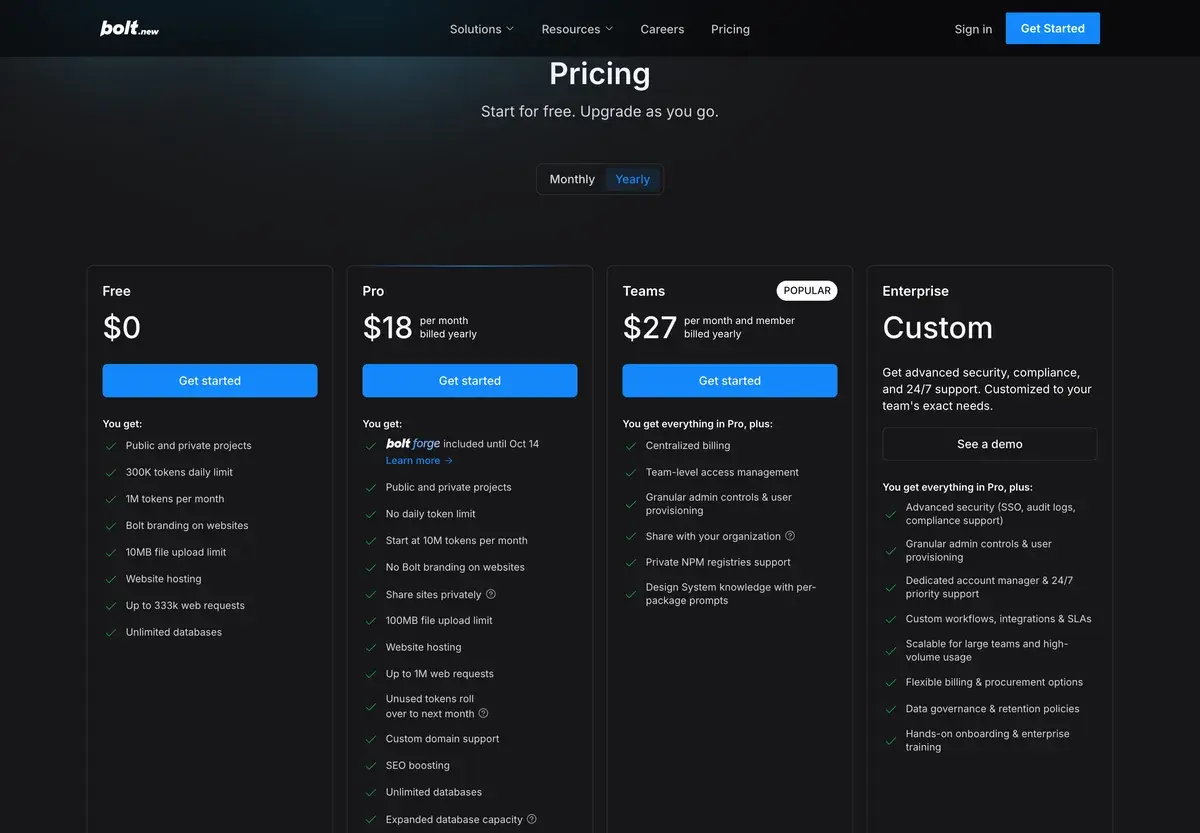
| Plan | Monthly Cost | Tokens/Month | Key Features | Best For |
|---|
| Free | $0 | 1M tokens | All features, free tier | Evaluation, casual use |
| Pro | $20/mo | 10M tokens | Higher limits, priority generation | Active developers |
| Teams | $50/user/mo | 26M tokens | Team collaboration, workspace features | Small teams, agencies |
| Pro Max | $200/mo | 120M tokens | Maximum limits for power users | Heavy users, larger projects |
| Enterprise | Custom | Custom | Custom features, dedicated support | Larger organizations |
Pricing verified April 2026 from bolt.new/pricing. Annual billing offers ~20% discount.
The Free tier with 1 million tokens monthly is genuinely useful for evaluation and casual building. Most developers can experiment with Bolt without committing to subscription. The token-based system tracks AI generation usage; small projects fit within free tier easily.
Pro at $20/mo with 10 million tokens monthly is the practical entry point for active developers. Sufficient for ongoing prototyping and development work. Reasonable price for AI development tool.
Teams at $50/user/mo unlocks team collaboration with shared workspace and project visibility across team members. For agencies or small teams using Bolt collaboratively, the Teams tier delivers value.
Pro Max at $200/mo serves heavy users with 120 million tokens monthly. Significant volume for users running Bolt as primary development environment. Most users don't need this tier; specific power users where Bolt is core to daily workflow benefit.
Enterprise pricing handles unique needs (SSO, advanced security, compliance features). Pricing typically starts $500+/mo with custom service agreements.
The token-based pricing structure rewards efficient AI usage. Generating focused components costs less than asking AI to repeatedly attempt complex builds. Users who learn to scope requests efficiently extend free or paid tier value substantially.
What I think about Bolt.new
I evaluated Bolt.new for AIVario research and have used the free tier briefly to test the in-browser experience. AIVario doesn't use Bolt in current development โ our codebase predates AI builders and we use Cursor for ongoing work โ but I understand the platform's value proposition.
What works well based on usage and research: the in-browser experience is genuinely fast. WebContainers technology creates instant feedback loops that traditional cloud IDEs can't match. The "click run, see app" cycle takes seconds rather than tens of seconds. For rapid prototyping and exploration, this speed advantage is real.
Generated code quality is solid. For typical web application patterns (SaaS dashboards, marketing sites, simple ecommerce), Bolt produces working applications with reasonable code quality. Output isn't always production-perfect but provides solid foundation for refinement.
The multi-framework support distinguishes Bolt from React-only tools like v0. Vue, Svelte, Astro developers get equivalent capability rather than being told to switch frameworks. This flexibility matters for teams with framework preferences.
What I would honestly flag based on usage: the in-browser environment, while fast, has limits versus local development. Some npm packages don't work in WebContainers due to native dependencies. Some advanced workflows (specific testing patterns, certain build tools) may not work in browser environment. Most common cases work; edge cases may require local development eventually.
The token-based pricing creates uncertainty about actual costs at scale. Users active with Bolt may consume tokens faster than expected for complex apps. Pro tier limits may feel tight for users iterating frequently on AI generation. Pro Max tier pricing is meaningful subscription cost.
For complex applications, generated code typically requires substantial manual refinement. Bolt accelerates initial creation but doesn't eliminate ongoing development. Don't expect to build production SaaS entirely through AI generation โ expect AI to accelerate creation while ongoing development requires standard practices.
For AIVario specifically, our codebase is established with patterns matured through ongoing development. Bolt-generated code wouldn't fit our existing structure without significant adaptation. For new projects starting fresh, Bolt would be on our consideration list alongside Lovable and traditional development with Cursor.
For someone evaluating today: try Bolt.new free with a real project idea. The in-browser experience either feels productive for your style or doesn't fit your preferences. Most developers find at least occasional value for prototyping even if they don't use Bolt for every project.
Use Cases
Indie hacker building MVP for product validation. Pro at $20/mo. Generates initial app from idea description; iterates with AI to refine functionality. Deploys to Vercel for user testing within days rather than weeks. Replaces traditional MVP development that often takes months.
Solo founder exploring multiple product ideas. Free tier or Pro at $20/mo. Builds prototype apps for 5-10 concepts before committing to specific direction. Bolt makes "let me see if this idea works" faster and cheaper than traditional development. Validates ideas before investing serious development time.
Designer transitioning to development. Free tier. Generates working applications matching design ideas; learns React/Next.js patterns by examining generated code. Bolt accelerates designer-to-developer transition by removing "where do I start" friction.
Hackathon team needing rapid prototype. Free or Pro tier. Builds working full-stack application within 24-48 hour hackathon timeframe. Bolt handles boilerplate while team focuses on differentiated features. Replaces traditional rapid prototyping that struggles to demo working full-stack apps within hackathon constraints.
Agency producing client prototypes. Teams plan at $50/user/mo. Each client engagement starts with rapid prototype generated by Bolt. Stakeholder review on working app rather than design mockups. Replaces design-only client deliverables with functional prototypes.
Developer exploring new framework. Pro at $20/mo. Tests Vue or Svelte capability by generating sample apps in those frameworks before committing local setup time. Bolt enables framework exploration without full local environment investment.
My Verdict
Bolt.new is the right choice for developers and technical founders wanting AI-accelerated full-stack development with browser-based execution. The combination of WebContainers technology, multi-framework support, and integrated development environment delivers genuinely different value than alternatives.
For developers wanting AI assistance integrated into their existing local development workflow, Cursor fits better. For non-developers wanting visual no-code, Bubble or specialized tools fit better. For component-only generation that integrates with existing projects, v0. Bolt specifically wins for full-stack browser-based AI app building.
The competitive landscape between Bolt.new and Lovable is the most relevant comparison. Both target similar audiences with overlapping features. Bolt's WebContainers technology creates faster in-browser experience; Lovable's hosted backend integration may feel smoother for users wanting less technical management. Try both before settling.
The free tier removes evaluation friction completely. Try Bolt.new with a real project idea. The platform either accelerates your prototyping or doesn't fit your style. Most developers find Bolt useful for at least occasional prototyping work even if they don't adopt it as primary development environment.
For solo founders and indie hackers specifically, Bolt represents meaningful productivity improvement for early-stage exploration. The combination with deployment to Vercel/Netlify creates dramatically faster idea-to-launch cycle than traditional development. Multiple ideas can be tested faster, increasing chance of finding viable products.
The token-based pricing requires planning at scale but free and Pro tiers cover most realistic usage. Don't worry about pricing during evaluation; assess value first, then determine which tier matches your actual usage pattern.
Note: Bolt.new does not currently have an active affiliate program for AIVario. We earn no commission from Bolt subscriptions. Our rating reflects evaluation based on platform usage and competitive positioning.
Best for: Developers prototyping ideas, solo founders and indie hackers building MVPs, designers transitioning to development, bootcamp graduates and learning developers, hackathon participants, engineering teams testing concept apps, educators teaching modern web development, agencies producing client prototypes
Not ideal for: Production applications with complex business logic, teams with established local development workflows, mobile app developers (use FlutterFlow), backend-heavy applications with extensive server logic, enterprise organizations with strict tooling requirements, performance-critical applications, privacy-sensitive contexts uncomfortable with cloud AI
Bottom line: The leading AI full-stack app builder with browser-based execution and multi-framework support. Best for developers wanting end-to-end environment with AI generation and instant execution. Free tier supports evaluation; Pro at $20/mo reasonable for active prototyping work.
Related Tools
- Lovable โ primary alternative with similar AI app builder positioning
- v0-vercel โ alternative for component-only generation
- Cursor โ AI code editor for ongoing development
- Vercel โ primary deployment target for Bolt-generated apps
- Supabase โ backend platform that integrates with Bolt-generated apps
Frequently Asked Questions about Bolt.new
Is Bolt.new free?
Yes, Bolt.new has a free tier with 1 million tokens per month included. Sufficient for evaluation, casual building, and small projects. Pro at $20/mo unlocks 10 million tokens/month and additional features. The free tier is genuinely useful โ most developers can build small projects without paying. Heavy users benefit from Pro tier for continuous workflow.
How does Bolt.new compare to Lovable?
Both are AI app builders with similar positioning. Bolt.new is built by StackBlitz with WebContainers technology that runs Node.js in the browser; deeper technical capability for full-stack development. Lovable focuses heavily on Supabase integration and full-stack apps with hosted backends. For technical users wanting in-browser full development environment, Bolt. For users wanting smoother integration with hosted backends, Lovable. Many developers try both.
What is WebContainers technology?
WebContainers is StackBlitz's technology that runs Node.js entirely in the browser. Unlike traditional cloud IDEs that run code on servers, Bolt.new runs the development environment in your browser. This means faster execution, no server costs, full debugging capability, and offline-capable development. The technology specifically enables Bolt's instant 'click and run' experience that other AI builders can't match.
Yes, Bolt.new generates production-ready applications. Output is real React/Next.js code that can be deployed to Vercel, Netlify, or other hosting platforms. Most production apps require some manual refinement after AI generation, but the foundation is genuinely production-quality. For MVPs and prototypes, generated code often works as-is.
Does Bolt.new work with backends?
Yes. Bolt.new integrates with Supabase, Firebase, and other backend services. Generated apps can include database integration, authentication, and API endpoints. The full-stack capability distinguishes Bolt from purely UI-focused tools like v0. For complete app development including backend, Bolt.new handles end-to-end workflow.
What frameworks does Bolt.new support?
Bolt.new supports React, Next.js, Vue, Svelte, Astro, and other major web frameworks. Generated code follows framework conventions. For users committed to specific framework, Bolt.new respects that choice rather than forcing one approach. The framework flexibility makes Bolt useful across diverse development preferences.
Does Bolt.new replace developers?
No, Bolt.new accelerates developer workflow rather than replacing developers. Generated code typically requires manual refinement, debugging, and ongoing development. For complex applications, manual development with AI assistance remains essential. Bolt's value is accelerating initial creation and removing 'blank canvas' friction, not eliminating need for developers entirely. Best framing: Bolt makes developers significantly faster, doesn't make non-developers into developers.