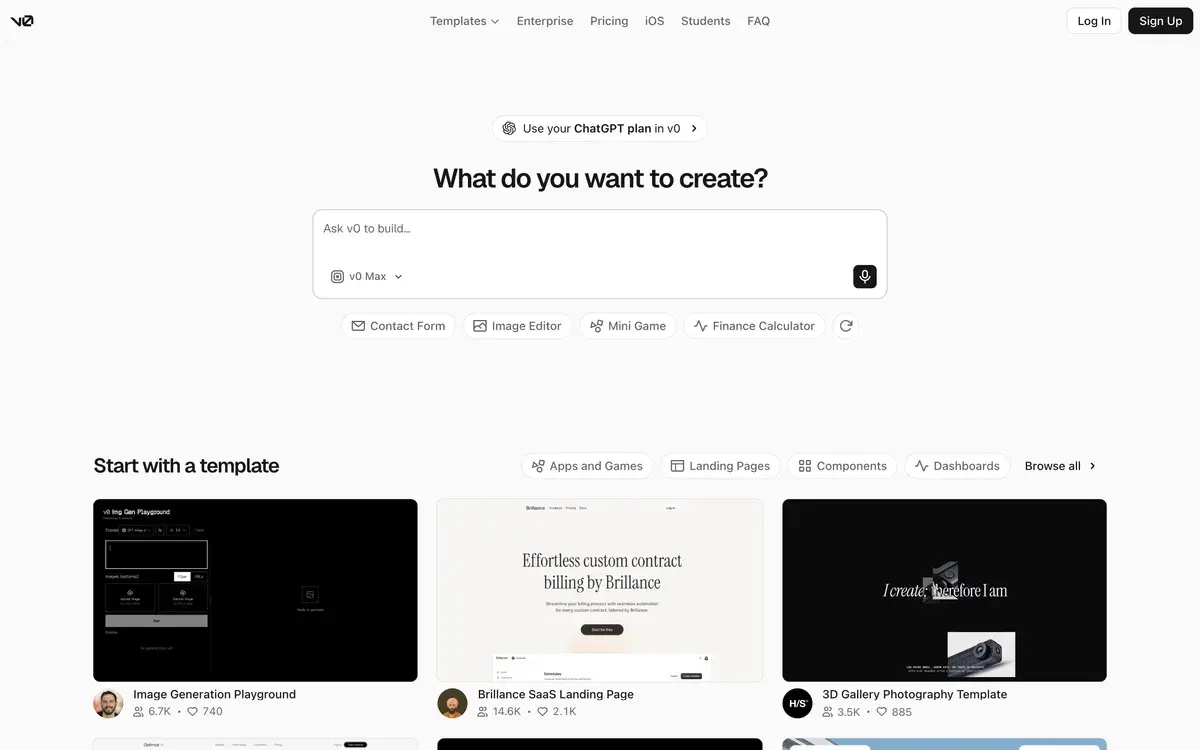
What is v0 by Vercel?
v0 by Vercel is an AI-powered UI generation tool that creates React components and full applications from text descriptions. Launched by Vercel in late 2023 alongside the broader Vercel AI ecosystem, v0 quickly became the leading tool in the AI UI generation category. The product evolved through 2024-2026 from component-only generation into full application building (Composer), establishing v0 as central to modern Next.js and React development workflows.
The platform's distinguishing characteristic is integration with the modern React ecosystem. Generated code uses shadcn/ui components, Tailwind CSS for styling, TypeScript for type safety, and Next.js patterns for routing. This standardization on widely-adopted tools means v0 output integrates directly into existing projects without conversion or adaptation. Developers don't have to translate v0's output to their stack — the tool already speaks the standard modern stack.
v0's positioning differs from general-purpose AI code editors (Cursor, GitHub Copilot) in scope. Cursor helps write any code as you type; v0 generates complete UI from descriptions. The tools serve different parts of the development workflow. Most professional React developers in 2026 use both — v0 for initial component or app generation, Cursor for ongoing development and refinement. The combination is more productive than either alone.
Who is it for?
v0 fits React and Next.js developers wanting AI acceleration for UI development. The shadcn/ui foundation and Tailwind CSS output assume specific stack preferences that match modern React development conventions. Specific user types where v0 fits:
- Next.js developers building marketing sites, dashboards, or applications.
- React developers at any experience level wanting AI-assisted UI generation.
- Frontend engineers producing components for design systems and product features.
- Solo founders and indie hackers building MVPs without dedicated frontend specialists.
- Designers transitioning to development with AI-assisted code generation reducing technical barrier.
- Product designers prototyping with code-quality output rather than just visual mockups.
- Agencies building Next.js client projects wanting acceleration on standard component patterns.
- Beginners learning React examining generated code to understand patterns.
User types where v0 may not fit:
- Vue, Angular, or non-React developers. v0 generates React-specific code. Other frameworks need conversion or different tools.
- Backend-only developers. v0 is UI-focused; backend AI tools (Cursor, Claude) fit better.
- Designers wanting visual builders rather than code-generating AI. Use Framer or Webflow instead.
- Teams committed to design systems with custom components that don't match shadcn/ui patterns.
- Mobile app developers (React Native works partially but v0 is web-optimized).
- Users wanting completely WYSIWYG editing. v0 generates code that you then edit in your IDE.
Key Features
The v0 feature set focuses on AI UI generation with deep React ecosystem integration.
Text-to-component generation is the core feature. Type description; v0 generates working React component with shadcn/ui components and Tailwind CSS styling. Output is production-ready code that copies directly into projects. Quality is consistently high for typical UI patterns — landing page sections, forms, dashboards, navigation, etc.
v0 Composer extends generation from individual components to complete applications. Multi-step planning, file creation, and integration. Specify application requirements; Composer builds multi-page apps with routing, components, and even backend integration. Released in 2024 and substantially improved through 2025-2026.
Iteration and refinement through conversational editing. Generated component not quite right? Tell v0 what to change ("make this card more compact, add an icon to the title, change the call-to-action button text"). v0 produces revised version. The iteration is faster than manually editing code for visual changes.
Component library based on shadcn/ui ensures generated code uses widely-adopted modern React component patterns. shadcn/ui has become the standard component library for Next.js projects in 2024-2026; v0's standardization on it means output integrates with most modern React projects.
Tailwind CSS styling is the default output approach. Tailwind has become near-universal for new React projects in 2024-2026. Generated styles use Tailwind utility classes that match modern conventions.
TypeScript output ensures generated code includes proper type definitions. Type-safe code reduces runtime errors and integrates with TypeScript-based projects without additional work.
Image-to-UI generation lets you upload screenshot, mockup, or design and v0 generates matching React component. Useful for converting designs into code without manual translation. Quality varies with input clarity but typically produces serviceable starting points.
Integration with Vercel deployment allows publishing generated apps directly to Vercel hosting. From generation to live URL takes minutes for simple projects. Useful for prototypes and demos.
GitHub integration for syncing generated code to repositories. v0 projects can connect to GitHub for version control and team collaboration.
Custom theme support for organizations with established design systems. Configure v0 with your brand colors, typography, and spacing tokens to generate components matching your design language.
API access (paid plans) for programmatic generation. Useful for tools that integrate AI UI generation into broader workflows.
Team collaboration features (Team plan) for shared projects, organization-level theming, and team workflow.
v0 vs Competitors 2026
| Tool | Strength | Pricing | Best For |
|---|
| v0 by Vercel | React/Next.js specialist, shadcn/ui | Free / $20-50/mo | React developers, Next.js projects |
| Bolt.new | In-browser app builder | Free / $20+/mo | Full-app generation in browser |
| Lovable | AI app builder | Free / $25+/mo | Similar full-app generation |
| Cursor | AI code editor | $20/mo | Ongoing coding with AI |
| GitHub Copilot | Inline code completion | $10+/mo | Code completion in IDE |
| Framer | Visual website builder | Free / $20+ | Visual builder vs code generation |
| Tempo Labs | React component generation | Free / $19+ | Alternative React component AI |
| Galileo AI | Design-to-code | $39+/mo | Design-to-code workflow |
Pricing verified April 2026.
v0 vs Bolt.new and Lovable. Different positioning despite overlap. Bolt and Lovable build full applications in browser environment with backend included. v0 generates code that you then deploy through your own infrastructure. For users wanting in-browser app building, Bolt or Lovable. For developers wanting code that integrates with existing infrastructure, v0. v0's stronger Vercel ecosystem integration matters for Vercel-based deployments.
v0 vs Cursor. Different categories. Cursor is AI code editor where AI helps write code as you type. v0 generates complete UI from descriptions. Most developers use both — v0 for initial generation, Cursor for ongoing refinement. They complement rather than compete.
v0 vs Framer. Different categories entirely. Framer is visual website builder; v0 is code generator. Framer outputs sites in Framer's hosting; v0 outputs code that runs anywhere. For non-developers wanting visual builders, Framer. For developers wanting code, v0.
v0 vs Tempo Labs. Direct competitor in React component generation. Tempo focuses on React component patterns with visual editing. v0 has stronger Vercel ecosystem integration and shadcn/ui standardization. For Vercel-based projects, v0. For broader React project flexibility, Tempo may fit.
v0 vs Galileo AI. Galileo focuses on design-to-code workflow with deeper design tool integration. v0 is broader UI generation including text-to-component. For designers wanting design-to-code specifically, Galileo. For developers wanting flexible UI generation, v0.
v0 vs other AI UI tools (Locofy, Anima, etc.). Various competitors in design-to-code space. v0's strength is the combination of text-to-UI generation, full app generation through Composer, Vercel ecosystem integration, and shadcn/ui standardization. The combination delivers stronger workflow integration than competitors specializing in narrower aspects.
Pricing 2026
| Plan | Monthly Cost | Generations | Key Features | Best For |
|---|
| Free | $0 | Limited credits/month | All features, free tier | Evaluation, casual use |
| Premium | $20/mo | Higher limits | Priority generation, advanced features | Active developers |
| Team | $50/mo (1 user) | Highest limits | Team collaboration, custom themes | Small teams, agencies |
| Enterprise | Custom | Custom | SSO, advanced security, dedicated support | Large organizations |
Pricing verified April 2026 from v0.dev/pricing. Annual billing offers ~20% discount.
The Free tier is genuinely useful for evaluation and casual generation. Most developers can experiment with v0 without committing to subscription. The credit-based limits on free tier are generous enough for occasional component generation but limit heavy continuous use.
Premium at $20/mo is the practical entry point for active developers. Higher generation limits, priority processing, and advanced features. Reasonable price for developers using v0 regularly in their workflow. Most professional developers working with React settle here.
Team at $50/mo unlocks team collaboration, custom themes, and shared workspaces. For small teams or agencies, the Team tier delivers value above Premium individual subscriptions. Per-user economics work well for 2-5 person teams.
Enterprise pricing handles larger organizations needing SSO, advanced security, and custom features. Pricing typically starts $200+/mo and includes dedicated support and custom service agreements.
The pricing structure aligns with broader Vercel ecosystem positioning. Premium positioning matches modern developer tools rather than competing on price with cheaper alternatives. The free tier addresses evaluation needs without artificial time limits.
What I think about v0
I evaluated v0 for AIVario research and have used the free tier briefly for component generation experiments. AIVario's site uses Next.js with our own components developed manually rather than v0-generated, but I understand the platform's value proposition.
What works well based on usage and research: v0 generates remarkably clean code for typical UI patterns. Common components (pricing tables, hero sections, dashboard layouts, forms) generate consistently well-structured output. The shadcn/ui standardization means code integrates with modern React projects without conversion.
The Composer feature for full-app generation is genuinely impressive when working with standard application patterns. Build a SaaS dashboard prototype in minutes that would have taken hours manually. Quality varies with complexity but typical applications generate workable starting points.
The integration with Vercel ecosystem (deployment, GitHub, design system support) creates smooth workflow for Vercel-based development. From generation to live deployed URL takes minutes for simple projects.
What I would honestly flag based on usage: v0 is React-specific. Vue, Angular, Svelte developers need different tools. The shadcn/ui standardization is strength for projects already using that library; constraint for projects using different component libraries.
Generated code typically requires manual refinement for production use. Out-of-the-box output works for prototypes; production deployment usually involves adjusting styling, optimizing performance, and integrating with broader codebase patterns. v0 accelerates initial work; doesn't eliminate ongoing development.
For complex business logic or non-UI code (state management, data fetching patterns, complex hooks), v0's generation is less reliable than for pure UI components. Use v0 for UI; use Cursor or other tools for business logic.
The pricing at $20/mo Premium is reasonable for developers using v0 regularly but adds to broader subscription burden (Cursor, Vercel hosting, GitHub, etc.). Cost-sensitive solo developers may find free tier limits adequate for their actual usage rather than committing to Premium.
For AIVario specifically, our site components are relatively bespoke for our editorial design system. v0 might be useful for occasional new component patterns but our existing codebase has matured enough that v0 generation typically requires more adjustment than building manually. Earlier in development, v0 would have been more useful.
For someone evaluating today: try v0 free tier with a real component you need. The output either accelerates your work or doesn't fit your project patterns. Most React developers find v0 useful for prototyping and standard components even if they don't use it for every component.
Use Cases
Solo founder building SaaS landing page. Free tier or Premium at $20/mo. Generates complete landing page with hero, features, pricing, testimonials, and CTA sections from description. Refines specific sections through iteration. Replaces "build landing page section by section" with rapid generation. Time-to-launch significantly reduced.
Frontend engineer at startup. Premium at $20/mo. Uses v0 for initial component generation when building new features. Generated code goes through manual review and refinement before merging. Productivity improvement of 30-50% on standard UI work versus manual building.
Agency building Next.js client projects. Team at $50/mo for collaboration. Each project starts with v0 generation for standard sections (hero, features, contact, etc.). Designers and developers iterate on generated code. Replaces "build from scratch every time" with template-driven approach using AI generation rather than rigid templates.
Designer learning React development. Free tier. Generates components matching design ideas; examines generated code to learn React patterns. v0 accelerates the design-to-implementation transition for designers exploring development.
Product designer prototyping with code-quality output. Premium at $20/mo. Generates working prototypes that can be tested in browser, not just visual mockups. Stakeholders interact with real prototypes during design reviews. Replaces static design tool prototypes with functional code prototypes.
Beginner learning modern React. Free tier. Generates components with shadcn/ui patterns; learns by examining generated code. v0 is unexpectedly good learning tool for understanding modern React patterns through working examples.
My Verdict
v0 by Vercel is the right choice for React and Next.js developers wanting AI acceleration for UI development. The combination of clean code generation, shadcn/ui standardization, and Vercel ecosystem integration delivers genuine productivity improvement that justifies the premium pricing for active developers.
For non-React developers, v0 doesn't apply directly. Vue, Angular, Svelte developers need different tools. The platform's value is concentrated in React/Next.js workflows specifically.
The competitive landscape is mature with clear category positioning. v0 leads in React UI generation. Bolt.new and Lovable lead in in-browser full-app generation. Cursor and Copilot lead in AI code editing. Framer leads in visual website building. Each tool serves distinct workflows; choosing based on actual workflow needs rather than searching for "the best AI dev tool."
The Composer feature for full-app generation is impressive but works best for standard application patterns. Custom or complex applications still benefit from manual development with AI assistance (Cursor) rather than full-app AI generation. Match the tool to the use case complexity.
The free tier removes evaluation friction. Try v0 with real component or app you need. The platform either accelerates your work or doesn't fit your patterns. Most React developers find at least occasional value, even if not subscribing to Premium.
For solo developers and indie hackers specifically, v0 represents meaningful productivity improvement. The combination with Cursor (for ongoing development), Vercel deployment, and Supabase backend creates dramatically faster MVP development than traditional approaches. The modern stack is genuinely more productive than alternatives.
Note: v0 by Vercel does not currently have a separate affiliate program for AIVario. Vercel as overall platform may have affiliate relationships through PartnerStack. Our rating reflects evaluation based on platform usage and competitive positioning.
Best for: Next.js developers, React developers at any level, frontend engineers building components, solo founders and indie hackers building MVPs, designers transitioning to development, product designers prototyping with code, agencies building React client projects, beginners learning modern React patterns
Not ideal for: Vue, Angular, or non-React developers, backend-only developers, designers wanting pure visual builders (use Framer), teams with custom design systems not matching shadcn/ui, mobile app developers, users wanting WYSIWYG editing
Bottom line: The leading AI UI generation tool for React and Next.js development. Clean code output, shadcn/ui standardization, and Vercel ecosystem integration deliver genuine productivity improvement. Free tier supports evaluation; Premium at $20/mo reasonable for active developers.
Related Tools
- Vercel — primary deployment platform that pairs naturally with v0
- Cursor — AI code editor for ongoing development beyond v0 generation
- Bolt.new — alternative for in-browser full-app generation
- Lovable — similar AI app builder alternative
- Supabase — backend platform pairing well with v0-generated frontends
Frequently Asked Questions about v0 by Vercel
Is v0 free?
Yes, v0 has a generous free tier with credits that reset monthly. Sufficient for evaluation and casual use. Premium at $20/mo unlocks higher generation limits and advanced features. The free tier is genuinely useful — most developers can build occasional components without paying. Heavy users benefit from Premium tier for continuous workflow.
How does v0 compare to Cursor or GitHub Copilot?
Different categories. Cursor and Copilot are AI code editors that help write code. v0 specifically generates UI components and full pages from text descriptions. v0 is better for 'build me a complete pricing section'; Cursor is better for 'help me debug this function.' Many developers use both — v0 for initial UI generation, Cursor for ongoing development. They complement rather than compete.
Does v0 produce good code?
Yes, v0 generates clean, production-ready React code using shadcn/ui components and Tailwind CSS. Code follows React best practices, includes proper TypeScript types, handles common patterns correctly. Quality is comparable to code written by mid-level developers for typical UI components. Complex business logic or non-UI code may require additional refinement, but UI output is consistently usable.
Can v0 build full applications?
Yes, v0 evolved through 2024-2025 from component-only generation to full application generation. Specify application requirements; v0 builds multi-page apps with routing, state management, and integrations. Quality varies by complexity but typical SaaS landing pages, dashboards, and content sites generate well. For complex business logic, manual refinement is usually needed after generation.
Does v0 work with frameworks other than Next.js?
v0 is optimized for Next.js but the generated React code works in plain React, Remix, Astro, or other React-based frameworks with minor adjustments. The shadcn/ui components and Tailwind CSS are framework-agnostic. Direct integration is best with Next.js; other frameworks may need import path adjustments and configuration.
What is v0 Composer?
v0 Composer (launched 2024) extended v0 from generating individual components to building full applications. Multi-step generation with planning, file creation, and integration. Composer handles complete app generation including backend integration, database schema, and authentication patterns. More sophisticated than initial v0 component generation.
Is v0 only for production code?
No, v0 works equally well for prototyping, exploration, and learning. Many developers use v0 to quickly try design ideas before implementing in production. Beginners use v0 to learn React patterns by examining generated code. The output works for prototypes, internal tools, and production applications depending on use case and refinement effort.