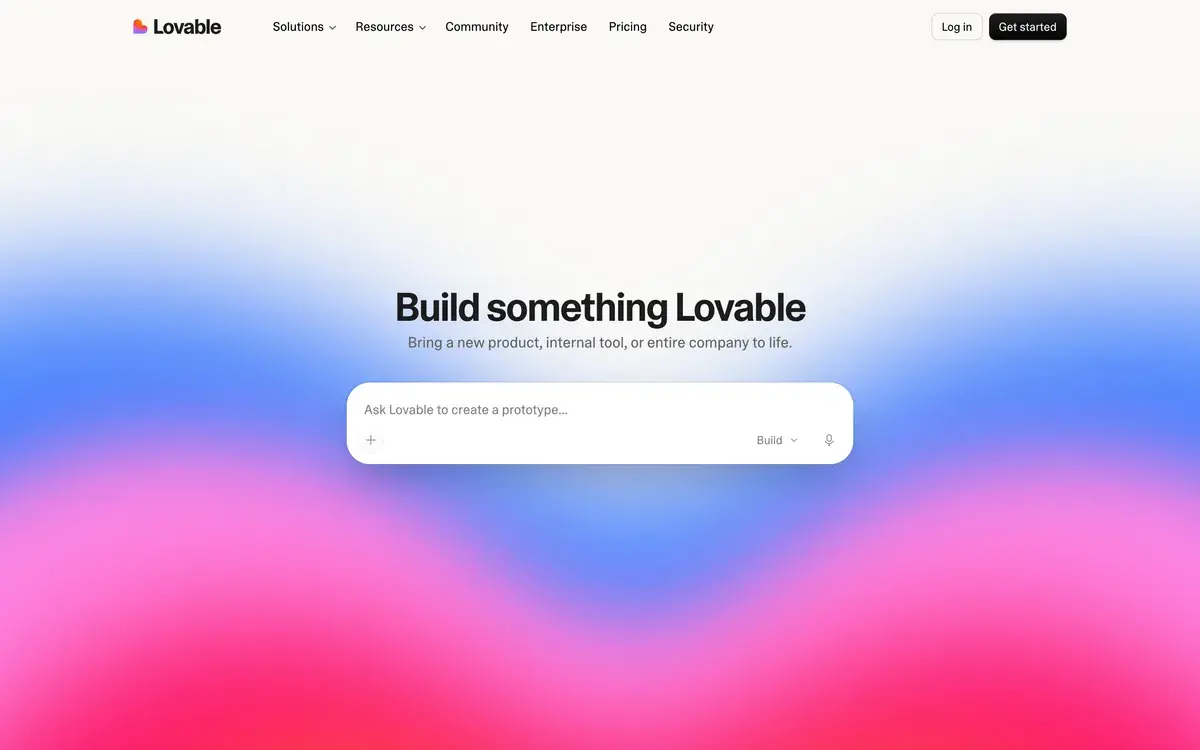
What is Lovable?
Lovable is an AI app builder that generates full-stack web applications from chat prompts, with native Supabase backend integration, free up to 5 daily messages with paid plans starting at $25/month. Used by non-technical founders, indie makers, designers shipping MVPs, and developers prototyping rapidly. Key differentiators: the deepest Supabase integration of any AI app builder in 2026, GitHub export that prevents vendor lock-in, and a chat-first iteration loop that compresses the prototype-to-MVP cycle from weeks to hours. Best for non-technical founders shipping their first version of an idea.
The AI app builder category is one of the loudest spaces in AI tooling in 2026. Lovable, Bolt (from StackBlitz), v0 (from Vercel), Replit Agent, Tempo, and several others are all racing to be the platform where "anyone can build an app from a chat prompt." Most demos look magical; most production realities are more nuanced. The honest framing on this entire category is that AI app builders have crossed the line where they reliably produce working MVPs, but they have not crossed the line where they replace engineering work for production-grade software.
Lovable's positioning within this crowded space is the friendliest experience for non-technical builders, particularly because of the Supabase integration. Where competitors like Bolt and v0 lean toward developer audiences (the output is great if you can read and modify the code), Lovable leans toward founders who genuinely want to ship without writing or reading code. Whether this works for any given project depends heavily on what you are building — but for the right use case, the speed gain is real.
Who is it for?
Lovable is built for people who want to ship working web applications without writing code, with particular emphasis on founders and operators who have product ideas and limited time or technical capacity. The clearest fit is non-technical founders building their first MVP — the chat-first interface plus Supabase backend means a complete authenticated app with database, sign-up flow, and core features can ship in a weekend rather than waiting for a developer or learning to code from scratch.
Designers and product people use Lovable to ship internal tools, prototypes, and side projects that would otherwise require coordinating with engineering. The output quality is good enough to put in front of users for real testing, not just static mockups. Designers who can think in flows and screens find Lovable's chat iteration matches how they already work.
Indie makers and side-project builders use Lovable to ship more projects faster — micro-SaaS, niche tools, internal utilities for friends. The economics work because the time investment per project drops meaningfully; failure is cheaper, and more shots get taken.
Developers use Lovable for rapid prototyping when they want to validate an idea before committing engineering time. The generated codebase is mainstream React/TypeScript that any developer can take over and extend; Lovable handles the boilerplate and initial scaffolding faster than starting from a template.
Solopreneurs running small businesses use Lovable for internal tools — booking systems, client portals, inventory dashboards — where commercial SaaS is overkill and engineering hire is impossible.
It is not the right pick for: complex enterprise applications with sophisticated business logic, applications requiring frameworks beyond React/Vite (no Vue, Svelte, Solid options), applications needing significant offline capability or native mobile features, security-sensitive applications without engineering review capacity, or any project where production-grade reliability matters more than time-to-prototype.
Key Features
- Chat-first app generation — describe the app you want in plain language; Lovable generates frontend, backend, and database
- Native Supabase integration — automatic database schemas, authentication, file storage, and real-time features
- GitHub export — full code export to GitHub at any point, with no vendor lock-in
- Live editing — see changes in real time as the AI generates and modifies code
- Visual editing — edit generated UI through a visual interface rather than chat for fine-tuning
- Multi-file generation — handles full project structure, not just single components
- Custom domains — deploy to Lovable-hosted subdomain or export and deploy elsewhere
- Component library — Tailwind-based components and shadcn/ui patterns built in
- Iterative refinement — chat with Lovable to refine, fix, and extend existing projects
- Image and asset upload — bring images, logos, and reference designs into the generation
- Authentication flows — email/password, magic links, OAuth via Supabase Auth
- API integrations — connect to external APIs (Stripe, OpenAI, others) through guided integration flows
Lovable vs Competitors 2026
| Tool | Best for | Backend | Code quality | Deployment | Free tier | Price/mo |
|---|
| Lovable | Non-tech founders, MVPs | ✅ Native Supabase | ⚠️ Good | ✅ Hosted + GitHub | ✅ 5/day | $25 |
| Bolt | Developer prototyping | ⚠️ Generated | ✅ Strong | ⚠️ StackBlitz/export | ✅ Limited | $20 |
| v0 (Vercel) | UI components, Next.js | ❌ Frontend-focused | ✅ Strong | ✅ Vercel-native | ✅ Limited | $20 |
| Replit Agent | Code-aware building | ✅ Replit DB or external | ✅ Good | ✅ Replit-hosted | ✅ Limited | $25 |
| Tempo | Designer-led building | ⚠️ Limited | ⚠️ Good | ✅ Hosted | ✅ Limited | $20 |
| Cursor | Developer with AI | N/A (IDE) | ✅ Best | ❌ BYO | ✅ Limited | $20 |
| Windsurf | Developer with AI | N/A (IDE) | ✅ Best | ❌ BYO | ✅ Limited | $15 |
Data verified April 2026 from each provider's official pricing pages.
Lovable vs Bolt: The most-asked direct comparison. Bolt produces technically cleaner code with a stronger generation engine on complex projects, and pairs naturally with developers who want to inspect and modify output. Lovable has the deeper Supabase integration and friendlier UX for non-technical users. The honest split: Bolt wins for developer-led prototyping and code quality; Lovable wins for non-technical founders wanting to ship full-stack apps without reading code. Many builders try both and pick the one that matches their working style.
Lovable vs v0: v0 is built around UI component generation with native Vercel and Next.js integration. It is excellent at producing polished React components and pages; less suited for full applications with backend logic. Lovable handles the full-stack story; v0 handles the UI story better. For Next.js projects where the team will write the backend separately, v0 + a developer often produces better outcomes. For end-to-end app generation by non-developers, Lovable wins.
Lovable vs Replit Agent: Replit Agent operates inside the Replit IDE environment, with full code visibility, terminal access, and Replit's hosting infrastructure. It is more powerful for users comfortable with code; less accessible for pure non-technical users. Lovable is more polished as a no-code product; Replit Agent is more flexible as a code-aware product.
Lovable vs Cursor / Windsurf: Different categories that overlap. Cursor and Windsurf are AI-first IDEs for developers who want to write code with AI assistance. Lovable is for users who do not want to write code at all. The right framing: Lovable is "build the app for me"; Cursor and Windsurf are "help me build the app." Many developers use Cursor or Windsurf as their primary tool; Lovable is for a different audience entirely.
Pricing 2026
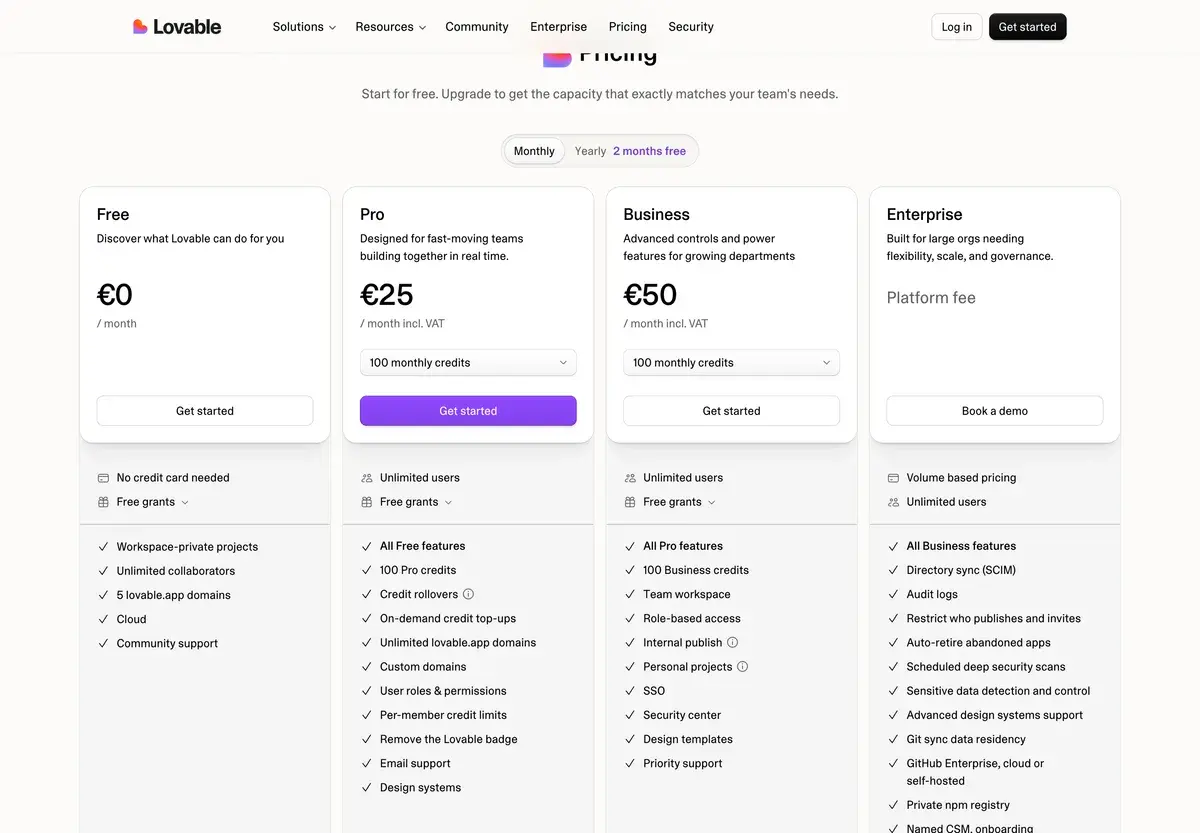
| Plan | Price | Messages/mo | Best for |
|---|
| Free | $0 | 5/day (~150/mo) | Casual experimentation, learning |
| Starter | $25/mo | 100 | Solo builders shipping projects |
| Pro | $50/mo | 250 | Active builders, multiple projects |
| Business | $100/mo | 500 + team features | Agencies, teams, professional use |
Prices verified April 2026 from lovable.dev/pricing.
The honest tier guide: the free tier is genuinely usable for evaluation and small projects, but 5 messages per day is constraining for active building. Starter at $25/month covers most solo builders who ship projects monthly — 100 messages handles meaningful iteration. Pro at $50/month is the right tier for active builders running multiple projects or refining apps over time. Business at $100/month adds team features and is the entry point for agencies and small teams. Annual billing offers ~20% off across all tiers. Most heavy users land on Pro or Business — message counts go faster than first-time users expect.
Add-on costs to budget for: Supabase usage at scale (free tier covers most early projects, paid Supabase plans start at $25/month for production workloads), custom domain hosting if you export and self-host, and any third-party API costs (Stripe, OpenAI, etc.) for features your app depends on.
Hands-on Notes
The first time you use Lovable to build an app and ship it to a real URL in under an hour, the future feels closer. Type a description, watch the AI generate React components, set up Supabase tables, wire authentication, and deploy to a live URL — all without writing or reading code. For non-technical founders especially, this is the kind of experience that changes what feels possible. The friction collapse is real, and it is worth taking seriously.
Where the honest reality kicks in is iteration depth. The first 80% of an app generates fast and works well. The remaining 20% — fixing edge cases, adding business logic, integrating with external services, handling errors gracefully, scaling to real users — gets harder, slower, and sometimes requires escape hatches into the generated code itself. This is the universal pattern in AI app building in 2026: magical at the start, human-grade engineering required toward the end.
Supabase integration is what distinguishes Lovable from frontend-focused alternatives. Watching the AI design schemas, set up authentication flows, and write working queries against a real Postgres database is meaningfully different from generating disconnected UI components. For applications that need data persistence, user accounts, and backend logic, Lovable's Supabase-native approach is more useful than competitors that punt on the backend story.
The GitHub export is the feature that makes Lovable defensible against vendor concerns. You can take the code at any point, hand it to a developer, deploy it anywhere — Lovable becomes a starting accelerator rather than a permanent dependency. This is the right architectural choice for a tool in this category. Builders who get serious about a Lovable-built app typically take ownership of the codebase eventually.
Where Lovable gets weaker: complex business logic still requires code-level work that the chat interface struggles to express precisely. Multi-step workflows, conditional logic with many branches, integrations with non-standard APIs — these often require either intricate prompting or manual code intervention. The "describe what you want" interface is great for common patterns and breaks down for novel ones.
The other quiet caveat is security. Generated authentication and authorization patterns are reasonable defaults, but defaults are not security audits. For applications handling sensitive data, payment flows, or regulated information, plan to have an engineer review the generated codebase before production deployment. The friendly UX of "just chat to ship an app" can obscure security responsibilities that builders should still take seriously.
Message counts go faster than first-time users expect. Each iteration on a complex feature can consume 3-5 messages; debugging a tricky issue can burn 10+. The Starter tier's 100 monthly messages is enough for one small project per month with limited iteration; serious builders move to Pro or Business quickly.
Use Cases
Non-technical founder shipping first MVP: A founder with a B2B SaaS idea uses Lovable Pro to ship version 1 of the product — landing page, authenticated dashboard, core feature, Stripe billing integration — over three weekends. Production users come from the founder's network; engineering work begins after early validation. Total Lovable spend: $50/month. Total tech stack cost: under $100/month including Supabase Pro and Stripe.
Designer shipping internal tool: A senior product designer at a Series B SaaS uses Lovable to ship an internal feedback collection tool that engineering deprioritized. Two days of building, deployed to a private subdomain, used by 30 PMs across the company. The kind of project that gets built when the friction to ship drops below a threshold.
Indie maker running side-project portfolio: An indie maker with a day job uses Lovable Pro to ship 6-8 micro-projects per year — niche tools targeting specific audiences. Most projects fail; one or two find product-market fit and become sustainable side income. The economics work because the per-project time investment dropped from months to weekends.
Developer prototyping before commitment: A senior developer at a Series A startup uses Lovable to prototype a major new feature direction before requesting engineering resources to build it properly. The Lovable prototype validates the user experience and generates real user feedback in two weeks; production engineering work starts on solid foundations. Cost: a Lovable subscription against weeks of saved engineering time.
Small business owner building client portal: A solo consultant builds a client portal — login, project status, document sharing, invoice display — using Lovable Pro over a weekend. Replaces a $200/month commercial SaaS with a custom solution that fits the consultant's exact workflow. Maintenance happens in 30 minutes per month using Lovable's chat to fix issues as they emerge.
Our Verdict
Lovable is one of the better AI app builders in 2026, particularly for non-technical founders and people who genuinely want to ship full-stack web applications without writing code. The Supabase integration is the architectural decision that distinguishes it from frontend-focused competitors; the GitHub export is the architectural decision that makes it safe to commit to. For the right use cases, the time-to-prototype compression is meaningful and real.
The honest weaknesses: AI app builders as a category cannot replace engineering work for production-grade applications, and Lovable is not an exception. Complex business logic, security-sensitive features, sophisticated integrations, and edge cases still require human judgment that chat-driven generation does not provide. Message counts can go quickly. The framework lock-in to React/Vite/Supabase is fine for most users but limiting for some. And generated authentication patterns are reasonable defaults, not security audits.
For non-technical founders, indie makers, designers shipping internal tools, and developers prototyping rapidly, Lovable earns its place. For complex production applications, sensitive business contexts, or projects needing frameworks beyond React/Supabase, plan to use Lovable as a starting accelerator rather than a finishing product, or pick a different tool.
Note: Lovable does not currently have an active affiliate program with AIVario. AIVario earns no commission from sign-ups. Our rating reflects ongoing use of the paid Pro tier across multiple side projects and prototypes.
Best for: Non-technical founders, indie makers, designers shipping internal tools, developers prototyping rapidly, small business owners building custom internal apps
Not ideal for: Complex enterprise applications, security-sensitive production deployments without engineering review, projects needing alternative frameworks (Vue, Svelte, Solid), users who need offline or native mobile capability
Bottom line: One of the best AI app builders for non-technical founders shipping MVPs — magical at the prototype stage, more nuanced toward production. Use it as an accelerator, not a finisher.
Related Tools
- Bolt — closest competitor with stronger code quality and developer-leaning UX
- v0 — Vercel's component-focused alternative for Next.js-based projects
- Cursor — AI-first IDE for developers who want to write code with assistance rather than generate apps
- Windsurf — alternative AI-first IDE with strong agentic workflows
- Claude — model that powers Lovable's generation, also useful for direct code work
Frequently Asked Questions about Lovable
Is Lovable free?
Yes, Lovable has a free tier with 5 messages per day, enough to build and iterate on a small project over weeks. Paid plans start at $25/month for Starter (100 monthly messages), $50/month for Pro (250 messages, advanced features), and $100/month for Business (500 messages, team features). Heavy users frequently exceed these caps and end up on higher tiers.
Is Lovable better than Bolt or v0?
They are the three leaders in AI app building in 2026, with different strengths. Lovable has the best Supabase integration and is generally easier for non-technical founders. Bolt produces technically cleaner code and works well for developer-led prototyping. v0 (from Vercel) is the strongest for component generation and pairs natively with Next.js. For non-technical users wanting full apps with backends, Lovable usually wins; developers often prefer Bolt or v0.
Can I deploy Lovable apps to my own domain?
Yes, Lovable apps can be deployed to a Lovable-hosted subdomain (free tier and above) or exported to GitHub for self-hosting and custom domain deployment on any platform that supports Vite/React (Vercel, Netlify, Cloudflare Pages). The GitHub export is the feature that prevents vendor lock-in — you own the code and can move at any time.
Does Lovable use Supabase by default?
Yes, Lovable's primary database integration is Supabase, which provides Postgres database, authentication, file storage, and real-time features. Connecting your own Supabase project takes a few clicks; the AI generates schemas, queries, and authentication flows tuned for Supabase. This is the deepest backend integration of any AI app builder in 2026.
Can Lovable build production-ready applications?
Lovable can build apps that work in production for limited use cases — internal tools, marketing sites with light backend, MVPs with low-to-medium complexity. For real production applications with significant business logic, security requirements, or scale needs, expect to take Lovable's output as a starting point and apply substantial engineering work afterward. Treat Lovable as 'build the prototype fast' rather than 'ship the final product.'
Does Lovable handle authentication?
Yes, Lovable generates authentication flows using Supabase Auth, supporting email/password, magic links, OAuth providers (Google, GitHub, others), and session management. The auth implementation is functional out of the box but should be reviewed for security best practices before production use, particularly around row-level security policies and protected routes.
What languages and frameworks does Lovable use?
Lovable generates React + Vite + TypeScript applications with Tailwind CSS for styling and Supabase for backend services. The output is modern, mainstream stack — easy for developers to take over and extend after Lovable's initial generation. There is no option to choose alternative frameworks (Vue, Svelte, Solid) — the React/Vite/Supabase combination is the entire product.
Is Lovable safe for sensitive business logic?
AI-generated code, including from Lovable, requires security review before handling sensitive business logic, payment flows, or regulated data. Lovable's generated authentication and database access patterns are reasonable defaults but not equivalent to a security audit. For sensitive applications, plan to engage an engineer to review the codebase before production deployment.