Hootsuite

Hootsuite

Social Media Management
Quick answer

Hootsuite is the oldest social media management platform still standing, and in 2026 it's an enterprise suite rather than a scheduler — listening, inbox, advocacy, analytics and OwlyWriter AI in one place. Two things define the buying decision. The free plan is gone, so there's no way to try it beyond a 30-day trial. And published pricing is genuinely inconsistent: reputable sources put entry at $99 a month, others at $199 per user, with Team around $249. That spread isn't sloppy reporting so much as a signal about how this product is now sold.

Best for: Mid-market and enterprise teams that will actually use listening, inbox and advocacy
Skip if: You mainly need to schedule posts — you'd be paying four times over for that
From ~$99/mo Professional · ~$249 Team · No free plan
EdGrowsReviewed by EdGrows·Updated Aug 18, 2026
Try Hootsuite for free

Affiliate link — we may earn a commission

Researched

This analysis is based on documentation, public user reports, and vendor materials — not yet on our own hands-on testing. How we rate

Two facts that shape everything

The free plan is gone. Hootsuite discontinued it, leaving a 30-day trial as the only way in. For a category where Buffer offers three channels indefinitely and Metricool's free tier includes real analytics and an AI assistant, that's a meaningful shift in how this product reaches anyone new.

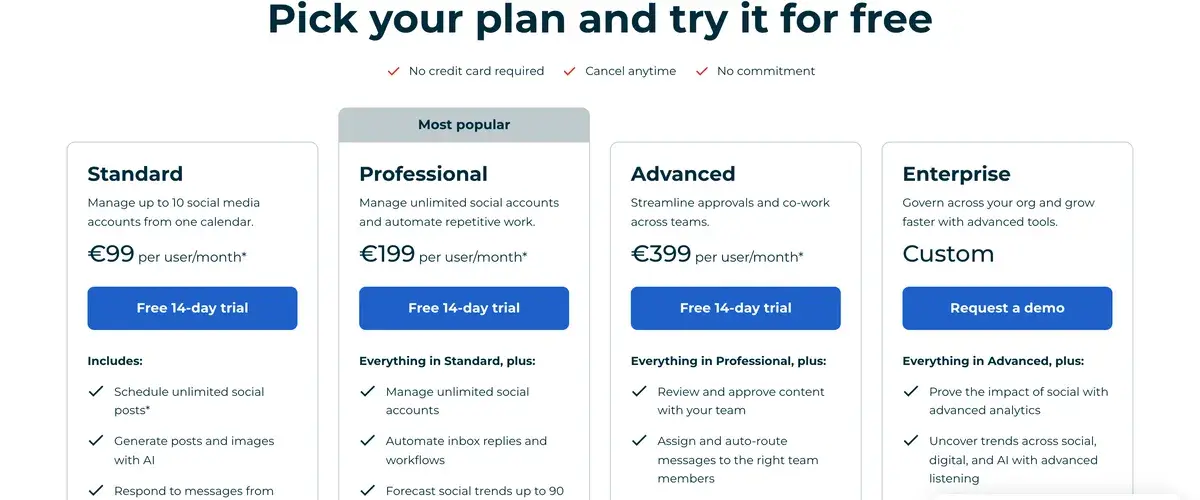
Nobody agrees what it costs. Working through 2026 sources: one puts Professional at $99 a month billed annually for up to ten accounts. Another states $199 per user monthly. A third cites $249 for Team and $739 for Business. A fourth mentions $19 a month, which is almost certainly promotional.

Those aren't careless errors — they reflect a product with frequent promotions, changing plan names, and per-user versus per-plan figures being reported interchangeably.

The practical consequence: get a quote. Any published number for Hootsuite, this page included, should be treated as an approximation.

What the money is for

The confusion above matters less if you understand what Hootsuite has become. It isn't a scheduler with extras. It's a suite:

Social listening — monitoring brand mentions, competitor activity and topic conversations across networks.

Unified inbox — messages and comments from every platform in one queue, routable to whoever should handle them.

Employee advocacy — the module that gets staff sharing company content, which is a genuine organisational capability and completely irrelevant to a solo operator.

Approval workflows — drafts routed through the people who need to sign off before anything publishes.

OwlyWriter AI — platform-optimised captions, repurposing of high-performing posts, and an AI content calendar suggesting schedules from engagement patterns. Its edge over generic AI writing is integration with listening, so suggestions can reflect what's trending rather than starting cold.

Analytics built for reporting upward rather than for a creator checking their week.

Read that list honestly against your own situation. If four or more of those are live requirements with named owners, Hootsuite's pricing is defensible. If you read it and thought "we'd probably use the scheduling," that's the answer.

The small business calculation

Five channels, one or two people posting:

  • Buffer Essentials: roughly $25–30 a month
  • Metricool Starter: roughly $20–22 a month for five brands
  • Hootsuite Professional: roughly $99 a month

You're paying three to four times as much for listening, advocacy and approval chains. Small businesses overwhelmingly do not open those modules — and the ones that do usually discover they needed a person to run them more than a tool.

Hootsuite's defenders would say this comparison is unfair because it's not competing for that buyer anymore. That's true, and it's exactly why the free plan disappearing makes sense from their side and makes the product less relevant to most people reading a review like this.

Where it's genuinely the right call

Multi-business-unit organisations. Several brands, several teams, one reporting structure. This is what the suite is shaped for.

Regulated or brand-sensitive industries. Approval workflows that actually enforce sign-off before publishing, with an audit trail.

Companies running employee advocacy. Few competitors do this properly, and it's a real programme rather than a feature when it works.

Teams whose bottleneck is response, not publishing. The unified inbox does something schedulers don't attempt — routing conversations to the right human at volume.

Where it doesn't fit

Small businesses and solo creators. Four times the price for the fraction you'll use.

Anyone who needs to try before buying. No free plan; 30-day trial with a card.

Budget certainty seekers. Published pricing is inconsistent enough that you can't plan from an article.

Instagram-first visual brands. Later does grid planning Hootsuite doesn't attempt.

Hootsuite vs the alternatives

Against Buffer: Buffer is the honest comparison for anyone who mostly schedules — $5 to $6 per channel, a free tier that doesn't expire, and pricing that's barely moved since 2022. Hootsuite has capabilities Buffer never will, and small teams rarely need them. The two aren't really competing for the same buyer anymore, which is the clearest thing to understand about both.

Against Sprout Social: the direct enterprise rival, generally rated stronger on CRM integration, sentiment analysis and customer intelligence, at roughly $199 to $399 per seat. Hootsuite counters on integration breadth and advocacy. Organisations typically decide on which existing systems each connects to.

Against Metricool: Metricool delivers analytics depth at a fraction of the price with per-brand tiers and a genuinely useful free plan — though X costs extra and it does no listening or review management. For agencies wanting reporting rather than a suite, it's the value option.

Against Vista Social: Vista Social targets Hootsuite's agency buyers directly with review management across 17-plus sites and DM automation, at lower entry pricing. A credible mid-market alternative for teams that want suite features without enterprise cost.

Against Later: Later is a specialist — visual planning, link-in-bio, influencer discovery — competing for a different job entirely.

Pricing 2026

PlanReportedNotes
FreeDiscontinued30-day trial only
Professional~$99/mo annual (some sources $199/user)Up to ~10 accounts
Team~$249/moCollaboration, approvals
Business~$739/moLarger orgs, advanced admin
EnterpriseCustomAdvocacy, listening at scale

Checked August 2026 — and flagged as uncertain. Published figures for Hootsuite vary substantially across current sources: Professional appears at both $99 monthly billed annually and $199 per user, with promotional rates as low as $19 cited elsewhere. Plan names and inclusions have changed repeatedly, and per-user versus per-plan reporting is often conflated. The free plan has been discontinued. Request a quote rather than budgeting from any published comparison, including this one.

Audit which modules you'd use before pricing anything. Listening, inbox, advocacy, approvals — if fewer than three are real requirements, the answer is a cheaper tool.

Get a direct quote. The published spread is too wide to plan against.

Existing users: check your own usage data. If your team touched only scheduling last quarter, that's a large annual saving sitting in plain sight.

Don't evaluate on the trial alone. Thirty days is enough to see the interface, not enough to know whether advocacy or listening will stick.

Our Verdict

Hootsuite has been in this market longer than anyone and the platform reflects it — social listening, unified inbox, employee advocacy, approval workflows, deep integrations and an AI layer in OwlyWriter that's genuinely broader than most rivals, particularly where it draws on listening data to inform suggestions. For an organisation with multiple brands, real approval chains and a live advocacy programme, that combination remains hard to replicate by assembling cheaper tools.

Two things make it hard to recommend broadly. The free plan is gone, leaving a 30-day trial as the only evaluation path in a category where competitors offer indefinitely usable free tiers. And published pricing is genuinely inconsistent — Professional appears at $99 and at $199 per user across reputable 2026 sources, with plan names having shifted repeatedly. That isn't a rounding error; it's a product sold through quotes and promotions, which is fine for enterprise procurement and unhelpful for anyone trying to compare.

Underneath both sits the same structural issue: most people who look at Hootsuite need a scheduler. At roughly $99 against Buffer's $25 for five channels, the surplus buys capability that small teams consistently don't open. Hootsuite's answer is that it isn't selling to them anymore, and that's a coherent position — it just means most readers of a comparison like this should look elsewhere.

For mid-market and enterprise teams that will use the suite, recommend after a direct quote. For everyone else, Buffer or Metricool does the actual job for a quarter of the money.

Note: Hootsuite does not currently have an affiliate program with AIVario. We earn no commission, and this rating carries no commercial incentive.

Best for: Multi-brand organisations, teams running employee advocacy, regulated industries needing enforced approvals, companies whose bottleneck is response volume rather than publishing Not ideal for: Small businesses and solo creators, buyers who want to test before paying, anyone needing predictable published pricing, Instagram-first visual brands Bottom line: A capable enterprise suite that stopped competing for small teams — worth it if you'll use listening, inbox and advocacy, and worth a quote because the published prices don't agree.

  • Buffer — the honest alternative for anyone who mainly schedules
  • Metricool — analytics depth at a fraction of the price, strong free tier
  • Vista Social — agency-focused suite with review management and DM automation
  • Later — visual-first planning for Instagram-led brands
  • Canva — design plus scheduling when publishing is the whole need

Frequently Asked Questions about Hootsuite

How much does Hootsuite cost in 2026?

This is harder to answer than it should be. Multiple 2026 sources put Professional at around $99 a month billed annually for up to ten accounts, while others report $199 per user monthly, with Team around $249 and Business considerably higher. Some comparison pages even cite figures near $19, which appear to reflect promotional rates rather than list pricing. The honest advice is to get a quote rather than trust any published number, including these.

Is there still a free plan?

No. Hootsuite discontinued it, which is the single biggest change to how this product reaches new users. What remains is a 30-day free trial. That matters more than it sounds — Buffer's free tier covers three channels indefinitely and Metricool's includes real analytics, so Hootsuite is now the only major option here where evaluation carries a deadline and a card requirement.

What does the price actually buy that cheaper tools don't?

Social listening, a unified inbox, employee advocacy, approval workflows and deeper analytics — the apparatus of managing social at organisational scale rather than publishing posts. Buffer and Later schedule and report; Hootsuite adds monitoring brand conversations, routing messages to the right person, and getting employees to share company content. If those are live requirements, the gap is real. If they aren't, you're paying for surface area.

What is OwlyWriter AI?

Hootsuite's content generation layer — captions optimised per platform, repurposing of top-performing posts, and an AI content calendar that suggests scheduling based on engagement patterns. Its distinguishing feature is integration with social listening, so suggestions can reflect trending topics rather than working from a blank prompt. It's among the broader AI feature sets in the category, though as everywhere the generation itself isn't better than a general model.

Is Hootsuite worth it for a small business?

Rarely. At roughly $99 a month against Buffer's $25 for five channels, a small business is paying four times as much for listening and advocacy features it typically never opens. The honest version of Hootsuite's pitch is organisational scale — several people, approval chains, brand monitoring, multiple business units. Below that threshold the cheaper tools do the job that's actually being done.

How does it compare to Sprout Social?

They're the two enterprise incumbents and they compete directly. Sprout Social is generally regarded as stronger on CRM integration, sentiment analysis and customer intelligence, at higher per-seat pricing — commonly cited around $199 to $399 a seat. Hootsuite is broader on breadth of integrations and employee advocacy. Organisations comparing them usually decide on which existing systems each connects to rather than on feature counts.

Why do published prices vary so much?

Partly because Hootsuite runs frequent promotional pricing, partly because plan names and inclusions have changed repeatedly, and partly because per-user versus per-plan reporting gets conflated. A source quoting $99 for ten accounts and one quoting $199 per user may both be accurate for different plans and dates. It's a practical warning: budget from a quote, not from a comparison article.

Should existing users stay?

If the suite is genuinely embedded — advocacy running, inbox routing configured, listening feeding reporting — switching costs are real and the platform works. If it's being used as an expensive scheduler, that's a straightforward saving. The useful audit is opening the analytics on which modules your team actually touched in the last quarter, then pricing the tools that cover only those.

View all →