What is Clay?
Clay is a data orchestration and AI-powered outreach platform built specifically for modern B2B sales operations. Founded in 2017 and growing rapidly through 2024-2026, Clay has become the leading choice for sales teams running sophisticated outbound motion. The platform's distinguishing characteristic is the consolidation of fragmented sales tech into single unified workflow — replacing the typical "data tool + enrichment service + outreach platform + research tool" stack with one intelligent system.
The core innovation is treating prospect data as a programmable spreadsheet rather than a CRM record. Clay tables import data from any source, enrich with AI research and 75+ data providers, generate personalized outreach copy, and push results back to CRM and outreach platforms. The spreadsheet metaphor is intuitive for sales operations teams while supporting capabilities that traditional CRMs and outreach tools can't match.
Clay's market positioning targets the specific shift in B2B sales toward AI-powered personalized outbound. The platform serves the audience that finds traditional outbound (mass blast emails) ineffective and traditional account-based marketing (manual research per account) too slow. Clay enables the middle ground — automated personalization at scale that performs much better than generic outbound while costing less than full ABM.
Who is it for?
Clay fits modern B2B sales operations teams running serious outbound motion at meaningful scale. The pricing structure reflects this audience — solo professionals get less return on premium investment. Specific user types where Clay fits:
- B2B SaaS sales teams running outbound across SDR and AE workflows.
- Revenue Operations and Sales Operations teams managing data and processes across sales orgs.
- Sales managers running outbound experiments to find effective patterns at scale.
- Founders running sales personally at early-stage startups before hiring sales team.
- Account-Based Marketing teams combining intent data with personalized research.
- Agencies running outbound for B2B clients wanting modern tooling beyond traditional alternatives.
- Marketing operations generating qualified leads through data-driven outreach.
- Recruiting teams running outbound to candidates (similar workflow to sales outbound).
User types where Clay may not fit:
- B2C sales operations. Clay is built around B2B firmographic data and research patterns.
- Solo professionals or freelancers with light outbound needs. Apollo.io or simpler tools fit better.
- Cost-sensitive small businesses. The Starter pricing at $149/mo is meaningful for businesses without dedicated sales operations budget.
- Enterprise sales teams with $50k+ deal sizes where 1-on-1 hand-crafted research outperforms automated personalization.
- Inbound-only sales organizations where outbound isn't core motion.
- Customer success teams primarily managing existing accounts (different workflow than outbound).
Key Features
The Clay feature set covers data orchestration, AI research, and personalized outreach. The features below drive most adoption decisions.
Clay Tables are the core interface — programmable spreadsheets where each row is a person or company. Columns can be data fields, AI prompts, formulas, or integrations. Users build custom workflows by composing columns rather than learning rigid CRM patterns.
75+ data integrations including Apollo.io, Clearbit, ZoomInfo, LinkedIn Sales Navigator, BuiltWith, Owler, Crunchbase, and many specialized providers. Single Clay account replaces individual subscriptions to multiple data services for many use cases.
AI Research Agent (Claygent) automates manual research tasks. Specify research questions; Claygent searches web, parses results, and structures findings. Examples: "What is this company's tech stack?" "Has this person been quoted in recent industry news?" "What are this prospect's main competitors?" Replaces hours of manual research with automated workflows.
AI personalized writing generates email copy customized per prospect using their data and research. Combines firmographic context, recent news, role-specific signals into personalized opening lines, value propositions, and call-to-actions. Quality is significantly higher than generic merge field personalization.
Waterfall enrichment tries multiple data providers in priority order until finding the right answer. If Apollo doesn't have the email, try Clearbit, then ZoomInfo, then specialized providers. Replaces "buy expensive data and hope it has what you need" with "use right tool for right query."
Webhook and API integration allows Clay to integrate with any system. Pull data from custom internal sources; push enriched data to any destination. Extensive API support enables custom workflows beyond pre-built integrations.
Outreach platform integration with Salesloft, Outreach, Apollo Sequences, Smartlead, Lemlist, and others. Clay handles enrichment and personalization; outreach platforms handle sending and reply tracking. The division of labor lets each tool excel at its specific strength.
CRM integration with Salesforce, HubSpot, Pipedrive, and other major CRMs. Two-way sync between Clay and CRM. Workflow triggers from CRM events. Enriched data flows back to CRM for AE handoff and ongoing relationship management.
Custom AI prompts beyond pre-built features. Use any LLM (GPT-4, Claude, etc.) within Clay tables. Custom prompts can answer specific questions about prospects using full Clay context (company data, person data, research findings).
Templates and recipes for common workflows. Pre-built table structures for outbound campaigns, ABM workflows, market research, and competitive intelligence. Accelerate setup for users new to the platform.
Team collaboration with shared tables, role-based permissions, and team workspaces. Larger teams collaborate on data and workflows rather than each person maintaining isolated tools.
Clay vs Competitors 2026
| Tool | Strength | Pricing | Best For |
|---|
| Clay | Data orchestration + AI research + outreach | Free / $149-800+/mo | Modern B2B outbound at scale |
| Apollo.io | Contact database + basic outreach | Free / $59-149/user/mo | SMB outbound, contact data primary |
| ZoomInfo | Enterprise contact database | Custom enterprise | Large enterprise sales orgs |
| Outreach | Sales engagement platform | Custom enterprise | Outreach execution at scale |
| Salesloft | Sales engagement + Drift Conversations | Custom enterprise | Enterprise sales engagement |
| Smartlead | Cold email automation | $39+/mo | Email outreach specialists |
| Instantly | Cold email at scale | $37+/mo | High-volume cold email |
| LinkedIn Sales Navigator | LinkedIn-specific prospecting | $99+/mo | LinkedIn-heavy outreach |
Pricing verified April 2026.
Clay vs Apollo.io. Most common comparison. Different scopes. Apollo is contact database with outreach features. Clay is data orchestration platform pulling from 75+ sources including Apollo. Apollo is simpler and cheaper at lower tiers. Clay is more powerful and consolidates more functionality. Many teams use both — Apollo for contact data, Clay for enrichment and personalization. The combination is common in modern sales stacks.
Clay vs ZoomInfo. Different positioning. ZoomInfo is enterprise contact database with comprehensive data and high pricing. Clay is workflow platform that can use ZoomInfo as one of 75+ data sources. ZoomInfo provides data; Clay provides intelligent application of data. Many enterprises use both — ZoomInfo for data, Clay for orchestration.
Clay vs Outreach/Salesloft. Different categories. Outreach and Salesloft handle sequence execution and engagement tracking. Clay handles data preparation and personalization. Most teams using Clay also use one of these for actual outreach execution. Clay enriches and personalizes; Outreach/Salesloft executes and tracks.
Clay vs Smartlead/Instantly. Different focuses. Smartlead and Instantly specialize in cold email at scale. Clay handles broader workflow including LinkedIn, email, and multi-channel personalization. For pure email cold outbound, Smartlead may be sufficient and cheaper. For multi-channel personalized outreach, Clay's broader capability matters.
Clay vs LinkedIn Sales Navigator. Different scopes. Sales Navigator is LinkedIn-specific prospecting tool. Clay can integrate with Sales Navigator data alongside other sources. Most sales operations use both — Sales Navigator for LinkedIn intent and prospecting, Clay for orchestration across data sources.
Pricing 2026
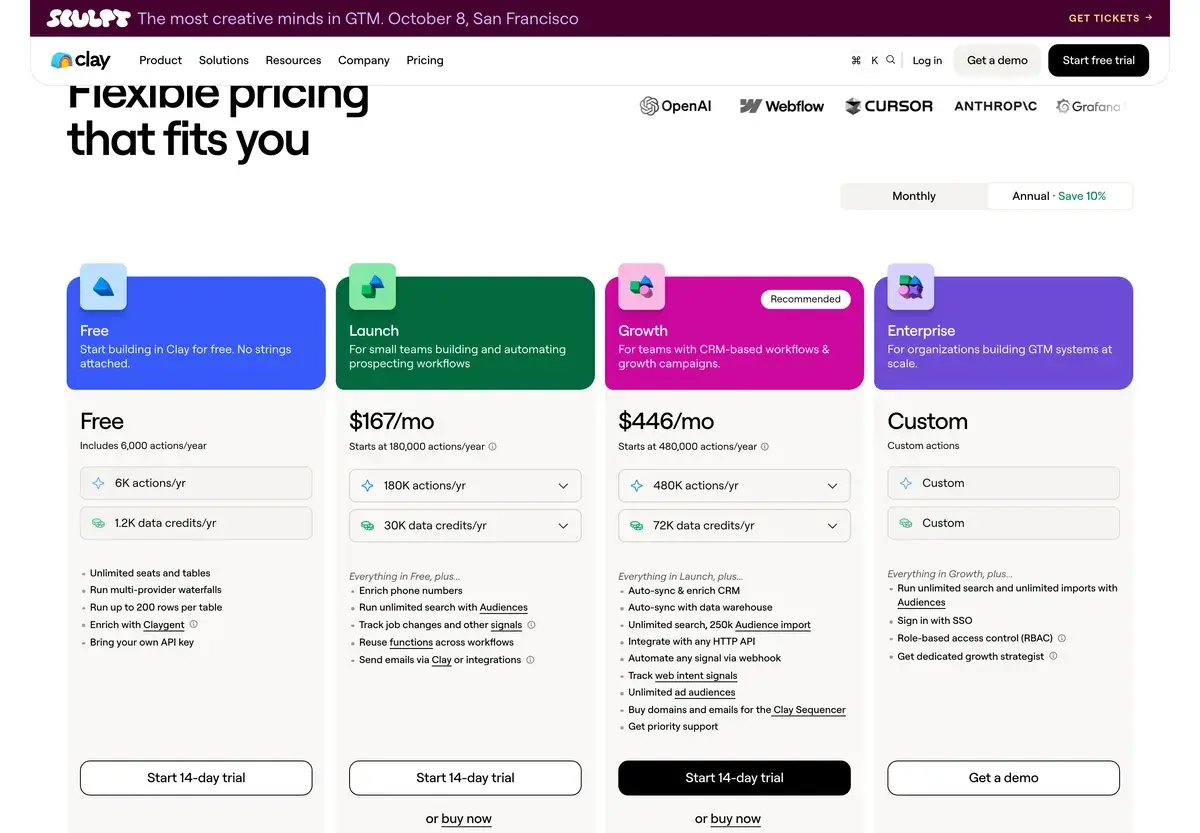
| Plan | Monthly Cost | Credits/Month | Best For |
|---|
| Free | $0 | 100 credits | Evaluation, very small projects |
| Starter | $149/mo | 2,000 credits | Solo professionals, small teams entering Clay |
| Explorer | $349/mo | 10,000 credits | Active sales teams, growing operations |
| Pro | $800/mo | 50,000 credits | Established sales operations, agencies |
| Enterprise | Custom | Custom | Large organizations with custom needs |
Pricing verified April 2026 from clay.com/pricing. Annual billing offers ~20% discount.
Clay's credit-based pricing reflects how each enrichment, AI research call, or data lookup consumes credits. Different operations cost different credit amounts — basic lookups are cheap, AI research with multiple data providers more expensive.
The Free tier with 100 credits is genuinely useful only for evaluation. Most realistic workflows consume 100 credits within minutes of testing. The free tier exists to demonstrate platform capability rather than enable ongoing free use.
Starter at $149/mo is the practical entry point. 2,000 credits handle modest outbound campaigns or experimentation. Most users settling on Clay either hit Starter limits within first month and upgrade, or determine the platform isn't fit and don't continue.
Explorer at $349/mo with 10,000 credits handles serious sales operations. Active outbound campaigns running 100-500 prospects per week typically fit within Explorer credit budget. Most professional sales teams using Clay settle here.
Pro at $800/mo with 50,000 credits supports established sales operations and agency use cases. Heavy enrichment workflows, large prospect lists, and complex research requirements need Pro tier capacity.
Enterprise pricing handles unique needs (custom integrations, dedicated support, advanced security, custom credit limits). Pricing typically starts $2,000+/mo and scales with usage.
The credit-based pricing creates uncertainty about actual costs at scale. Users new to Clay should plan for credit consumption pattern that may differ from initial expectations. Most users find their actual usage settles within their planned tier within first 1-2 months of usage.
What I think about Clay
I evaluated Clay for AIVario research and have observed its market trajectory closely as part of competitive analysis in B2B sales tools. AIVario doesn't use Clay currently — our outbound activity is minimal and Clay's pricing is overkill for our scale — but the platform deserves comprehensive coverage given its market position.
What works well based on research and customer reports: Clay genuinely consolidates fragmented sales tech into coherent workflow. Sales operations teams adopting Clay typically replace 3-5 separate tools with single platform. The cost consolidation often justifies Clay pricing on its own, before considering productivity gains.
The AI research capabilities are genuinely powerful. Claygent automates research tasks that previously required SDRs to spend hours per week on manual research. The time savings flow into actual conversations and relationship building, which is where SDRs add value.
The data integration breadth (75+ providers) is meaningful differentiation. Most sales tools force teams to choose data providers; Clay lets teams use multiple in priority order. The waterfall enrichment approach finds better data than any single source.
What I would honestly flag based on research: Clay has real complexity. The platform isn't plug-and-play despite spreadsheet-like interface. Sales operations teams typically need 2-4 weeks of setup and training before getting consistent value. For teams without dedicated sales operations capability, the complexity may exceed value.
The credit-based pricing creates ongoing cost uncertainty. Heavy enrichment workflows can consume credits faster than expected. Teams need monitoring and budgeting around credit usage rather than predictable monthly costs.
For very small sales operations (solo founders running outbound, sub-5-rep teams), Clay's pricing is hard to justify. Apollo.io at $59-149/user/mo with built-in outreach often delivers more value for less complex needs at much lower cost.
For very large enterprises (500+ reps), Clay may not have enterprise-grade features that ZoomInfo or specialized enterprise platforms offer. The platform's sweet spot is mid-market sales operations with sophisticated needs but not yet at full enterprise scale.
For AIVario specifically, Clay isn't relevant to our content-driven business model. We don't run outbound sales as part of AIVario's strategy. If we evolved into agency offering serving B2B clients with outbound services, Clay would be obvious tool consideration.
For someone evaluating today: if you run modern B2B outbound at meaningful scale (not solo, not enterprise — mid-market sales operations), Clay deserves serious evaluation. The free tier is too limited for meaningful evaluation; Starter at $149/mo is essentially required for fair platform assessment over 1-2 months. For users matching the audience profile, Clay's productivity improvements typically justify pricing within first quarter of use.
Use Cases
B2B SaaS sales team running outbound campaigns. Explorer at $349/mo. SDRs use Clay to enrich prospect lists with firmographic data, AI research, and personalized email copy. Replaces fragmented stack of Apollo + ZoomInfo + manual research + generic email templates. Outbound reply rates improve 2-3x while volume per SDR maintained or increased.
Revenue Operations team building data infrastructure. Pro at $800/mo. RevOps team uses Clay as data orchestration layer between CRM, outreach platform, and external data sources. Enriches CRM records continuously with fresh data. Replaces custom-built data pipelines with maintainable platform.
Founder running sales personally at early-stage startup. Starter at $149/mo. Solo founder uses Clay for prospect research, enrichment, and outreach personalization across 50-100 prospects monthly. Replaces "manually research each prospect for hours" with automated workflow that scales founder capability.
Agency running outbound for B2B clients. Pro or Enterprise plan. Agency uses Clay across multiple client accounts running outbound campaigns. Workflow templates accelerate setup for new clients. Premium service offering enabled by Clay's automation. Replaces "individual tool subscriptions per client" with consolidated platform.
Account-Based Marketing team targeting key accounts. Pro at $800/mo. Combines intent signals, account research, and personalized outreach in single platform. Workflow triggers based on intent data; automated research per target account; personalized engagement at scale. Replaces fragmented ABM stack with unified approach.
Recruiting team running outbound to candidates. Starter or Explorer. Similar workflow to sales outbound applied to candidate recruitment. Enrich candidate profiles with skills, work history, and engagement signals. Personalized outreach at scale. Replaces "use multiple recruiting tools separately" with consolidated workflow.
My Verdict
Clay is the right choice for modern B2B sales operations running serious outbound at mid-market scale. The combination of data orchestration, AI research, and personalized outreach in single platform delivers genuinely transformative productivity improvement for teams that match the audience profile.
For solo professionals and very small teams, Clay's pricing and complexity exceed need. Apollo.io or simpler alternatives fit better at lower cost. Don't try to use Clay at scales below its target audience — the value isn't unlocked.
For very large enterprises (500+ reps with complex compliance and procurement), Clay may not have features required at extreme enterprise scale. Specialized enterprise platforms (ZoomInfo, Salesforce ecosystem) may fit better despite cost differences.
The credit-based pricing creates ongoing budget management requirement. Teams need to monitor credit usage and adjust workflows as patterns develop. Predictable monthly costs are harder to project than seat-based subscriptions.
The competitive landscape is mature. Clay leads the "modern B2B sales orchestration" category clearly. Apollo competes at lower scales with simpler value proposition. Outreach and Salesloft compete in adjacent execution category. ZoomInfo competes at enterprise scale. For Clay's specific positioning and audience, alternatives don't directly match what Clay delivers.
The free tier is too limited for meaningful evaluation. Plan to commit to Starter at $149/mo for 1-2 months of fair platform assessment. Most teams either find clear value within that period or determine Clay doesn't fit. The ROI calculation typically becomes obvious in first quarter of usage.
For B2B sales leaders specifically: Clay represents the modern stack approach that's becoming standard for high-performing outbound sales operations. Teams not adopting Clay-equivalent tooling are likely losing competitive advantage to teams that have. Worth serious evaluation if you fit the audience profile.
Note: Clay does not currently have an active affiliate program for AIVario. We earn no commission from Clay subscriptions. Our rating reflects evaluation based on platform research, market position, and competitive analysis.
Best for: B2B SaaS sales teams running outbound, Revenue Operations and Sales Operations teams, sales managers running outbound experiments, founders running sales personally at early-stage, Account-Based Marketing teams, agencies running outbound for B2B clients, marketing operations generating qualified leads, recruiting teams running outbound
Not ideal for: B2C sales operations, solo professionals with light outbound, cost-sensitive small businesses, enterprise sales with $50k+ deal sizes (manual research wins), inbound-only sales organizations, customer success teams managing existing accounts
Bottom line: The leading data orchestration and AI outreach platform for modern B2B sales operations. Genuinely transformative for teams matching audience profile. Pricing reflects mid-market positioning rather than mass market. Best for teams running serious outbound at scale.
Related Tools
- Apollo.io — primary alternative with simpler positioning at lower cost
- Smartlead — alternative for email-focused cold outbound
- Instantly AI — alternative for high-volume cold email
- Lavender — email personalization that complements Clay workflow
- Lemlist — outreach platform pairing with Clay
Frequently Asked Questions about Clay
Is Clay worth $149/mo Starter?
For sales teams running modern outbound, yes. Clay consolidates data enrichment, AI research, and outreach personalization that previously required separate $50-200/mo subscriptions for each function. Starter at $149/mo replaces typically $400-800/mo in fragmented tool spend. For solo professionals with light outbound, simpler tools like Apollo.io may fit better at lower cost.
How does Clay compare to Apollo.io?
Different positioning. Apollo.io is contact database with built-in outreach. Clay is data orchestration platform pulling from 75+ sources including Apollo. Apollo is simpler and cheaper for basic prospecting. Clay is more powerful for complex enrichment and personalized outreach. Many teams use both — Apollo for initial contact data, Clay for enrichment and personalization. The integration between them works well.
What is Clay's AI Research Agent?
Clay's AI Research Agent (Claygent) automates manual research tasks. Specify what you need — competitor analysis for prospect, recent news mentions, hiring patterns, technology stack — and Claygent searches web, parses results, and writes structured findings to your Clay table. Replaces hours of manual research per prospect. Quality varies by research complexity but typically saves substantial time on routine intelligence gathering.
Can Clay write personalized emails?
Yes. Clay generates personalized email copy at scale based on prospect data and research. Combines firmographic data, recent news, role-specific context, and other signals into AI-generated personalization. Email copy adapts to each prospect rather than generic templates. For high-quality outbound where personalization drives reply rates, Clay's AI writing significantly outperforms generic merge fields.
Does Clay integrate with my CRM?
Yes. Clay integrates with Salesforce, HubSpot, Pipedrive, Outreach, Salesloft, and other major sales platforms. Two-way sync writes enriched data back to CRM. Workflow triggers from CRM events. The CRM integration is essential to Clay's value — enriched data flows into existing sales operations rather than living in isolated tool.
What size company is Clay for?
Clay targets B2B sales teams of 5-200 reps with modern outbound motion. Smaller teams (under 5 reps) often find ROI harder to justify versus simpler alternatives. Larger enterprises (200+ reps) may need custom enterprise features beyond Clay's standard offering. The sweet spot is mid-market sales organizations with serious outbound investment.
Does Clay replace SDRs?
No, but it dramatically increases their productivity. Clay handles research, enrichment, and personalization tasks that SDRs spent hours on manually. SDRs focus on actual conversations and relationship building rather than data preparation. Most teams adopting Clay don't reduce SDR headcount; they increase outbound volume per SDR while maintaining or improving personalization quality.