Instantly AI

Instantly AI

🔥 Hot
Cold Email & Outreach
Quick answer

Instantly is a cold email platform with flat-fee pricing — $37, $97 or $358 a month regardless of team size — plus unlimited connected mailboxes and a bundled B2B database. That pricing model is its real advantage over per-seat rivals: three SDRs on Lemlist costs three times as much, while Instantly costs the same as one. What the plan doesn't include is the inboxes themselves, which you buy separately at roughly $5 to $8 each, and those inboxes now have to survive sender rules that moved from advisory to hard rejection during 2025 and 2026.

Best for: Founders and small teams running outbound where per-seat pricing would multiply the bill
Skip if: You haven't sorted authentication and warmup — no platform saves you from that now
$37 Growth · $97 Hypergrowth · $358 Light Speed
EdGrowsReviewed by EdGrows·Updated Aug 18, 2026
Try Instantly AI for free

Affiliate link — we may earn a commission

Researched

This analysis is based on documentation, public user reports, and vendor materials — not yet on our own hands-on testing. How we rate

Flat fee is the actual product

Most cold email platforms charge per user. Instantly doesn't.

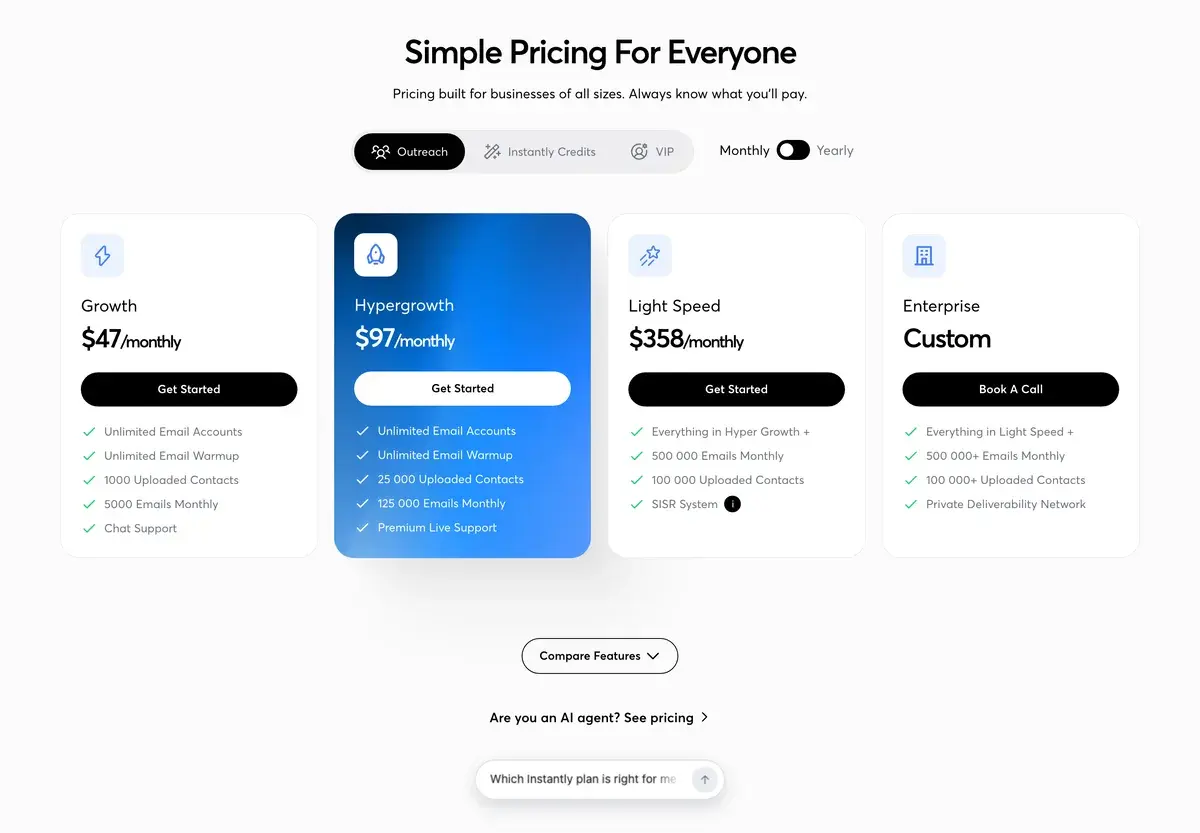
$37 for Growth, $97 for Hypergrowth, $358 for Light Speed — the same whether one founder uses it or ten SDRs do. Unlimited connected mailboxes on every paid plan.

Compare that against Lemlist, where three SDRs on the email plan means three seats, or Apollo, where the same three people is three times $49. At small scale the difference is modest; at five or ten users it reshapes the budget.

PlanMonthlyActive leadsEmails/month
Growth$375,00010,000
Hypergrowth$9725,000100,000
Light Speed$358500,000500,000

Annual billing brings Growth and Hypergrowth to around $30 and $77.60 by some reports.

That structure is why Instantly became the tool people name first when they hear "cold email software." It's also the honest core of any recommendation — you're buying pricing shape as much as features.

The cost that isn't on the pricing page

You buy the inboxes separately. Every platform works this way — Instantly, Smartlead, Lemlist, Reply.io all require you to connect your own Google Workspace or Microsoft 365 accounts.

Instantly sells them through Instantly Accounts at around $8 each, rented. Third-party providers offer pre-warmed inboxes from around $5 with full admin access and ownership.

For a 20-inbox operation that's roughly $160 versus $100 a month — more than the platform fee itself at the Growth tier.

Realistic all-in monthly costs, by scale: a solo founder at 150 emails a day runs roughly $62 to $111; a B2B SaaS team at 500 a day around $268; an agency at 2,000 a day across ten clients around $570. The platform is a minority of that in every case.

"Unlimited mailboxes" needs a 2026 asterisk

Unlimited connections, not unlimited safe sending.

Current deliverability practice puts the safe limit at two to three inboxes per domain, because a flagged domain takes every inbox on it down simultaneously. Scaling means buying more domains, not stacking inboxes onto one.

So the shape of a real operation is something like ten domains with two inboxes each, sending 40 to 50 emails per inbox per day. Instantly not charging per mailbox genuinely helps that model. It doesn't do the domain purchasing, DNS configuration or warmup for you.

What actually changed under all of this

This matters more than any feature comparison, and it applies to every tool in the category.

February 2024: Google and Yahoo made SPF, DKIM, DMARC, one-click unsubscribe and a sub-0.30% complaint rate mandatory for volume senders.

May 2025: Microsoft enforced a near-identical framework for Outlook, covering roughly a third of B2B inboxes.

November 2025: Gmail moved from soft deferrals to permanent rejections.

By 2026 the penalty changed character entirely. Non-compliant mail is refused at the receiving server rather than filtered — there's no spam folder to be rescued from, and a run of rejections damages the domain's wider reputation. Deliverability vendors report Microsoft's automated flag triggering around a 0.10% complaint rate, new domain caps near 200 sends a day with a 30-day ramp, and automated review for campaigns sitting under 8% opens.

Reply rates reflect the squeeze. Published figures range from 0.45% across 7.5 million sends in one study to 3.7% in others — the disagreement itself tells you how much depends on list quality and infrastructure rather than software.

The practical conclusion: the platform is no longer the variable that decides your results. Authentication, warmup, domain spread, list hygiene and copy are. A good platform makes managing that easier; none of them make it optional.

Where Instantly is strong

Setup speed and interface. Consistently the fastest to get running, and the reason solo operators pick it over more technical rivals.

Bundled database. A B2B contact set included rather than requiring a separate subscription — reported between 160 and 450 million records depending on source. Useful at small scale, shallower than Apollo or Clay for precise targeting.

Unified inbox and AI reply handling. Autonomous agents triage replies, which is where outbound operations genuinely lose hours. Automating the sorting is a real saving; automating the responses deserves careful testing first.

Warmup network integration, which is table stakes now and better implemented here than in generalist platforms.

Where it doesn't fit

Agencies running 30 to 300 inboxes. Smartlead's rotation and API-first design suits that scale better, with client pricing at $29 each.

Multichannel sequences. No native LinkedIn or calling. Lemlist or Reply.io.

Teams without deliverability discipline. No platform survives bad authentication in 2026.

Precise targeting needs. The bundled database is convenience, not depth.

Instantly vs the alternatives

Against Smartlead: Smartlead entry is $39 against $37, mid-tier $94 against $97 — the price difference is noise. Smartlead wins on inbox rotation, API depth and agency client management; Instantly wins on setup speed, interface and the bundled database. Choose on operation shape, not cost.

Against Lemlist: Lemlist charges per user — reportedly $39 to $109 depending on tier and channel — so three SDRs cost $117 to $327 against Instantly's flat $37 to $97. Lemlist buys native LinkedIn automation and creative personalisation. Email-only teams should take the flat fee.

Against Apollo: Apollo is a database with sending attached; Instantly is sending with a database attached. Apollo's data is deeper and its credit system harder to predict. Many teams run both.

Against Reply.io: Reply.io is per-seat sales engagement with stronger multichannel workflow and CRM depth. Better for structured sales teams; more expensive for volume outbound.

Pricing 2026

PlanMonthlyAnnual (reported)Includes
Growth$37~$305,000 leads, 10,000 emails, unlimited mailboxes, warmup
Hypergrowth$97~$77.6025,000 leads, 100,000 emails, AI agents
Light Speed$358500,000 leads and emails
InboxesSeparate~$8 via Instantly Accounts, ~$5 third-party

Checked August 2026. Reported figures vary between monthly and annual views — Growth appears at both $37 and $30 depending on billing. Lead database size is cited between 160M and 450M records across sources and dates. Inboxes are purchased separately on every platform in this category. Confirm on instantly.ai/pricing before committing.

Add inboxes to the platform cost before comparing anything. At 20 inboxes they exceed the Growth subscription.

Count your users. Flat fee is the differentiator, and it only pays off if you have more than one or two.

Do the authentication work before your first send. SPF, DKIM, DMARC aligned, warmup run properly, two to three inboxes per domain. This decides results more than the software does.

Watch complaint rate above all else. The practical ceiling is 0.10%, and crossing 0.30% on Gmail requires seven consecutive compliant days before normal delivery resumes.

Our Verdict

Instantly's flat-fee model is a genuine structural advantage in a category where most rivals charge per seat. Paying $37 to $97 whether one person or ten uses the platform, with unlimited mailbox connections, changes the economics of scaling outbound in a way feature comparisons miss. Add the fastest setup in the category, a clean interface, a bundled B2B database and AI reply triage, and it's the sensible default for founders and small teams running email-led outbound.

Two things belong in the cost model that aren't on the pricing page. Inboxes are bought separately — around $8 each through Instantly, $5 elsewhere — and at twenty inboxes they cost more than the subscription. And "unlimited mailboxes" means unlimited connections, while safe practice caps you at two to three inboxes per domain, so scaling is a domain-purchasing exercise the platform doesn't do for you.

The larger point applies to every tool here. Sender rules moved from advisory to enforced between 2024 and 2026, and Gmail now issues permanent rejections rather than routing to spam. With a practical complaint ceiling around 0.10% and published reply rates as low as 0.45%, the platform stopped being the variable that decides outcomes. Authentication, warmup, domain spread and list quality are.

For founders and small teams doing email outbound, recommend at Growth or Hypergrowth. For agencies at inbox scale, look at Smartlead; for multichannel sequences, Lemlist or Reply.io.

Note: Instantly AI does not currently have an affiliate program with AIVario. We earn no commission, and this rating carries no commercial incentive.

Best for: Founders running their own outbound, small teams where per-seat pricing would multiply costs, email-led campaigns, operators who want fast setup over deep configuration Not ideal for: Agencies managing 30+ inboxes across many clients, multichannel sequences with LinkedIn or calling, teams without deliverability discipline, precise targeting requirements Bottom line: The best pricing shape in cold email and a fast, clean platform — just budget the inboxes separately and accept that deliverability work, not software, decides your results now.

  • Smartlead — near-identical pricing, better inbox rotation and agency features
  • Lemlist — per-seat multichannel with native LinkedIn automation
  • Apollo.io — deeper data, credit-metered, commonly paired with a sending tool
  • Reply.io — sales engagement with CRM depth for structured teams
  • Clay — enrichment orchestration when the bundled database isn't enough

Frequently Asked Questions about Instantly AI

How much does Instantly cost in 2026?

Growth at $37 a month covers 5,000 active leads and 10,000 emails, Hypergrowth at $97 covers 25,000 leads and 100,000 emails, and Light Speed at $358 covers 500,000 of each. Some sources cite $30 and $77.60 on annual billing. Crucially the price doesn't change with team size — unlimited mailboxes and no per-seat fees on every paid plan, which is the structural difference from Lemlist and Reply.io.

Do I have to buy inboxes separately?

Yes, and every major platform works this way. Instantly, Smartlead, Lemlist and Reply.io all require you to bring your own Google Workspace or Microsoft 365 inboxes via OAuth. Instantly sells them through Instantly Accounts at around $8 each on a rental basis, while third-party providers offer pre-warmed inboxes from about $5 with full admin access. For a 20-inbox setup that difference is roughly $60 a month, which is worth pricing before you assume the platform fee is the cost.

What does 'unlimited mailboxes' actually mean now?

Unlimited connections to the platform, not unlimited safe sending. Deliverability practice in 2026 puts the safe limit at two to three inboxes per domain, because a flagged domain takes every inbox on it down together. So scaling means more domains, not more inboxes on the same one — 10 domains with 2 inboxes each is a common shape. The platform not charging per mailbox is genuinely useful; it just doesn't remove the infrastructure work.

How much has cold email deliverability actually changed?

Fundamentally. Google and Yahoo made authentication and complaint thresholds mandatory for volume senders in February 2024, Microsoft followed for Outlook in May 2025, and by November 2025 Gmail had moved from soft deferrals to permanent rejections. Failing mail is now refused at the receiving server rather than filtered to spam — there's no folder to be rescued from. The practical complaint ceiling is around 0.10%, well below Google's published 0.30%.

Is the bundled lead database any good?

Useful for getting started, not a replacement for a dedicated data tool. Instantly bundles a B2B contact database — reported at 160 million and 450 million records depending on source and date — which removes the need for a separate subscription at small scale. For precise targeting, verified mobile numbers or complex filters, dedicated platforms like Apollo or Clay go deeper. The bundle's value is convenience for founders rather than depth for sales teams.

What are the AI agents?

Instantly added autonomous agents including an AI Sales Agent that handles reply triage and responses. Reply handling is where cold email operations genuinely lose time — a campaign that generates 40 replies produces hours of sorting interested from unsubscribe from out-of-office. Automating the triage is a real saving. Automating the responses themselves is worth testing carefully before trusting, because a bad automated reply costs more than a slow human one.

Instantly or Smartlead?

Pricing is nearly identical and the split is operational. Entry is $37 versus $39, mid-tier $97 versus $94 — differences too small to decide on. Smartlead is stronger on inbox rotation and API-first workflows, which suits agencies running 30 to 300 inboxes. Instantly is faster to set up with a better interface and a bundled database, which suits founders and small teams. Agencies also note Smartlead's client-management pricing at $29 per client.

Can I run cold email safely as a beginner in 2026?

Only if you do the infrastructure work first, and that's a bigger job than it was. You need SPF, DKIM and DMARC properly aligned, a warmup period of several weeks per new domain, sends kept low on new inboxes — some vendors report Microsoft capping new domains near 200 a day with a 30-day ramp — and list hygiene tight enough to hold bounces under 2%. Skipping any of it now means rejection rather than the spam folder.

View all →