Apollo.io

Apollo.io

🔥 Hot
Sales Intelligence
Quick answer

Apollo.io bundles a contact database of 230 million-plus records with sequencing, a dialer and CRM sync, which is why it displaced more expensive sales intelligence tools for teams under 50 reps. The seat price is the easy part: $49, $79 or $119 per user on annual billing, roughly $65, $99 and $149 monthly. The harder part is that Apollo runs two separate credit pools, and a Basic seat's 75 monthly mobile credits covers about nine phone reveals at 8 credits each. Analysts put real per-user costs at $150 to $400 once overages land.

Best for: Teams under 50 reps who want data and outreach in one place and will manage credits
Skip if: You need reliable phone data at volume — the mobile credit ceiling is brutal
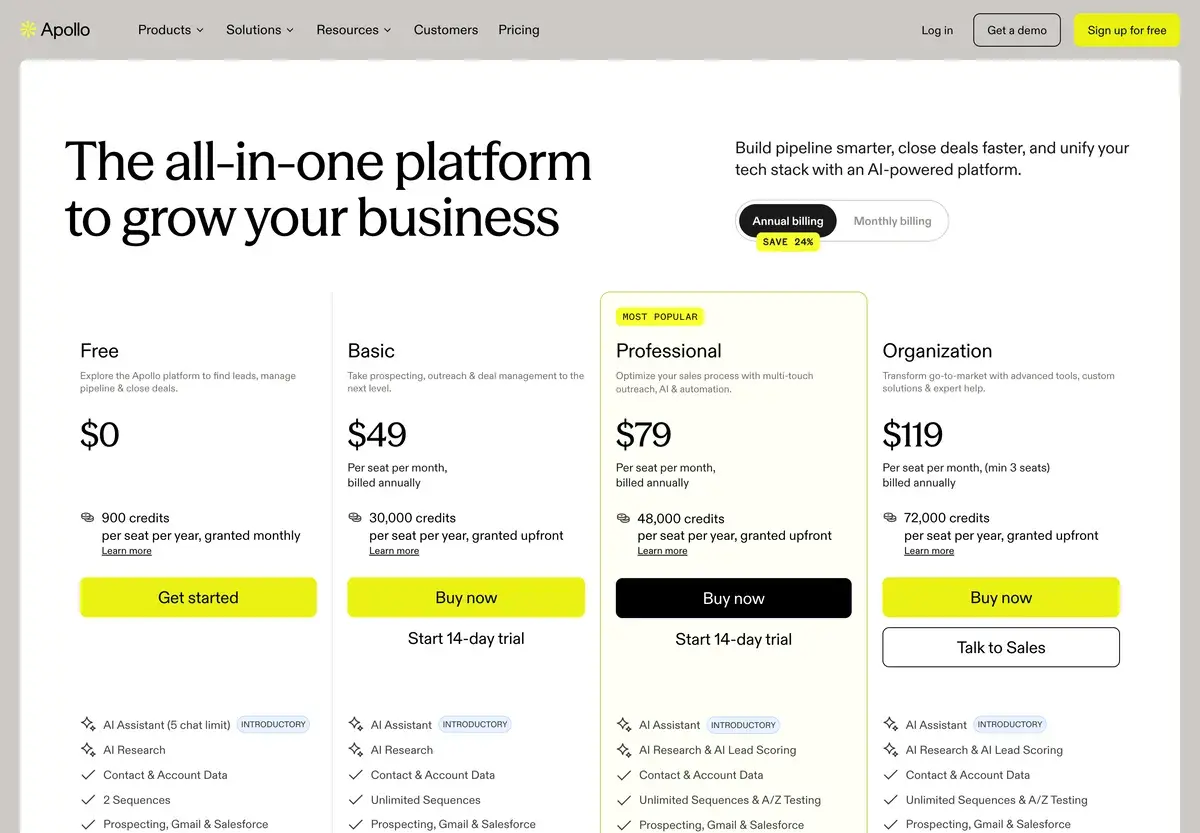
Free · $49 Basic · $79 Pro · $119 Org (per seat, annual)
EdGrowsReviewed by EdGrows·Updated Aug 18, 2026
Try Apollo.io for free

Affiliate link — we may earn a commission

Researched

This analysis is based on documentation, public user reports, and vendor materials — not yet on our own hands-on testing. How we rate

The seat price is the entry ticket

Apollo publishes four tiers and they look reasonable:

PlanAnnual (per seat)MonthlyNotes
Free$0$0900 credits/year, 2 sequences, 250 daily emails
Basic$49~$6575 mobile credits/mo, CRM sync, sequencing
Professional$79~$99API access, dialer, A/B testing
Organization$119~$1493-seat minimum, SSO, highest limits

Organization's three-seat minimum means the real entry there is $357 a month, $4,284 a year — even if one person logs in.

Underneath sits the part that actually decides your bill: two separate credit pools. Mobile credits, allocated monthly for phone reveals. Data credits, an annual pool for email reveals, exports and direct dials.

Run the arithmetic on Basic. 75 mobile credits a month at 8 credits per phone reveal is nine phone numbers. Not ninety. Nine.

Professional's roughly 100 monthly mobile credits doesn't change the shape of that. Which is why one analysis puts real per-user costs at $150 to $400 once overages at around $0.20 a credit land — two to three times the listed price.

The API trap

API access is the main reason to move from Basic to Professional, and it's where credits disappear fastest.

A single bulk enrichment run of 500 contacts can burn 3,000 credits — close to two months of one seat's allowance, consumed by a script that takes five minutes to run.

Manual prospecting spends credits at human pace. Automated enrichment spends them at machine pace, against an allowance sized for humans. Teams that turn on API enrichment without a hard cap find out in the first week.

If you're buying Professional for the API, model API consumption as a separate line from seat prospecting. They're different orders of magnitude.

What justifies it anyway

Coverage and consolidation.

230 million-plus contacts and 30 million-plus companies in one place, at a price ZoomInfo doesn't approach — ZoomInfo contracts typically start in five figures annually. For a team under 50 reps, that gap is the whole argument.

Data plus outreach in one platform. Contact database, email sequencing, built-in dialer, CRM sync, intent data, and an AI assistant added in March 2026. Most competitors do one half well and leave you to integrate the other.

Roughly 100,000 paying customers and over a million sales professionals use it, with customers ranging from pre-seed founders to Lyft and Oracle. The company raised $251 million and hit a $1.6 billion valuation in 2023, and acquired Pocus in March 2026 to fold signal-based revenue intelligence into the platform.

The honest summary: Apollo won by being good enough at everything for a price that made specialised tools hard to justify.

Where the data falls short

Accuracy gaps are consistent enough that many teams buy a separate verification tool — and that belongs in your cost model rather than being discovered later.

The trade is legible: UpLead and similar precision-first databases charge more per contact and lead with accuracy guarantees; Apollo leads with volume. For most teams under 50 reps the comparison genuinely is volume versus precision, and which one wins depends on whether your motion is high-touch or high-throughput.

Mobile numbers are where gaps hurt most, because that's also where the credit ceiling bites hardest. If phone outreach is central to your motion, price that carefully before committing.

The sequencer question

Apollo's sequencing works. It isn't specialised, and 2026 made that matter more.

Google, Yahoo and Microsoft moved sender requirements from advisory to enforced, and by late 2025 Gmail had shifted from soft deferrals to permanent rejections for non-compliant mail. Deliverability is now infrastructure work — inbox rotation, warmup, domain spread, authentication — rather than a feature.

Dedicated platforms like Instantly and Smartlead built their products around that. Apollo's sequencer is a component of a larger platform.

The split most serious outbound teams end up with: Apollo for data, a sending platform for delivery. That costs more than one tool and produces materially better inbox placement, which in 2026 is the difference between an outbound programme and a burned domain.

Where it doesn't fit

Phone-heavy motions. Nine reveals a month on Basic, and overages at $0.20 a credit.

Teams that shrink. No mid-contract seat reductions.

Accuracy-critical prospecting. Buy verification separately or buy a precision-first database.

Serious cold email at volume. Use a dedicated sending platform alongside it.

Apollo vs the alternatives

Against ZoomInfo: the enterprise incumbent with custom contracts typically starting five figures annually. Apollo delivers most of the coverage for a fraction of that, which is why it took the mid-market. ZoomInfo still wins on data depth and enterprise support.

Against Instantly: Instantly is a sending platform with a bundled database rather than a database with sending attached. Flat-fee pricing regardless of team size, versus Apollo's per-seat model. For email-led outbound, Instantly's economics are better; for research and multi-channel, Apollo's data is deeper.

Against Smartlead: Smartlead is API-first infrastructure for high-volume sending with no comparable database. Apollo for finding people, Smartlead for reaching them — a common and sensible pairing.

Against Lemlist: Lemlist charges per user for multichannel sequences including LinkedIn and calls. Narrower than Apollo, better at personalised low-volume outreach.

Against Reply.io: Reply.io is a sales engagement platform at similar per-seat pricing with stronger multichannel workflow. Apollo's database advantage is the main separator.

Pricing 2026

PlanAnnual/seatMonthly/seatCredits
Free$0$0900/year, 2 sequences, 250 daily emails
Basic$49~$65~1,000 email credits, 75 mobile/mo
Professional$79~$99Higher pools, API, dialer, A/B testing
Organization$119 (3-seat min)~$149Highest limits, SSO, international dialing
Overage credits~$0.20 eachApplies across pools

Checked August 2026. Reported figures vary slightly across sources — Basic appears at both $49 and $59 depending on billing view — and Apollo markets "up to 20%" annual savings that in practice runs closer to 17% on Basic. Credit allocations differ by tier and are the main driver of real cost; independent analyses put effective per-user spend at $150–400 once overages are included. Seat reductions aren't permitted mid-contract. Verify on apollo.io/pricing before committing.

Model credits before seats. The seat price is predictable and the credits aren't. Estimate reveals per rep per month, multiply by 6–8 credits, and compare against the allowance.

Cap API enrichment. One 500-contact run is 3,000 credits. Set a limit before switching it on.

Size annual commitments conservatively. No mid-contract seat reductions, and Organization needs three seats minimum.

Budget a verification tool. Most teams end up buying one. Better to plan for it than to discover it after a bounce-heavy campaign.

Our Verdict

Apollo.io earned its position by making sales intelligence affordable for teams that ZoomInfo priced out. A 230 million-contact database with sequencing, a dialer, CRM sync and intent data in one platform at $49 to $119 a seat is a genuinely strong offer, and 100,000 paying customers reflects that rather than marketing. For a team under 50 reps that wants to find people and contact them without integrating three vendors, it remains the sensible default.

The pricing is where care is needed, and the pattern is consistent across every independent analysis. Two separate credit pools govern real cost, and the numbers are tighter than they look — 75 mobile credits on Basic covers nine phone reveals a month. API enrichment burns credits at machine speed, with a single 500-contact run consuming close to two months of a seat's allowance. Overages at around $0.20 push effective per-user costs to $150–400 by several estimates. And seat reductions aren't allowed mid-contract, with Organization requiring three seats minimum.

Two structural caveats beyond price. Data accuracy gaps mean many teams buy verification separately. And the sequencer isn't a deliverability platform — in a year when Gmail moved to permanent rejections for non-compliant mail, that distinction stopped being academic.

For mid-market teams that will actively manage credits, recommend at Basic or Professional. For phone-heavy motions or serious cold email volume, budget for Apollo plus something else.

Note: Apollo.io does not currently have an affiliate program with AIVario. We earn no commission, and this rating carries no commercial incentive.

Best for: Teams under 50 reps, founders doing their own prospecting, organisations wanting data and outreach consolidated, mid-market budgets priced out of ZoomInfo Not ideal for: Phone-heavy outreach, teams with fluctuating headcount, accuracy-critical prospecting, high-volume cold email without a dedicated sending platform Bottom line: The best value in sales intelligence and the least predictable bill — model credit consumption before seats, because that's what you're actually buying.

  • Instantly AI — flat-fee sending platform that doesn't penalise team growth
  • Smartlead — high-volume sending infrastructure to pair with Apollo's data
  • Lemlist — multichannel sequences including LinkedIn and calls
  • Reply.io — sales engagement with stronger multichannel workflow
  • Clay — enrichment orchestration across multiple data sources

Frequently Asked Questions about Apollo.io

How much does Apollo.io cost in 2026?

Four tiers: Free at $0, Basic at $49 per seat, Professional at $79 and Organization at $119, all on annual billing. Monthly billing raises those to roughly $65, $99 and $149. Organization carries a three-seat minimum, so the real entry there is $357 a month or $4,284 a year even if one person uses it. Apollo markets up to 20% annual savings, though the actual discount varies by tier and Basic saves closer to 17%.

Why is my Apollo bill higher than the advertised price?

Credits, mostly. The advertised figure covers seats on annual billing only. On top of that sit overage credits at around $0.20 each, features gated behind Organization, monthly billing premiums, and often an external verification tool bought because Apollo's data accuracy has gaps. One analysis puts real per-user costs at $150 to $400 once phone credit overages land — two to three times the listed price.

How do the two credit pools work?

Apollo runs mobile credits, allocated monthly for phone reveals, and data credits, an annual pool covering email reveals, exports and direct dials. Every reveal draws from one of them. The arithmetic that catches people: a Basic seat gets 75 mobile credits a month at 8 credits per phone reveal, which is exactly nine phone numbers before the allowance runs out. Professional typically gets 100 monthly mobile credits, which isn't a dramatic improvement.

How fast do data credits go on the API?

Much faster than manual prospecting, which is the trap in the Professional tier. API access is the main reason to upgrade, and a single bulk enrichment run of 500 contacts can burn 3,000 credits — close to two months of one seat's allowance in a five-minute script. Teams that automate enrichment without capping it discover this in week one. Budget API usage separately from human prospecting.

Is the free plan enough to evaluate it?

To test the interface, yes. To prospect, no. Free gives 900 credits per seat per year granted monthly, an AI assistant capped at 5 chats, 2 active sequences, 250 daily emails and basic filters. That's enough to run searches and see whether the data covers your market — which is the right question — and nowhere near enough to run outbound. Treat it as a database sample rather than a working tier.

How good is the data?

Broad rather than precise, and that's the standing trade. With 230 million-plus contacts and 30 million-plus companies, coverage is the strongest argument for Apollo at this price. Accuracy gaps are consistent enough that many teams buy a separate verification tool, which belongs in your cost model. Competitors like UpLead charge more per contact and lead with accuracy guarantees — for most teams the honest comparison is volume versus precision.

Can I reduce seats mid-contract?

No, and this catches growing-then-shrinking teams. Seat reductions aren't allowed mid-contract, so a team that goes from ten people to six keeps paying for ten until renewal. Combined with Organization's three-seat minimum, that makes annual commitments worth sizing conservatively. Plan for the team you have rather than the one you're hoping to hire.

Should I use Apollo's sequencer or a dedicated tool?

It's functional and it isn't specialised. Apollo's sequencing works well enough for teams already in the platform, particularly from Professional upward where team sequences and the dialer unlock. Dedicated cold email platforms like Instantly or Smartlead handle deliverability infrastructure — inbox rotation, warmup, domain management — considerably better, which matters more in 2026 than it did two years ago. A common split is Apollo for data, a sending platform for delivery.

View all →