Lemlist

Lemlist

★ Top rated
Cold Email & Outreach

Cold outreach pioneer that introduced multichannel sequences and image personalization — premium pricing for premium UX, less competitive at scale.

$39/mo
📖 14 min read
Try Lemlist for free

Affiliate link — we may earn a commission

Ready to try it?
Lemlist
$39/mo
Get started →
Affiliate link — we may earn a commission
Our rating
4.5/ 5
AIVario Editor's rating →

What is Lemlist?

Lemlist invented what is now standard practice in cold outreach. When the company launched in 2018, cold email tools were primarily template-driven sending platforms — bring a list, choose a template, send to everyone. Lemlist's contribution to the category was the recognition that scale and personalization could coexist: the platform introduced custom image personalization at scale (where each recipient sees their name or company logo automatically embedded in an image), and later pioneered multichannel sequences combining email with LinkedIn touches and phone outreach in one coordinated workflow.

These features were genuinely novel at the time. Custom image personalization in cold email was unusual; multichannel orchestration was largely manual; the idea that cold outreach could feel personalized while operating at scale was the insight Lemlist built around. The product reflected this — premium UX, design polish, opinionated workflows that pushed users toward thoughtful relationship-building rather than pure volume.

The category has evolved since 2018. Smartlead launched the unlimited-mailbox model that fundamentally changed cold email economics for scaled use. Instantly built around bundled B2B contact databases and similar unlimited mailbox approaches. AI personalization features that were novel in 2019 are now standard across competitors. Lemlist's per-mailbox pricing and premium positioning that made sense in the early days now create pricing pressure against scale-focused alternatives.

Lemlist remains one of the most polished products in cold outreach, with the most mature multichannel features and a design quality that competitors have not matched. The product's positioning has shifted — from "the way to do cold outreach" to "the relationship-quality option in a category dominated by volume-focused alternatives." For users whose outbound is relationship-driven and moderate-volume, Lemlist's positioning fits well. For users running scaled volume outbound, the economics favor Smartlead or Instantly.

Where Lemlist still wins

The user experience genuinely is the best in the category. Building a campaign in Lemlist follows a more thoughtful workflow than competitors — the platform pushes you toward considering each step, each personalization variable, each message in the sequence rather than just blasting volume. For users who care about cold outreach as craft rather than as commodity, this thoughtful UX matters. The visual polish, the helpful tutorials, the campaign-building flow all reflect a product designed by people who think cold outreach should be done well.

Image personalization remains distinctive. While Smartlead and Instantly have added similar features, Lemlist's implementation is the most mature. Custom images with embedded personalization can lift reply rates meaningfully when executed thoughtfully — not because the images themselves are revolutionary, but because they signal effort that resonates with prospects accustomed to obvious mass templates. The execution still requires editorial judgment; cluttered or gimmicky personalized images underperform clean ones.

Multichannel sequences are the feature that justifies Lemlist's higher tier specifically. Combining email outreach with coordinated LinkedIn touches and phone follow-ups in one campaign produces stronger response rates than email-alone sequences for many B2B audiences. The multichannel orchestration in Lemlist is more mature than competitors' offerings; for users where multichannel matters, this feature gap is real.

Education and community is the underrated aspect of Lemlist. The company has invested heavily in cold outreach education — blog content, video tutorials, community resources teaching the actual craft of cold email rather than just promoting the tool. Users learning cold outreach often start with Lemlist's educational content and stay because the product reinforces the principles taught. This education-product alignment is genuine and meaningful.

Where Lemlist's positioning weakens

The per-mailbox pricing model is the consistent practical limitation. As cold email best practice in 2026 has shifted toward distributing volume across many low-volume mailboxes (20-30 sends per mailbox per day rather than concentrated high-volume sending), per-mailbox pricing creates economic friction with the technical reality. A team running outbound at scale needs many mailboxes; per-mailbox pricing punishes the architecture that produces best deliverability.

Smartlead and Instantly's unlimited-mailbox models address this directly. Same number of mailboxes, flat pricing regardless of count. For volume outbound — agencies running multi-client campaigns, scaled SDR teams, high-volume founders — the economics favor unlimited-mailbox alternatives substantially.

The B2B contact database integration is another competitive consideration. Instantly bundles a 250M+ contact database; Apollo brings prospecting and sending into one product. Lemlist requires bringing your own list, which means an additional tool subscription (Apollo, Clay, ZoomInfo) for prospecting alongside Lemlist for sending. The total stack cost is higher than alternatives that bundle both.

This is not a critique of Lemlist's product quality; the product itself remains strong. The critique is about pricing model fit for current category economics. For users where the per-mailbox limit does not constrain operations, Lemlist's premium experience earns its place. For users at scale, the model creates pressure that the product quality cannot fully overcome.

Who is it for?

Sales professionals doing relationship-driven B2B outbound at moderate volume. SDRs and AEs running 50-200 emails per week with thoughtful personalization rather than pure volume blasting. The Lemlist UX matches this working style; the per-mailbox economics work at this volume.

Founders running founder-led outbound where personal touch matters. Lemlist's multichannel sequences support the email + LinkedIn + occasional call rhythm that founder-led GTM often follows. The premium UX supports the thoughtful approach that produces relationship-quality outcomes rather than spam-quality volume.

Account executives with named-account focus working larger deals. Where SDR cold email is volume-driven, AE outreach often benefits from multichannel orchestration and image personalization that Lemlist handles well. For account-based marketing approaches, Lemlist fits the methodology.

Recruiters and talent professionals doing candidate outreach. The same patterns that drive sales reply rates drive recruiting reply rates; Lemlist's craft-focused approach fits recruiting's relationship-quality bias. Many recruiters specifically prefer Lemlist over volume-oriented sales tools.

Consulting and professional services firms doing business development. Premium positioning in service work supports premium-quality outreach; Lemlist's polish matches.

Lemlist is not the right pick for: high-volume cold outreach at scale (Smartlead or Instantly are economically better), agencies running many clients with many mailboxes per client (unlimited-mailbox models are essential), users wanting bundled B2B database (Apollo or Instantly bundle this), enterprise sales engagement at scale (Salesloft or Outreach.io serve enterprise needs), or transactional email work.

Key Features

  • Multichannel sequences — coordinate email, LinkedIn (connection requests, messages), and phone touches in one campaign
  • Image personalization — automatically generate custom images with prospect's name, company logo, or other personal elements
  • AI personalization — generate personalized first lines, opening sentences, and value propositions per prospect
  • Email warm-up — built-in warmup network that maintains sender reputation continuously
  • Deliverability tools — domain setup, reputation monitoring, blacklist alerts
  • CRM integrations — native sync with HubSpot, Salesforce, Pipedrive, and other major CRMs
  • A/B testing — test subject lines, copy variants, and send times within campaigns
  • Reply detection — AI-powered classification of inbound replies (interested, not interested, OOO, referred)
  • Templates and inspiration — community-shared templates and proven structures for common outreach scenarios
  • Lemlist Academy — extensive education content on cold outreach craft (free for users)
  • Sales engagement — task management, notes, and follow-up workflows for relationship tracking
  • API and webhooks — integrate with Zapier, Make, and custom workflows

Lemlist vs Competitors 2026

ToolMailbox modelMultichannelImage personalizationB2B databasePrice entry
LemlistPer-mailbox✅ Most mature✅ Best in class❌ BYO$39
SmartleadUnlimited⚠️ Decent⚠️ Available❌ BYO$39
Instantly AIUnlimited⚠️ Decent⚠️ Available✅ Built-in$37
Apollo.ioLimited⚠️ Limited✅ Built-in (large)$49
Reply.ioPer-mailbox✅ Strong✅ Available⚠️ Limited$59
MailshakePer-mailbox⚠️ Limited⚠️ Limited$59
SalesloftPer-seat✅ Enterprise⚠️ Limited$125
Outreach.ioPer-seat✅ Enterprise⚠️ Limited$130

Data verified April 2026 from each provider's pricing pages.

The clearest comparison is Lemlist vs Smartlead vs Instantly. All three target overlapping markets with different competitive choices. Smartlead leads on agency features and unified inbox depth. Instantly leads on bundled B2B database and accessibility. Lemlist leads on UX polish and multichannel maturity. The pricing model is the structural difference: Lemlist's per-mailbox model versus the unlimited models of Smartlead and Instantly.

For volume-focused users, the Smartlead/Instantly economics dominate. For relationship-quality users, Lemlist's UX and multichannel features earn the premium. Many sales operations evaluate all three and pick based on whether scale or craft is the priority.

Reply.io is the closest direct competitor on positioning — similar multichannel features, similar per-mailbox model, similar relationship-quality positioning. Lemlist generally has more mature features and stronger education community; Reply.io is sometimes cheaper at equivalent scale. For users specifically choosing between premium relationship-quality cold outreach tools, evaluate both.

The enterprise alternatives (Salesloft, Outreach.io) serve a fundamentally different market — large sales orgs (50+ SDRs) with full pipeline management, integrated dialers, and deep workflow customization. Lemlist is the SMB and mid-market alternative; for enterprise scale, the dedicated platforms win on capability while costing 3-5x more.

Pricing 2026

PlanPriceMailboxesMultichannelBest for
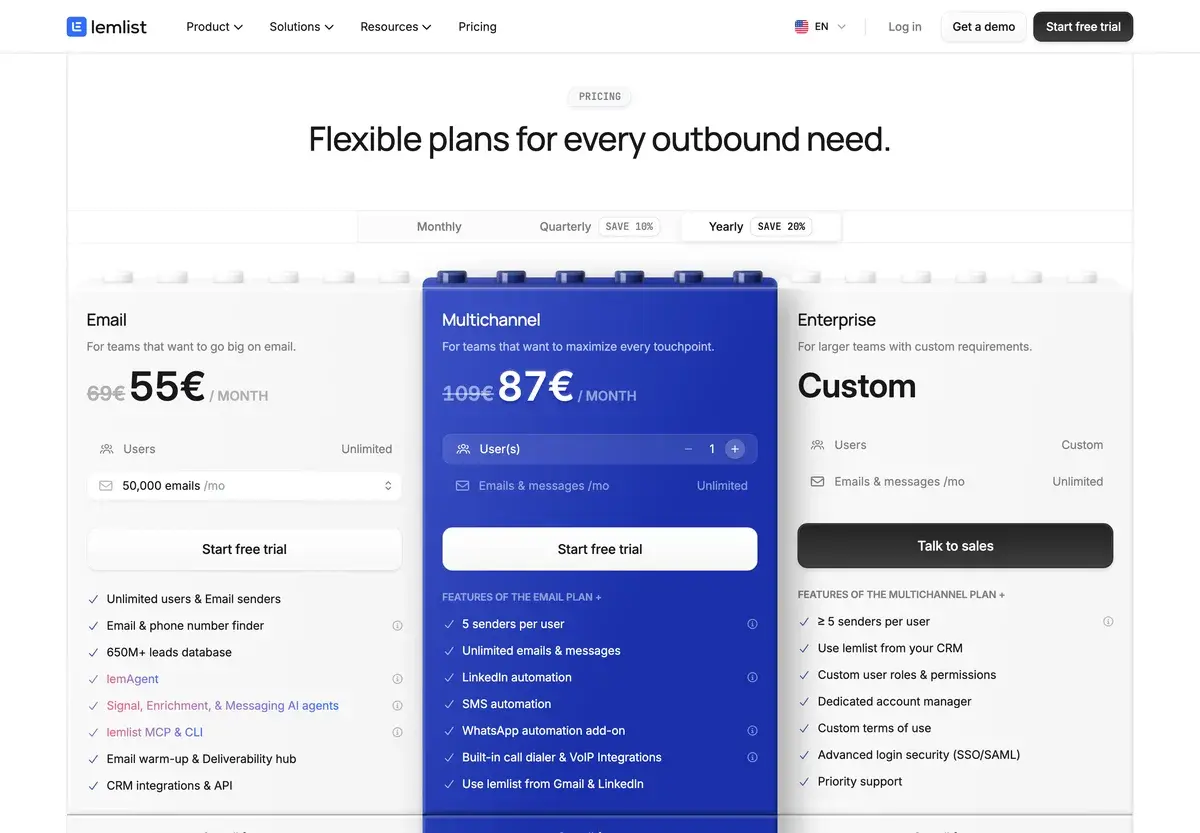
Email Starter$39/mo per userPer-mailbox costsSolo users, small teams, low volume
Email Pro$69/mo per userPer-mailbox costsActive outreach with advanced features
Multichannel Expert$99/mo per userPer-mailbox costs✅ Email + LinkedIn + PhoneRelationship-driven outbound
Outreach ScaleCustomCustom✅ Full multichannelLarge teams, agencies

Prices verified April 2026 from lemlist.com/pricing. Annual billing offers ~20% off paid tiers.

The pricing structure reflects Lemlist's premium positioning. Email Starter at $39/month is competitive with Smartlead and Instantly entry tiers, but per-mailbox costs compound as you add mailboxes for volume distribution. For users sticking with 1-3 mailboxes, the math is reasonable; for users running 10-30 mailboxes (which is typical for serious cold outreach in 2026), Lemlist's costs scale much faster than unlimited-mailbox alternatives.

Multichannel Expert at $99/month is the tier where Lemlist's distinctive features fully unlock — multichannel sequences combining email, LinkedIn, and phone. For relationship-driven outbound, this tier earns the premium against email-only competitors. For email-only outbound, this tier is overkill and the lower tiers compete directly with Smartlead and Instantly on per-mailbox economics.

Hands-on Notes

The first thing that stands out about Lemlist compared to alternatives is how thoughtfully designed everything feels. From the campaign builder to the analytics dashboard to the inbox UX, the product reflects design care that volume-focused alternatives have deprioritized. For users who care about working in well-designed tools, this matters; for users who care primarily about getting outreach sent, the design polish does not justify the pricing premium.

Multichannel sequences work better than competitors' implementations. Coordinating email touches with LinkedIn connection requests and follow-up messages in one campaign — with appropriate spacing, conditional logic based on prospect actions, and orchestrated timing — produces measurably better response rates than email-only sequences for many B2B audiences. For users where multichannel is the value proposition, Lemlist's maturity is the reason to pick it over alternatives.

Image personalization is one of those features that polarizes opinion. Some sales reps swear it lifts reply rates meaningfully; others find it gimmicky and counterproductive. The honest assessment depends on execution: well-designed personalized images that feel thoughtful rather than templated do lift response rates; poorly-designed personalized images that look obviously automated reduce response rates. The feature is a tool, not magic; the user's design judgment matters.

The Lemlist Academy and educational content are genuinely valuable beyond just being marketing for the product. Users learning cold outreach craft pick up actual skills from Lemlist's content that improve their outreach regardless of which tool they ultimately use. This investment in user education is one of the more underrated aspects of Lemlist's market position.

Where Lemlist gets weaker in practice: per-mailbox costs add up faster than first-time buyers expect. A team scaling outbound from 3 mailboxes to 15 mailboxes finds Lemlist costs increasing 5x while the equivalent move on Smartlead would not change pricing at all. For users who underestimate how many mailboxes they will need at scale, this becomes a real surprise.

The unified inbox is functional but less feature-rich than Smartlead's. Reply categorization works; volume management is reasonable; analytics are decent. None of these are weak, but Smartlead's inbox is generally regarded as more advanced for high-volume agency use.

The other practical consideration: Lemlist deliberately constrains some workflows that volume-focused tools allow. Sending caps, warmup-readiness gates, and quality-focused defaults are designed to push users toward thoughtful outbound rather than pure volume blasting. For users who view these constraints as quality-protection features, they are positives; for users who view them as friction against scaling, they create competitive pressure against unlimited alternatives.

Use Cases

A B2B SaaS sales team of 8 AEs uses Lemlist Multichannel Expert for named-account outreach. Each AE manages 4-5 dedicated mailboxes for their named accounts; multichannel sequences coordinate email, LinkedIn, and occasional phone touches per account. The relationship-quality approach fits the team's account-based methodology; the per-mailbox costs are acceptable at this volume; image personalization reinforces the thoughtful approach the team wants to project.

A bootstrapped founder doing founder-led B2B outbound during early-stage growth uses Lemlist Email Pro. Three mailboxes spread across two domains, careful personalization, multichannel orchestration with LinkedIn. Founder spends time on relationship quality rather than volume; Lemlist's UX and education support the craft-focused approach.

An SDR team at a mid-market SaaS evaluates Lemlist against Smartlead and chooses Smartlead for the unlimited-mailbox economics. Lemlist's UX is preferred but the per-mailbox costs do not work for the team's scale; the team migrates to Smartlead and uses Lemlist's free educational content separately. This is the use case where Lemlist's positioning is most challenged by alternatives.

A recruiter at a high-growth startup uses Lemlist Multichannel Expert for senior candidate outreach. The relationship-driven recruiting approach matches Lemlist's design philosophy; multichannel sequences (email + LinkedIn) fit recruiting communication patterns; image personalization adds touch that obvious recruiting templates lack. The premium pricing is justified by the value of senior-level placements.

A small agency serving SMB clients evaluates Lemlist Multichannel Expert vs Smartlead Pro for client outbound campaigns. Lemlist's UX would be preferred but per-mailbox costs across multiple client mailboxes would compound unfavorably; agency picks Smartlead for economics while keeping Lemlist for one premium client where relationship quality justifies higher per-mailbox investment.

Our Verdict

Lemlist remains one of the more polished products in cold outreach and the category pioneer that introduced features now standard across competitors. For users where outbound is relationship-driven, moderate-volume, and craft-focused, Lemlist's UX, multichannel maturity, and educational community justify its place. The product quality is real and the differentiation against scale-focused alternatives is genuine.

The honest considerations: per-mailbox pricing creates real pressure at scale that unlimited-mailbox alternatives do not impose. Smartlead and Instantly's economics dominate for volume outbound; Lemlist's premium positioning works for users where the per-mailbox costs do not constrain operations. The B2B database integration is missing — users need separate tools for prospecting (Apollo, Clay) alongside Lemlist for sending.

For relationship-quality outbound, founder-led GTM, named-account approaches, and craft-focused sales work, Lemlist earns its place. For volume outbound at scale, the economics favor alternatives. The buying decision should be informed by which side of this divide your work fits.

Note: Lemlist does not currently have an active affiliate program with AIVario. AIVario earns no commission from sign-ups. Our rating reflects ongoing use of the paid Email Pro tier alongside parallel evaluation against Smartlead and Instantly.

Best for: Relationship-driven B2B outreach at moderate volume, founder-led GTM, account-based sales approaches, recruiting outreach, consulting business development, users who value craft-focused outbound Not ideal for: High-volume cold outreach at scale (use Smartlead or Instantly), agencies running many clients (unlimited mailbox models work better), enterprise sales engagement (use Salesloft or Outreach.io), users wanting bundled B2B database (use Apollo or Instantly) Bottom line: Premium UX and the most mature multichannel features in the category, with pricing that works for the right audience and pressures against scaled outbound. Match the buying decision to whether your outreach is craft-driven or volume-driven.

Related Tools

  • Smartlead — primary alternative for users prioritizing unlimited-mailbox economics
  • Instantly AI — alternative with bundled B2B database and unlimited mailboxes
  • Apollo.io — B2B contact database commonly paired with Lemlist for prospecting
  • Clay — data enrichment that pairs with Lemlist for advanced personalization
  • HubSpot AI — common CRM destination for Lemlist replies via native integration

Frequently Asked Questions about Lemlist

How much does Lemlist cost?

Lemlist's Email Starter plan is $39/month, Email Pro is $69/month with unlimited campaigns and advanced features, and Multichannel Expert is $99/month adding LinkedIn outreach and phone integration. Pricing is per user with per-mailbox costs that compound at scale (unlike Smartlead and Instantly's unlimited mailbox models). Annual billing offers ~20% off.

Is Lemlist better than Smartlead or Instantly?

Different positioning. Smartlead and Instantly use unlimited-mailbox models that scale better economically for high-volume outbound. Lemlist uses per-mailbox pricing but offers the most polished UI in the category and the most mature multichannel features (email + LinkedIn + phone in one sequence). For relationship-driven outbound at moderate volume, Lemlist's UX wins. For scaled volume outbound, Smartlead or Instantly win economically.

What is image personalization?

Lemlist generates custom images for each prospect with their name, company logo, or other personalized elements automatically embedded. A prospect named Sarah at Acme Corp receives an email with an image showing 'Hi Sarah!' written on a personalized graphic. The image personalization was Lemlist's original differentiator and remains one of the more distinctive features in cold outreach. Whether it actually lifts reply rates depends heavily on execution and audience.

Does Lemlist have multichannel sequences?

Yes, Lemlist's Multichannel Expert tier supports sequences combining email, LinkedIn (connection requests, messages, profile views), and phone calls in one coordinated workflow. The multichannel approach was Lemlist's invention in the late 2010s and remains one of the more mature implementations. For relationship-driven outbound where prospects benefit from touchpoints across multiple channels, the multichannel sequences fit well.

How does Lemlist's pricing compare for high-volume use?

Less favorable than alternatives. Lemlist's per-mailbox pricing means scaling beyond 5-10 mailboxes becomes meaningfully expensive. A team running 20 mailboxes for volume outbound would pay 20x the per-mailbox costs, while equivalent volumes on Smartlead or Instantly run at flat per-month pricing regardless of mailbox count. For high-volume cold outreach, this pricing model is a real competitive disadvantage.

Does Lemlist include email warmup?

Yes, Lemlist Warm-up is included on all paid plans and operates through a network of warmup mailboxes that exchange emails with your sending mailboxes to build sender reputation. Quality is competitive with Smartlead and Instantly's warmup features. The warmup runs continuously rather than only before campaigns launch, which produces stronger long-term sender reputation.