Salesloft is a sales engagement and revenue platform that completed a merger with Clari on December 3, 2025, under CEO Steve Cox, and now markets itself as a predictive revenue system. For account teams it offers Cadence for multichannel outreach, Conversation Intelligence, Deals and Rhythm, which ranks sellers' next best actions; for revenue leaders it adds Clari Forecast, Inspect and Analytics, connected by AI agents, an MCP server and a shared revenue data layer. Pricing isn't published: buyers book a call with sales. Integration is still visible from outside, with separate logins for Salesloft, Clari Forecast, Conversations, Drift and Groove.
✓Best for: Sales organizations that want engagement, conversation intelligence and forecasting from one vendor, especially existing Salesloft or Clari customers
✗Skip if: You need published self-serve pricing, a quick setup for a small team, or a vendor without an integration project underway
This analysis is based on documentation, public user reports, and vendor materials — not yet on our own hands-on testing. How we rate
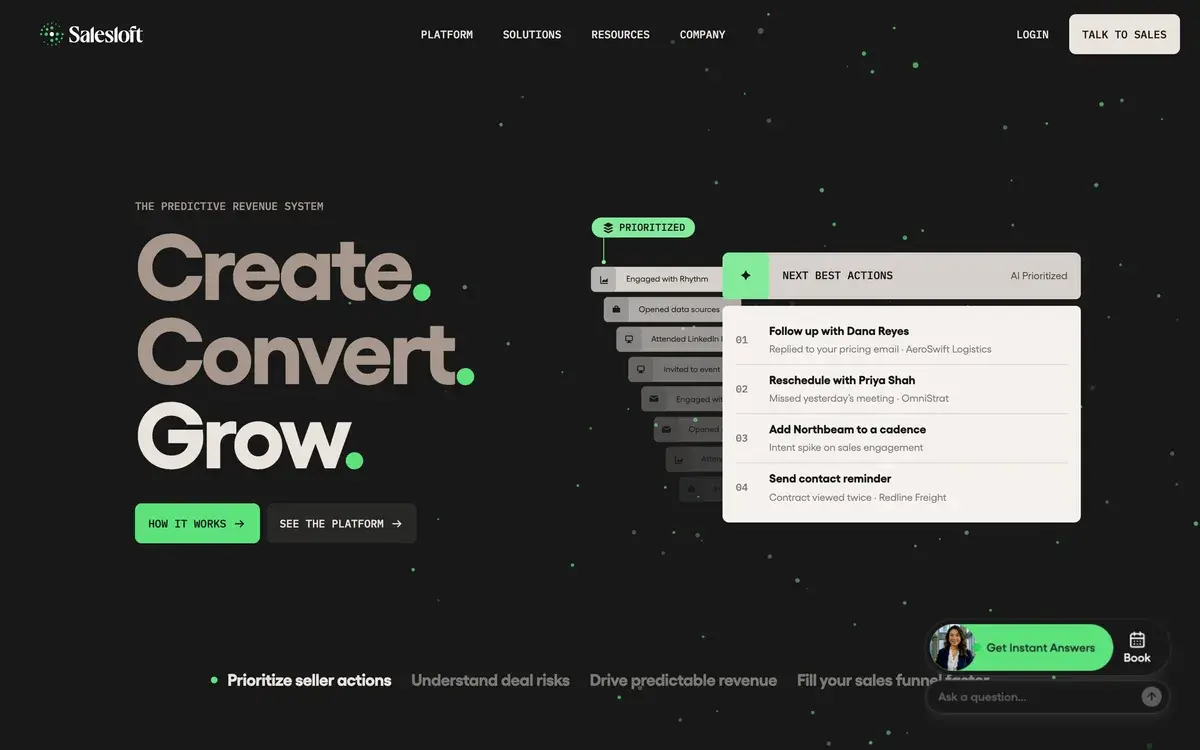
Salesloft homepage, captured Oct 2, 2026.
Salesloft is now two companies' worth of products under one name. On December 3, 2025, it completed its merger with Clari, the revenue forecasting company, and named Steve Cox chief executive. Ten months later, the homepage calls the combined product a predictive revenue system. The login menu still lists five separate products, a sign that the integration is unfinished.
What you can buy now
Salesloft groups its products by who uses them, all running on the same data and AI:
For account teams: Cadence for engaging buyers at scale, Conversation Intelligence for recording and analysing calls, Deals for keeping opportunities moving, and Rhythm, which tells each seller what to do next.
For revenue leaders: Clari Forecast for predicting revenue, Inspect for spotting pipeline risk early, and Analytics for reporting.
Connecting it all: AI agents that take action across the revenue cycle, an MCP server so other agents and systems can use Salesloft's revenue context, context-aware AI and a unified revenue data layer that keeps data in sync.
At the merger, Salesloft highlighted agents for account research, person research and an Ask Salesloft agent.
Rhythm and the signal engine
The homepage shows the idea in miniature. Signals come in, such as an email reply, a missed meeting, an intent spike or a contract opened twice. Rhythm turns them into a ranked list of next best actions for each seller. The pitch is that sellers stop deciding where to spend the day, and managers stop guessing which deals are at risk. Both work from the same signals. How useful that is depends on how much of your activity data flows into the platform, which is why the data layer features so prominently.
Pricing: a conversation, not a page
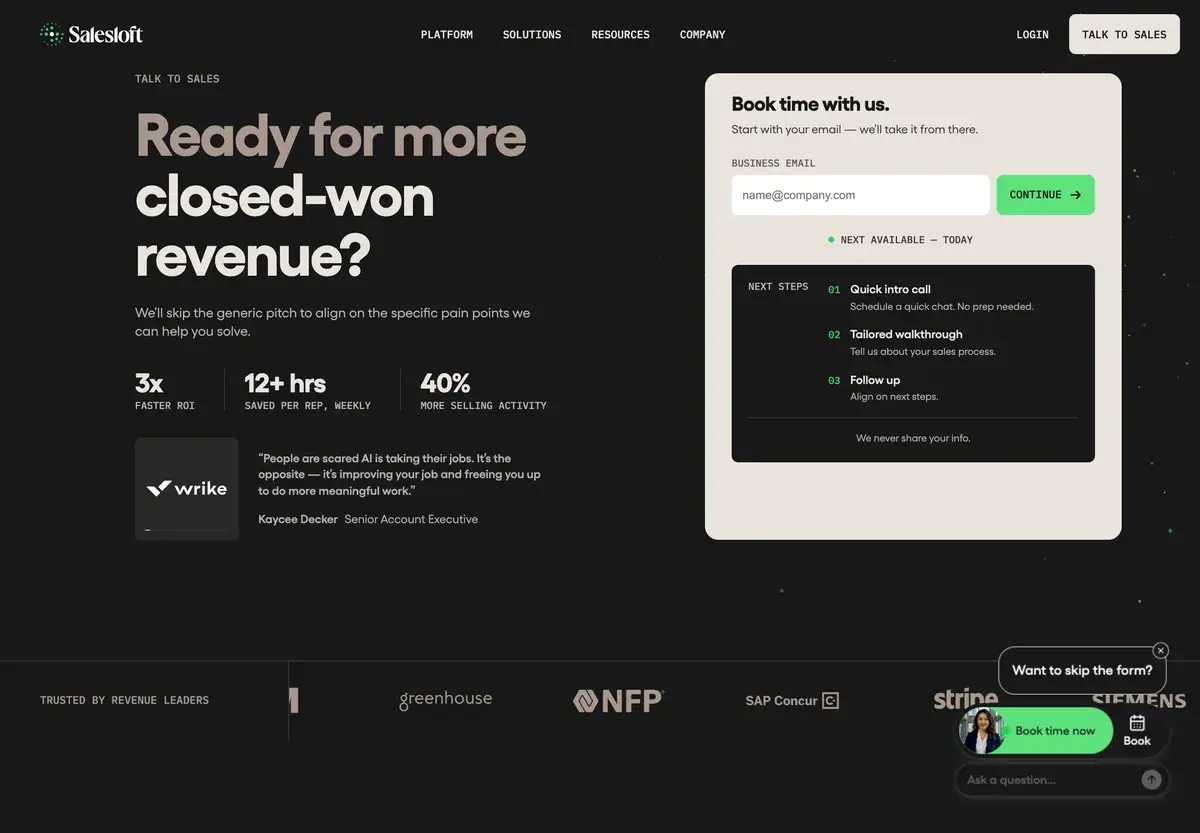
What Salesloft shows instead of a price list, October 2, 2026.
Salesloft doesn't publish prices. Its pricing page is a form to book time with sales, with a promise of a quick intro call, a tailored walkthrough and follow-up. The cost depends on the products and seats you choose. A team that only needs cadences and calls will pay very differently from one that adds Clari Forecast and the agents. The page does show some figures, such as 12 or more hours saved per rep each week and a three times faster return on investment. Those are Salesloft's own claims.
Getting the signals in
Rhythm and the agents are only as good as the activity they can see, so most of the work in a Salesloft rollout is plumbing. Connect reps' email and calendars, the CRM, call recordings and any intent or website-visit data you buy. Then agree which fields count as the source of truth when systems disagree. Teams that skip this get a prioritized list built on half the picture; teams that do it get recommendations that managers can coach against.
It also pays to decide early which products you actually need. A team without a forecasting problem may get most of the value from Cadence, Conversations and Rhythm. Clari Forecast, Inspect and Analytics earn their cost where the weekly forecast call is a real pain.
What the merger means for buyers
For existing Salesloft or Clari customers, the merger promises forecasting and engagement in one place. For new buyers, it raises questions worth asking early. Which products will be consolidated, and how long will separate logins and admin consoles remain? Will contracts signed now move to new packaging at renewal? And who owns support for each product? Large vendor combinations often bring roadmap changes, and it's reasonable to ask for commitments in writing.
How it compares with Outreach and Gong
Outreach is the closest alternative, also quote-based, selling one platform with AI credits in every package and forecasting in its top tier. Gong is the usual choice for conversation intelligence alongside another engagement tool, and smaller teams that want self-serve pricing usually start with Apollo or Lemlist. Our AI sales tools guide lists more options. Salesloft fits organizations that want Clari's forecasting and Salesloft's cadences from one vendor. They also need the operations capacity to run a platform that's still being stitched together.
Frequently Asked Questions about Salesloft
Did Salesloft merge with Clari?
Yes. Clari and Salesloft completed their merger on December 3, 2025 and named Steve Cox chief executive of the combined company. Salesloft is the platform name, Clari survives in the Clari Forecast product, and the company says it doubled R&D investment to build what it calls a predictive revenue system.
Does Salesloft publish its prices?
No. Salesloft's pricing page is a booking form for a call with sales, with no plan prices. Costs depend on which products you buy, such as Cadence, Conversations, Deals, Rhythm or Clari Forecast, and how many seats. Ask for each product priced separately and for renewal terms in writing.
What is Salesloft Rhythm?
Rhythm is Salesloft's prioritization engine. It reads signals such as email replies, meetings, intent data and contract views and turns them into a ranked list of next best actions for each seller, like following up after a pricing email or adding an account to a cadence.
What happened to Drift and Groove?
Both still have their own logins on Salesloft's site, alongside Salesloft, Clari Forecast and Conversations. Drift is the conversational marketing tool Salesloft bought in 2024; separate logins show that the merged product line hasn't yet been unified into a single sign-in.
Is Salesloft better than Outreach?
They compete closely on sequencing, conversation intelligence and deal management. Salesloft's case is Clari's forecasting and revenue analytics joined to its engagement tools; Outreach sells a single platform with AI credits in every package and forecasting in its top tier. A pilot on your own pipeline data is the only reliable tie-breaker.