Intercom is a customer service helpdesk with Fin, its AI agent, built in: a shared inbox, ticketing, the Messenger live chat, a help center and reporting, with Fin answering customers over chat, email, phone and messaging apps. You pay per seat plus usage. Billed annually, Essential is $29 per seat a month, Advanced $85 and Expert $132 ($39, $99 and $139 billed monthly), and Fin costs $0.99 per outcome on every plan. The company renamed itself Fin in May 2026 and Salesforce completed its roughly $3.6 billion purchase on September 10, 2026; the helpdesk keeps the Intercom name.
✓Best for: SaaS, ecommerce and fintech support teams that want an AI agent to resolve a large share of conversations inside one helpdesk
✗Skip if: You are a small team with unpredictable volume and a fixed budget, since per-outcome AI charges and channel fees make the monthly bill hard to cap
This analysis is based on documentation, public user reports, and vendor materials — not yet on our own hands-on testing. How we rate
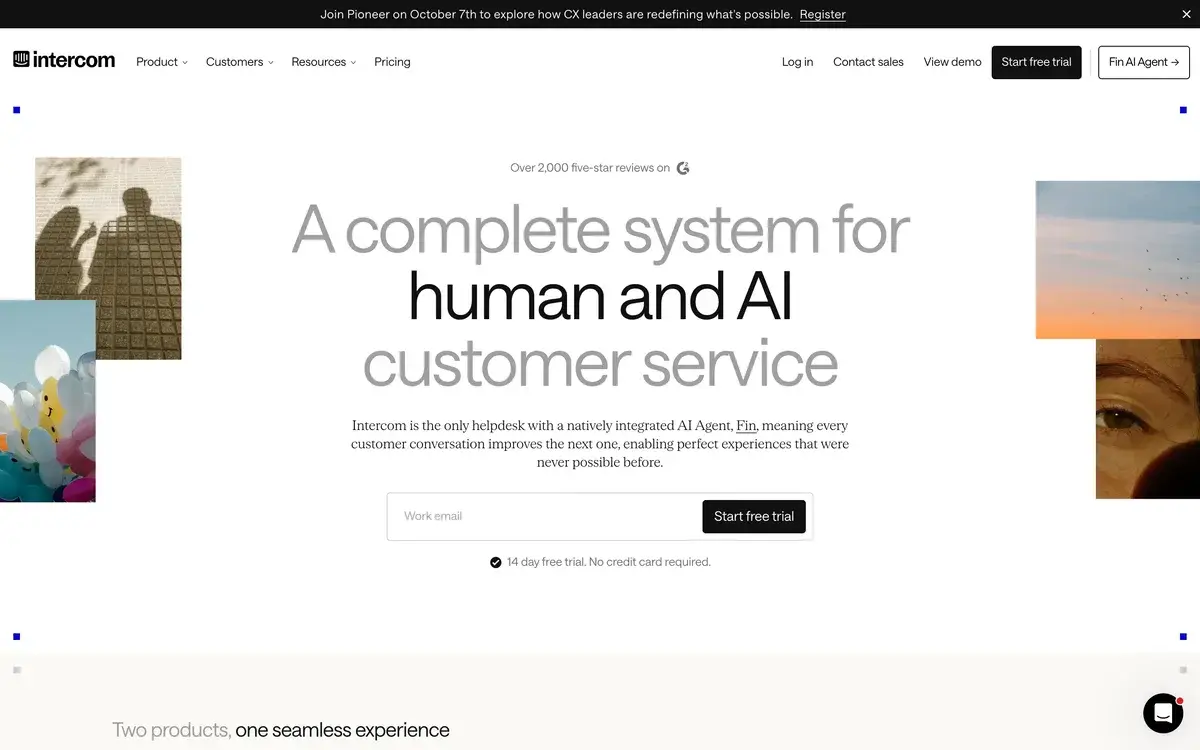
Intercom homepage, captured Sep 29, 2026.
A helpdesk with an AI agent at the front desk
Intercom began in 2011 as the chat bubble in the corner of SaaS products and grew into a full helpdesk: the Messenger for live chat on websites and apps, a shared inbox and ticketing system, a public help center, workflows and reporting. Since 2023 its center of gravity has been Fin, an AI agent that answers customers first and hands over to humans when it cannot resolve something.
The homepage now reads "A complete system for human and AI customer service" and claims Intercom is the only helpdesk with a natively integrated AI agent. The claim is marketing, but the design is real: Fin draws on your help center and other support content, answers over live chat, email, phone, SMS and WhatsApp, can take actions in external systems through workflows, and passes unresolved conversations to agents in the same inbox with the context attached.
The pricing follows that design. Every plan includes Fin, charged per outcome, and the seat plans exist for the humans who handle what Fin does not.
Renamed Fin, then bought by Salesforce
2026 changed who owns Intercom. On May 12 the company renamed itself Fin, saying the AI agent had become the business, and kept Intercom as the name of the helpdesk product. On June 15 Salesforce signed a definitive agreement to buy Fin for about $3.6 billion in cash, and on September 10 it completed the deal, adding a customer base of more than 30,000 companies. Salesforce's announcement put Fin's average resolution rate at 76%.
When we checked on September 29, 2026, the site still sold the Intercom helpdesk alongside Fin for other helpdesks, including Salesforce's own, at the prices on this page. Salesforce says Fin will continue to serve its customers as part of Salesforce AI Labs and describes the deal as making Agentforce "even more powerful for customer service". Watch renewal terms all the same: ownership changes are when pricing and packaging tend to move.
Seats plus outcomes: how the bill is built
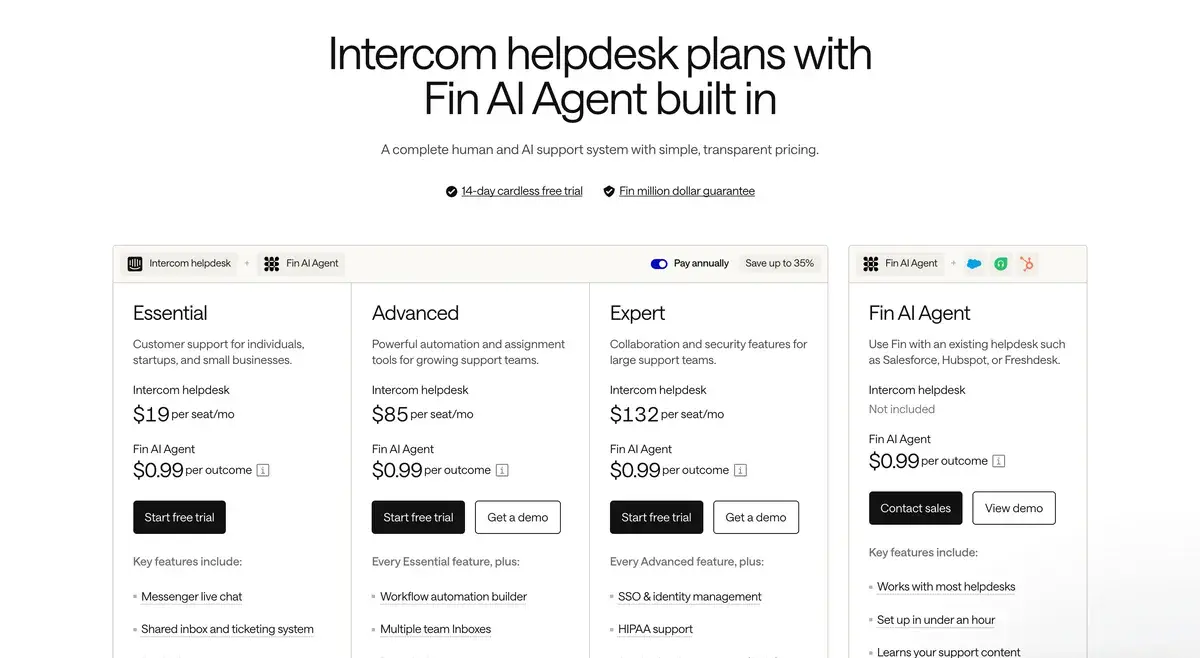
Intercom's pricing page on annual billing, September 29, 2026. The $19 Essential price was part of a price test shown to some visitors; the standard annual price is $29.
Intercom's bill has two meters. Seats are paid per teammate who works in the helpdesk, and usage is paid for what customers and Fin consume.
Plan
Annual billing, per seat a month
Monthly billing
Key additions
Essential
$29 ($19 in a September 2026 price test)
$39
Fin, Messenger, shared inbox and ticketing, pre-built reports, public help center
Advanced
$85
$99
Multiple team inboxes, workflow automation builder, round-robin assignment, private and multilingual help center, 20 free Lite seats
Expert
$132
$139
SSO and identity management, HIPAA support, SLAs, multibrand Messenger and help center, 50 free Lite seats
Fin with another helpdesk
No seats
$0.99 per outcome, minimum monthly commitment
On top of seats, Fin costs $0.99 per outcome on every plan. Live chat, support email, in-app chats, banners and tooltips are included without limit; email campaigns, SMS, WhatsApp and phone are pay-as-you-go at rates that vary by volume and region.
The price test is worth knowing about. The page we loaded carried an experiment marker named for an Essential price reduction and showed $19, while the page's own structured data and most price trackers list $29 annually and $39 monthly. If you see $19 at signup, it is a real offer; if you see $29, that is the standard price.
A worked example: five agents and a thousand resolutions
Seat prices look modest until outcomes are added. Take a support team of five agents on Advanced, billed annually, whose customers start 2,000 conversations a month.
Item
Monthly cost
5 Full seats on Advanced at $85
$425
Fin resolves 1,000 conversations at $0.99
$990
Copilot for 5 agents at $29
$145
Total before SMS, WhatsApp or phone
$1,560
Fin is the largest line, and it grows with success: the more conversations it resolves, the more you pay, which is the point of outcome pricing and also the reason budgets are hard to cap. The comparison that matters is the cost of the alternative. At $0.99 a resolution, Fin is cheaper than any human-handled conversation, and teams that measure cost per resolution rather than software spend usually find the numbers work. Teams with a fixed software budget and spiky volume, after a launch or an outage, find the bill hard to predict.
The 14-day trial includes Fin and every add-on without a credit card, so the realistic approach is to run it on real traffic and read the outcome count before committing.
Copilot, Pro and the other add-ons
Three add-ons change the total. Copilot, a personal AI assistant for agents inside the inbox, costs $29 per agent a month billed annually or $35 monthly, and each agent gets 10 Copilot and 10 AI auto-translation conversations free every month before it is needed.
The Pro add-on, from $99 a month, is aimed at support leaders: it analyzes 1,000 conversations a month to find trends and quality problems, monitors and improves Fin, and includes Operator, an agent for customer operations work. Operator runs on credits, with 2,000 included each month and more at $0.01 each, and spend limits and alerts available. Proactive Support Plus, $99 a month for 500 messages, adds product tours, surveys, in-app messages, mobile push and carousels for outbound engagement.
Contracts are optional for Essential and Advanced on monthly or annual self-serve plans. Upgrades and seat changes happen in the workspace, and downgrades usually take effect at renewal.
Fin without the Intercom helpdesk
Companies happy with their helpdesk can buy Fin alone. It plugs into Salesforce, HubSpot, Freshdesk and other systems, answers email, live chat and phone, follows your tone and answer-length settings, takes actions in external systems and hands conversations to agents in their usual inbox. Pricing is the same $0.99 per outcome, with no seats and no setup, integration or platform fees, and a minimum monthly commitment, such as 50 outcomes.
Intercom says setup takes under an hour. For a team that wants to test AI resolution without migrating its ticket history, this is the lower-risk entry point, and it is a direct competitor to the AI agents Zendesk and others build into their own platforms.
Teams that should look elsewhere
Very small teams with modest volume often overpay. A two-person support team on a tight budget gets a chat widget, shared inbox and AI answers for less from Tidio, and companies whose sales and marketing already run on HubSpot can add its service hub and AI to the same CRM.
Teams that want full control of their AI agent's logic, or to run it across many products and channels they build themselves, may prefer a platform such as Botpress. And organizations already deep in Salesforce can now buy Fin through Salesforce itself, alongside Agentforce, rather than adopting a second helpdesk.
Intercom against Zendesk, Tidio, HubSpot and Botpress
Zendesk is Intercom's closest rival: a larger ticketing heritage, strong for email-heavy support and big organizations, with its own AI agents priced by automated resolution. Intercom is usually preferred for chat-first, in-app support, especially at software companies. Tidio targets small ecommerce stores with a cheaper entry point, HubSpot wins where one CRM for sales, marketing and service matters more than helpdesk depth, and Botpress is for teams building custom AI agents.
Where Intercom stands out is how closely Fin and the helpdesk work together, and the option to buy Fin alone. Its pricing is also more transparent than most rivals', with seat and outcome prices published in full; the difficulty is predicting the outcome count, not finding the rates.
Frequently Asked Questions about Intercom
What counts as a Fin outcome?
Intercom charges $0.99 when a customer confirms their issue is resolved, when they do not ask for more help after Fin responds, or when Fin completes a workflow it calls a Procedure, including a handoff to a human. You pay once per conversation, however many questions Fin answers in it.
What do Intercom's seats cost per month?
Billed annually, Essential costs $29 per seat a month, Advanced $85 and Expert $132; billed monthly, $39, $99 and $139. Intercom says annual billing saves up to 35%. When we checked in September 2026, the pricing page was also testing a lower Essential price of $19 on annual billing with some visitors. Seats cover human agents; Fin is billed separately per outcome on every plan.
Can I use Fin without switching to Intercom's helpdesk?
Yes. Fin AI Agent works on top of existing helpdesks such as Salesforce, HubSpot and Freshdesk for $0.99 per outcome, with no seat costs and no setup or platform fees, though a minimum monthly commitment applies, such as 50 outcomes. Intercom says it can be set up in under an hour and hands conversations to agents in the inbox they already use.
What is the difference between Full and Lite seats?
Full seats are paid and required for anyone who talks to customers or uses core features such as sending messages and outbound content. Lite seats are free on Advanced and Expert and give limited access for internal collaboration, such as a product manager reading conversations. Advanced includes 20 Lite seats and Expert 50.
What do Intercom's add-ons cost?
Copilot, the AI assistant for agents in the inbox, costs $29 per agent a month billed annually or $35 monthly, and every agent gets 10 Copilot and 10 AI auto-translation conversations free each month. The Pro add-on costs $99 a month with analysis of 1,000 conversations and 2,000 credits for Operator. Proactive Support Plus costs $99 a month for 500 outbound messages.
Is Intercom owned by Salesforce now?
Yes. The company renamed itself Fin on May 12, 2026, keeping Intercom as the name of its helpdesk, and Salesforce signed a deal to buy it for about $3.6 billion on June 15. Salesforce completed the acquisition on September 10, 2026. When we checked on September 29, the pricing page still listed the seat and Fin prices on this page, but customers renewing should watch for changes.
How long is Intercom's free trial?
Fourteen days, with no credit card required. The trial includes every feature, Fin and the add-ons, and you pay only once you choose a plan and enter payment details. After it, the minimum is one Full seat on a self-serve monthly or annual plan, with no contract needed for Essential or Advanced.
Does Intercom have a startup discount?
Yes. Intercom's Early Stage program offers eligible startups up to 93% off plus a year of Fin free. Eligibility depends on funding and company size, and Intercom reviews applications. Enterprise discounts are negotiated with sales.