Semrush is an SEO and marketing platform for keyword research, rank tracking, site audits and competitor analysis, and since 2026 it also tracks how brands appear in AI search. Adobe completed its $1.9 billion acquisition of Semrush on April 28, 2026. The old Pro, Guru and Business plans have given way to Semrush One: SEO at $139.95 a month without AI features, Starter at $199 with AI visibility tracking, Pro+ at $299 and Advanced at $549. Annual billing saves up to 17%, and a free account allows 10 reports a day.
✓Best for: Marketing teams, agencies and site owners who need keyword, competitor and rank data plus AI search visibility in one platform
✗Skip if: You run one small site on a tight budget, or you only need backlink data or a single content tool
This analysis is based on documentation, public user reports, and vendor materials — not yet on our own hands-on testing. How we rate
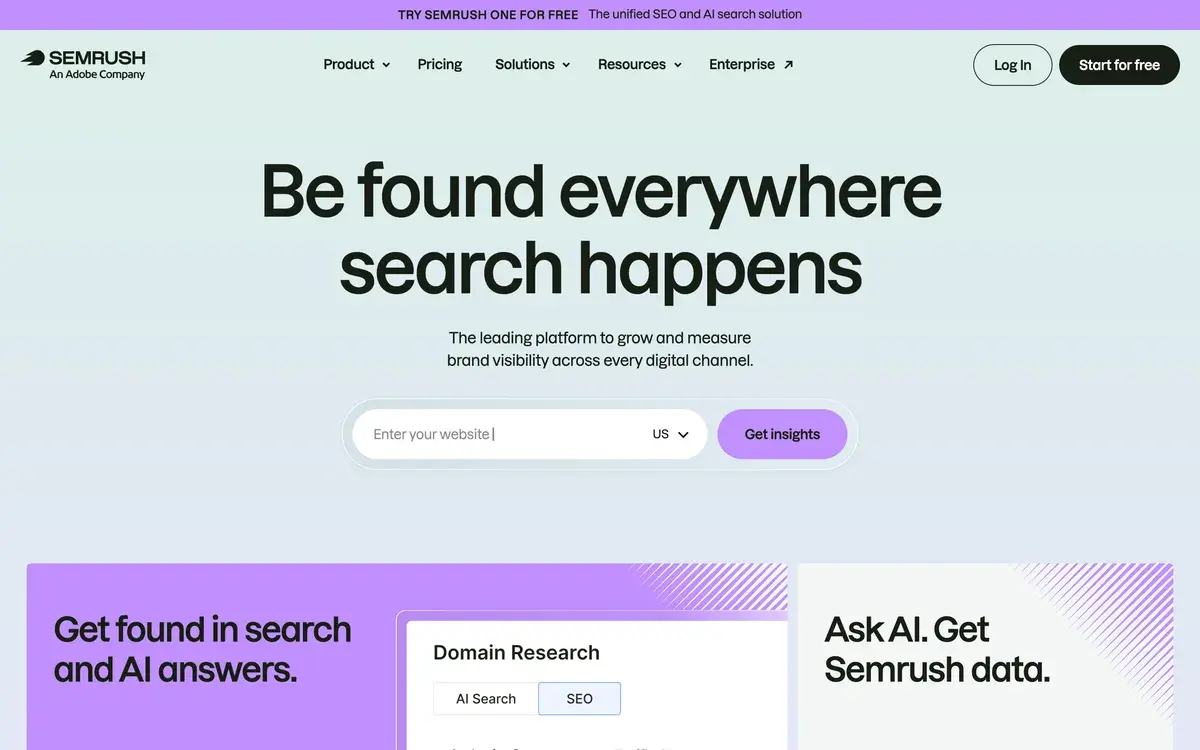
Semrush homepage, captured Sep 28, 2026.
Semrush in 2026: an Adobe company
Semrush built its name on data for search marketers: keyword research with volumes and difficulty, position tracking, site audits, backlink analysis and a view of competitors' traffic and rankings. In 2026 two things changed around it.
The first is ownership. Adobe announced in November 2025 that it would buy Semrush for $1.9 billion in cash, $12 a share, and completed the deal on April 28, 2026. The logo now reads "An Adobe Company", and Adobe presents Semrush as the brand visibility piece of its enterprise customer experience products.
The second is the product. The homepage no longer talks only about SEO: "Be found everywhere search happens" covers Google results and the answers AI assistants give. Every plan above the entry tier now includes AI visibility tracking, and the plans have new names.
Semrush One plans
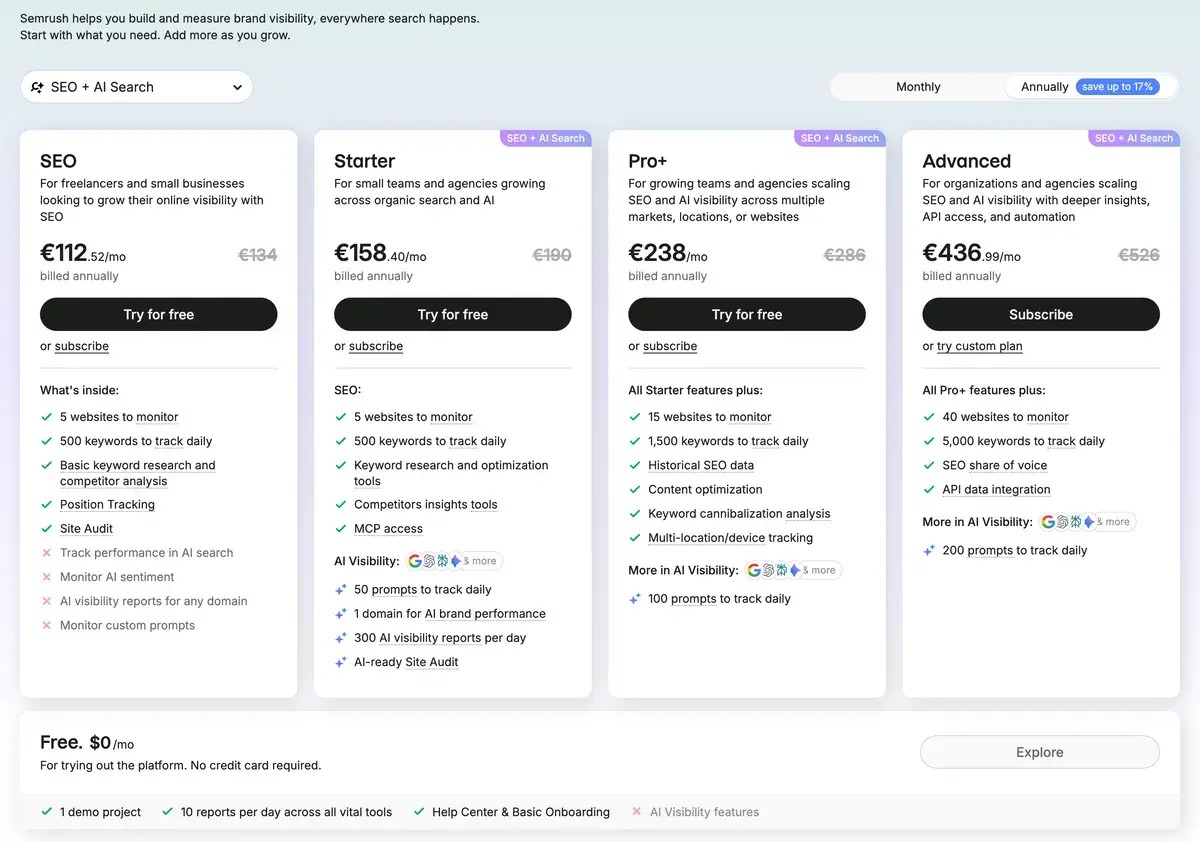
Semrush's plans on annual billing, as shown to us in euros on September 28, 2026. US prices are listed in the table.
Plan
Monthly (US)
Billed yearly, per month
Websites
Keywords tracked daily
AI prompts tracked daily
Free
$0
$0
1 demo project
None
None
SEO
$139.95
about $117
5
500
None
Starter
$199
about $165
5
500
50
Pro+
$299
about $248
15
1,500
100
Advanced
$549
about $456
40
5,000
200
Enterprise
Custom
Custom
Unlimited
Custom
Custom
Annual billing saves up to 17%. Additional users, lead generation and white-label reports are sold as add-ons.
What changed from Pro, Guru and Business
The new plans are easiest to read against the old ones, because the SEO limits carry over:
Old plan
Old price
Closest new plan
New price
What the difference buys
Pro
$139.95
SEO
$139.95
Same limits, no AI visibility
(none)
Starter
$199
Pro-level SEO plus 50 AI prompts, MCP access, AI-ready site audit
Guru
$249.95
Pro+
$299
Historical data, content optimization, 100 AI prompts
Business
$499.95
Advanced
$549
Share of voice, API, 200 AI prompts
For teams that do not care about AI search, the SEO plan is the old Pro at the same price. Everyone who wants Guru or Business capabilities now pays $50 a month more, and gets AI visibility tracking whether they asked for it or not.
What AI visibility adds
Semrush's AI features answer a question traditional rank tracking cannot: when someone asks ChatGPT or Google's AI results about your category, does your brand appear, and how is it described? Paid plans from Starter track a set of prompts daily, 50, 100 or 200 depending on the plan, report AI visibility for any domain, monitor sentiment and include an AI-ready version of the site audit. Starter also includes MCP access, so AI assistants can query Semrush data directly.
The prompt limits are the thing to plan around. Fifty prompts cover a single brand's core questions; agencies tracking several clients reach Pro+ or Advanced quickly.
A suite for teams, expensive for one blog
Semrush's appeal is breadth. Keyword research, rank tracking, audits, backlinks, competitor traffic, content tools and now AI visibility live in one account, which saves a marketing team several subscriptions, and seeing which keywords and pages drive a competitor's traffic remains one of the fastest ways to plan content. The limits also scale predictably, from 5 to 15 to 40 websites, with Enterprise for multi-brand organizations.
The same breadth makes it hard to justify for small sites. At $139.95 a month, one blog pays for far more than it uses, and the free account's 10 reports a day is a sampler rather than a workable tier. Teams that want Guru-level SEO tools now also pay for AI tracking in Pro+, whether or not they use it. And Adobe tends to fold acquisitions into enterprise suites over time, so it is too early to know how the self-serve plans for small businesses will evolve.
Ahrefs, Surfer, Frase and MarketMuse instead
The closest alternative is Ahrefs, known for its backlink index and with AI search tracking of its own. Writers who mainly optimize individual pages can do it for less with Surfer SEO or Frase, and MarketMuse plans content around topic coverage for larger sites.
SEO, Starter, Pro+ or Advanced: picking by team
In-house marketing teams and agencies that use keyword, competitor and rank data every week are Semrush's audience. The SEO plan fits teams for whom AI search does not matter yet; Starter suits a single brand that wants to watch its AI visibility; Pro+ is the agency and multi-site plan; Advanced adds the API and share of voice. Solo bloggers can usually do more with a cheaper content tool and Google Search Console.
Related Tools
Ahrefs: backlinks, keyword research and site audits
They were replaced by the Semrush One plan family. The new limits line up with the old tiers: SEO keeps Pro's 5 websites and 500 tracked keywords at $139.95 a month, Pro+ matches Guru's 15 websites and 1,500 keywords at $299, and Advanced matches Business's 40 websites and 5,000 keywords at $549. Starter, at $199, is new: Pro-level SEO plus AI visibility tracking.
What do the Semrush One plans cost?
Month to month in the US, SEO costs $139.95, Starter $199, Pro+ $299 and Advanced $549. Billed yearly they work out to about $117, $165, $248 and $456 a month, a saving of up to 17%. Semrush shows prices in local currency; in euros we saw 134, 190, 286 and 526 a month. Enterprise is priced by sales, and extra users are an add-on.
Who owns Semrush now?
Semrush is now part of Adobe. Adobe announced the $1.9 billion all-cash deal, $12 a share, in November 2025 and completed it on April 28, 2026. Semrush's logo now reads An Adobe Company, and Adobe describes the purchase as adding brand visibility tools to its customer experience products for enterprises.
What does AI visibility in Semrush track?
How your brand appears in AI answers. Starter tracks 50 prompts daily, Pro+ 100 and Advanced 200, across AI engines including Google's AI results and ChatGPT, with AI visibility reports for any domain, sentiment monitoring and an AI-ready site audit. The SEO plan leaves these features out, so it suits teams that only need classic search data.
Can I use Semrush for free?
Yes, with limits. A free account includes one demo project and 10 reports a day across the main tools, with no credit card, but no AI visibility features. The paid SEO, Starter and Pro+ plans can be started as a free trial from the pricing page.
Does Semrush have an API or MCP access?
MCP access, which lets AI assistants query Semrush data, is included from the Starter plan. API data integration is part of Advanced, and Enterprise adds custom integrations. The SEO plan includes neither.
Which Semrush plan fits a small agency?
Usually Pro+. It monitors 15 websites and 1,500 keywords, adds historical data, content optimization, keyword cannibalization analysis and multi-location tracking, and includes 100 AI prompts tracked daily. Starter's 5 websites are tight for more than a handful of clients.
Is Semrush better than Ahrefs?
They overlap heavily. Semrush is broader for marketing, with rank tracking, content and local tools and now AI visibility in the same plans. Ahrefs is known for its backlink index and a cleaner interface. Choose by the reports you use weekly rather than by feature count.