Suno AI

Suno AI

🔥 Hot
AI Music Generation

The most popular AI music generator in 2026 — type a prompt, get a complete song with vocals in under a minute.

Free · $10/mo
📖 12 min read
Try Suno AI for free

Affiliate link — we may earn a commission

Ready to try it?
Suno AI
Free · $10/mo
Get started →
Affiliate link — we may earn a commission
Our rating
4.7/ 5
AIVario Editor's rating →

What is Suno AI?

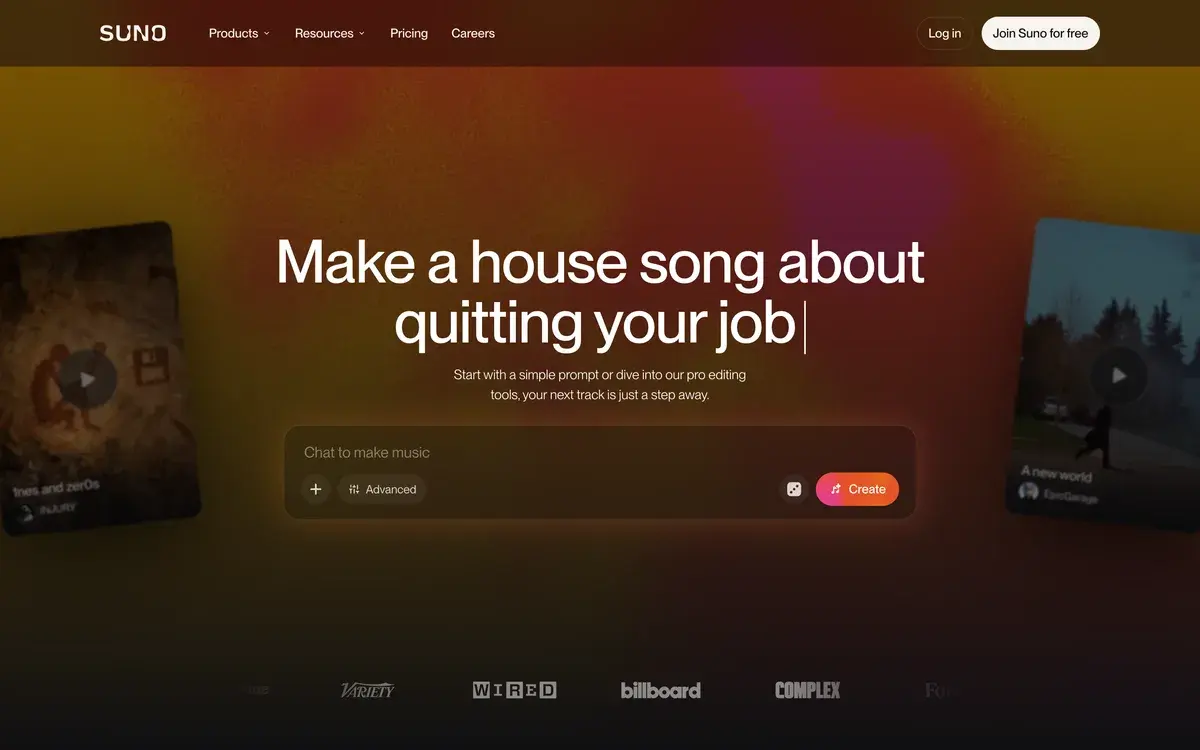
Suno AI is a text-to-music generator that produces complete songs — with vocals, lyrics, and instruments — from a prompt in under a minute, free up to 50 daily credits with paid plans starting at $10/month. Used by content creators, indie game developers, marketers, and millions of casual users making birthday songs, meme tracks, and viral clips. Key differentiators: vocal quality is genuinely good, multi-genre range from lo-fi to metal, and an API for app integration. Best for non-musicians who want music without learning music.

The first time you generate a Suno song that you actually want to listen to, something clicks. You realize the barrier to making music — twenty years of guitar lessons, a $3,000 DAW setup, knowing what reverb is — has just collapsed for an entire category of use cases. That does not make Suno a replacement for real music production. It makes Suno a new category: music generation as a creative primitive, sitting next to text and image generation as something most people can now do.

Suno's V4.5 model (released in 2025) was the version that pushed it past the "novelty" threshold. Vocal performance got expressive enough to handle emotional inflection. Instrumental layering started sounding like real arrangements rather than MIDI presets. Genre range expanded to handle hip-hop, indie folk, and electronic with genuine fidelity. The current model continues that trajectory — there are still tells if you listen carefully, but most listeners stop noticing within the first verse.

Who is it for?

Suno is built for people who want music for something — a video, a game, a moment, a joke — and do not have the time, skill, or budget to make it traditionally. The clearest fit is content creators on YouTube, TikTok, and Instagram who need original background tracks, custom intros, or one-off songs for specific videos. Royalty-free libraries are saturated; Suno gives you something that has not been used in a thousand other videos.

Indie game developers use Suno for procedural soundtracks, level music, and character themes — areas where licensing professional composition is cost-prohibitive for solo and small-team studios. The API makes runtime music generation possible inside games for dynamic scoring.

Marketing teams generate ad music, jingles, and brand audio for social campaigns without paying composer fees or licensing stock tracks. Podcasters create custom intros and outros that match their brand sonically.

Casual users — and there are tens of millions of these — make birthday songs, joke songs about their cats, songs for inside jokes between friends, and roast-songs for office parties. This is the use case Suno marketing leans into, and it is the use case that drove Suno's viral 2024 growth.

It is not a replacement for serious music production. Professional musicians and audio engineers use Suno mostly as a sketching tool, not for final masters. If you care about producing music as the primary craft, Suno is a sketchpad, not the studio.

Key Features

  • Text-to-song generation — type a prompt describing the song you want, get a complete track with vocals and instruments in under a minute
  • Custom mode — provide your own lyrics, control song structure (verse / chorus / bridge), and specify exact style references
  • Genre versatility — handles pop, lo-fi, electronic, hip-hop, indie folk, rock, country, and most mainstream genres convincingly
  • Lyric generation — AI writes lyrics from your prompt, or accept your own and have Suno perform them
  • Instrumental mode — generate music without vocals for background scoring, ambient use, and sound design
  • Song extension — extend any generated song with new verses, choruses, or outros for longer compositions
  • Cover songs — recreate a Suno-generated song in a different genre or style
  • API access — integrate music generation into apps, games, and creative tools (separate pricing)
  • Mobile apps — full generation workflow on iOS and Android, including offline playback of generated tracks
  • Stem separation — Premier plan unlocks downloadable stems (vocals, drums, bass, other) for further mixing in a DAW

Suno vs Competitors 2026

ToolVocal qualityGenre rangeCommercial useFree tierPrice/mo
Suno✅ Excellent✅ Broad✅ Paid plans✅ 50 credits/day$10
Udio✅ Excellent✅ Broad✅ Paid plans✅ Limited$10
ElevenLabs Music✅ Strong⚠️ Growing✅ Paid plans✅ Limited$11
Stable Audio❌ Instrumental only✅ Broad✅ Paid plans✅ Limited$12
AIVA❌ Instrumental only⚠️ Classical/film✅ Paid plans✅ Limited$11
Soundraw❌ Instrumental only⚠️ Royalty-free focus✅ Paid plans❌ Trial$17
MusicGen (Meta)⚠️ Limited vocals⚠️ Variable✅ Open-source✅ FreeFree

Data verified April 2026 from each provider's official pricing pages.

Suno vs Udio: The closest competitor and the most-asked comparison. Udio's instrumentals tend to sound a touch more polished — drums hit harder, mixes feel more "produced." Suno's vocals are generally more expressive and lyric-clarity is better. For pop and electronic with strong vocal hooks, Suno usually wins. For instrumental-heavy genres or songs where the production quality matters more than the vocal delivery, Udio often takes the trophy. Both tools are good enough that creators who care use them as a pair.

Suno vs ElevenLabs Music: ElevenLabs entered AI music in 2024 leveraging its voice synthesis legacy. Vocal quality is competitive with Suno, and ElevenLabs has the strongest voice-cloning workflow if you want consistent vocalists across multiple songs. Suno has more generation maturity, broader genre range, and a stronger community. ElevenLabs Music is the right pick if you also need voice work; Suno is the right pick if music is the primary use case.

Suno vs Stable Audio: Different products. Stable Audio (from Stability AI) is instrumental-only, focused on sound design, ambient, and electronic. It does not generate vocals. For background music, soundscapes, and electronic instrumental content, Stable Audio's outputs are excellent. For songs with vocals, Suno is the only option in this comparison.

Suno vs AIVA: AIVA specializes in classical, orchestral, and cinematic instrumental music. It has the best output quality in those specific genres. Suno is broader but weaker on classical/orchestral specifically. Film composers use AIVA for sketching scores; Suno for everything else.

Suno vs Soundraw / Mubert: These are royalty-free music generators marketed at YouTubers and TikTok creators. They produce background-suitable instrumental tracks but no vocal songs. Suno's free tier and broader generation range outclass them for most content creator needs.

Pricing 2026

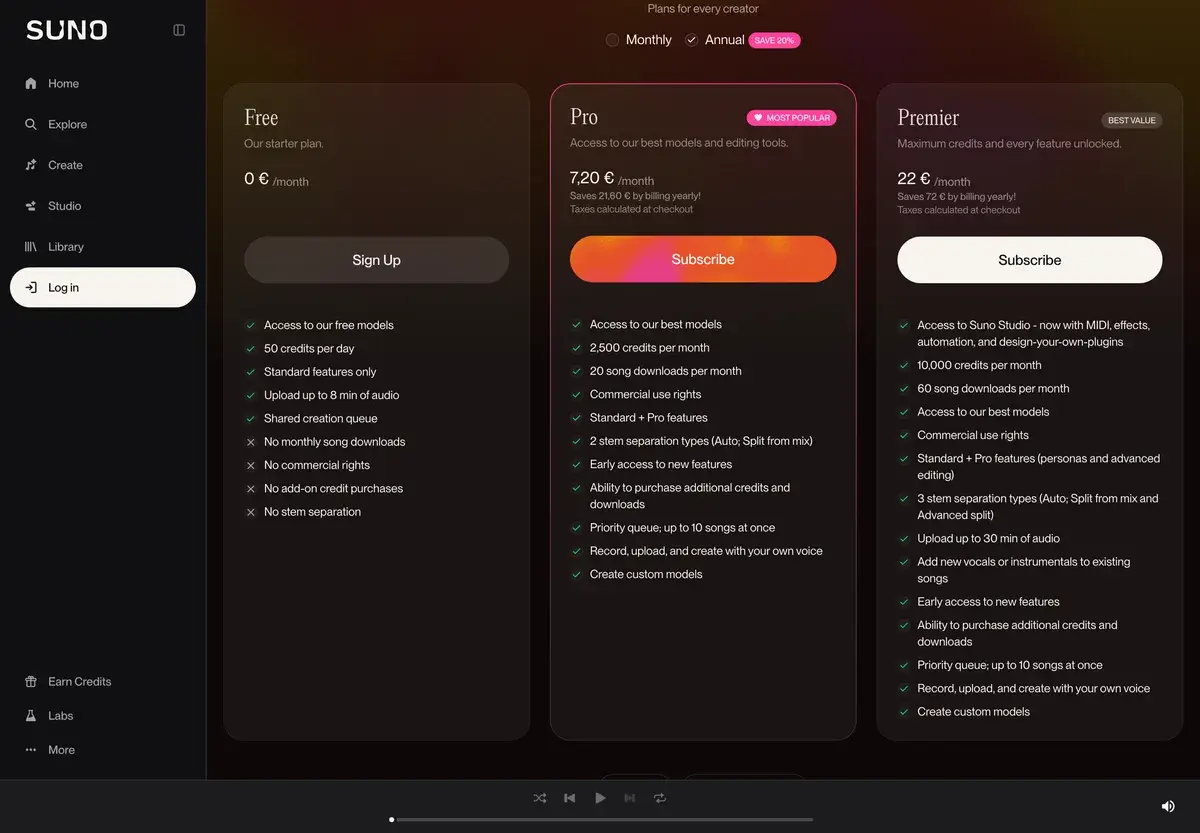
PlanPriceCreditsCommercial useStem separationBest for
Free$050/day❌ Personal onlyCasual experimentation
Pro$10/mo2,500/moContent creators, indie devs
Premier$30/mo10,000/moHeavy users, agencies, pros sketching

Prices verified April 2026 from suno.com/pricing.

The honest tier guide: the free tier (50 credits/day, ~10 short songs) is genuinely usable for casual exploration but cannot be used commercially. Pro at $10/month is the right tier for the vast majority of paying users — 2,500 credits gives you 200+ songs per month with commercial rights. Premier at $30/month adds stem separation (which matters if you want to remix in a DAW) and is the right tier for heavy users or anyone running music as a service. Annual billing offers ~17% off.

Hands-on Notes

The best way to describe Suno is that it makes music generation feel like sketching. Type a prompt, hit generate, hear something. If it is not right, change a word in the prompt and try again. The whole loop takes 30-60 seconds, and after a dozen attempts you usually have something you genuinely want to keep. There is a creative joy in this loop that does not show up in screenshots or marketing copy — you have to actually do it to feel why people get hooked.

The vocal quality is the thing. Older AI music tools sounded like karaoke MIDI with a robot singing on top. Suno's V4.5 model crossed the threshold where most casual listeners cannot tell the difference from a human-sung indie pop track. Inflection, emotional weight, vowel shaping — it is doing things that should not be possible from a text prompt and a few seconds of compute. There are still tells (sometimes a phrase repeats unnaturally, or a vocal shimmer hits in the wrong spot), but you have to listen for them.

Where Suno gets weaker: anything outside mainstream song structures. Jazz with extended solos, classical with complex counterpoint, prog rock with non-standard time signatures, full orchestral arrangement — these are still hard. The model is best at song structures it has been trained on heavily (verse-chorus pop, lo-fi loops, hip-hop with hooks), and it gets weirder as you push toward niche genres.

Auto-generated lyrics are the feature most users overestimate. They are grammatical, on-topic, and often catchy in a generic way — but they are also the thing that gives Suno songs the "AI tells" that make them feel slightly hollow. Writing your own lyrics and using Custom mode produces noticeably better songs. The performance gap between "good prompt + auto lyrics" and "good prompt + your own lyrics" is larger than most users realize.

The other quiet truth: Suno songs do not really compete with human-made music for music fans, but they compete fiercely with stock music libraries for utility use. Background tracks, intros, podcast bumpers, indie game soundtracks — these are the use cases where Suno output is not just "good enough" but often better than the stock alternative, because it is custom to your context.

Use Cases

YouTube intro music: A creator with a 200K-subscriber channel generates custom intro music in their preferred genre — something nobody else has. The track is theirs, fits their channel aesthetic, and avoids the overused stock tracks that signal "amateur YouTube." A few hours of prompting yields enough variations for a year of content.

Indie game soundtrack: A solo game developer working on an indie pixel-art game uses Suno's API for procedural music generation — different tracks for different levels, generated at runtime based on game state. This was prohibitively expensive a few years ago; Suno's API metering makes it feasible for a hobbyist budget.

Podcast intro and outro: A B2B podcast host generates a custom 15-second intro and 30-second outro, then refines until the brand sound feels right. The same audio identity carries across hundreds of episodes without per-episode licensing costs.

Marketing campaign jingle: A small e-commerce brand creates a custom 30-second jingle for paid social ads. Suno generates 50+ variations in an hour; the team picks the best three and runs A/B tests against each other in ad creative. Cost saved versus commissioning a composer: roughly the price of two Pro subscriptions.

Personal moments and viral content: A user makes a custom song for their parents' anniversary, complete with their parents' love story as lyrics. The song is sentimental, embarrassing, and absolutely beloved. Another user makes a song about their cat that gets 2M views on TikTok. Both use cases are why Suno is consumer-popular in a way that B2B tool reviews tend to underweight.

Our Verdict

Suno AI is the most accessible AI music generator in 2026, and the V4.5 model has crossed the line where the output is genuinely useful rather than just impressive-as-a-demo. For non-musicians who want music — and there are far more of these than the music industry typically counts — Suno is the easiest path from idea to track that has ever existed.

The honest weaknesses: auto-generated lyrics are mediocre and noticeably AI-flavored. Genres outside mainstream song structures (jazz, classical, prog) are weaker. Professional musicians use it as a sketchpad, not a finishing tool. And the model has tells that careful listeners will catch — slight unnatural phrasing, occasional vocal shimmer, repeated patterns that betray the architecture.

For content creators, indie devs, marketers, and casual users, Suno is straightforwardly recommended. The free tier is generous enough to evaluate properly, the Pro tier at $10/month is one of the best value-per-dollar AI subscriptions available in 2026, and the API opens use cases that were not possible before.

Note: Suno does not currently have a public affiliate program with AIVario. AIVario earns no commission from sign-ups. Our rating reflects regular use of the paid Pro tier across content and personal projects.

Best for: Content creators, indie game developers, marketers, podcasters, casual users making custom songs Not ideal for: Professional music production (use as sketchpad only), classical and jazz purists, anyone expecting Spotify-charting hits without effort Bottom line: Suno is the easiest way to go from an idea to a complete song in 2026, and the fact that the song is often genuinely good is what makes it more than a novelty.

Related Tools

  • ElevenLabs — voice synthesis for narration, paired with Suno for full audio production
  • Adobe Podcast — audio cleanup tool for refining Suno output before publishing
  • CapCut — video editor for syncing Suno-generated music with content
  • Descript — audio editing for podcasts that use Suno-generated intros and outros
  • Murf — alternative voice tool for narration when paired with Suno music

Frequently Asked Questions about Suno AI

Is Suno AI free?

Yes, Suno has a free tier with 50 daily credits, enough for about 10 short songs per day. Paid plans start at $10/month for 2,500 monthly credits with commercial use rights, and $30/month for the Premier plan with 10,000 credits. The free tier does not include commercial use — songs are for personal use only.

Can I use Suno songs commercially?

Yes, but only on paid plans (Pro at $10/month or Premier at $30/month). Both grant commercial rights to songs you generate, meaning you can use them in YouTube videos, podcasts, ads, games, and other monetized content. Free tier songs are personal-use only — no monetization, no client work.

Is Suno better than Udio?

Suno and Udio are the two leaders in AI music generation in 2026. Suno is generally considered stronger on vocals, mainstream pop genres, and ease of use. Udio produces more polished instrumentals and a more 'finished' sound. Most serious creators who care about music quality use both and pick the better take per song.

Does Suno write the lyrics for me?

Yes, Suno can generate lyrics from your prompt automatically, or you can provide your own lyrics in a custom mode. Auto-generated lyrics are usable for casual content but tend toward generic phrasing — most creators write their own lyrics for anything they care about and let Suno handle the music and vocal performance.

What genres does Suno handle well?

Suno is strongest at pop, lo-fi, electronic, hip-hop, indie folk, and rock — genres with established vocal-driven structures. It is weaker at genres that require complex instrumental arrangements (jazz, classical, prog rock, full orchestral). Metal and aggressive rock are inconsistent. For ambient and soundscape music, dedicated tools like AIVA or Stable Audio often produce better results.

Can Suno extend or remix existing songs?

Yes, Suno lets you extend any generated song with additional verses, choruses, or outros, and the Cover Songs feature lets you recreate a song in a different style or genre. You cannot upload existing copyrighted music to remix, only Suno-generated tracks or your own original audio.

Does Suno have an API?

Yes, Suno offers API access for developers building music into their applications. The API is used by indie game studios for procedural soundtracks, video editing platforms for background music, and creative tools that need on-demand music generation. Pricing is metered per generation, separate from the consumer subscription tiers.

Can professional musicians use Suno?

Some do, mostly as a sketching and ideation tool rather than a final-production tool. Suno is excellent for quickly testing song concepts, melody ideas, and arrangement directions before producing seriously in a DAW. For final masters, professional musicians still rely on traditional production. The honest answer: Suno is magic for non-musicians and a useful sketchpad for pros.