CapCut is ByteDance's video and photo editor for phones, desktop and the web, built around templates, auto captions and a growing set of AI tools. In 2026 CapCut restructured its paid plans: Pro now costs $19.99 a month or $179.99 a year in the US, with AI points raised from 550 to 1,200 and cloud storage from 100 GB to 1 TB, and a new Standard plan sits below it for people who want premium templates and editing tools without the full AI allowance. Teams start at $24.99 a month. The core editor remains free to use.
✓Best for: Creators editing short vertical videos for TikTok, Reels and Shorts who want templates, captions and effects in one free editor
✗Skip if: You edit long-form or client work and need predictable pricing, full ownership terms and professional color and audio tools
This analysis is based on documentation, public user reports, and vendor materials — not yet on our own hands-on testing. How we rate
CapCut homepage, captured Sep 28, 2026.
ByteDance's editor for phone, desktop and browser
CapCut is the editor most short-form video passes through. ByteDance, the company behind TikTok, launched it in China as JianYing in 2019 before rolling it out worldwide, and it now runs as a phone app, CapCut Desktop for Windows and Mac, CapCut Online in the browser and a tablet version. The homepage pitch is broad: an AI-powered photo and video editor for everyone, with everything needed to make trending content for YouTube, Instagram and beyond.
The editing core is a multi-track timeline with keyframes, chroma key, color adjustment and a large template library. Around it sit AI tools: auto captions and caption templates, text to speech and custom voices, background removal for video and images, quality enhancement, and generation of images and video through ByteDance's own models and others, including Seedance and Seedream.
Plans after the 2026 restructure
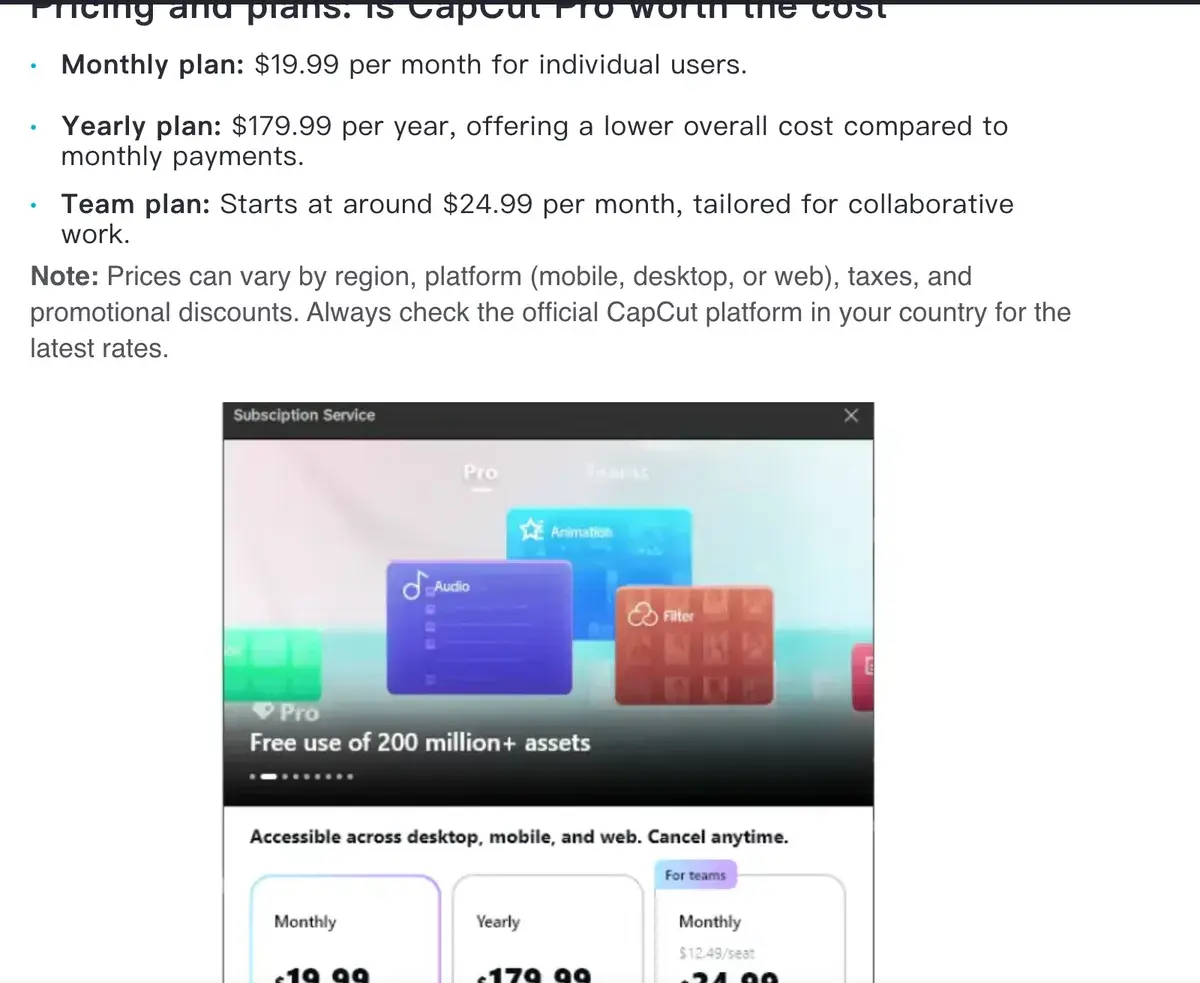
CapCut's own pricing guide on September 28, 2026. The subscription window itself opens only after you sign in.
CapCut has no public pricing page; plans appear in the app after you sign in. Its help center and its Standard versus Pro guide describe the structure:
Plan
US price
What it adds
Free
$0
The editor, templates, basic effects and transitions, no cloud storage
Standard
Shown in the app; reported at about $9.99 a month
Wide template and materials library, advanced editing tools, around 100 GB of cloud storage
Pro
$19.99 a month or $179.99 a year
1,200 AI points a month, 1 TB of cloud storage, full premium assets and AI tools
Teams
From about $24.99 a month ($12.49 per seat)
Team templates, brand libraries and review tools
CapCut notes that prices vary by region, platform, taxes and promotions; the figure on its subscription page after sign-in is the one that applies.
Billed yearly, Pro works out to $15 a month. The change behind the jump is that the old Pro, at roughly $10 a month, no longer exists: CapCut split it into a Standard plan that keeps the editing extras and a new Pro that carries far more AI capacity and storage.
What the AI points pay for
The split between Standard and Pro comes down to AI. Everyday editing, trimming, captions and transitions, does not touch points. Generative features do: creating video or images from prompts, AI voices and the heavier enhancement tools draw from the monthly pool, which is 1,200 points on Pro, up from 550 on the old Pro.
That makes the choice fairly simple. If you edit footage you filmed and mostly want premium templates, effects and more storage, Standard is the cheaper fit. If you generate B-roll, voices or images inside CapCut every week, Pro's allowance is what you are paying for.
The trade-off: speed and templates against opaque pricing
CapCut earns its place through speed. Templates, trending effects, beat sync and one-tap captions turn phone footage into a finished vertical video faster than a traditional editor, and even after the paywall moved, the free editor remains one of the most capable ways to edit on a phone at no cost. Because the same account and projects work on phone, desktop and web, creators can shoot on mobile and finish on a laptop without exporting anything.
The costs are less visible. There is no public price list, prices differ by platform and region, and the 2026 restructure roughly doubled the price of the top plan. A June 2025 update to CapCut's terms of service drew criticism for the broad license it takes over content users upload, so anyone editing client or brand work should read the current terms first. Color grading, audio mixing and long timelines stay basic next to dedicated editors, and heavier AI use depends on the monthly points pool.
If CapCut is not the right fit
Teams that need subtitles, translation and brand kits with clear per-seat prices tend to prefer VEED in the browser. When a video is mostly people talking, Descript is quicker, because you edit the transcript rather than the timeline. Captions and Submagic automate the finishing work, captions, zooms and B-roll, for talking-head shorts, and OpusClip is built for cutting clips out of long recordings.
Free, Standard or Pro: which to pick
Start on the free editor and stay there until a specific Pro asset or AI tool becomes part of your weekly routine. Standard suits regular creators who want the premium templates and materials without paying for AI capacity. Pro billed yearly, at $179.99, makes sense for creators and small brands who generate footage, voices or images inside CapCut every week and need the 1 TB of storage, while social teams producing for one brand should price Teams against VEED's team plans.
Related Tools
VEED: browser editor with subtitles, translation and brand kits
Descript: edit video and podcasts by editing the transcript
CapCut rebuilt its membership in 2026. According to its help center, the old Pro plan was upgraded with more professional and marketing features, AI points rose from 550 to 1,200 and cloud storage from 100 GB to 1 TB, and the previous price is no longer offered to new subscribers. CapCut's own guide lists the new Pro at $19.99 a month or $179.99 a year in the US.
What is the CapCut Standard plan?
A cheaper subscription introduced alongside the upgraded Pro. CapCut describes it as a plan for editing enthusiasts, with a wide selection of templates and materials, a complete set of advanced editing tools and around 100 GB of cloud storage, but without Pro's full AI allowance and team features. CapCut shows its exact price on the subscription page after you sign in; US trackers report about $9.99 a month.
Can you still edit in CapCut without paying?
Yes. The editor, templates, basic effects and transitions and the multi-track timeline work without a subscription, on mobile, desktop and the web, and CapCut's homepage stresses that no credit card is needed. What sits behind a paywall is Pro-marked assets, most AI tools and cloud storage, since CapCut discontinued its free 1 GB of cloud storage in August 2024.
How much does CapCut Teams cost?
CapCut's guide puts Teams at around $24.99 a month, and its checkout shows that as $12.49 per seat. Teams adds collaboration features such as shared team templates, brand libraries and review tools on top of Pro-level editing, which suits a social media team producing videos for one brand.
Is CapCut available in the United States?
Yes. CapCut went offline in the US for about two days in January 2025, along with TikTok, before being restored. The TikTok US joint venture that closed on January 22, 2026 also covers CapCut, and the app remains available in the App Store, Google Play and on the web.
Does one CapCut subscription work on desktop, web and mobile?
Yes. CapCut's checkout says Pro is accessible across desktop, mobile and web, so projects and assets follow you between the phone app, CapCut Desktop and CapCut Online. Prices can differ by platform, though, because App Store and Google Play billing, taxes and promotions change the final amount.
Should I use CapCut or Descript?
CapCut if you make short vertical videos from footage and want templates, trending effects and fast captions. Descript if your videos are talk-driven, such as podcasts, interviews and tutorials, because it edits video by editing the transcript and removes filler words and retakes automatically.