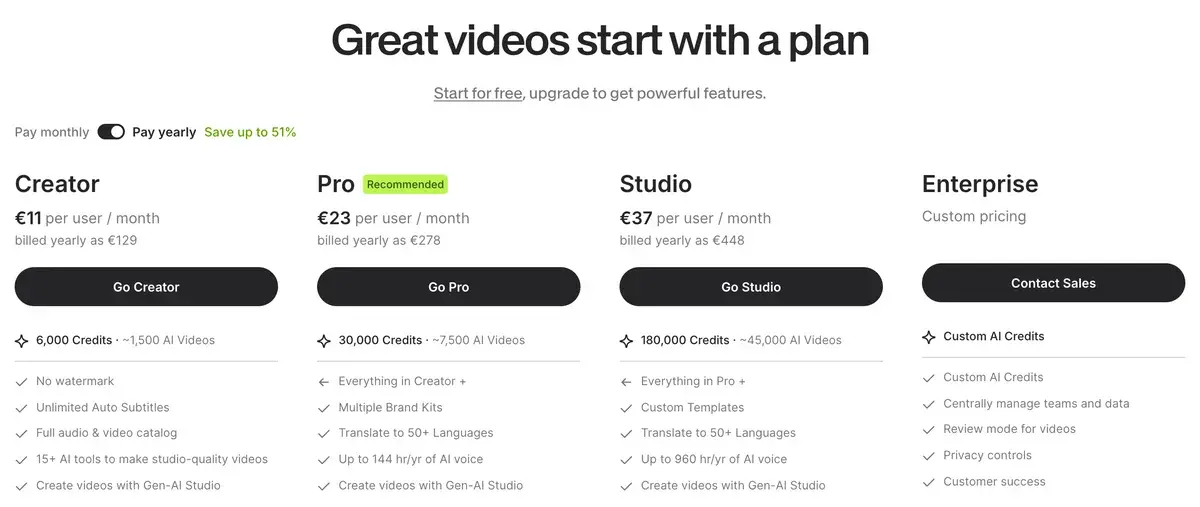
VEED is a browser-based video editor for social content: AI video generation with avatars, auto subtitles, translation, brand kits and cleanup tools such as eye-contact correction, with nothing to install. In the euro prices we were shown, Creator costs 11 per user a month billed yearly (22 monthly) for 6,000 AI credits a year, Pro 23 (47) for 30,000 and Studio 37 (76) for 180,000; US reviews report $12, $22 and $39 on yearly billing. Every added editor is another seat.
✓Best for: Marketers and creators who publish subtitled, branded social videos from a browser, alone or in small teams
✗Skip if: You edit long-form video on a timeline, or you need many editors on a tight budget, since every seat is billed
This analysis is based on documentation, public user reports, and vendor materials — not yet on our own hands-on testing. How we rate
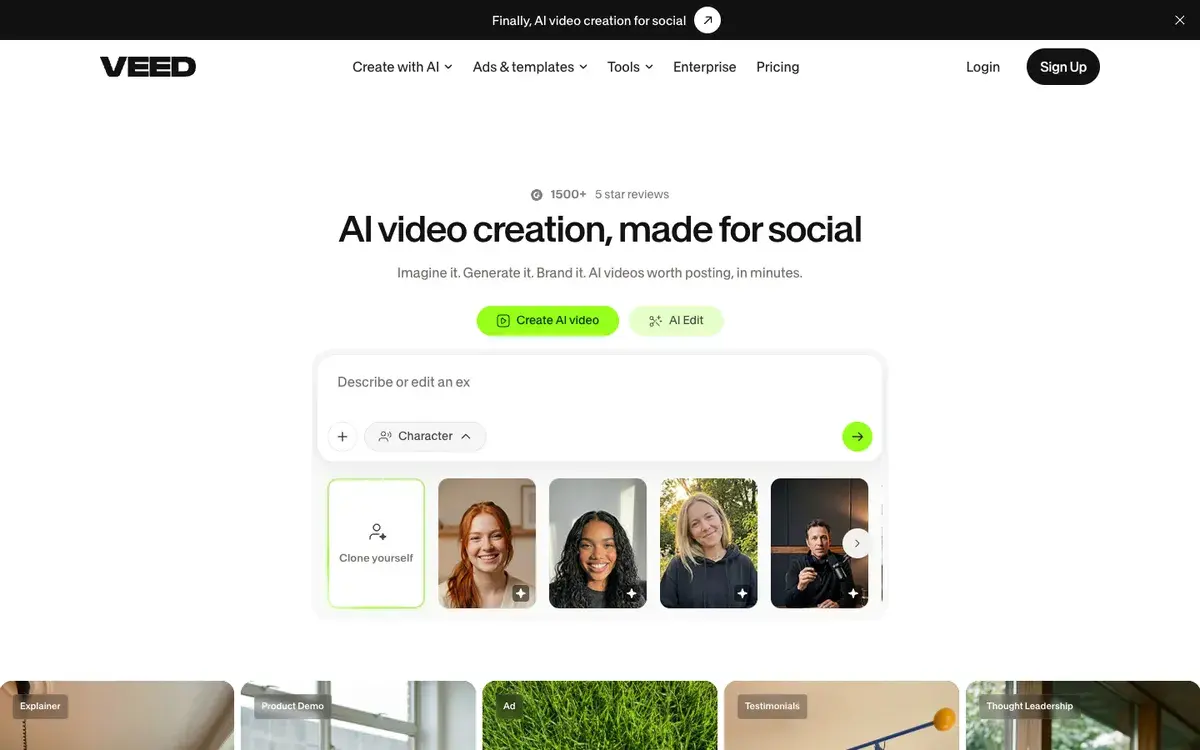
VEED.IO homepage, captured Sep 26, 2026.
A subtitle editor that grew an AI layer
VEED started as a simple browser video editor and built its reputation on subtitles: automatic captions that were accurate, easy to style and fast to burn in, at a time when most tools treated them as an afterthought. That is still the core. Around it, VEED has added the AI layer most editors now carry, and its homepage leads with generation: AI video creation, made for social.
In practice VEED does four jobs:
Generate: text to video with AI characters and avatars, including cloning yourself, plus AI images, image to video, a script generator and ready-made formats for explainers, product demos, ads and testimonials.
Subtitle and translate: auto subtitles in styled templates, translation into more than 50 languages, dubbing and text to speech.
Brand: brand kits with your colors, fonts, logos and watermark, applied across projects.
Clean up: eye-contact correction, background noise removal, background removal, a teleprompter and a screen recorder, all in the browser.
There is also a developer side. VEED sells APIs for Fabric 1.0, its own model that turns an image and an audio track into talking video, and for lip sync, subtitles, background removal and green screen.
Pricing: what we were shown, and what US buyers report
VEED's plans on yearly billing, as shown to us in euros on September 26, 2026. VEED sets prices by market.
Plan
Yearly (per user, per month)
Monthly (per user)
AI credits
Highlights
Free
0
0
50
Watermark on exports
Creator
11 (129 a year)
22
6,000 a year or 500 a month
No watermark, unlimited subtitles, stock library, 15+ AI tools
Pro
23 (278 a year)
47
30,000 a year or 2,500 a month
Multiple brand kits, translation to 50+ languages, up to 144 hours a year of AI voice
Studio
37 (448 a year)
76
180,000 a year or 15,000 a month
Custom templates, up to 960 hours a year of AI voice
Enterprise
Custom
Custom
Custom
Central team management, review mode, privacy controls
Euros. US reviews report $12, $22 and $39 per user a month on yearly billing.
VEED's pricing API, which its pricing page loads, confirms the market logic: it returned a euro bundle for our location, with each plan offered in several credit sizes. The plan you see depends on where you are.
Three things the pricing table hides
The first is how steep the monthly price is. Yearly billing saves up to 51%, so monthly Creator costs twice the yearly rate. If you know you will use VEED for a year, monthly billing is simply the expensive option.
The second is how credits arrive: on yearly billing the whole year's allowance lands at once: 6,000 credits on Creator, 30,000 on Pro. That is flexible, because a heavy launch month can draw on the full pot, but it also means a busy first quarter can leave you without credits for the rest of the year. Monthly subscribers get a twelfth each month. Either way, unused credits disappear when the allowance refreshes.
The third is seats, because VEED bills every user you invite. A solo creator pays one price; a four-person marketing team on Pro yearly pays four times 278, or about 1,112 euros a year, before any credit upgrades. Tools that price by workspace rather than by editor get cheaper as teams grow; VEED does not.
Subtitles, branding and cleanup, with credits and seats to watch
Subtitles remain the best reason to choose VEED. Styled, accurate captions are unlimited on paid plans within a fair-use limit of 50 hours a month, with translation, dubbing and text to speech in the same editor. The browser workflow suits marketing teams, since there is nothing to install, projects are shareable and brand kits keep every video in a workspace consistent, and eye-contact correction and noise removal rescue the laptop recordings that make up much of what marketers and founders publish on LinkedIn and YouTube.
Long-form editing is where it strains. A 40-minute interview can be cut on the multi-track timeline, but Descript, which edits video through its transcript, or a desktop editor handles it better. AI generation draws on credits whose per-generation cost the pricing page does not publish, so VEED's estimate of about 1,500 AI videos from Creator's 6,000 credits depends on what you make, and per-seat billing plus prices that differ by market make larger teams expensive and comparisons with US-priced tools harder.
VEED against CapCut, Descript and Opus Clip
CapCut is the stronger editor for solo short-form creators and has a generous free tier, with Pro at $19.99 a month or $179.99 a year. VEED's yearly Creator plan costs less than that, and VEED is better at shared brand kits, translation and team workspaces.
Descript is the better choice when the raw material is talk: podcasts, interviews and webinars that you want to cut by editing text.
Opus Clip does one job VEED only partly covers, turning long videos into short clips automatically; the two are compared in detail in Opus Clip vs VEED. For avatar-led business video, HeyGen goes further than VEED's avatars.
Creator for one person, Pro for translation
Marketers, founders and small content teams who publish subtitled, branded social video from a browser, and value speed over timeline control, are VEED's audience. Creator on yearly billing is enough for one person posting regularly, and Pro becomes worthwhile once you need translation or several brand kits. Long-form editors, large teams paying per seat and people whose main activity is AI generation will get further per dollar with a timeline editor or a credit-based generator such as Kling or Runway.
Related Tools
CapCut: the free default for short-form editing, with Pro at $19.99 a month
What do VEED's Creator, Pro and Studio plans cost?
In the euro prices VEED showed us, Creator costs 11 per user a month billed yearly (129 a year) or 22 monthly, Pro 23 yearly (278) or 47 monthly, and Studio 37 yearly (448) or 76 monthly; Enterprise is custom. US reviews list $12, $22 and $39 per user a month on yearly billing. Yearly billing saves up to 51%, so monthly plans cost about twice as much.
How do VEED's AI credits work?
Every plan includes AI credits for generations such as AI video, avatars and voice. On yearly billing they arrive as one annual allowance: 6,000 on Creator, 30,000 on Pro and 180,000 on Studio. On monthly billing you get a twelfth of that each month: 500, 2,500 or 15,000. Unused credits do not carry over when the allowance refreshes.
Does the free VEED plan add a watermark?
Yes. Videos made on the free plan carry a VEED watermark in the corner, and the free plan includes only 50 AI credits. Removing the watermark requires Creator or above. VEED's FAQ also describes a seven-day trial of paid plans with a card required, and a trial for enterprise teams of at least three users.
Are VEED subtitles really unlimited?
On paid plans, auto subtitles are unlimited within a fair-use limit of 50 hours a month, and the available caption styles grow with the plan. Translation is different: it is counted in minutes against a monthly or yearly allowance, depending on how you bill, and unused minutes do not roll over.
Can I buy more VEED credits?
Yes, through higher credit tiers of the same plan. VEED sells each plan in several credit sizes: Creator on yearly billing, for example, goes from 6,000 credits for 129 to 18,000 for 237 and up to 126,000 for 1,209, in euros. Moving to a bigger plan is the other route, and it also unlocks more AI voice hours.
Is VEED better than CapCut?
For teams publishing branded, subtitled marketing video from a browser, often yes: brand kits, translation, review tools and per-seat workspaces are built for that. For a solo creator making TikToks, CapCut is cheaper and more capable as an editor, with Pro at $19.99 a month or $179.99 a year, though VEED's yearly Creator plan costs less.
Does VEED have an API?
Yes. VEED offers APIs for its Fabric 1.0 model, which turns an image and audio into talking video, plus lip sync, subtitles, background removal and green screen, with a live avatar API on a waitlist. Fabric 1.0 is also available on other platforms; Hedra's API lists it from about 10.7 cents a second.