HeyGen is an AI avatar video platform: type a script and a stock or custom avatar presents it, in 175+ languages, with lip-synced translation and a Video Agent that builds whole videos from a prompt. Creator costs $29 a month ($24 billed yearly) for 600 credits, Pro starts at $49 for 1,000 and Business at $149 plus $20 a seat. Credits buy about 37 minutes of Avatar IV from a photo or 12 minutes of the newest Avatar V on Creator, and unused credits roll over.
✓Best for: Businesses and creators who publish presenter-led videos, training and translations at volume without filming
✗Skip if: You want to animate stylized characters or mascots, or you need cinematic generation rather than talking presenters
This analysis is based on documentation, public user reports, and vendor materials — not yet on our own hands-on testing. How we rate
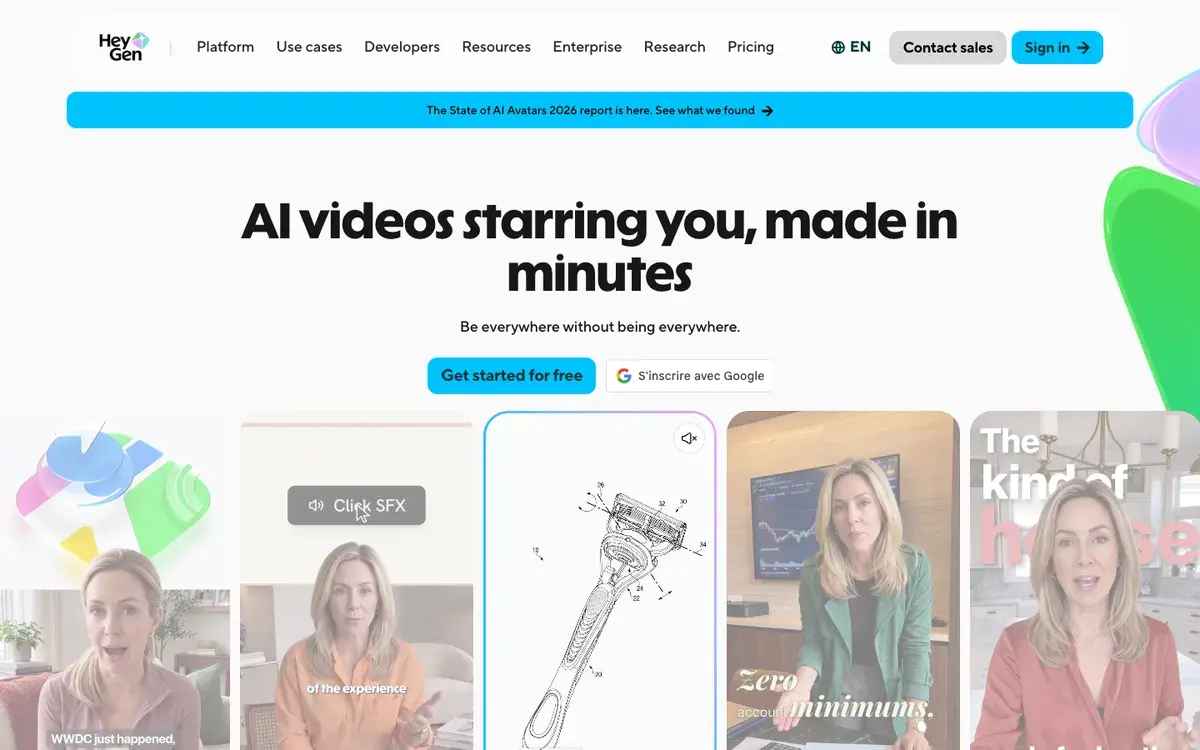
HeyGen homepage, captured Sep 26, 2026.
What HeyGen is in 2026
HeyGen is the best-known name in AI presenter video: you write a script, pick an avatar, and a realistic person delivers it, in any of more than 175 languages and dialects. The avatar can be one of 700+ stock presenters on paid plans, a photo avatar made from a single picture, or a custom video avatar trained on footage of you. HeyGen says more than 100,000 businesses use it, and G2 named it its fastest-growing product of 2025.
Around the avatars, HeyGen has built a full production tool. There is an AI studio editor with templates, PowerPoint and PDF imports, a screen recorder, brand kits and team collaboration; video translation that re-voices and lip-syncs existing footage; a Video Agent that builds a complete video from a prompt; and generation of images and B-roll with outside models such as Seedance and Veo. Integrations with HubSpot, Clay, Zapier, Make and n8n let companies generate personalized videos automatically.
In 2026 HeyGen moved its plans to a single credit balance. Older subscribers on the previous unlimited plans can keep them, but anyone who cancels or switches cannot go back.
What each feature costs in credits
HeyGen publishes its credit rates in its help center. Because everything draws on one balance, the model you pick decides how far a plan goes.
Feature
Credits
Minutes from Creator's 600
Cost per minute on Creator, yearly
Avatar III, video look
4 a minute
150
$0.16
Avatar III, photo look
7 a minute
85
$0.28
Avatar IV, photo look
16 a minute
37
$0.64
Avatar IV, video look
31 a minute
19
$1.24
Avatar V, photo or video look
48 a minute
12
$1.92
Custom expressive motion (Avatar IV)
+40 a minute
+$1.60
Translation with lip sync, Speed / Precision
6 / 10 a minute
100 / 60
$0.24 / $0.40
Translation without lip sync
4 a minute
150
$0.16
Video Agent, Standard / Seedance mode
40 / 120 a minute
15 / 5
$1.60 / $4.80
Rates from HeyGen's help center, September 2026. Cost per minute uses Creator billed yearly: $24 for 600 credits, or 4 cents a credit.
Other items are priced per generation: 1 credit per generated avatar look, 60 credits to train a custom look model, 2 credits per image, 60 or 150 credits for a Seedance 2 clip at 720p or 1080p, and 90 credits for a Veo 3 clip, regardless of length.
The spread is the thing to plan around. The same 600 credits make two and a half hours of Avatar III or twelve minutes of Avatar V. For internal training and explainers, Avatar III and Avatar IV photo looks stretch a plan furthest; save Avatar V and expressive motion for the videos customers will watch closely.
HeyGen plans by credits
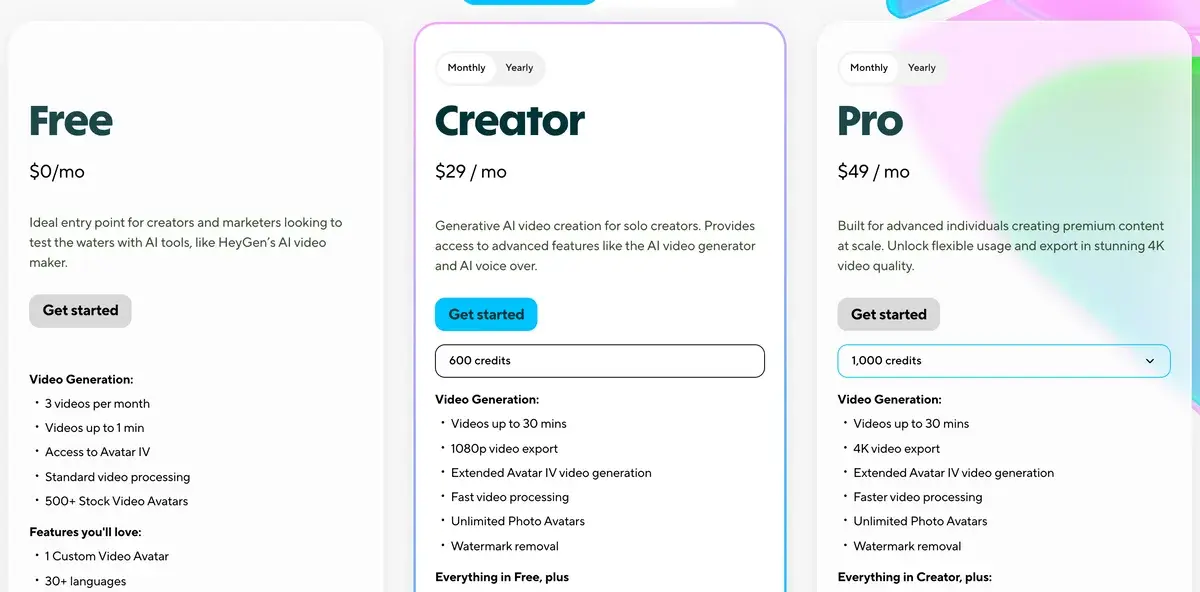
HeyGen's individual plans on monthly billing, screenshot taken September 26, 2026.
Plan
Price
Credits
What it adds
Free
$0
3 videos a month, up to 1 minute each
500+ stock avatars, 1 custom video avatar, 30+ languages, trial access to premium features
Creator
$29 a month, $24 billed yearly
600 a month
Videos up to 30 minutes, 1080p, watermark removal, voice cloning, unlimited photo avatars, 175+ languages
Pro
From $49 a month
1,000 to 100,000 a month
4K export, faster processing, translation script editing, all advanced models
Business
$149 a month plus $20 a seat
1,500 a month
Collaboration, brand kit, SSO and access controls, credit packs and auto-reload
Enterprise
Custom
Custom
Custom volumes and security
Pro's tiers go all the way to 100,000 credits for $4,300 a month. The price per credit barely moves across plans: about 4.8 cents on Creator billed monthly, 4.9 on Pro's first tier and 4.3 at the top Pro tier. The real saving is yearly billing on Creator, which brings a credit down to 4 cents.
Rollover and top-ups
HeyGen is more forgiving than most credit-based tools here. Monthly subscribers' unused credits roll over for one more month, and yearly subscribers' credits accumulate until the annual renewal, so a quiet month is not money lost.
Buying more is more restrictive. Creator has no top-ups at all; if you run out, you upgrade to Pro. Pro has no packs either, only higher tiers. Only Business can buy one-time credits, at $5 per 100, or switch on auto-reload. Cancelling keeps your plan and credits until the end of the billing cycle, after which the account drops to the free plan and unused credits expire.
Realistic presenters and translation, with credits to plan around
HeyGen's core strength is realistic human presenters, and Avatar IV and V push them further with more natural motion and expression. Translation is the other draw: re-voicing and lip-syncing an existing video into dozens of languages for 6 to 10 credits a minute is inexpensive localization for training, sales and support content. For businesses, collaborative workspaces, SSO, SCORM export, interactive quizzes and branching for learning teams, and integrations that build personalized videos from CRM data are mature.
The credit system is where plans go wrong. Avatar V and expressive motion drain a Creator plan in minutes, Creator users cannot top up, and Pro's first tier adds only 400 credits over Creator for $20 more a month. The generous-looking minutes are counted on Avatar III, HeyGen's oldest model, rather than the ones that show it at its best. And HeyGen is built for people: to make a cartoon mascot, an animal or an illustrated host speak, Hedra is designed for exactly that.
HeyGen against Synthesia, Hedra and D-ID
Synthesia is the closest rival, with a similar focus on corporate training and localization; the choice usually comes down to which avatars and workflow a team prefers after trialing both.
Hedra animates any character image with its own Character 3 model, from 2.5 cents a second, and even resells HeyGen's Photo Avatar 4 at 10 cents a second, or $6 a minute, which makes HeyGen's own plans the far cheaper way to use HeyGen's models.
D-ID and Vidnoz cover similar photo-to-presenter ground. For editing and subtitling footage you filmed yourself, VEED is the better tool.
Creator for one person, Business for teams
Marketing, sales, HR and learning teams that need presenter-led video in many languages without filming get the most from HeyGen, along with creators who want a digital double for regular content. For one person, Creator billed yearly is the sensible start; Business makes sense once several people share the work or you need credit packs. Plan by model before subscribing: an explainer channel built on Avatar IV photo looks gets more than half an hour a month from Creator, while one built on Avatar V gets twelve minutes.
What do HeyGen's Creator, Pro and Business plans cost?
Creator costs $29 a month, or $24 a month billed yearly, for 600 credits. Pro starts at $49 a month for 1,000 credits and scales in tiers up to 100,000 credits for $4,300 a month, with 4K export and every advanced model. Business costs $149 a month plus $20 per seat for 1,500 credits, with collaboration and security features. There is also a free plan.
How many minutes of video do 600 HeyGen credits make?
It depends on the avatar model and look. At HeyGen's published rates, 600 credits make about 150 minutes with an Avatar III video look, 37 minutes with an Avatar IV photo look, 19 minutes with an Avatar IV video look or 12 minutes with Avatar V. Lip-synced translation in Speed mode would cover 100 minutes.
Do HeyGen credits roll over?
Yes, within limits. On monthly plans, unused credits roll over for one more month. On yearly plans, credits accumulate until the annual renewal date. If you cancel, you keep your credits until the end of the billing cycle; after that the account moves to the free plan and unused credits expire.
What can you make on HeyGen's free plan?
Up to three videos a month, each up to one minute, with standard processing, 500+ stock avatars, one custom video avatar and 30+ languages. It includes limited trial access to Avatar IV, the Video Agent and lip-synced translation. It is enough to test the quality of a custom avatar, not to publish regularly.
How much does HeyGen video translation cost?
Lip-synced translation costs 6 credits a minute in Speed mode and 10 in Precision mode, and translation without lip sync costs 4. On Creator billed yearly, where a credit works out to 4 cents, Precision translation costs about 40 cents a minute. Paid plans cover 175+ languages and dialects; Pro adds editing and proofreading of the translated script.
Can I buy extra HeyGen credits?
Only on Business, where extra credits cost $5 per 100 and auto-reload is available. Creator cannot buy one-time credits, so running out means upgrading to Pro. Pro does not sell packs either; you move to a higher Pro tier with more monthly credits, and upgrades take effect immediately with prorated billing.
Is HeyGen cheaper direct or through other platforms?
Direct, by a wide margin. On HeyGen's Creator plan billed yearly, an Avatar IV photo-look video costs about 64 cents a minute. Hedra's API, which resells HeyGen's Photo Avatar 4 model, charges 10 cents a second, or $6 a minute. Resellers make sense only if you need the model inside another pipeline.