D-ID

D-ID

★ Top rated
AI Avatar Video

Budget AI avatar video tool — most affordable entry into the category, weaker on enterprise features than Synthesia or HeyGen.

Free · $4.70/mo
📖 14 min read
Try D-ID for free

Affiliate link — we may earn a commission

Ready to try it?
D-ID
Free · $4.70/mo
Get started →
Affiliate link — we may earn a commission
Our rating
4.4/ 5
AIVario Editor's rating →

What is D-ID?

D-ID is the most affordable entry point into AI avatar video among major providers in 2026. The Lite tier starts at $4.70/month — a fraction of Synthesia's $29 entry tier or HeyGen's $24 entry tier — and the price differential matters for budget-conscious businesses, educators, solo creators, and high-volume personalization use cases where per-video cost economics dominate.

The competitive trade-off behind this pricing is real and worth being honest about. D-ID's avatars are functional but noticeably less polished than Synthesia's enterprise-grade avatars or HeyGen's higher-tier creator avatars. The video quality clears the practical bar for typical business use cases (training videos, internal communications, marketing explainers, personalized outreach), but does not match the production polish of premium alternatives. For users prioritizing peak avatar quality, Synthesia or HeyGen serve better at their higher pricing. For users prioritizing affordable access to AI avatar video for cost-conscious use cases, D-ID's pricing makes the category accessible in ways the alternatives do not.

This positioning shapes the buying decision clearly. D-ID is not trying to compete with Synthesia for enterprise corporate training contracts or with HeyGen for creator-economy content production. It is trying to make AI avatar video accessible at the small-business and budget-creator tier, plus serve high-volume personalization use cases where per-video economics dominate. For these audiences, D-ID is genuinely useful; for premium use cases, alternatives serve better.

The budget-tier value proposition

The AI avatar video category has stratified through 2024-2025 with clearer competitive positioning across providers. Synthesia anchors the enterprise corporate tier with strong polish, broad language support, and compliance features. HeyGen anchors the creator-economy tier with more lifelike avatars and aggressive consumer-creator features. D-ID anchors the budget tier with the most affordable entry pricing and high-volume personalization capabilities through its Streaming API.

For users matched to the budget tier, D-ID's value is genuine. Small businesses producing occasional training videos or marketing content find Synthesia's $29/month tier expensive relative to actual use; D-ID's $4.70/month tier matches the actual cost-per-video math for low-frequency users. Educators producing course content for individual instructors who teach at small institutions benefit from the affordable pricing. Solo creators experimenting with AI avatar content can adopt D-ID without the budget commitment that Synthesia or HeyGen require.

The high-volume personalization use case is where D-ID has its strongest differentiation against premium alternatives. Producing hundreds or thousands of personalized videos — one per prospect for sales outreach, one per customer for customer success programs, one per recipient for marketing campaigns — requires per-video economics that scale. D-ID's Streaming API and batch generation handle this volume; Synthesia's per-minute pricing model makes the same volume cost-prohibitive.

The trade-off is quality polish at the upper end. For brand-conscious customer-facing video where the avatar represents the company publicly, D-ID's quality is meaningful weaker than Synthesia or HeyGen at their higher tiers. For internal use, personalized outreach, or volume use cases, the quality is sufficient. Match the use case to the right tier; mismatching produces buyer's remorse regardless of which tool is chosen.

Who is it for?

Small businesses producing occasional video content (training, marketing, internal communications) where premium quality is unnecessary and budget matters. The Lite tier at $4.70/month covers genuine use cases at sustainable cost.

Educators and trainers building course content where the AI presenter is a functional element rather than the visual centerpiece. The integration with PowerPoint and Google Slides supports the slide-based course delivery format that many educators use.

Sales teams running personalized video outreach at scale. The Streaming API and batch generation support per-prospect personalization economics that premium tools cannot match. For SDR teams sending hundreds of personalized videos monthly, D-ID is often the only economically feasible option.

Customer success teams sending personalized check-in videos, milestone congratulations, or onboarding content. The volume use case fits D-ID's economics; the quality is sufficient for internal-feeling customer communications.

Marketing teams producing personalized campaign videos, retargeting content, or audience-segmented video advertising. The per-recipient personalization at scale is the use case D-ID supports best.

Solo creators and hobbyists experimenting with AI avatar video for personal projects, social content, or YouTube content. The affordable entry pricing makes experimentation feasible without budget commitment.

Developers building products with embedded AI avatar capabilities through D-ID's API. The pricing and API design support developer use cases that consumer-positioned alternatives handle less directly.

D-ID is not the right pick for: brand-conscious customer-facing video where production polish matters (Synthesia or HeyGen serve better), enterprise corporate training programs requiring compliance features and broad language support (Synthesia is purpose-built for this), creator-economy content production where avatar realism is creative priority (HeyGen often serves better), or organizations requiring formal commercial indemnification (consider Synthesia Enterprise tier).

Key Features

  • Photo to talking video — generate talking avatar videos from uploaded photos with appropriate consent
  • AI voices — 100+ voices in 40+ languages with voice cloning option
  • Voice cloning — clone your own voice or licensed voices for branded narration
  • Streaming API — real-time interactive AI avatars for embedded product use cases
  • Creative Reality Studio — web-based video creation interface for non-technical users
  • PowerPoint and Google Slides integration — embed talking avatars directly in presentations
  • Canva integration — incorporate AI avatar video into Canva designs
  • Custom avatars — create consistent branded digital twins for ongoing use
  • Batch generation — produce hundreds or thousands of personalized videos at scale
  • Multi-language support — script-to-speech across 40+ languages
  • Mobile responsive — full functionality across desktop and mobile devices
  • API access — programmatic generation for embedded use cases and custom workflows
  • Stock avatar library — pre-built avatars for users without their own photos

D-ID vs Competitors 2026

ToolPrice entryQuality polishPersonalization volumeFree tierAPI
D-ID✅ $4.70 (cheapest)⚠️ Mid✅ Best (Streaming API)✅ Trial✅ Strong
Synthesia$29✅ Strong⚠️ Mid✅ 3 min/mo✅ Enterprise
HeyGen$24✅ Strong⚠️ Mid✅ Limited✅ Strong
Hour One$25✅ Strong⚠️ Mid⚠️ Trial✅ Strong
DeepBrain AI$24✅ Strong⚠️ Mid✅ Limited✅ Decent
Colossyan$35✅ Strong⚠️ Mid✅ Limited✅ Decent
Vidnoz$14.99⚠️ Mid⚠️ Mid✅ Limited⚠️ Limited
Yepic AI$20⚠️ Mid✅ Strong (real-time)⚠️ Trial✅ Decent

Data verified April 2026 from each provider's pricing pages.

The clearest competitive picture: against Synthesia and HeyGen, D-ID trades quality polish for substantially lower entry pricing. For users where the quality difference matters more than the price difference, the premium tools win; for users where price economics dominate, D-ID wins. The trade-off is real and matches each tool's positioning honestly.

For high-volume personalization use cases specifically, D-ID's Streaming API and batch capabilities are genuine differentiators. Synthesia's per-minute pricing model makes the same volume use cases cost-prohibitive; HeyGen has API access but with similar per-minute economics. Yepic AI is the closest direct competitor on real-time and personalization volume; the choice often comes down to specific feature priorities and pricing negotiation rather than fundamental capability gaps.

Vidnoz at $14.99/month is the closest budget-tier competitor with comparable pricing. For users specifically prioritizing budget, evaluating both is reasonable; D-ID has more mature API and integration ecosystem; Vidnoz is sometimes slightly cheaper at equivalent feature levels.

For developers building products with embedded AI avatar capabilities, D-ID's API maturity and pricing make it a frequent choice. The streaming API for real-time interactive avatars is one of the more capable offerings in the category for embedded product use.

Pricing 2026

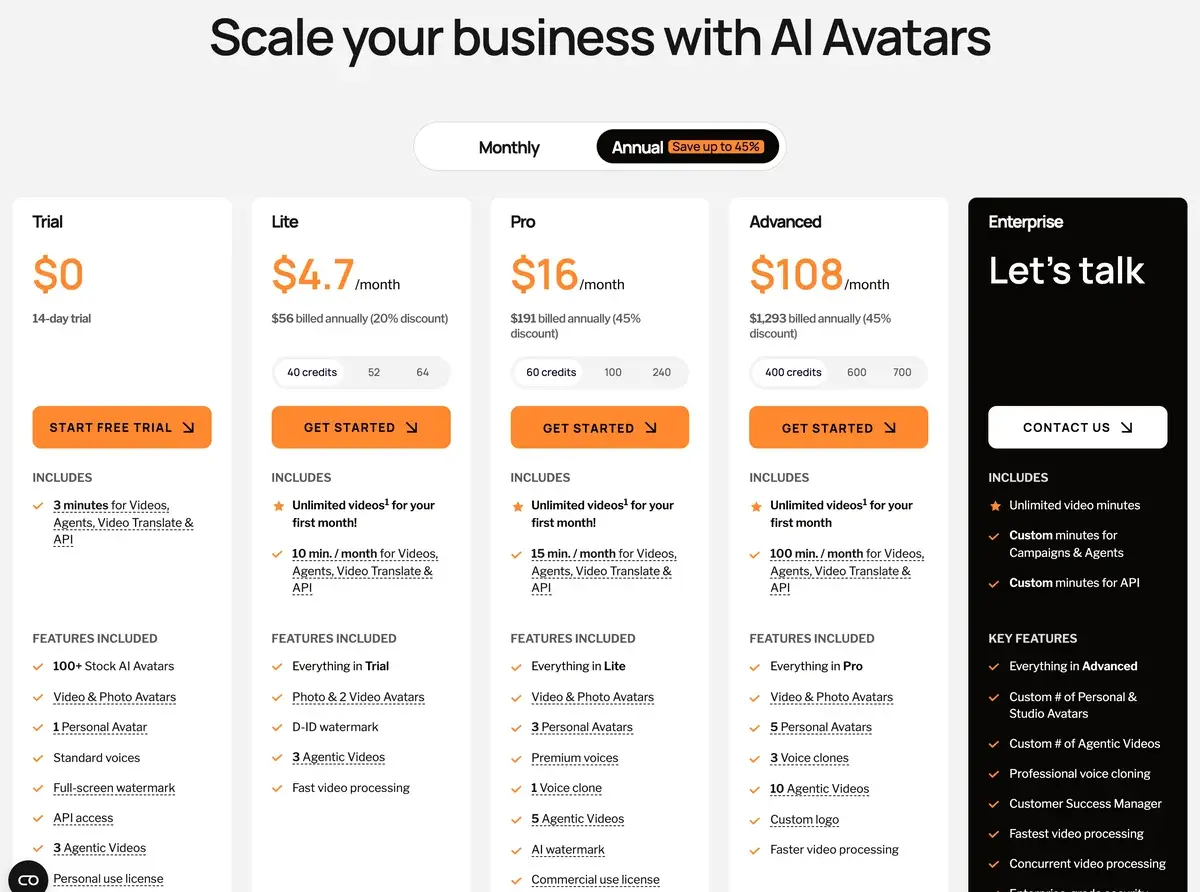
PlanPriceVideo minutesBest for
FreeTrial14 days, limited creditsEvaluation only
Lite$4.70/mo10 minutesCasual users, budget-conscious small businesses
Pro$19.80/mo15 minutes + advanced featuresActive users, light business use
Advanced$99/mo50 minutes + team featuresSerious commercial use, agencies
EnterpriseCustomCustomLarger organizations, high-volume API use

Prices verified April 2026 from d-id.com/pricing. Annual billing offers ~20% off paid tiers.

The pricing structure is genuinely budget-friendly at the lower tiers. Lite at $4.70/month for 10 minutes makes AI avatar video accessible at small-business scale; Pro at $19.80/month for 15 minutes plus advanced features fits active commercial use. The Advanced tier at $99/month for 50 minutes is where serious commercial use cases land.

Enterprise pricing varies based on volume, API usage, and feature requirements. For high-volume personalization use cases (thousands of videos monthly), Enterprise contracts can produce favorable per-video economics that lower tiers cannot match. The pricing model matches the volume use case D-ID is designed to serve.

The free tier is a 14-day trial rather than a permanent free product. For evaluation purposes, this is sufficient; for ongoing free use, alternatives with permanent free tiers (HeyGen, DeepBrain AI) may serve better.

Hands-on Notes

The first thing that distinguishes D-ID from Synthesia and HeyGen in actual use is the photo-to-video workflow. Uploading any photo and generating a talking avatar video from it is a workflow that competitors often gate behind paid avatar libraries or studio-recorded custom avatars. D-ID makes this accessible at the entry tier — useful for educators bringing historical figures to life, businesses generating personalized outreach with the recipient's profile photo (with appropriate consent), or creators experimenting with AI avatar concepts.

Output quality is acceptable but visibly weaker than Synthesia or HeyGen at their premium tiers. The avatars produce talking video; the lip-sync is functional; the expressions are reasonable; but the overall polish is noticeably less polished. For internal use, personalized outreach, or budget-conscious commercial work, the quality clears the practical bar. For brand-conscious customer-facing video, the polish gap matters and Synthesia or HeyGen produce better results.

The Streaming API is the feature that justifies D-ID for embedded product use cases. Real-time interactive AI avatars — chatbots with avatar interfaces, training experiences with avatar instructors, customer service interfaces with avatar representatives — work in D-ID where Synthesia's asynchronous-only positioning does not. For developers building products requiring real-time avatar interaction, D-ID is often the right choice.

Batch generation works at scale meaningfully better than premium alternatives' per-minute economics. Producing 1,000 personalized videos for a sales campaign costs substantially less in D-ID than Synthesia or HeyGen would charge for the same volume. For sales operations and marketing teams running personalization-at-scale programs, this volume economics is genuinely consequential.

Voice quality across the 100+ supported voices varies. Major language voices (English, Spanish, French, German, Portuguese, Japanese, Mandarin) produce strongest results; less common languages produce competent but more obviously synthetic voices. For organizations producing content in major world languages, the voice quality is sufficient; for languages with smaller voice library coverage, alternatives may serve better.

Where D-ID gets weaker: enterprise corporate features (advanced compliance, audit trails, formal indemnification, dedicated support) are less mature than Synthesia's enterprise tier. For organizations requiring these features, Synthesia is often the right choice despite the higher cost. Brand voice and team collaboration features at the upper tiers are functional but less polished than premium alternatives.

The other practical consideration: ethics and consent around photo-to-video usage. Using photos of real people without explicit consent violates D-ID's terms and may carry broader legal implications regardless of platform terms. The capability is powerful and easy to misuse; responsible commercial use requires consent processes that D-ID does not enforce technically. Organizations deploying D-ID at scale should establish internal consent protocols proactively rather than reactively.

For corporate L&D buyers comparing D-ID against Synthesia, the honest framing is whether the cost savings justify the quality and feature gap. For organizations producing significant training video volume where polish matters and language coverage matters, Synthesia's higher cost is often justified. For organizations producing modest video volume or where personalization-at-scale is the use case, D-ID's economics work better.

Use Cases

A small business with 25 employees uses D-ID Lite ($4.70/month) for occasional internal training videos and customer onboarding content. Total monthly use is 5-7 minutes; the cost is trivially justified against the alternative of producing or recording videos manually. Quality is sufficient for internal use; the price fits small business budget realities.

An educator producing online course content uses D-ID Pro ($19.80/month) for lecture supplementation. AI avatars (the educator's own clone for consistency) handle narration of slide-based content; the integration with Google Slides supports the existing course production workflow. Course expansion from 30 to 60+ lessons over a year is supported without proportional production time investment.

A B2B SaaS sales operations team uses D-ID Enterprise for personalized video outreach at scale. SDRs send personalized video messages to thousands of prospects monthly, with the prospect's name, company, and personalization in each video. Per-video cost economics work where premium alternatives would make the program cost-prohibitive; reply rates on personalized video outreach measurably outperform plain email outreach.

A startup builds a customer service product with embedded AI avatar interface using D-ID's Streaming API. Real-time avatar conversations handle common customer service interactions with text-to-speech-to-avatar workflow; the product's avatar capability differentiates against text-only competitors. The API pricing scales with usage in ways that fit the startup's growth.

A marketing agency producing video content for SMB clients uses D-ID Advanced ($99/month) across multiple client engagements. Per-client production economics work where premium tools would compress agency margins; the volume features support diverse client needs across the portfolio. Quality is sufficient for typical SMB client expectations.

A senior L&D buyer at a 5,000-person enterprise evaluates D-ID and determines that quality polish, enterprise features, and language coverage favor Synthesia for the organization's training video portfolio despite Synthesia's higher cost. D-ID is appropriate for some specific use cases (high-volume internal personalization) but not the primary corporate training tool. This use case reveals where D-ID's positioning is least competitive — at the enterprise corporate training tier.

Our Verdict

D-ID is the right AI avatar video tool for cost-conscious users, high-volume personalization use cases, and developers building products with embedded AI avatar capabilities. The combination of affordable entry pricing, mature API, and Streaming API capabilities serves audiences that premium alternatives (Synthesia, HeyGen) cannot economically reach.

The honest considerations: output quality is meaningfully weaker than Synthesia or HeyGen at their premium tiers. For brand-conscious customer-facing video, public-facing creator content, or enterprise corporate training where polish matters, the premium alternatives are worth the cost premium. D-ID wins on price-and-volume economics; loses on quality polish at the upper end.

The pricing tier matters for the buying decision. Lite at $4.70/month is excellent for casual and small-business use; Pro at $19.80/month covers active commercial use; Advanced and Enterprise serve volume use cases. Match the tier to actual use case rather than to aspirational use cases that would be better served by premium alternatives at higher cost.

For developers, sales operations doing personalized video at scale, educators producing course content, and small businesses needing affordable AI avatar video, D-ID earns its place. For enterprise corporate training, brand-conscious public-facing video, and creator-economy content where avatar realism is creative priority, alternatives serve better. The buying decision should be honest about which audience your use case actually fits.

Note: D-ID does not currently have an active affiliate program with AIVario. AIVario earns no commission from sign-ups. Our rating reflects evaluation of paid tiers across volume video production work alongside parallel use of Synthesia and HeyGen for comparison.

Best for: Cost-conscious small businesses, educators producing course content, sales operations running personalized video at scale, developers building products with AI avatar features, marketing teams producing personalization-at-scale campaigns Not ideal for: Brand-conscious customer-facing video (use Synthesia or HeyGen), enterprise corporate training requiring compliance features (use Synthesia), creator-economy content production (HeyGen often serves better), users requiring formal commercial indemnification Bottom line: Most affordable entry into AI avatar video with strong volume economics for personalization use cases. Match the tool to actual use case priorities; right choice for budget and volume, wrong choice for premium quality.

Related Tools

  • Synthesia — premium alternative with stronger enterprise features and polish
  • HeyGen — alternative with stronger creator-economy positioning
  • ElevenLabs — voice generation alternative for users wanting voice without avatar
  • Descript — alternative for users producing recorded human-presenter video
  • Notion — common organization tool for the script work that feeds into D-ID production

Frequently Asked Questions about D-ID

How much does D-ID cost?

D-ID has a free tier with 14-day trial credits. Lite is $4.70/month for 10 video minutes. Pro is $19.80/month for 15 minutes plus advanced features. Advanced is $99/month for 50 minutes and team features. Enterprise pricing is custom. The Lite tier at $4.70/month is the cheapest entry point into AI avatar video among major providers.

Is D-ID quality comparable to Synthesia or HeyGen?

Lower than Synthesia and HeyGen at their premium tiers. D-ID's avatars are functional and the video quality is acceptable for typical business use cases (training videos, marketing explainers, personalized outreach), but they are noticeably less polished than Synthesia's enterprise-grade avatars or HeyGen's higher-tier creator avatars. For professional public-facing video, Synthesia or HeyGen often produce better outputs; for cost-conscious internal use or volume personalization, D-ID's quality clears the practical bar.

What is the photo-to-video feature?

D-ID's distinctive capability is generating talking avatar videos from any uploaded photo. You provide a photo of any person (with appropriate rights and consent) plus a script, and D-ID produces a video of that person speaking with lip-sync and natural expressions. This is useful for personalized outreach (videos appearing as personalized greetings) and for using historical photos (educators creating videos featuring historical figures from photographs, for example). The capability has obvious ethical considerations around consent that should be respected.

Can D-ID handle high-volume personalized video?

Yes, the Streaming API and batch generation features support producing hundreds or thousands of personalized videos at scale. For sales outreach with personalized video for each prospect, customer success programs sending personalized check-ins, or marketing campaigns with per-recipient personalization, D-ID's volume economics work better than Synthesia or HeyGen's per-minute pricing models.

Does D-ID work with PowerPoint or other tools?

Yes, D-ID has native integrations with PowerPoint, Google Slides, and Canva for embedding talking avatar videos in presentations and design work. The integrations are designed for use cases where avatar video augments existing content tools rather than replacing them. For corporate training videos delivered through PowerPoint, this integration matters.

Is D-ID safe for commercial use?

Commercial usage rights are included on paid plans for D-ID-generated content. The platform requires consent for photos used as avatar sources — using photos of real people without their consent violates D-ID's terms and may carry legal implications regardless of platform terms. For commercial use cases (marketing, sales outreach, training), use D-ID-provided avatars or your own images with appropriate consent. The platform does not provide explicit copyright indemnification the way Adobe Firefly does for image AI.

Should small businesses choose D-ID over Synthesia?

Often yes for budget-conscious businesses. The Lite tier at $4.70/month is meaningfully cheaper than Synthesia's $29/month entry tier; for small businesses producing modest video volume where quality polish matters less than cost, D-ID's economics work better. For businesses producing brand-conscious customer-facing video where production polish matters, Synthesia justifies the price premium. Match the buying decision to actual use case.