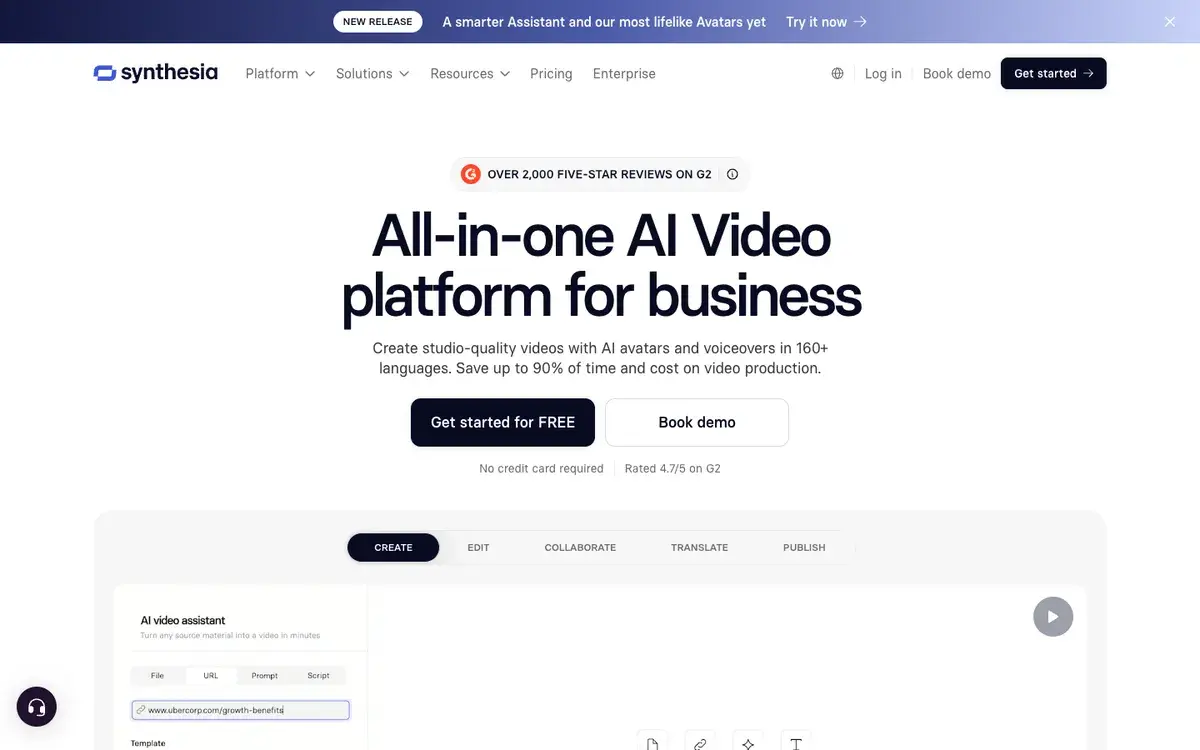
What is Synthesia?
A learning and development manager at a 5,000-person company needs to produce a training video about an updated compliance policy. The traditional path involves writing a script, scheduling a presenter, booking a recording studio, coordinating filming, editing, adding graphics, then re-doing the whole thing in 6 months when the policy changes. The cost runs $5,000-$15,000 per video; the timeline is weeks; updating content as policies evolve requires repeating the process.
Synthesia exists to solve exactly this problem. The L&D manager writes the script, picks an AI avatar from the library, hits generate, and gets a finished video in minutes. The cost is per-month subscription rather than per-video production budget. When the policy changes 6 months later, updating the video takes minutes — change the script, regenerate. The total production economics shift in ways that change what is feasible: organizations can produce 10x more training content, update it consistently, and localize across languages without separate production runs per region.
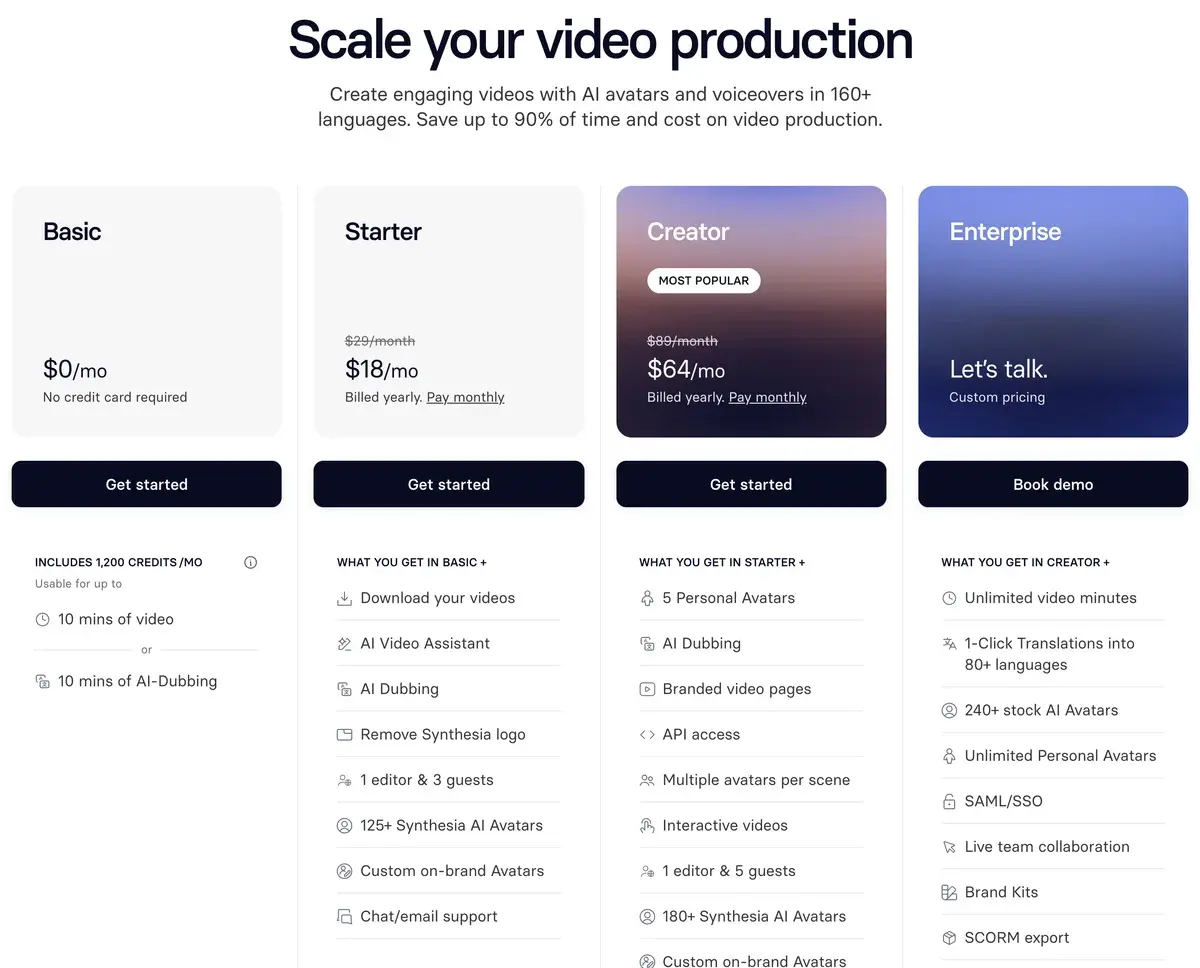
This is the use case Synthesia was built around and where it produces clear value. The product is used by 50,000+ companies primarily for L&D, internal communications, sales enablement, and educational content. Pricing starts at a free tier (3 minutes monthly) and scales through $29/month Starter, $89/month Creator, and Enterprise contracts that typically run substantial annual commitments.
For corporate training video production, Synthesia is one of the most consequential tools in the AI video category. For most other video use cases — cinematic creative, social content, consumer marketing, entertainment — Synthesia is the wrong fit by design.
The corporate training video reality
Corporate training video production is unglamorous as a topic but genuinely important to large organizations. Compliance training, onboarding videos, product training for sales teams, system training for new tools, customer service training, safety training in industrial environments — all of this content has to exist, get watched, and get updated as the underlying material changes. The cumulative volume across a 5,000-person organization can exceed 200 training videos in active rotation.
Traditional production economics make this volume painful. Even at $5,000 per video on the low end, 200 videos represent $1M in production cost; at $15,000 per video, $3M. Updating content as policies, products, or processes change requires repeating production cycles. Localizing across multiple languages multiplies the cost. The economics push organizations toward producing fewer videos, updating less often, and skipping localization — which means the training is less effective, less current, and less accessible to non-native English speakers.
Synthesia changes these economics in ways that affect operational reality. Subscription pricing replaces per-video production budgets. Updates take minutes rather than weeks. Localization across 140+ languages happens through script translation rather than separate production runs. For organizations with active L&D operations, the shift produces both cost savings and capability expansion — more videos, more current, more languages, all within budgets that previously supported a fraction of that output.
The underlying technical capability has improved meaningfully through 2024-2025. Avatar realism has crossed the threshold where viewers in training contexts focus on content rather than being distracted by AI artifacts. Voice quality across languages has matured to the point where localized versions sound professional rather than obviously synthesized. Lip-sync across languages handles the hardest technical challenge in this category. None of this is magic — it is solid execution on a well-defined problem.
Where Synthesia genuinely earns its place
Corporate L&D teams managing significant training video portfolios are the primary use case. The combination of subscription economics, fast iteration, multi-language support, and asynchronous delivery matches the operational reality of L&D work directly. For organizations producing 20+ training videos per quarter, Synthesia is often the most consequential tool investment in the L&D stack.
Internal communications teams producing executive updates, all-hands recaps, policy announcements, and similar internal content. The asynchronous video format works for distributed organizations where live communication is impractical; AI avatars handle the executive face-time that real executives cannot scale to.
Sales enablement teams producing product training, competitive battlecards, demo recordings, and onboarding content for sales reps. The volume of sales enablement content combined with the rapid pace of product updates fits Synthesia's iteration economics directly.
Customer education programs producing onboarding tutorials, feature tutorials, and self-service training content. For SaaS companies with significant onboarding video libraries, the ability to update content as products evolve produces operational benefits.
Global organizations producing localized training content across multiple regions. The 140+ language support handles the hardest part of localization — speaker quality and lip-sync — that traditional dubbing and subtitle workflows handle imperfectly.
Compliance-heavy industries (financial services, healthcare, industrial environments) where training currency matters for regulatory reasons. The ability to update training content quickly when regulations change supports compliance posture in ways that traditional production does not.
Synthesia is not the right pick for: cinematic creative work (use Runway or Luma for visual creativity), social-first content where authenticity and surprise matter (use Pika or PixVerse), consumer brand marketing where production values and emotional resonance matter, entertainment content production, talking-head content where AI avatar limitations would distract from the message, or live presentations and video conferencing.
Key Features
- AI avatars — 230+ pre-made avatars across diverse demographics, ages, and styles
- Personal Avatar — clone yourself from a 5-minute webcam recording (Creator tier)
- Custom Avatar — high-fidelity studio-recorded clones for executive use (Enterprise tier)
- 140+ languages — script-to-speech and lip-sync across major world languages
- AI script generator — generate scripts from prompts or convert existing documents to video scripts
- Brand templates — locked colors, fonts, logos, and intro/outro structures for consistency
- Screen recording integration — combine avatar narration with screen recordings for software training
- Slide-style editor — slide-based composition resembling PowerPoint for non-video editors
- Multi-scene videos — chain multiple avatars and scenes for longer, more dynamic content
- Background customization — choose from libraries or upload custom backgrounds
- Closed captions — automatic captions in multiple languages with editing controls
- API access — programmatic video generation for integrating Synthesia into custom workflows
- Team workspaces (Enterprise) — shared brand assets, video review workflows, admin controls
- Compliance and security — SOC 2 Type II, ISO 27001, GDPR, HIPAA-ready Enterprise tier
Synthesia vs Competitors 2026
| Tool | Avatar realism | Language coverage | Enterprise focus | Free tier | Price entry |
|---|
| Synthesia | ✅ Strong | ✅ 140+ | ✅ Best in class | ✅ 3 min/mo | $29 |
| HeyGen | ✅ Strong | ✅ 100+ | ⚠️ Mid | ✅ Limited | $24 |
| D-ID | ✅ Strong | ✅ Decent | ⚠️ Mid | ✅ Limited | $4.7 |
| Hour One | ✅ Strong | ✅ 80+ | ✅ Strong | ⚠️ Trial | $25 |
| DeepBrain AI | ✅ Strong | ✅ 80+ | ⚠️ Mid | ✅ Limited | $24 |
| Colossyan | ✅ Strong | ✅ 70+ | ✅ Strong | ✅ Limited | $35 |
| Vyond | ⚠️ Animated | ⚠️ Limited | ✅ Strong | ❌ | $99 |
| Powtoon | ⚠️ Animated | ⚠️ Limited | ⚠️ Mid | ✅ Limited | $19 |
Data verified April 2026 from each provider's pricing pages.
The clearest comparison is Synthesia vs HeyGen. They are direct competitors with overlapping capabilities and different positioning. HeyGen produces slightly more lifelike facial expressions and is more aggressive on consumer-creator features (UGC-style content, viral templates, mobile-first creator workflows). Synthesia is more focused on enterprise corporate use cases with broader language support, stronger compliance posture, and more mature team collaboration features. For corporate L&D and internal communications, Synthesia tends to fit better. For creator-economy content, HeyGen often fits better.
D-ID is positioned at lower entry pricing with strong avatar quality, fitting solo creators and small teams whose use cases do not require enterprise features. For individual creators producing AI avatar content, D-ID is often the more economical option.
Hour One and Colossyan are both enterprise-positioned with strong feature sets; the choice between these and Synthesia often comes down to specific feature priorities and pricing negotiation rather than fundamental capability gaps. For organizations evaluating multiple enterprise AI avatar tools, all three deserve evaluation.
Vyond and Powtoon target a different category — animated character video rather than realistic AI avatars. For organizations preferring animated training videos (avoiding the AI avatar question entirely), these tools serve well. The choice between animated and AI-avatar approaches is a creative decision; both have legitimate use cases for corporate training.
Pricing 2026
| Plan | Price | Video minutes | Avatars | Best for |
|---|
| Free | $0 | 3/mo | Basic library | Evaluation, very light use |
| Starter | $29/mo | 120/year | Full library | Solo users, small teams |
| Creator | $89/mo | 360/year | Full + Personal Avatar | Active content creators, teams |
| Enterprise | Custom | Custom | Full + Custom Avatar | Larger organizations with security and customization needs |
Prices verified April 2026 from synthesia.io/pricing. Annual billing offers ~17% off paid tiers. Per-minute pricing replaces unlimited minutes on most tiers, which is a meaningful planning consideration for high-volume use.
The pricing structure prioritizes Enterprise contracts where most actual customer revenue concentrates. The Starter and Creator tiers serve as entry points and small-team deployments; serious corporate use cases typically reach Enterprise tier where contracts are negotiated for specific organizational needs (custom avatars, API access, security features, dedicated support).
For solo creators and small teams, the per-minute math at Starter and Creator tiers can produce surprises if usage is concentrated in longer videos. A team producing 10 fifteen-minute training videos per month consumes 150 minutes — exceeding Starter tier and approaching Creator tier limits. Planning for actual video volume and length matters for tier selection.
Enterprise pricing varies substantially based on team size, custom avatar needs, API usage, and integration scope. Expect mid-five to six-figure annual contracts for typical mid-market deployments; larger enterprises with extensive custom avatar libraries and broad organizational use can reach seven-figure annual commitments.
Hands-on Notes
The first thing that affects practical use is how unobtrusive the production workflow is. Opening Synthesia, writing a script, picking an avatar, and generating a finished video happens within minutes — orders of magnitude faster than any traditional video production approach. For L&D and corporate communications teams, this speed matters more than per-video quality polish; the ability to produce many videos quickly enables operational patterns (more frequent updates, more localization, more topic coverage) that traditional production cannot support.
Avatar realism in 2026 is good enough for the corporate training context. Viewers watching a training video about a compliance policy are focused on understanding the policy, not evaluating whether the presenter looks fully natural. The avatars convey information clearly, maintain appropriate professional demeanor, and do not produce uncanny-valley distractions in this context. For consumer-facing or entertainment use cases where viewers would scrutinize the presenter's authenticity, avatar limitations remain visible.
The 140+ language support is one of Synthesia's distinctive practical advantages. Producing the same training video in 8 languages for a global organization happens through script translation followed by regeneration, with consistent avatar appearance across all languages. The voice quality varies by language — major languages (English, Spanish, French, German, Mandarin, Japanese) produce strongest results; less common languages produce competent but more obviously synthetic voices. For organizations producing content in major world languages, the multilingual workflow is genuinely useful.
The slide-based editor is the workflow choice that affects how non-video producers interact with the tool. Composing videos as a sequence of slides — with avatars, backgrounds, text, and graphics on each slide — resembles PowerPoint composition more than video editing. For corporate users comfortable with PowerPoint, the workflow is accessible. For users expecting a video editor experience, the slide approach takes adjustment.
Personal Avatars (clone yourself) work well enough for most internal use cases. The webcam-recorded Personal Avatar is recognizably you to colleagues who know what you look like; the quality is appropriate for internal communications and asynchronous executive updates. For higher-stakes use (customer-facing video, executive communications to external audiences), Custom Avatars (studio-recorded) produce more polished results — at meaningful cost and lead time.
Where Synthesia gets weaker: the slide-based editor constraint produces video that feels structured rather than dynamic. Videos consist of clear scene transitions rather than the continuous flow of traditional video. For training content, this structure is appropriate and even helpful for comprehension; for content where dynamic flow matters, the format constraint shows.
The other practical consideration: avatars cannot match every casting need. The 230+ pre-made avatars cover broad demographic ranges but cannot represent every specific demographic, age, or appearance an organization might want for specific content. For organizations with strong DEI considerations or specific casting requirements, Custom Avatars become more important — at the corresponding cost.
For users coming from cinematic AI video tools (Runway, Luma) hoping Synthesia produces similar visual creativity, the experience is initially frustrating. Synthesia is not solving the same problem; the comparison is essentially category-confusion. Calibrating expectations to "talking-head training video" rather than "creative AI video" produces better evaluation outcomes.
Use Cases
A 5,000-person enterprise produces and maintains 200+ training videos using Synthesia Enterprise. Custom Avatars represent senior leaders and subject matter experts; the avatar library covers diverse training contexts; multi-language support handles localization across 12 regions. Annual Synthesia spend exceeds $200K but replaces production budgets that previously ran $1M+ for substantially less content. The ROI calculation favors Synthesia clearly at this scale.
A B2B SaaS company produces customer onboarding video tutorials using Synthesia Creator. Personal Avatars of customer success managers create trainer-led onboarding content; updates happen as the product evolves; the videos run on the customer-facing knowledge base. The combination of customer success team presence and rapid update capability supports onboarding effectiveness.
A regulated financial services firm uses Synthesia Enterprise for compliance training updates. When regulations change, training content updates within days rather than the weeks traditional production would require; this responsiveness matters for compliance posture and regulator relationships. The compliance features (SOC 2, audit trails, content versioning) support the use case appropriately.
A growing startup with global remote team uses Synthesia Starter for internal communications — weekly updates from the CEO, product announcements, and onboarding content. The team is too small to justify Enterprise pricing; Starter tier covers the modest video volume needed; the asynchronous format works for the distributed team across time zones.
A creator economy participant evaluates Synthesia for YouTube content production and finds the tool poorly suited for the use case. The corporate-positioned avatars and structured slide format do not match the creator-economy production aesthetic; the creator switches to HeyGen or traditional production for YouTube work. This use case reveals where Synthesia's positioning is least flexible.
Our Verdict
Synthesia is the right AI video tool for corporate training, internal communications, sales enablement, and educational content production at organizations where these workflows produce meaningful video volume. The combination of subscription economics, fast iteration, multi-language support, and corporate-appropriate avatar realism solves the corporate training video problem in ways that change what is operationally feasible.
The honest considerations: Synthesia is purpose-built for corporate use cases and not flexible enough for creative or consumer-facing video production. The slide-based editor constraint, the corporate-positioned avatars, and the asynchronous-only delivery format all reflect the target audience. For users outside this audience, alternatives serve better; for users matched to this audience, the constraints are features rather than limitations.
The pricing is reasonable for organizational use at scale. Free tier serves evaluation; Starter and Creator tiers fit smaller deployments and individual users; Enterprise pricing is where the actual value compounds for serious corporate deployment. Most meaningful customer revenue concentrates at the Enterprise tier where contracts are negotiated for specific organizational needs.
For corporate L&D teams, internal communications, and similar workflows, Synthesia deserves serious evaluation alongside HeyGen, Hour One, and Colossyan. For creative video work, social content, or consumer-facing video production, the tool category is wrong; alternatives (Runway, Luma, Pika) serve those needs.
Note: Synthesia does not currently have an active affiliate program with AIVario. AIVario earns no commission from sign-ups. Our rating reflects evaluation through customer interviews and product documentation alongside hands-on use of Starter and Creator tiers.
Best for: Corporate L&D teams, internal communications, sales enablement, customer education programs, global organizations producing localized training, regulated industries with compliance training needs
Not ideal for: Cinematic creative work (use Runway or Luma), social-first content (use Pika or PixVerse), consumer brand marketing, entertainment content, video conferencing or live presentations
Bottom line: A purpose-built tool for corporate training video production, executed well within its intended scope. Match the buying decision to whether your video work fits the corporate-content category — if yes, strongly recommended; if no, look elsewhere.
Related Tools
- HeyGen — closest competitor with stronger creator-economy positioning
- D-ID — alternative with lower entry pricing for solo creators
- ElevenLabs — voice generation alternative for users wanting voice without avatar video
- Descript — video editing alternative for users producing recorded human-presenter content rather than AI avatars
- Notion — common organization tool for the script and storyboard work that feeds into Synthesia production
Frequently Asked Questions about Synthesia
How much does Synthesia cost?
Synthesia has a free tier with 3 minutes of monthly video and basic avatars. Starter is $29/month with 120 minutes annually. Creator is $89/month with more minutes and advanced features. Enterprise is custom pricing for organizations needing custom avatars, API access, security features, and team collaboration. Annual billing offers ~17% off.
Are Synthesia avatars convincing enough for actual use?
For their target use case — corporate training videos, internal communications, educational content — yes. Viewers in these contexts know they are watching training content, not entertainment, and the AI avatars deliver information clearly without uncanny-valley issues that would distract from the message. For consumer-facing creative work or contexts where the avatar would be expected to feel fully natural, the avatars are still recognizably AI-generated and would not pass as real video.
How is Synthesia different from HeyGen?
Direct competitors with overlapping capabilities. HeyGen often produces slightly more lifelike facial expressions and is more aggressive on consumer-creator features (UGC-style content, viral video templates). Synthesia is more focused on enterprise corporate use cases with broader language support, more mature compliance features, and stronger team collaboration. For corporate L&D and internal communications, Synthesia tends to fit better. For creator-economy content production, HeyGen often fits better.
Can I create a custom avatar of myself in Synthesia?
Yes, Synthesia offers Personal Avatars (clone yourself from a webcam recording) on Creator tier and Custom Avatars (studio-recorded high-quality clones) on Enterprise tier. Personal Avatars are good enough for most internal use cases; Custom Avatars produce higher-fidelity results suitable for executive communications and customer-facing content. The Custom Avatar process requires in-studio recording sessions, which adds cost and lead time.
What languages does Synthesia support?
Synthesia supports 140+ languages for both script-to-speech and avatar lip-sync, which is one of the strongest language coverage offerings in the AI video category. The same script can be regenerated in multiple languages with consistent avatar appearance, which is genuinely useful for global organizations producing training content across regions. Voice quality varies by language; major European, Asian, and Latin American languages produce the highest quality.
Is Synthesia good for marketing videos?
It works for marketing videos in specific contexts — explainer videos, product demos, educational marketing content — but is less suited for marketing where production values, creative differentiation, or emotional resonance matter. For B2B marketing content with educational positioning, Synthesia fits. For consumer brand marketing, lifestyle content, or creative campaigns, traditional production or AI tools focused on visual creativity (Runway, Luma) produce better outcomes.
Does Synthesia work for video meetings or live presentations?
No, Synthesia is for asynchronous video creation only — you create videos and people watch them later. It is not a real-time video conferencing tool or a tool for live presentations. For live use cases, traditional video conferencing (Zoom, Microsoft Teams) is needed. The asynchronous-only positioning is intentional and matches the corporate training use case.