Researched
This analysis is based on documentation, public user reports, and vendor materials — not yet on our own hands-on testing. How we rate
What is Copy.ai?
If you last looked at Copy.ai a couple of years ago, put that memory aside — the product you remember has been replaced.
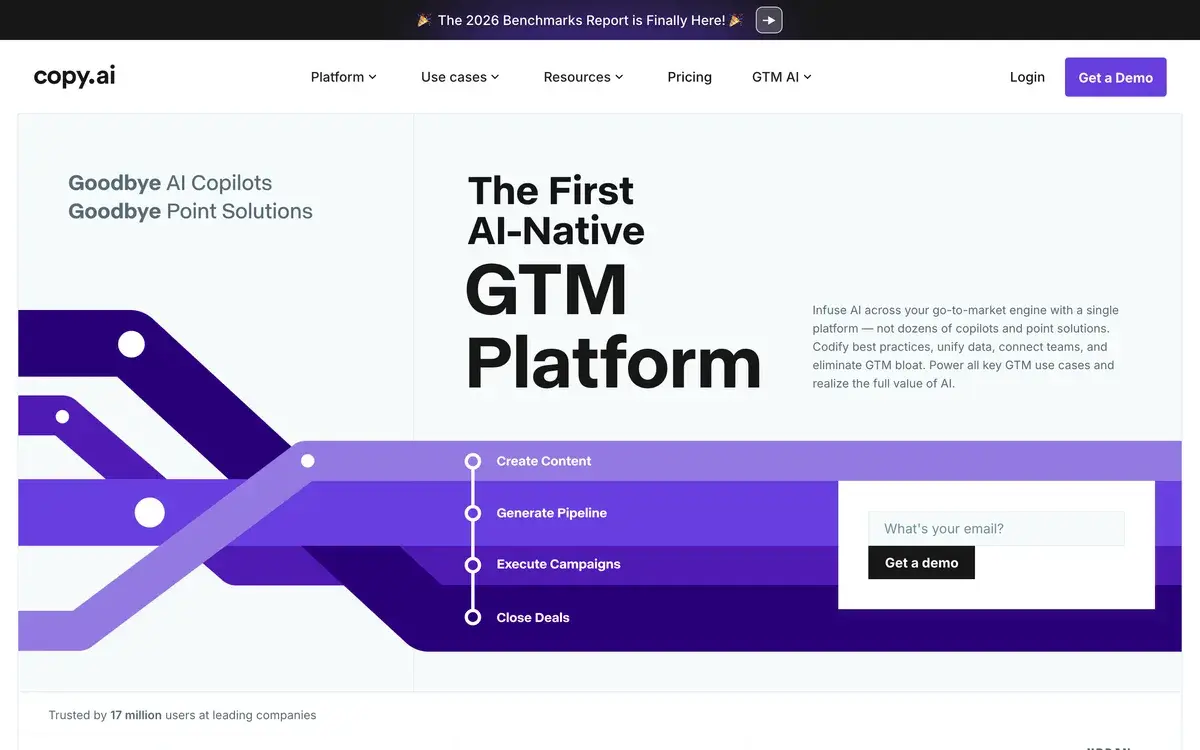
Copy.ai launched as an AI copywriting tool: templates in, ad copy and blog posts out, free tier to get you started. Somewhere around 2024 it repositioned as a Go-To-Market AI Platform, and by 2026 the transformation is complete. It now sells a workflow builder where you chain CRM records, scraped sites, and uploaded lists through AI steps that research, summarize, score, and write, then push results back into HubSpot or Salesforce.
Closer to Zapier where every step can reason than to a word processor.
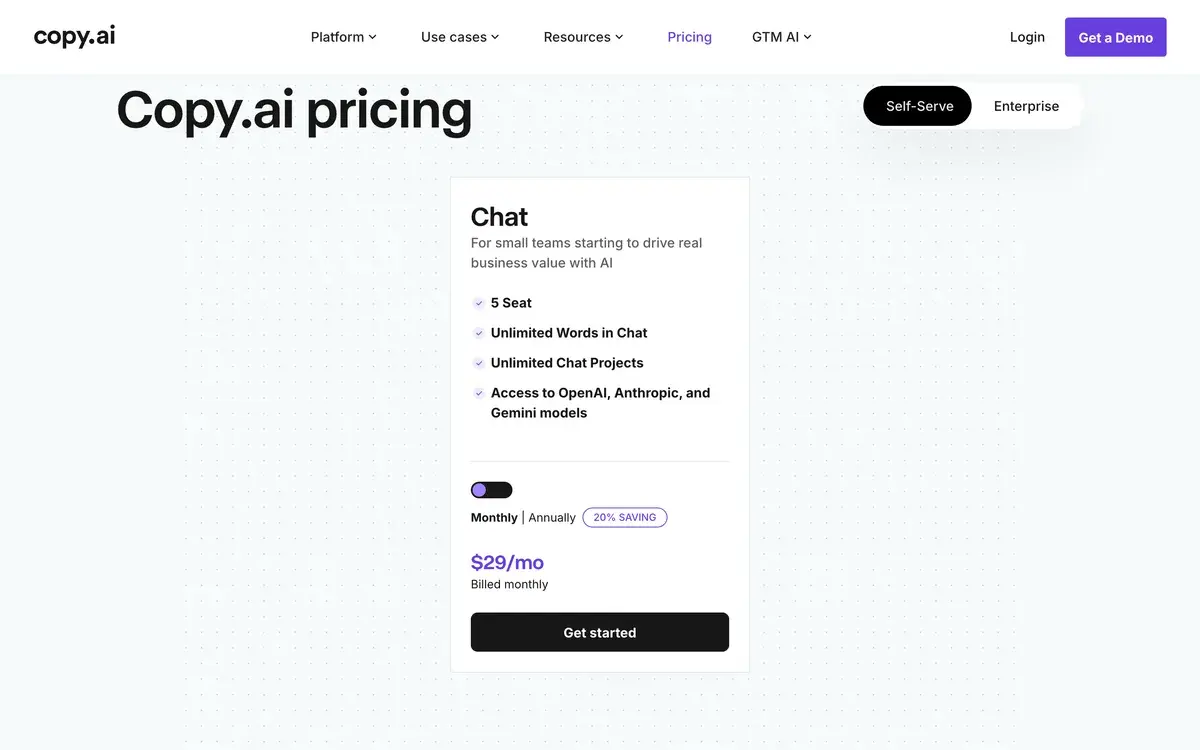
The free tier is gone. Entry pricing runs somewhere around $29-49/month for chat and templates, but the workflow automation that actually defines the platform starts near $249 and climbs into four figures monthly. Around 17 million registered users, SOC 2 Type II, 2,000-plus integrations.
That pivot is the single most important fact about Copy.ai, and it's why so much of what you'll read about it is misleading. Old tutorials describe an interface that changed. Old reviews price a product that no longer exists. Comparisons that call it "an AI writer that costs $49" are misreading what's on sale.
Who is it for?
Copy.ai in 2026 fits revenue teams — roughly three to ten people spanning marketing and sales — who need high-volume short-form copy and automated prospecting in one system. If you're producing ad variations while also enriching leads and personalizing outreach from CRM data, the platform genuinely consolidates work that would otherwise span three tools.
Content teams that need consistent brand voice at scale get real value from Content Agent Studio and Infobase, which together produce more consistent output than prompting cold.
It's the wrong purchase for: solo creators and freelancers (built for teams, priced for teams, and general assistants match the writing quality), anyone whose need is blog posts (long-form comes out generic — testers report rewriting 40-60%), small ecommerce brands who'd use a fraction of what they're paying for, and buyers who want transparent per-seat pricing without a sales conversation.
What it does now
- GTM workflow builder — chain data inputs through multi-step AI processes and push results to your stack
- Workflow Credits — usage metering that varies by task complexity, with no public calculator
- Content Agent Studio — brand-voice training from your own writing samples
- Infobase — stores company and product context so output isn't generic
- Chat with multi-model access — GPT, Claude, and Gemini variants
- 90-plus templates — the copywriting heritage, still present
- Lead enrichment — adequate for SMB use, shallower than dedicated sales intelligence tools
- 2,000-plus integrations — Salesforce, HubSpot, Google Docs, Slack
- Unlimited words on paid plans — no per-word anxiety
- API access — higher tiers only
- No image generation — text-only, unlike Jasper
Copy.ai vs Competitors 2026
| Tool | What it is now | Free tier | Workflow automation | Entry paid |
|---|
| Copy.ai | GTM platform | ❌ Sunset | ✅ Core (from ~$249) | ~$29-49 |
| Jasper | Marketing content platform | ⚠️ Trial | ⚠️ Some | ~$49 |
| Writesonic | SEO content + writing | ✅ Limited | ⚠️ Some | ~$20 |
| Clay | GTM data enrichment | ✅ Limited | ✅ Core | Usage-based |
| Claude / ChatGPT | General assistant | ✅ Yes | ❌ | $20 |
Pricing checked August 2026 from each provider's pages. Copy.ai figures vary meaningfully across sources — verify directly. Competitor prices are approximate.
Copy.ai vs Jasper: Jasper stayed a marketing content platform rather than pivoting, with image generation Copy.ai lacks and a clearer identity for content teams. Copy.ai reaches further into sales workflows. For content-only teams, Jasper is the more coherent buy; for teams spanning marketing and revenue ops, Copy.ai.
Copy.ai vs Writesonic: Writesonic targets SEO content with article generation and Surfer integration, at a lower entry price with a free tier intact. Copy.ai is broader but pricier and no longer serves solo users. For SEO blog production, Writesonic; for GTM breadth, Copy.ai.
Copy.ai vs Clay: Clay does GTM data enrichment and list-building with more depth on the data side. Copy.ai combines lighter enrichment with content generation. For serious prospect data, Clay; for enrichment plus copy in one platform, Copy.ai.
Copy.ai vs a general assistant: Worth taking seriously, because reviewers keep raising it. Claude and ChatGPT at $20 produce comparable short-form ad copy and better long-form. What they don't do is chain workflows into your CRM. If writing is the job, the assistant wins on price and quality. If automation is the job, that's what you're paying Copy.ai for.
Pricing 2026
| Tier | Reported cost | What it covers |
|---|
| Free | ❌ Sunset | Limited demo tools only |
| Chat / Starter | ~$29-49/mo | Chat, templates, unlimited words, up to ~5 seats |
| Agents / Advanced | ~$249/mo | Workflow automation, Content Agents, API access |
| Growth / Expansion / Scale | ~$1,000-3,000/mo | Larger seat counts and credit allocations |
| Enterprise | Custom | SSO, custom models, guided setup |
Pricing checked August 2026. Sources report entry pricing anywhere from $29 to $49 and platform tiers from $249 into four figures — that spread reflects genuine restructuring during the pivot. Verify on copy.ai before budgeting. Additional seats on Advanced are reported around $49 each.
Here's the honest framing on cost, and it's the whole review compressed.
You're not paying for words anymore. You're paying for seats, plus credits consumed by workflow runs, plus — at the top — a platform contract. Anyone evaluating Copy.ai as a writing subscription will conclude it's overpriced, and they'll be right, because that's not what it's selling.
The entry tier is a chat tool. Around $29-49 buys chat and templates. It does not buy the workflow automation the whole platform is built around. That starts near $249, and the tiers above run $1,000-3,000/month. If you're buying Copy.ai for its actual differentiator, budget for the Agents tier, not the entry one.
Workflow Credits have no public calculator. Cost varies by task complexity and reviewers consistently flag the lack of forecastability. Pilot your real workflows before committing to an annual platform contract.
The tidy summary: for a three-to-ten-person revenue team running copy volume alongside automated prospecting, $249 replaces meaningful headcount time and the math works. For anyone smaller, you're funding an enterprise platform to do a job a $20 assistant handles.
Use Cases
Personalized outreach at scale: A revenue team pulls CRM records through a workflow that researches each account and generates tailored outreach, pushing results back to a sequencer.
Brand-consistent ad variations: A marketing team trains Content Agent Studio on existing copy, then generates dozens of on-voice ad variations for testing.
Product description volume: An ecommerce operation auto-generates descriptions across hundreds of SKUs from a single workflow.
Lead enrichment and scoring: Inbound leads get researched, enriched, and scored automatically before a human ever opens them.
Content repurposing: One source asset becomes a blog draft, email, and a batch of social captions — with the caveat that long-form output needs heavy editing.
Our Verdict
Copy.ai executed one of the more complete pivots in the AI tools space, and on its own terms it worked: the workflow engine genuinely automates revenue-team busywork, Content Agent Studio and Infobase produce more consistent output than cold prompting, and 2,000-plus integrations plus SOC 2 Type II make it credible for real GTM deployment. For a mid-sized revenue team, the Agents tier replaces hours of manual research and personalization.
The problems are legibility and fit. The pivot orphaned everyone who came for a writing tool — the free tier is gone, the interface is built for teams, and long-form writing quality hasn't improved since 2024, with testers rewriting 40-60% of drafts. Workflow Credits have no forecasting calculator. Pricing is opaque enough that credible sources report entry costs anywhere from $29 to $49 and platform tiers across a $249-to-$3,000 range. And short-form copy — the original strength — is now matched by assistants that cost $20 and do more.
For revenue teams of three to ten wanting copy plus prospecting automation, recommend at the Agents tier with a workflow pilot first. For writing alone, Claude, ChatGPT, or Writesonic will serve you better and cheaper.
Note: Copy.ai's affiliate program status should be verified before publishing. This rating reflects genuine assessment with no commercial incentive.
Best for: Revenue teams of 3-10 spanning marketing and sales, high-volume short-form copy with brand-voice consistency, teams automating lead research and personalized outreach, ecommerce generating descriptions at SKU scale
Not ideal for: Solo creators and freelancers, anyone whose main need is blog posts, small teams who'd use a fraction of the platform, buyers wanting transparent per-seat pricing
Bottom line: A capable GTM automation platform wearing the name of a copywriting tool. Buy it for the workflows at $249-plus; if you want an AI writer, the market moved on and so did Copy.ai.
- Jasper — stayed a marketing content platform; clearer fit for content teams
- Writesonic — SEO content with a free tier still intact
- Clay — deeper GTM data enrichment and list-building
- Outreach — enterprise sales engagement to pair with enriched data
- Rytr — budget short-form writing for solo users
Frequently Asked Questions about Copy.ai
Does Copy.ai still have a free plan?
No. The free writing tier was sunset during the GTM repositioning, and billing documentation now states only paid subscriptions are available to new customers. Some limited free tools and demo access remain, but functional use requires a paid plan. Older articles citing a free tier with a monthly word allowance predate the change — that's the single clearest signal a review is out of date.
How much does Copy.ai cost?
Reported figures vary considerably across sources, which reflects genuine restructuring rather than sloppy reporting. Entry-level chat and template access lands somewhere around $29-49/month, typically bundling up to five seats. The Agents or Advanced tier that unlocks meaningful workflow automation sits around $249/month. Growth, Expansion, and Scale tiers run roughly $1,000-3,000/month, with Enterprise quoted separately. Confirm on copy.ai before budgeting.
What actually changed in the pivot?
The identity of the product. Copy.ai launched as a copywriting tool — blog posts, ad copy, product descriptions from templates. It now sells a GTM AI Platform: a workflow builder where you chain data inputs like CRM records and scraped sites through AI steps that research, summarize, score, and write, then push results back into HubSpot or Salesforce. Think Zapier where every step can reason. The writing features still exist, but they're no longer the point.
Is the writing quality any good?
For short-form, yes — ad copy, subject lines, product descriptions, social posts hold up well. For long-form, reviewers are consistently unimpressed: blog posts come out generic and surface-level, with testers reporting they rewrote 40-60% of every long-form draft. Notably, quality hasn't meaningfully improved since 2024, and free tools like Claude and ChatGPT now produce comparable short-form copy. The writing is no longer the differentiator.
What are Workflow Credits?
The metering system underneath the platform tiers. Running an automated workflow consumes credits, with the cost varying by task complexity — and reviewers consistently note there's no clear calculator to forecast that in advance. You're not buying words anymore; you're buying seats plus credits plus, at the top, a platform contract. That's a fundamentally different purchase from a per-word writing subscription, and it's where teams get caught out.
What is Content Agent Studio?
Copy.ai's brand-voice system, and its strongest differentiator for teams. Feed it a few samples of your existing content and it learns your style, then generates against that voice consistently. Paired with Infobase — which stores company and product details so output uses accurate context rather than generic guesses — it produces noticeably more consistent output than prompting from scratch. It's on the higher tiers, which is part of the value calculation.
Should solo creators use Copy.ai?
Probably not in 2026. The interface is built for teams, the features that justify the price are workflow automation and CRM integration you likely don't need, and short-form writing quality is now matched by free general assistants. Reviewers consistently point solo users toward Jasper or Writesonic for better individual value, or simply toward Claude and ChatGPT. Copy.ai left the solo market deliberately, and the pricing reflects that.