Claude is Anthropic's assistant, strongest on long-context reasoning, extended writing, and code. Pro is $20/month ($17 billed annually), Max is $100 or $200, and Team seats start at $20 on annual billing. The recurring complaint isn't price: Anthropic doesn't publish usage limits in absolute numbers, so you find your ceiling by hitting it. Below are the figures independent testing has established, checked against Anthropic's own pages in September 2026.
✓Best for: Professionals doing long-document analysis, extended writing, and code where reasoning depth matters
✗Skip if: You need image generation or the widest plugin ecosystem. ChatGPT has both and Claude has neither
Claude is Anthropic's assistant, and its reputation rests on a fairly specific set of strengths: long-context reasoning, extended writing, and code. Feed it a hundred-page document and ask what changed between sections, or hand it a codebase problem that needs holding several files in mind at once, and that's where it separates from the pack.
It spans more surfaces than most people realize. The chat app is the front door. Claude Code runs agentic development from the terminal. Cowork does the same for knowledge work (research, analysis, long documents) and moved from Max-exclusive to all Pro subscribers on January 16, 2026. There's Claude in Chrome, Excel, PowerPoint, and Design, plus a separately-billed API.
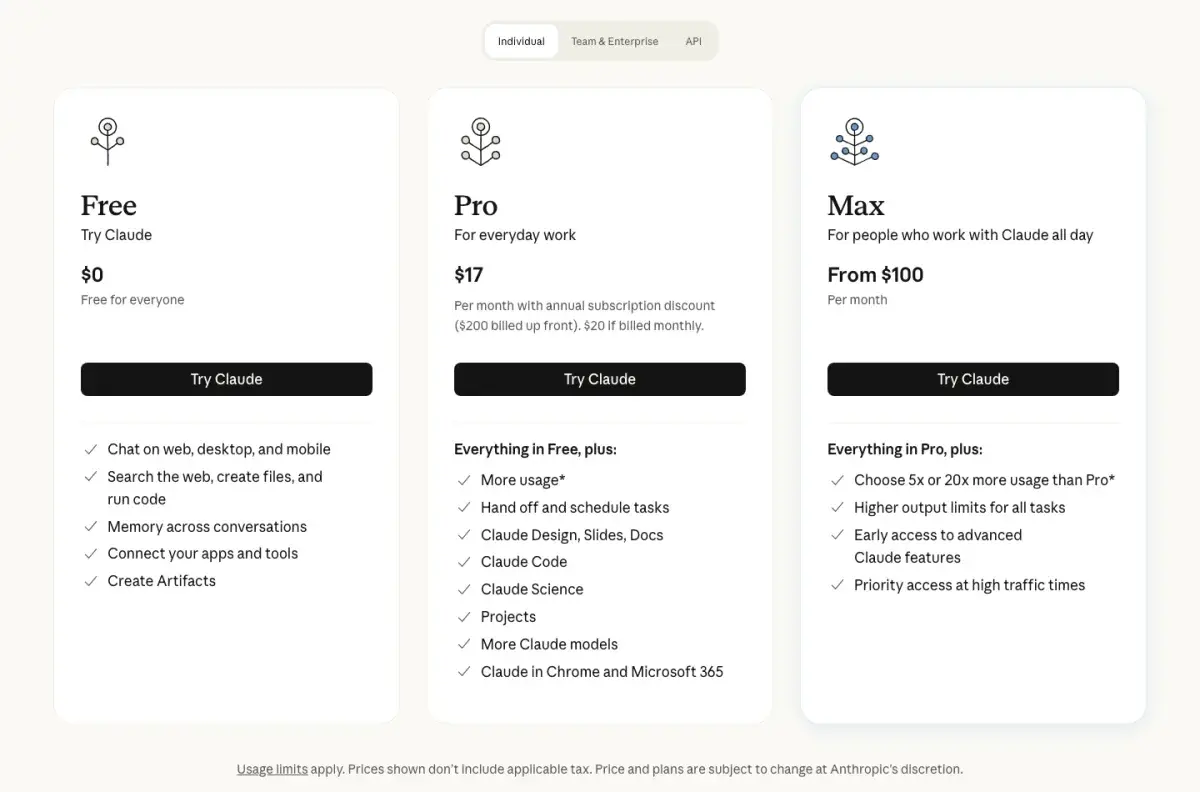
Pro is $20/month, or $17 a month billed annually. Max runs $100 or $200. Team seats start at $20 on annual billing.
The price isn't the problem. The problem is that Anthropic doesn't tell you what you're getting for it.
Claude usage limits: the unpublished part
This is the most consistent complaint about Claude, and it's a fair one.
Anthropic doesn't publish usage limits in absolute numbers. The pricing page says usage limits apply and stops there. The Help Center only gives relative figures: Max 5x and Max 20x get five and twenty times Pro's per-session allowance, and every paid plan has a weekly cap across all models. There's still no table saying "Pro gives you X messages" or "Max gives you Y hours."
Independent testing has filled in some of the gaps. What the figures suggest:
Plan
Approximate ceiling
Free
Sonnet and Haiku, limited sessions
Pro ($20)
Enough for writing; interrupts heavy coding
Max 5x ($100)
3-5 hours daily of Claude Code comfortably
Max 20x ($200)
~220,000 tokens per 5-hour window; roughly 240-480 hours of Sonnet or 24-40 hours of Opus weekly
Those numbers come from third-party measurement, not from Anthropic, and they shift when models change. Treat them as estimates, including the ones in that table.
The practical consequence: you discover your ceiling by hitting it, usually mid-task. For a writer, that's an inconvenience. For a developer three hours into a refactor, it's a real interruption, and it's the specific experience that pushes people from Pro to Max.
If you're deciding between plans, the practical advice is to run Pro for a month on your actual workload rather than trying to model it in advance. There isn't enough published information to model it accurately.
Is Claude Pro worth it? The API comparison
The clearest way to judge $20 is against what the same usage costs on the API.
Testing from early 2026 found professionals working more than three hours daily consistently paid dramatically less on Pro than equivalent API consumption, which landed in the $200-400 monthly range at that intensity. That's a ten-to-twenty-fold difference, and it's why the subscription exists.
The crossover points, roughly:
Monthly token volume
Cheaper option
Under ~50 million
API pay-as-you-go
50-200 million
Max 5x ($100)
200 million to 1 billion+
Max 20x ($200)
Power users tracking real consumption report savings near 93% against raw API rates on Max plans. One documented case put eight months of usage at roughly $15,000 of API-equivalent value for $800 paid.
So the rule of thumb: sporadic integrations and batch jobs favour the API. Sustained interactive work favours a subscription, and the heavier the use, the more lopsided that gets.
The Sonnet 5 price rise that didn't happen
In August this page told you to budget for a price increase. It never came.
Claude Sonnet 5 launched with introductory API pricing of $2 per million input tokens and $10 per million output, announced as running through August 31, 2026 before moving to $3 and $15. Anthropic has since made $2/$10 the standard price, and its pricing page now says the scheduled September increase will not occur.
So if you modelled costs on the higher number, take it back out. Sonnet 5 costs a third less than Sonnet 4.6 ($3/$15) on both input and output. The new Opus got cheaper too: Opus 5.5 runs $4/$20, 20% below the $5/$25 of Opus 5.
Current API rates:
Model
Input / output per million tokens
Haiku 4.5
$1 / $5
Sonnet 5
$2 / $10
Opus 5.5
$4 / $20
Fable 5.1
$10 / $50
For coding specifically, the useful split is that Sonnet handles roughly 80% of tasks well, Opus earns its rate on complex multi-file work, and Haiku covers simple lookups. Routing by task rather than defaulting to the flagship is the single biggest API cost saving available. The Batch API halves every rate above for work that can wait.
Which Claude model am I actually using?
Worth checking, because the lineup keeps moving and most published guides haven't caught up.
Free gets Sonnet and Haiku, while Pro and Max add Opus. Fable, Anthropic's most capable model, is available on paid plans too, but on a tighter allowance than the others, so it's not something to leave running all day.
On the developer side, Anthropic's own docs now say to start with Claude Opus 5.5 for most work and step up to Claude Fable 5.1 for the hardest reasoning and long agentic runs. Opus 5 and Fable 5, which this page called current in August, are now listed as legacy models: still available, no longer the default.
If you're reading a guide that describes Opus 4.8 or Opus 5 as the flagship, it predates the change rather than being wrong at the time.
The general point applies here as much as it does to any assistant: model lineups shift every few months, and tier-to-model mapping shifts with them. Check the picker in your own account. Any published table, including this one, is a snapshot.
How I use Claude to run AIVario
I use Claude alongside Cursor as part of how I actually build and run AIVario, a Next.js 16.2 site in TypeScript with MDX content, deployed on Netlify, plus the research and writing that goes into the reviews themselves. That's daily use on real work rather than a weekend evaluation.
Three things stand out from living with it.
Long context is the feature that changes how you work. Handing Claude a full component file, the type definitions it depends on, and a description of what should change produces something that accounts for all three rather than the one file in front of it. On a project where content loading, types, and rendering sit in different directories, that's the difference between useful and merely fast.
It also pushes back: ask whether an approach is sound and you get a real answer, including when the answer is that it isn't. That's more valuable than it sounds, because the failure mode of an agreeable assistant is confident agreement with a bad plan, and you don't find out until later.
The writing holds up at length, with extended, structured prose staying coherent across thousands of words in a way that matters when the output is an article rather than a paragraph.
One session, in detail
In September 2026 I gave Claude Code (running Opus 5.5) this site's repository and asked for a full audit. What came out of that one session:
Dead weight, removed safely. It found 18 files the site no longer used (old code dumps, starter-template assets, three orphaned components) and two npm packages nothing imported. It deleted them, then ran a production build of all 299 pages to prove nothing broke.
A crawlability bug I'd missed. The /tools catalog only rendered in the browser. Without JavaScript the page said "Loading tools..." and linked to nothing. After the fix, all 210 tool links are in the HTML that search engines and AI crawlers read.
Markup and link fixes. The review markup pointed at the review page instead of the product, five page titles repeated the brand name, six pages had no canonical tag, and 13 internal links led to pages that don't exist.
Disagreement, with evidence. I suspected a sitemap change was behind a Search Console problem. It went through the git history and showed that change had shipped a month earlier with no effect, which saved me from chasing the wrong fix.
The same session showed where you still have to pay attention. Twice a first-pass number was off: a search for unsupported "I tested" claims also matched the phrase "hands-on" and nearly doubled the count, and a network timeout made one category page look empty. Both times it re-checked before building on the number. That's the right habit, and it's also why you review what it does rather than rubber-stamping it.
The real weak spot of the subscription: rate limits on Pro interrupt long sessions. Not constantly, but at the wrong moment, deep into a task where stopping is expensive. That's the reason Max exists, and the reason to test your own workload before assuming $20 covers it.
The work Claude suits, and where it doesn't
Claude fits professionals whose work rewards reasoning depth over feature breadth: analysts working through long documents, writers producing extended structured prose, developers on problems that need several files held in mind at once. If your work involves reading something long and thinking carefully about it, this is the assistant built for that.
It also suits developers specifically, through Claude Code. For terminal-native agentic development, the subscription economics against API billing are strongly favourable at any real volume, and Max 5x at $100 is a common landing spot for people using it as a primary tool.
And privacy-conscious users get a real choice: on Free, Pro and Max, whether your chats help train future models is a setting you control, and declining keeps Anthropic's standard 30-day retention instead of five years. Team and Enterprise content isn't used for training by default.
Where it isn't the right pick: anyone needing image generation (Claude has none), users wanting the widest plugin ecosystem (ChatGPT's is larger, though MCP has narrowed the gap), teams deep in Google Workspace (Gemini integrates natively), and anyone who needs published usage limits to plan around, because that information doesn't exist officially.
Claude against ChatGPT, Gemini, Cursor, Copilot and NotebookLM
Against ChatGPT: same $20, different strengths, and the split is clear. ChatGPT has the broader feature set (image generation, custom GPTs, a much larger ecosystem, and voice) plus a bigger integration surface. Claude is generally regarded as stronger on long-context reasoning, extended writing, and careful analysis. ChatGPT also now shows ads on its Free and $8 Go tiers, which Claude doesn't. If you want one assistant that does the most things, ChatGPT. If you want the one that thinks hardest about a long document, Claude. Plenty of professionals pay for both.
Against Gemini: Gemini integrates natively across Docs, Sheets, Gmail, and Drive, which is decisive if your work already lives there, and carries very large context. Claude edges ahead on reasoning quality for complex analysis. For Google Workspace teams, Gemini; for depth on hard problems, Claude.
Against Cursor for coding: different tools rather than competitors. Cursor is an editor with AI inside it, working interactively at your speed with autocomplete and inline edits. Claude Code is a terminal agent you delegate to. Many developers run both: Cursor for the code they're writing, Claude Code for tasks they're handing off. Cursor's own agents also run on frontier models including Claude.
Against GitHub Copilot: Copilot is $10 flat with excellent inline completion and predictable costs, working inside the editor you already use. Claude Code goes further on multi-step autonomous work but bills by usage or subscription. For completion on a budget, Copilot; for agentic development, Claude Code.
Against NotebookLM for documents: NotebookLM is free and grounds every answer strictly in documents you upload, with citations. Claude reasons more capably but will answer from general knowledge as well as your sources. For traceable answers from a fixed corpus, NotebookLM; for analysis that goes beyond what's written, Claude.
Claude plans and API prices
Anthropic's pricing page on September 24, 2026. The Max card says "from $100"; the $200 price for Max 20x comes from the Help Center.
Individual plans
Plan
Monthly
Billed annually
What it's for
Free
$0
n/a
Sonnet and Haiku, web search, files, code execution
Pro
$20
$17/mo ($200 up front)
Most professionals: Claude Code, Opus, Projects, Cowork
Max 5x
$100
n/a
Heavy daily use, Claude Code as a primary tool
Max 20x
$200
n/a
Near-continuous use, concurrent sessions
Business plans
Plan
Per seat
Notes
Team Standard
$20/mo annual, $25 monthly
2 to 150 people; SSO, admin controls, no training on your content by default
API, billed separately and not included in any subscription:
Model
Input / output per million tokens
Haiku 4.5
$1 / $5
Sonnet 5
$2 / $10
Opus 5.5
$4 / $20
Fable 5.1
$10 / $50
Pricing checked September 24, 2026 against claude.com/pricing, Anthropic's API pricing page, and the Help Center article on the Max plan. US prices, before tax. Usage limits are not published in absolute terms. Model lineups and tier assignments change every few months, so verify in your own account.
The plan logic, plainly:
Free is a real evaluation tier running Sonnet and Haiku, not a demo. Enough to judge whether Claude's reasoning suits your work.
Pro at $20 is where most professionals should land, and it's held that price across several model generations while gaining Cowork, Claude Code access, and successive flagship upgrades. Against ChatGPT Plus at the same $20, it's a choice about depth versus breadth rather than value.
Max 5x at $100 is the developer tier. If Claude Code is your primary tool for three to five hours daily, the arithmetic against API billing favours it by roughly two to two-and-a-half times.
Max 20x at $200 is for people running near-continuously with concurrent sessions. Worth it at that intensity and hard to justify below it.
The API is for building software rather than using an app. Route by task: Sonnet for most work, Opus for hard problems, Haiku for simple lookups. With the September increase cancelled, Sonnet 5 at $2/$10 is the cheapest Sonnet Anthropic has sold.
Bottom line: which plan to buy
Claude is the strongest assistant available for work that rewards careful reasoning: long documents, extended writing, complex code. Pro at $20 has held its price across several model generations while the product grew to include Cowork, Claude Code, and successive flagship upgrades, which makes it one of the better-value professional subscriptions in this category. On consumer plans the training setting is yours to control, and Team and Enterprise don't train on your content by default. And for developers running Claude Code seriously, the subscription economics against API billing are decisively favourable.
The real complaint is transparency, not price. Anthropic doesn't publish usage limits in absolute numbers, so you find your ceiling by hitting it, usually mid-task, which is the worst time to discover a constraint. Independent estimates exist but aren't official and shift with model changes. Model lineups move every few months, fast enough that most published guides describe an older flagship. And the feature gaps against ChatGPT are real: no image generation, a smaller plugin ecosystem, and rate limits on Pro that interrupt long coding sessions.
Against ChatGPT at the same price, the choice is depth against breadth. Neither answer is wrong, and a lot of professionals end up paying for both.
For reasoning-heavy professional work, recommend at Pro. For Claude Code as a primary development tool, Max 5x. And run your own workload for a month before choosing, because the limits that decide it aren't published anywhere.
Note: Claude does not have an affiliate program with AIVario. We earn no commission from Anthropic subscriptions, and this rating carries no commercial incentive.
Related Tools
ChatGPT: same $20, broader features, larger ecosystem, ads on cheaper tiers
Gemini: the better pick if your work lives in Google Workspace
Cursor: AI editor that pairs with Claude Code rather than replacing it
GitHub Copilot: flat $10 with predictable costs for inline completion
NotebookLM: free, and grounds every answer strictly in your own documents
Free at $0, Pro at $20/month or $17/month billed annually ($200 up front), Max 5x at $100/month, and Max 20x at $200/month. For businesses, Team Standard seats cost $20/month on annual billing or $25 monthly, and Team Premium seats $100 or $125, for teams of 2 to 150 people. Enterprise is $20 per seat plus usage at API rates, billed annually. The API is billed separately per token and includes none of the subscription. Pro has held at $20 for a long stretch while the models behind it changed several times.
What are Claude's actual usage limits?
Anthropic publishes them only in relative terms: Max 5x and Max 20x give five and twenty times Pro's per-session allowance, and every paid plan also has a weekly limit across all models. There's no absolute number, which is the most common complaint about the product. Independent testing puts Max 20x at roughly 220,000 tokens per five-hour window, something like 240-480 hours of Sonnet or 24-40 hours of Opus weekly. Pro's ceiling is considerably lower and is usually reached during heavy coding sessions rather than writing. Because the figures aren't official and shift with model changes, treat any published number as an estimate, including these.
Is Claude Pro worth $20 a month?
For anyone using it more than casually, yes, and the API comparison makes the case. Testing from early 2026 found professionals working over three hours daily consistently paid far less on Pro than equivalent API usage, which ran $200-400 monthly at that intensity. The counterpoint is that ChatGPT costs the same $20 with a broader feature set including image generation and custom GPTs. Claude wins on reasoning depth and long context; ChatGPT wins on breadth.
Claude Pro vs Max: when should I upgrade?
When rate limits start interrupting work rather than merely existing. Max 5x at $100 makes sense for developers running Claude Code as a primary tool for three to five hours daily; at that volume the subscription runs roughly two to two-and-a-half times cheaper than API billing. Max 20x at $200 is for near-continuous use across multiple concurrent sessions. One documented case reported $15,000 of API-equivalent usage over eight months for $800 total on a Max plan. Below heavy daily use, Pro is enough.
Which Claude model do I get on my plan?
Free includes Sonnet and Haiku. Pro and Max add Opus, and Fable, Anthropic's most capable model, is available on paid plans on a tighter allowance. For developers, Anthropic now recommends starting with Claude Opus 5.5, which replaced Opus 5 and costs less; Opus 5 and Fable 5 are still available but listed as legacy. Model lineups shift every few months here, so check the model picker in your own account rather than trusting a comparison table.
How much does the Claude API cost?
Rates vary by model and are billed entirely separately from any subscription. Per million input and output tokens: Haiku 4.5 costs $1 and $5, Sonnet 5 $2 and $10, Opus 5.5 $4 and $20, and Fable 5.1 $10 and $50. The Batch API halves those rates. Sonnet 5's $2/$10 launched as introductory pricing due to rise to $3/$15 on September 1, 2026, but Anthropic made it the standard price and the increase did not happen.
When is the API cheaper than a subscription?
The crossover sits around usage volume. Under roughly 50 million tokens a month, pay-as-you-go API often costs less than a subscription. Between 50 and 200 million, Max 5x at $100 becomes worthwhile. Above 200 million, Max 20x saves hundreds to thousands monthly, with power users reporting savings near 93% against raw API rates. Sporadic integrations and batch jobs favour the API; sustained interactive work favours a subscription.
What is Claude Cowork?
An agentic desktop application for multi-step knowledge work: research, analysis, long-form writing, tasks spanning many files and tool calls. It launched as a Max-exclusive and expanded to all Pro subscribers on January 16, 2026. Free users don't have access. It sits alongside Claude Code, which does the same thing for development from the terminal, and both are included in the subscription rather than billed separately.
What can't Claude do?
Three things worth knowing before you switch from ChatGPT. There's no image generation. The plugin and integration ecosystem is smaller, though MCP has closed some of that gap. And on Pro, rate limits do interrupt long coding sessions. That's the specific frustration that pushes people to Max, and it's the reason to test your own workload before committing to a plan.
Does Anthropic train on my conversations?
On Free, Pro and Max it's your choice. Since late 2025 a model-improvement setting decides whether your chats are used for training: allow it and Anthropic keeps that data for up to five years, decline and the standard 30-day retention applies. You can change the setting at any time in Privacy Settings. Team and Enterprise content isn't used for training by default. Check the setting in your own account before putting sensitive material through it.