Hailuo and Vidu used to be an easy split: Hailuo for realistic faces, Vidu for sound. Since MiniMax H3 arrived in July, both generate audio in the same pass as the picture, so the question is narrower. Do your clips need people who look real, or several characters who stay the same from shot to shot?
How we compared: both pricing pages checked on September 24, 2026, plus MiniMax's H3 documentation and Vidu's plan table and FAQ. We have not run side-by-side generations of these two tools.
Quick verdict
Realistic people, talking heads, lifestyle clips: Hailuo AI.
Anime, illustration and stylised characters: Vidu.
A scene with two characters, a product and a fixed setting: Vidu, for its multi-entity reference.
Anyone who iterates a lot on a paid plan: Hailuo AI, because failed generations cost nothing and per-second prices are published.
Realistic people: Hailuo's home ground
MiniMax trained Hailuo on human subjects: skin texture, facial micro-expressions, hair and fabric detail, and how light behaves on a face. Reviewers have consistently placed it near the top of blind comparisons for realistic human footage, and H3 now renders those faces in 2K.
Vidu is the mirror image. Reviewers describe its anime and stylised animation as fluid in a way larger competitors do not match, but photorealistic human motion is its documented weakness: complex actions, multi-person scenes and hand gestures often produce artifacts.
If the footage has to pass as real, this section decides the comparison on its own.
Recurring characters: Vidu's multi-entity reference
Character drift is what quietly ruins narrative AI video. The protagonist looks slightly different in every generation and the sequence stops reading as one story.
Vidu's answer is multi-entity reference: up to seven reference images, for example a main character, a second character, a product and a location, combined in one generation and kept stable across the next ones. It is the feature Vidu is known for, and reviewers report that it works as advertised.
Hailuo now has a serious answer of its own. H3's Omni Reference accepts up to 12 files per prompt, combining up to nine images with up to three video clips and three audio clips. On paper that is more input than Vidu takes. What Hailuo lacks is Vidu's track record with several distinct characters in one scene, so for a two-character story with props and a fixed setting, Vidu is still the safer start. For one recurring person, Hailuo holds up well.
Sound and length now look alike
Vidu brought audio to an entry-level plan first: its Q3 model, launched in January 2026, generates dialogue, sound effects and music with the picture in clips of up to 16 seconds. MiniMax H3 caught up on July 31, 2026, with native stereo sound, dialogue in 11 languages and clips of 4 to 15 seconds.
On sound and length the two are now close to level. The remaining gap is resolution: Hailuo renders 2K on every plan, the free trial included. Vidu generates 1080p on paid plans, and its plan table lists "Ultra HD up to 4K" for Standard and above.
Prices, trials and failed renders
| Hailuo AI | Vidu |
|---|
| Free plan | One-time trial credits, Hailuo models only | 10 references a month, sign-up trial and daily login credits |
| Entry plan | Standard: $10.50/mo ($8.40 yearly), 1,000 credits | Standard: $10/mo ($8 yearly), 800 credits |
| Mid plan | Pro: $38/mo ($30.40 yearly), 4,500 credits | Premium: $35/mo ($28 yearly), 4,000 credits |
| Top plan | Max: $216/mo ($184 yearly), 27,000 credits | Ultimate: $99/mo ($79 yearly), 8,000 credits + free off-peak mode |
| Published price per second | Yes: $0.081 to $0.126 for H3 at 2K | No |
| Failed renders | Not charged | Charged, per the pricing page in July 2026 |
| Refunds | Not supported | Not provided |
| Coming changes | Discounts may end without notice | Plans change on October 6, 2026 |
Both checked on September 24, 2026. Vidu quotes Standard as "up to 200 videos", which works out to 4 credits per clip and describes its shortest, cheapest settings.
Two things decide the real cost. Hailuo publishes what a second of video costs and does not charge for failed generations, so you can budget and iterate. Vidu does not publish a per-second rate and charged failed renders when we last saw that stated, which makes long 16-second attempts the risky ones.
For heavy volume, both offer a slow lane. Vidu's $99 Ultimate plan adds a free off-peak mode of up to 200 videos a day, the cheapest way to generate a lot if you can wait. Hailuo's Max plan includes unlimited generation with the older Hailuo 2.x models in a slower queue, but not with H3.
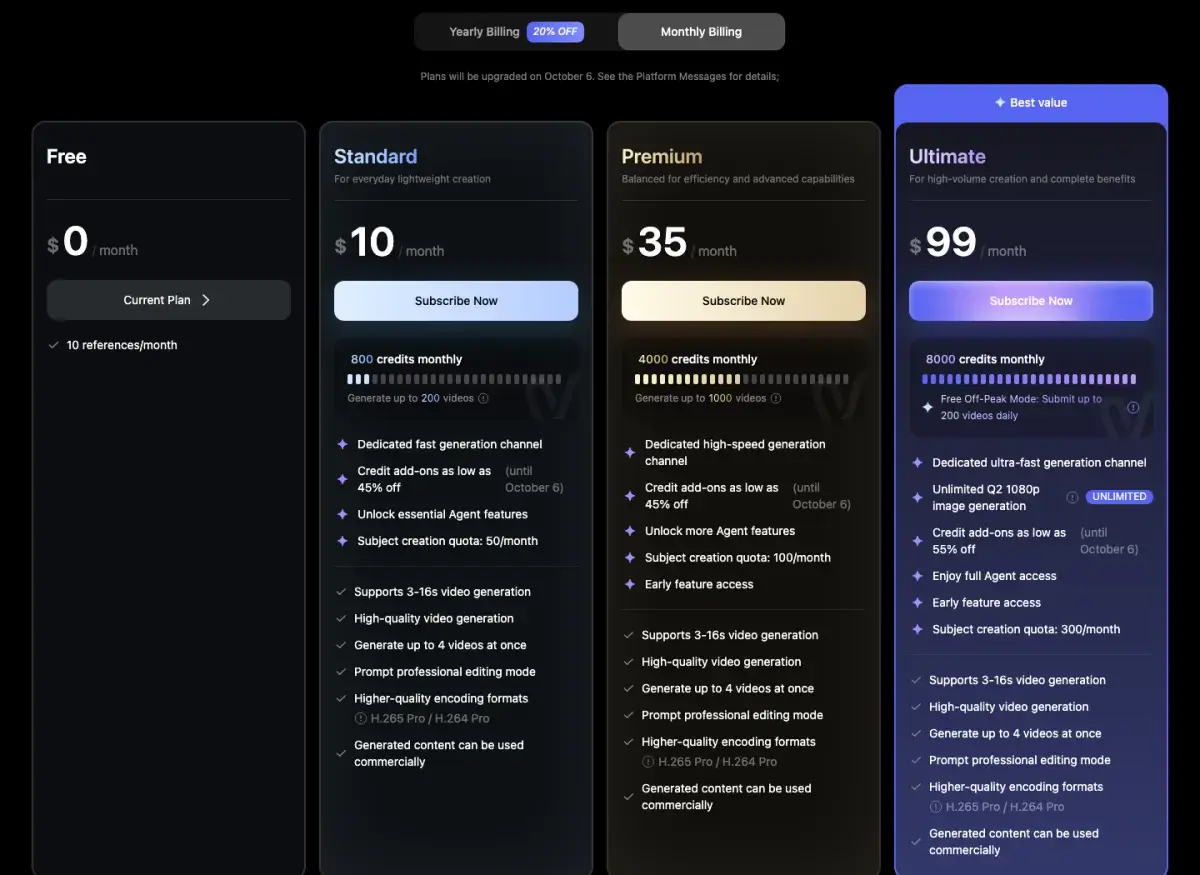
Vidu's pricing page on monthly billing, September 24, 2026, with the notice that plans change on October 6.
Hailuo AI and Vidu side by side
| Hailuo AI | Vidu |
|---|
| Maker | MiniMax, Shanghai (listed in Hong Kong) | ShengShu Tech, Beijing (Tsinghua spin-off) |
| Current model | MiniMax H3, July 2026 | Vidu Q3, January 2026 |
| Native audio | ✅ Stereo, 11 dialogue languages | ✅ Dialogue, effects, music |
| Clip length | 4 to 15 s | 3 to 16 s |
| Resolution | 2K native | 1080p, Ultra HD up to 4K on paid plans |
| Photorealistic people | ✅ Category-leading | ⚠️ Artifacts on complex motion |
| Anime and stylised | ✅ Supported | ✅ Main strength |
| Reference input | Up to 12 files (images, video, audio) | Up to 7 reference images |
| Failed renders | Not charged | Charged |
| Try Hailuo AI free | Try Vidu free |
Which to choose
Hailuo AI for the broader audience. Realistic people are what most creators need, H3 now brings sound and 15-second clips, and a pricing model that publishes per-second rates and does not charge for failures is easier to live with.
Vidu for stylised and narrative work: anime, illustrated characters, product videos with the same item in several settings, and stories with a recurring cast. Its multi-entity reference and 16-second clips suit sequences better than single shots.
Whichever you pick, use the free plan with your own prompts before subscribing. Neither tool refunds a subscription, and Vidu's plans change on October 6.
Full reviews: Hailuo AI and Vidu. For every option in one place, see the best AI video generators of 2026.
Disclosure: AIVario earns a commission if you sign up through our links. This does not affect our ratings or which tool we recommend.
Try Hailuo AI free
Try Vidu freeHailuo AI vs Vidu: frequently asked questions
Is Hailuo AI or Vidu better in 2026?
Hailuo for most people, Vidu for multi-character narrative and anime. Hailuo renders photorealistic faces in 2K with native sound, publishes per-second prices and does not charge for failed generations. Vidu keeps up to seven referenced characters, objects and settings consistent, handles stylised animation better and runs clips to 16 seconds. Both now generate audio in the same pass as the video.
Does Hailuo generate audio like Vidu?
Yes, since MiniMax H3 launched on July 31, 2026. H3 produces native stereo sound with dialogue in 11 languages, plus effects and music, in the same pass as the picture. Vidu has done this since its Q3 model in January 2026. Comparisons that call Hailuo silent were written before H3.
Which keeps characters consistent across shots, Hailuo or Vidu?
Vidu has the longer track record. Its multi-entity reference combines up to seven reference images, such as two characters, a product and a setting, and is built to keep all of them stable. Hailuo's H3 Omni Reference accepts up to 12 files, including video and audio clips, and holds a single character well. For scenes with several fixed elements, start with Vidu.
Do Hailuo and Vidu charge for failed renders?
Hailuo does not: its FAQ says failed generations cost no credits. Vidu's pricing page stated in July 2026 that failed renders consume credits. Neither offers refunds on subscriptions, so test your own prompts on each free plan before paying.
How much do Hailuo and Vidu cost per month?
Both start near $10. Hailuo Standard is $10.50 a month for 1,000 credits and Pro $38 for 4,500. Vidu Standard is $10 for 800 credits, Premium $35 for 4,000 and Ultimate $99 for 8,000 plus a free off-peak mode. Yearly billing lowers both. Vidu says its plans will change on October 6, 2026.
Is Vidu good for realistic people?
It is Vidu's weakest area. Reviewers report artifacts on complex human motion, multi-person scenes and hand gestures, while anime and stylised characters look fluid. For footage that has to pass as real, Hailuo is the safer choice, because MiniMax trained its models specifically on faces, skin and lighting.