Until July this comparison was lopsided. Kling had native audio, longer clips and 4K; Hailuo had realistic faces and a low price. MiniMax H3 changed that. Both tools now generate sound with the picture and clips of up to 15 seconds, so the choice comes down to three things: what is in your shot, how much you generate, and what happens when a generation fails.
How we compared: both pricing pages checked on September 24, 2026, plus MiniMax's H3 documentation and Kling's Video 3.0 guides. We have not run side-by-side generations of these two tools.
The short answer
Clips built around a person: Hailuo AI. Facial realism is what MiniMax trained for, and H3 renders it in 2K.
Action, sport and anything physical: Kling AI. Weight, momentum and body mechanics are where Kling built its reputation.
Paying for steady output: Hailuo AI. It costs less per second of video with sound on every plan below Kling's Ultra, and failed generations are free.
Testing for free, or delivering in 4K: Kling AI. Sixty-six credits a day, and a 4K option Hailuo does not have.
Faces against physics
MiniMax trained Hailuo on people: skin texture, facial micro-expressions, hair and fabric detail, and how light falls on a face. Reviewers have consistently placed it near the top of blind comparisons for realistic human footage. A face filling the frame is where Hailuo is hardest to beat.
Kuaishou trained Kling on motion. Kling 3.0 is built around physics-accurate movement: objects with weight, characters that follow real body mechanics, fabric and water that behave. A person picking something up, a car turning, a camera orbiting a dancer are the shots where weaker models look floaty and Kling holds together.
Most people-centred social clips favour Hailuo. Most action favours Kling. A talking head with little movement is Hailuo territory; a runner crossing the frame is Kling's.
Cost per second, with sound on
Both tools bill credits per second of video, so the useful number is the price of one finished second.
| Plan | Hailuo: MiniMax H3, 2K, with sound | Kling 3.0: 1080p, with audio |
|---|
| Entry, monthly | $0.126/s (Standard, $10.50) | $0.160/s (Standard, $8.80 after the first month) |
| Entry, yearly | $0.101/s | $0.120/s |
| Mid, monthly | $0.102/s (Pro, $38) | $0.130/s (Pro, $32.56 after the first month) |
| Mid, yearly | $0.081/s | $0.098/s |
| Top plan, yearly | $0.081/s (Max) | $0.055/s (Ultra) |
Hailuo rates as published on its plan cards. Kling rates calculated from 12 credits per second for 1080p with audio and the plan prices below. Both checked September 24, 2026.
On entry and mid plans Hailuo delivers a higher resolution for less money: Standard's 1,000 credits buy about 84 seconds of 2K video, while Kling Standard's 660 credits buy 55 seconds at 1080p with audio. Kling's Ultra plan, at $1,429.99 a year for 26,000 credits, reverses the order at agency volume.
Kling's prices come in three versions: a struck-through list price, a first-month offer and a renewal price. Standard showed $10 list, $6.99 for the first month and $8.80 after it; yearly billing takes a flat 34% off list.
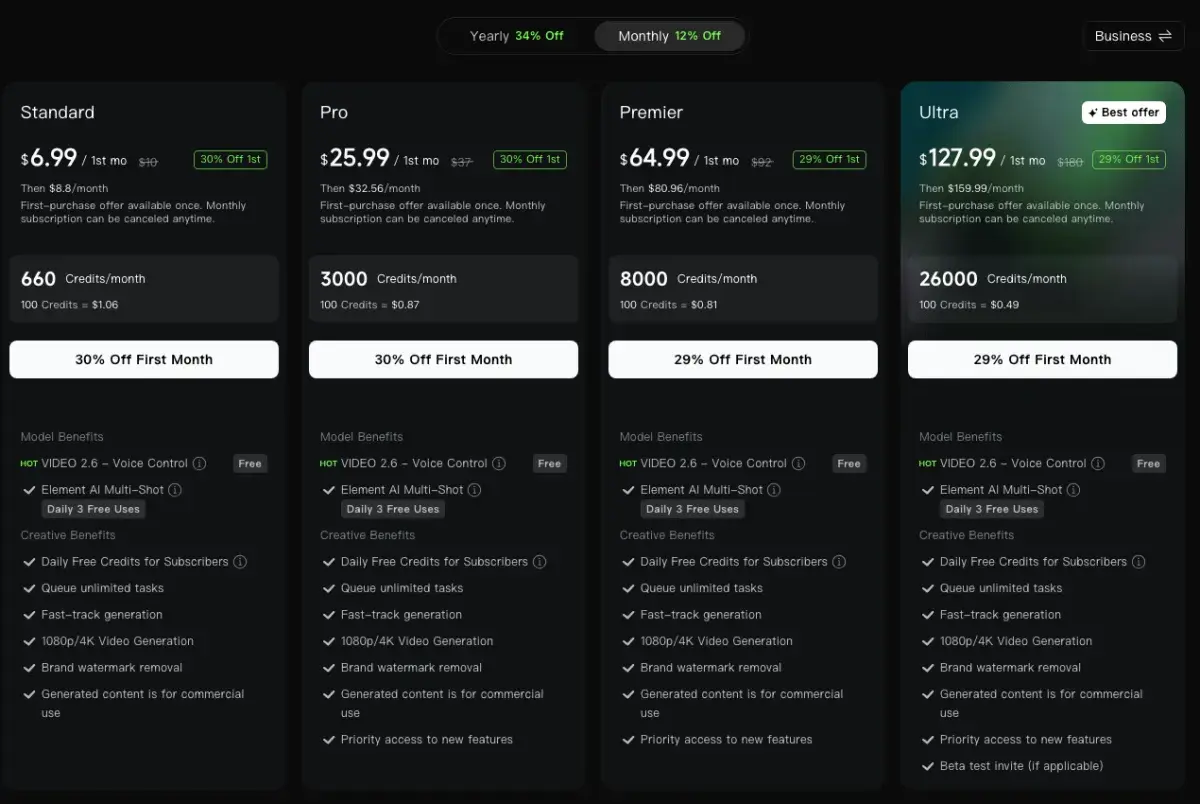
Kling's membership page on monthly billing, September 24, 2026.
Failed generations and free plans
Two policies change the real cost more than the price table does.
Failed generations: Hailuo's FAQ says videos that fail to generate cost no credits. Kling charges failed generations in its web app, but not through its API. AI video fails often on complex prompts, so on Kling the habit that saves money is previewing in Draft Mode, which renders drafts roughly 5 to 20 times faster, before paying for a full render.
Free plans point the other way. Kling gives logged-in users 66 credits a day, enough for two 5-second 720p clips, and the credits expire after 24 hours. Hailuo's September pricing page lists its free plan as one-time trial credits for its own models, with watermarked output and one task at a time. For free testing week after week, Kling is the one.
Neither is forgiving about unused spend: Hailuo does not offer refunds, and Kling's subscription credits expire at the end of each billing month with no rollover.
Audio, length and resolution
Both generate sound in the same pass as the picture. Kling produces dialogue, effects and ambience with lip sync, with dialogue in Chinese, English, Japanese, Korean and Spanish, dialect and accent support, and scenes where characters switch languages. MiniMax lists stable dialogue support in 11 languages for H3, among them English, Spanish, French, German, Russian and Arabic, with native stereo output.
On length they are level: Kling 3.0 generates 3 to 15 seconds, H3 4 to 15. Kling adds an explicit multi-shot mode that splits a generation into as many as six shots, plus an extend feature for continuing a clip, although quality drifts on long extensions.
On resolution, Hailuo renders 2K on every plan, the trial included. Kling caps free output at 720p and adds 1080p and 4K on paid plans. For a 4K deliverable, only Kling has a path.
One more difference matters to developers: MiniMax released H3's weights as open source in August 2026, so the model can run on your own infrastructure. Kling is available only as a service, through its app and API.
Where each one is ahead
| Hailuo AI | Kling AI |
|---|
| Maker | MiniMax (listed in Hong Kong) | Kuaishou (listed in Hong Kong) |
| Current model | MiniMax H3, July 2026 | Kling 3.0 |
| Photorealistic faces | ✅ Category-leading | ✅ Strong |
| Motion and physics | ✅ Strong | ✅ Category-leading |
| Native audio | ✅ Stereo, 11 languages | ✅ Lip sync, 5 languages |
| Clip length | 4 to 15 s | 3 to 15 s, up to 6 shots |
| Top resolution | 2K | 4K |
| Free plan | One-time trial | 66 credits a day |
| Entry plan | $10.50/mo, 1,000 credits | $8.80/mo after a $6.99 first month, 660 credits |
| Failed generations | Not charged | Charged in the app, not via API |
| Open weights | ✅ H3 | ❌ |
| Try Hailuo AI free | Try Kling free |
The verdict
Hailuo AI for most people paying for short clips. Since H3 it matches Kling on sound and clip length, renders a higher resolution than Kling's 1080p on every plan, costs less per second below Kling's Ultra tier, and does not charge for generations that fail. If your clips are built around people, it is the better subscription.
Kling AI when motion carries the shot, when you need 4K, or when you want to test for free every day. Its physics are still the reference point in the category, multi-shot sequences are an explicit tool, and 66 daily credits make it the easier place to learn.
The two work well together: Hailuo for close character shots, Kling for action and wide movement. Hailuo Standard plus Kling Standard on yearly billing comes to about $15 a month.
Full reviews: Hailuo AI and Kling AI. For the wider field, see the best AI video generators of 2026.
Disclosure: AIVario earns a commission if you sign up through our links. This does not affect our ratings or which tool we recommend.
Try Hailuo AI free
Try Kling AI freeHailuo AI vs Kling AI: frequently asked questions
Is Hailuo AI or Kling better in 2026?
It depends on the shot. Hailuo is the better value for short clips with people: MiniMax H3 renders 2K with native sound for less per second than Kling's 1080p, and failed generations cost nothing. Kling is better for action and physics, offers multi-shot sequences and 4K, and gives 66 free credits a day. For paid work built around faces, Hailuo; for motion, Kling.
Which is cheaper per second, Hailuo or Kling?
Hailuo, on entry and mid plans. With sound on, MiniMax H3 at 2K costs $0.102 a second on Hailuo Pro monthly and $0.081 on yearly billing. Kling 3.0 at 1080p with audio costs about $0.130 a second on Pro after the first month and $0.098 yearly. Kling's Ultra plan reverses the order at agency volume, at roughly $0.055 to $0.074 a second.
Do Hailuo and Kling charge for failed generations?
Hailuo does not: its FAQ says videos that fail to generate cost no credits. Kling charges failed generations in its web app but not through its API. Complex prompts fail often in AI video, so on Kling it pays to preview in Draft Mode before a full render.
Which has the better free plan, Hailuo or Kling?
Kling. Logged-in users get 66 credits a day, enough for two 5-second 720p clips, and unused credits expire after 24 hours. Hailuo's free plan is a one-time trial for its own models, with watermarked output. Kling suits ongoing free testing; Hailuo's trial is for judging quality before you pay.
Do Hailuo and Kling both generate audio?
Yes. Kling generates dialogue, effects and ambience with lip sync, with dialogue in Chinese, English, Japanese, Korean and Spanish plus dialect and accent support. Hailuo's MiniMax H3, launched on July 31, 2026, generates native stereo sound with stable dialogue in 11 languages. Both produce the sound in the same pass as the picture.
How long can Hailuo and Kling clips be?
Both reach 15 seconds per generation. Kling 3.0 runs 3 to 15 seconds and can split that into up to six shots; MiniMax H3 runs 4 to 15 seconds. Kling can also extend a finished clip, though quality drifts on long extensions. Past 15 seconds, both mean combining clips in an editor.