Both tools come from Chinese companies and both start at about $10 a month, but they are built for different jobs. PixVerse is built for volume: 30 free credits every day and renders that finish in under a minute. Hailuo is built for realism: MiniMax trained it on faces, and its new H3 model renders 2K clips of up to 15 seconds with sound.
How we compared: Hailuo's pricing page and MiniMax's H3 documentation, checked on September 24, 2026. PixVerse figures come from AIVario's own account in August 2026; its plan prices were last verified in April 2026 because PixVerse's plan page blocks automated checks.
The short answer
Daily TikTok, Reels or Shorts with no budget: PixVerse. Its free credits refill every night, while Hailuo's free plan is a one-time trial.
Clips where a person fills the frame: Hailuo AI. Faces are what MiniMax trained for, and H3 renders them in 2K.
Paying around $10 a month: Hailuo AI for resolution (2K with sound on the $10.50 Standard plan), PixVerse for more credits and a cheaper route to 1080p.
Ad variants, effects and templates: PixVerse. Four visual styles, an Agent and a library of Mini-Apps built for social formats.
What changed in 2026
Most comparisons of this pair are out of date, including the version of this page published in July. Three things moved.
MiniMax launched H3 on July 31, 2026. It is the first Hailuo model that generates sound with the picture: native stereo, dialogue in 11 languages, effects and music, in clips of 4 to 15 seconds at up to 2K. MiniMax released the model's weights as open source three days later.
Hailuo's free plan changed shape. The September pricing page lists one-time trial credits for Hailuo's own models rather than a daily allowance. It also says failed generations cost no credits, and that subscriptions are not refundable.
PixVerse moved to V6, which PixVerse describes as 1080p video with native audio and high-fidelity portraits. In AIVario's account in August 2026, a 1-second 540p V6 clip with audio cost 8 credits.
The old split, silent Hailuo against PixVerse with sound, no longer exists. The new one is free volume against paid quality.
Faces and realism
MiniMax trained Hailuo around a narrow target: skin texture, facial micro-expressions, hair and fabric detail, and how light falls on a face. Independent reviewers have consistently placed it near the top of blind comparisons for realistic human footage, and H3 adds 2K output on top of that reputation.
PixVerse is optimised for something else. Its Realistic style is credible and V6 improved portraits, but its strengths are stylised, fast-paced and effects-driven clips. A face filling the frame for five seconds is where the two separate; in a cut that changes every two seconds, the difference mostly disappears.
Hailuo is the pick when the eye lingers on a person.
Free plans: a daily allowance against a one-time trial
For anyone not paying yet, this is the biggest practical difference.
PixVerse gives 60 credits at signup plus 30 credits a day, refilled at midnight UTC and expiring at the end of the day (October 2026, down from 60 a day in July). Free output is up to 540p with a watermark, two generations at a time. Short drafts are cheap, so the daily allowance covers several tests; a longer 1080p clip costs much more.
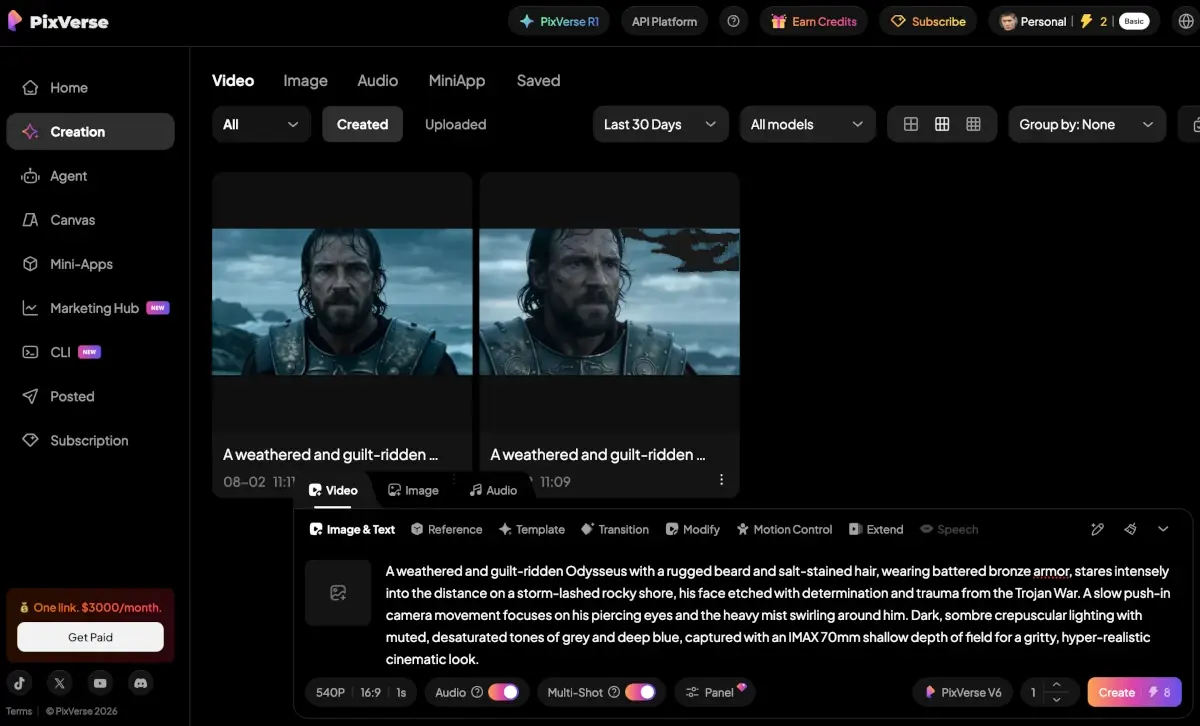
PixVerse in AIVario's account, August 2026: a V6 generation at 540p with audio cost 8 credits.
Hailuo's free plan is a trial: one-time credits, Hailuo models only, watermarked output and one task at a time. A 5-second H3 clip at 2K costs 60 credits, so the trial is enough to judge the output and not enough to keep posting.
PixVerse wins this one clearly, and it is the main reason it keeps the overall verdict.
What $10 a month buys
| Hailuo Standard | PixVerse Standard |
|---|
| Price | $10.50/mo (list $14.99), $8.40/mo yearly | $10/mo, $8/mo yearly |
| Credits | 1,000 a month | 1,200 a month |
| Top resolution | 2K (MiniMax H3) | 720p |
| Sound | Native, same pass | Native, same pass |
| What the credits buy | About 84 s of 2K or 143 s of 768P video | Short drafts from 8 credits; 1080p needs Pro |
| Failed generations | Not charged | Not stated on the plan page |
| Next plan up | Pro: $38, 4,500 credits | Pro: $30, 6,000 credits, 1080p |
At the entry price Hailuo gives more resolution per dollar and absorbs failed attempts. PixVerse gives more credits and a cheaper jump to 1080p. Above the entry tier the prices are close enough that the free plan and the subject of your clips decide it.
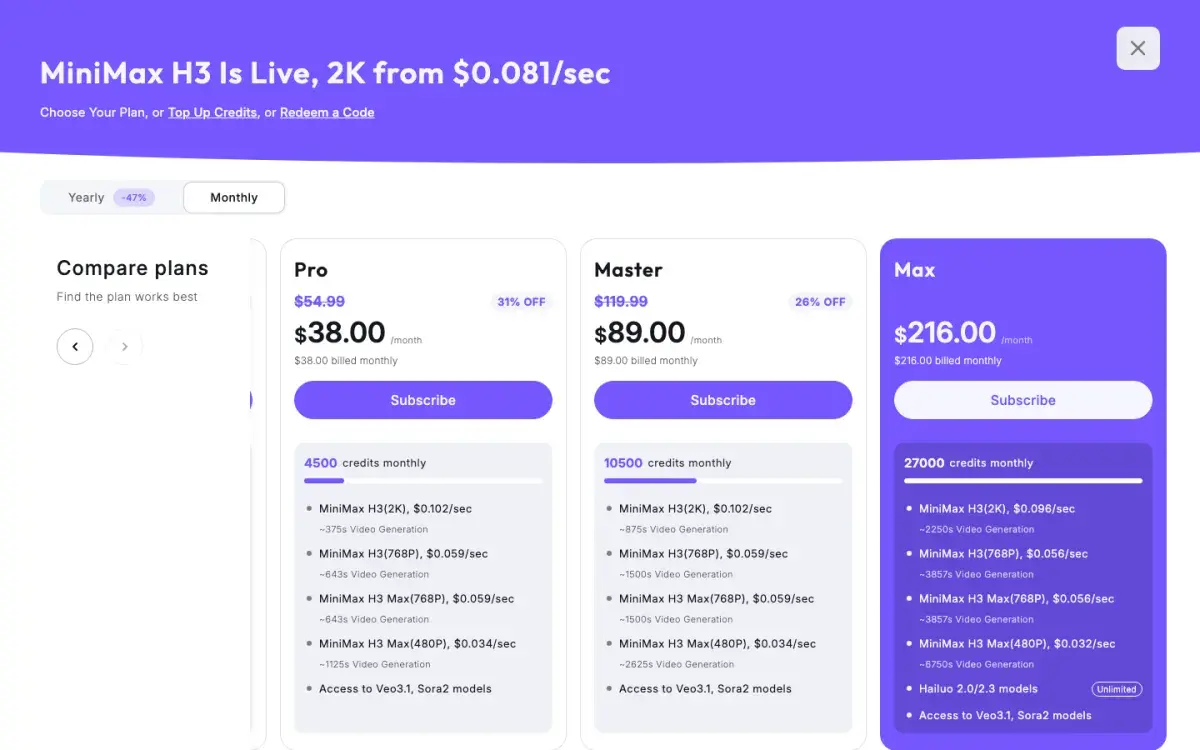
Hailuo's plan picker on monthly billing, September 24, 2026. Standard at $10.50 sits to the left of the carousel; on Pro, H3 costs $0.102 a second at 2K.
Sound, length and resolution
Both tools now generate sound in the same pass as the picture. PixVerse leans toward automatic soundtracks, effects and lip sync for social clips that publish without an audio stage. H3 leans toward dialogue: MiniMax lists stable support for 11 languages, including English, Spanish, Russian and Arabic.
On length, H3 generates 4 to 15 seconds per clip on every plan. PixVerse clips run up to about 12 seconds, and multi-shot mode chains several shots in one generation.
On resolution, Hailuo renders 2K on every plan, the trial included. PixVerse outputs 720p on the free and Standard plans, 1080p from Pro, and 4K on Ultra at $149 a month billed yearly.
Speed, styles and templates
PixVerse finishes a generation in roughly 30 to 60 seconds, and speed compounds when most attempts are drafts. Around the model it offers Realistic, Anime, Clay and 3D styles, an Agent for plain-language prompting, and Mini-Apps such as Storyboard, VibeMV for music videos, Avatar Lip Sync and Ad Master.
Hailuo's toolkit is aimed at control over a specific subject. Omni Reference accepts up to 12 files per prompt (images, video clips and audio), the older Hailuo 2.3 model adds anime, ink wash and game CG styles, and paid plans include Veo 3.1 as a third-party model.
For fast social formats, PixVerse has more ready-made tools. For keeping a specific person consistent across shots, Hailuo's references go further.
Side by side
| Hailuo AI | PixVerse |
|---|
| Maker | MiniMax, Shanghai (listed in Hong Kong) | Aishi Technology, Beijing |
| Current model | MiniMax H3 (July 2026) | PixVerse V6 |
| Free plan | One-time trial credits | 90 at signup + 60 a day |
| Entry plan | $10.50/mo, 1,000 credits | $10/mo, 1,200 credits |
| Mid plan | $38/mo, 4,500 credits | $30/mo, 6,000 credits |
| Native audio | ✅ Stereo, 11 dialogue languages | ✅ Soundtracks, effects, lip sync |
| Clip length | 4 to 15 s | Up to about 12 s, multi-shot |
| Top resolution | 2K | 1080p (4K on Ultra) |
| Render speed | Fast, not published | 30 to 60 s |
| Failed generations | Not charged | Not stated |
| Photorealistic faces | ✅ Category-leading | ⚠️ Good, not the focus |
| Styles and templates | 2.3 styles, Omni Reference | 4 styles, Agent, Mini-Apps |
| Try Hailuo AI free | Try PixVerse free |
Hailuo prices and specifications checked on September 24, 2026. PixVerse plan prices last verified in April 2026; credit costs from AIVario's account in August 2026.
Which one to pick
PixVerse for most people making short social video, because of what happens before you pay. Sixty credits a day, fast renders, native audio and a toolbox built for TikTok and Reels mean you can publish for months on the free plan and pay $10 only when the watermark starts to matter.
Hailuo AI when a real-looking person carries the shot, or when you are ready to pay for quality. $10.50 buys 2K clips of up to 15 seconds with sound, failed generations do not cost credits, and a publicly listed parent company is a plus for client work.
A few common situations:
- A lifestyle creator who appears on camera every day: Hailuo Standard, moving to Pro if 84 seconds of 2K a month runs out.
- A social manager producing five branded clips a week: PixVerse Pro at $30, for 1080p, styles and fast renders.
- A student learning AI video with no money: the PixVerse free plan.
- An agency making testimonial-style video for a client: Hailuo Pro, for 2K faces and no charge for failed attempts.
Running both is common: PixVerse for daily volume, Hailuo for the shots where a face has to hold up. Together they cost about $20 a month.
Full reviews: Hailuo AI and PixVerse.
Disclosure: AIVario earns a commission if you sign up through our links. This does not affect our ratings or which tool we recommend.
Try PixVerse free
Try Hailuo AI freeHailuo AI vs PixVerse: frequently asked questions
Is Hailuo AI or PixVerse better in 2026?
PixVerse for most social creators, Hailuo for clips built around a person. PixVerse refills 30 free credits a day and renders in 30 to 60 seconds, which suits daily TikTok and Reels. Hailuo's MiniMax H3 renders photorealistic people in 2K with native sound, and its $10.50 Standard plan outputs a higher resolution than PixVerse's $10 Standard. Pick by the subject of your clips and whether you plan to pay.
Does Hailuo AI still have a free plan like PixVerse?
It has a free plan, but it works differently. In September 2026 Hailuo's pricing page lists one-time trial credits for its own models, while PixVerse gives 60 credits at signup plus 30 every day, refilled at midnight UTC (October 2026). A 5-second 2K clip on MiniMax H3 costs 60 Hailuo credits, so the trial covers a few tests. For ongoing free use, PixVerse is the one.
Do Hailuo and PixVerse generate audio with the video?
Both do now. PixVerse has generated soundtracks, sound effects and lip sync since V5 in August 2025, and V6 keeps native audio. Hailuo added sound with MiniMax H3 on July 31, 2026: native stereo with dialogue in 11 languages, plus effects and music from the same pass. Comparisons that describe Hailuo as silent were written before H3.
Which gives more for $10 a month, Hailuo or PixVerse?
It depends on what you measure. Hailuo Standard costs $10.50 for 1,000 credits, about 84 seconds of 2K video or 143 seconds at 768P, and failed generations cost nothing. PixVerse Standard costs $10 for 1,200 credits but tops out at 720p; 1080p starts on Pro at $30. Hailuo gives more resolution per dollar, PixVerse more credits.
How long can Hailuo and PixVerse videos be?
MiniMax H3 generates 4 to 15 seconds per clip on every Hailuo plan, including the trial. PixVerse clips run up to about 12 seconds, and its multi-shot mode chains several shots inside one generation. Anything longer means combining clips in an editor such as CapCut.
Can I use Hailuo and PixVerse videos commercially?
Yes, on paid plans. Hailuo says any video you can download without a watermark is yours to use commercially, and PixVerse includes commercial rights on all paid plans. Free output from both carries a watermark. Hailuo does not offer refunds, so test your prompts on the trial before subscribing.