Vidu and PixVerse are aimed at different finished products. PixVerse is built for a steady stream of standalone clips. Vidu is built for sequences in which the same characters, products and places have to appear again and again. Both generate sound, both start at $10 a month, and the choice follows from what you publish.
How we compared: Vidu's pricing page, plan table and FAQ checked on September 24, 2026. PixVerse figures come from AIVario's own account in August 2026, with plan prices last verified in April 2026 because PixVerse's plan page blocks automated checks.
Which one fits your work
PixVerse fits if you:
- publish short standalone clips to TikTok, Reels or Shorts;
- want a free plan you can keep using, not just a trial;
- work with effects, templates and quick style changes.
Vidu fits if you:
- tell stories with the same characters across many shots;
- make product videos with one item in several settings;
- work in anime or an illustrated style.
Keeping a cast consistent
Vidu's defining feature is multi-entity reference. You upload up to seven reference images, for example a main character, a second character, a product, a location and a lighting style, and Vidu combines them in one generation and keeps them stable in the next. Reviewers report that it works as advertised, and it is uncommon at this price.
PixVerse approaches control through the single clip: multi-shot generation, image-to-video, motion control and extend. Those tools shape one clip precisely. They do not keep a cast of three recognisable across twenty separate generations, which is the problem Vidu solves.
For a series of unrelated clips this difference never comes up. For a story, it decides the comparison.
Free credits and paying
PixVerse has the more predictable free plan: 60 credits at signup plus 30 a day, refilled at midnight UTC, at up to 540p with a watermark (October 2026). In AIVario's account in August 2026, a 1-second 540p V6 draft with audio cost 8 credits, so the daily allowance covers about three tests.
Vidu's free plan lists 10 references a month. Its FAQ adds trial credits at sign-up and credits for logging in daily, without publishing amounts, and the plan table reserves 720p and 1080p video, watermark-free downloads and commercial use for paid plans. It is an evaluation plan.
Paid plans reverse part of that. At $10 a month, Vidu Standard gives 800 credits with 1080p output and clips up to 16 seconds; PixVerse Standard gives 1,200 credits at 720p, with 1080p starting on its $30 Pro plan.
| Vidu | PixVerse |
|---|
| Free | 10 references a month + trial and daily login credits | 90 at signup + 60 credits a day, 720p |
| Entry | Standard: $10/mo ($8 yearly), 800 credits, 1080p | Standard: $10/mo ($8 yearly), 1,200 credits, 720p |
| Mid | Premium: $35/mo ($28 yearly), 4,000 credits | Pro: $30/mo ($24 yearly), 6,000 credits, 1080p |
| Top | Ultimate: $99/mo ($79 yearly), 8,000 credits + free off-peak mode | Ultra: $149/mo billed yearly, 25,000 credits, 4K |
| Refunds and failures | No refunds; failed renders charged (July 2026) | Not stated on the plan page |
Vidu checked on September 24, 2026; its plans change on October 6. PixVerse plan prices last verified in April 2026.
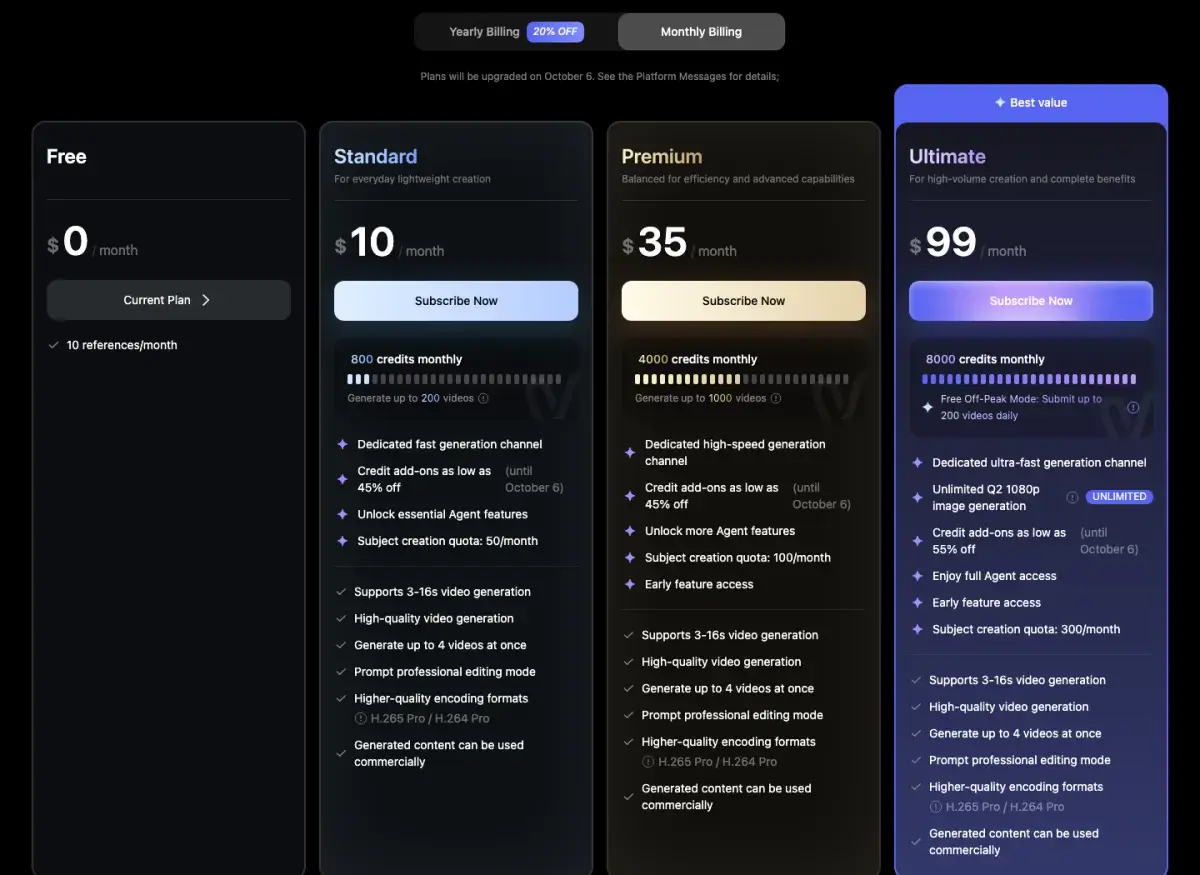
Vidu's pricing page on monthly billing, September 24, 2026.
Sound, length and output
Both generate sound in the same pass as the picture. PixVerse's audio, added with V5 in August 2025, leans toward automatic soundtracks, effects and lip sync for clips that publish without an audio stage. Vidu Q3, launched in January 2026, generates synchronised dialogue, effects and music, which suits scenes where characters speak.
Vidu's paid plans generate 3 to 16 seconds per clip; PixVerse clips run up to about 12 seconds, with multi-shot mode chaining shots inside one generation. Sixteen seconds is enough for a complete beat of setup, action and reaction with sound attached.
Vidu generates 1080p on every paid plan and lists "Ultra HD up to 4K" from Standard upward. PixVerse outputs 720p on Standard, 1080p from Pro and 4K on Ultra.
Templates, styles and speed
PixVerse wraps its model in a creator toolbox: Realistic, Anime, Clay and 3D styles, an Agent for plain-language prompting, image generation with third-party models, and Mini-Apps for storyboards, music videos, lip sync and ads. It renders a generation in roughly 30 to 60 seconds.
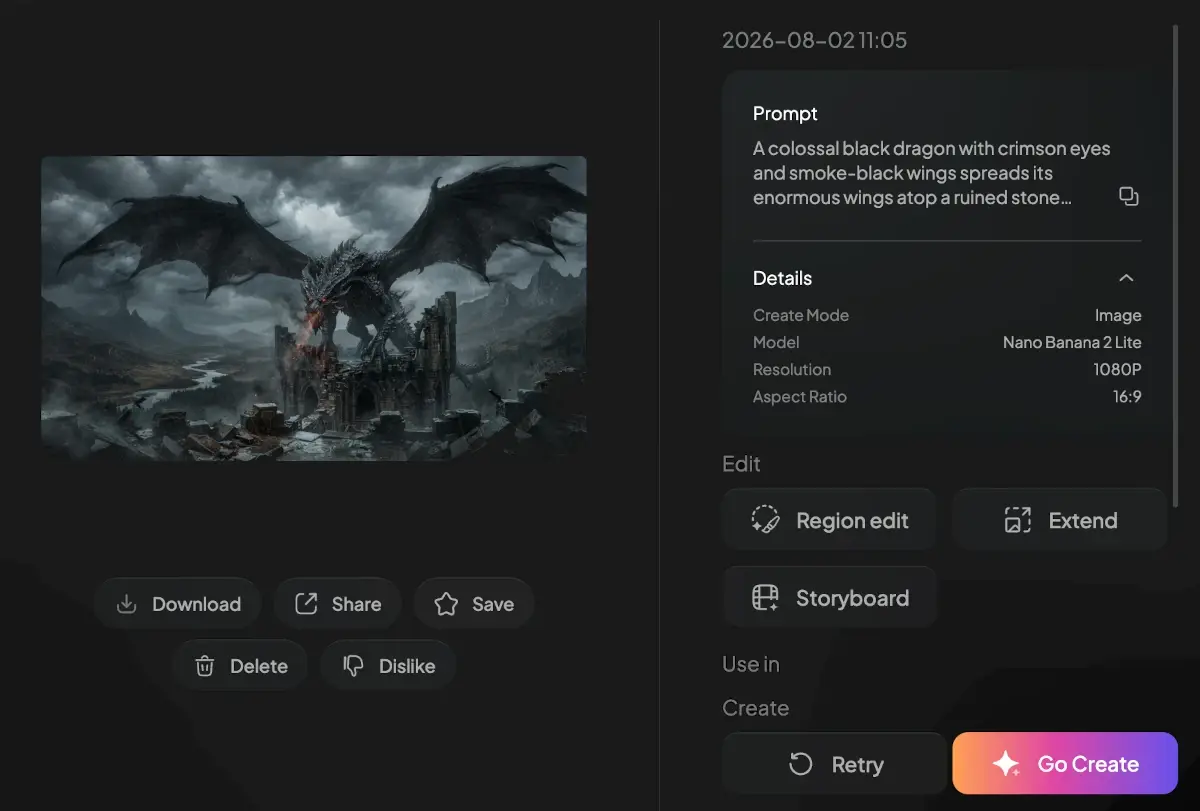
PixVerse's editor in AIVario's account, August 2026: image generation sits next to video, with Extend and Storyboard one click away.
Vidu is quick too: reviewers report four-second clips in about ten seconds and longer clips in under a minute. Its own template library and agent features are growing, but its reputation rests on reference control and anime-style animation rather than on templates.
Vidu and PixVerse side by side
| Vidu | PixVerse |
|---|
| Maker | ShengShu Tech, Beijing (Tsinghua spin-off) | Aishi Technology, Beijing |
| Current model | Vidu Q3 | PixVerse V6 |
| Consistency across shots | ✅ Up to 7 reference entities | ⚠️ Per clip: multi-shot, image-to-video |
| Free plan | Evaluation credits | 60 credits a day |
| Entry resolution | 1080p | 720p |
| Clip length | 3 to 16 s | Up to about 12 s |
| Native audio | ✅ Dialogue, effects, music | ✅ Soundtracks, effects, lip sync |
| Anime and stylised | ✅ Main strength | ✅ Anime, Clay and 3D styles |
| Templates | ⚠️ Growing library | ✅ Mini-Apps, Agent |
| Refunds | ❌ None | Not stated |
| Try Vidu free | Try PixVerse free |
The pick
PixVerse for most people making AI video, because most people are making standalone social clips. Its free plan works as a real production budget, its renders are fast, and its styles and Mini-Apps are built for exactly those formats. When the watermark starts to matter, $10 removes it.
Vidu for anything that behaves like a story: a recurring cast, a product shown in several settings, an anime series. Multi-entity reference, 1080p on the entry plan and 16-second clips make it the better subscription for sequences. Test on the free plan first, because Vidu does not refund subscriptions and its plans change on October 6.
Full reviews: Vidu and PixVerse. The wider field is covered in the best AI video generators of 2026.
Disclosure: AIVario earns a commission if you sign up through our links. This does not affect our ratings or which tool we recommend.
Try PixVerse free
Try Vidu freeVidu vs PixVerse: frequently asked questions
Is Vidu or PixVerse better in 2026?
PixVerse for daily social volume, Vidu for narrative work with a recurring cast. PixVerse refills 30 free credits a day and wraps its V6 model in styles and templates for TikTok and Reels. Vidu keeps up to seven referenced characters, objects and settings consistent across shots, generates 1080p on its $10 plan and runs clips to 16 seconds.
Which free plan is better, Vidu or PixVerse?
PixVerse. It gives 60 credits at signup plus 30 a day, refilled at midnight UTC, at up to 540p with a watermark (October 2026). Vidu's free plan lists 10 references a month, and its FAQ adds sign-up trial credits and daily login credits without publishing the amounts. Vidu's plan table reserves 720p and 1080p video for paid plans.
Which keeps characters consistent, Vidu or PixVerse?
Vidu. Its multi-entity reference combines up to seven reference images, such as characters, a product and a setting, and keeps them stable across generations. PixVerse offers multi-shot generation, image-to-video and motion control, which shape a single clip well but do not hold a whole cast steady across a sequence.
What does $10 a month buy on Vidu and PixVerse?
Vidu Standard costs $10 ($8 yearly) for 800 credits, quoted as up to 200 videos, with 1080p output, clips of 3 to 16 seconds and commercial use. PixVerse Standard costs $10 ($8 yearly) for 1,200 credits at 720p without a watermark, with commercial rights; 1080p starts on the $30 Pro plan. PixVerse prices were last verified in April 2026.
Do Vidu and PixVerse generate audio?
Both do. PixVerse has generated soundtracks, effects and lip sync since V5 in August 2025. Vidu Q3, launched in January 2026, generates synchronised dialogue, effects and music in clips of up to 16 seconds. PixVerse suits clips that need a soundtrack; Vidu suits scenes where characters speak.
Does Vidu refund failed renders?
No. Vidu's FAQ says it is unable to provide refunds, and its pricing page stated in July 2026 that failed renders consume credits. Longer clips fail more often, so test prompts at short lengths first. PixVerse does not state a failure policy on its plan page, but its daily free credits absorb most early mistakes.