Kling and Vidu attack the same weakness of AI video from different sides. Kling makes a single shot move like the real world. Vidu makes several shots look as if they belong to the same story. Both generate sound, both come from Chinese companies, and both start around $10 a month.
How we compared: both pricing pages checked on September 24, 2026, plus Kling's Video 3.0 guides and Vidu's plan table and FAQ. We have not run side-by-side generations of these two tools.
In one line each
- Kling AI: the best motion physics in the accessible tier, dialogue in five languages, 4K, and a free allowance of 66 credits a day.
- Vidu: seven-entity reference for a consistent cast, fluid anime and stylised animation, clips up to 16 seconds, and a free off-peak mode on its top plan.
Realistic motion: Kling
Kuaishou built Kling 3.0 around physics-accurate movement. Objects carry weight, characters follow real body mechanics, and fabric, water and hair behave the way they should. It is the reason Kling has more than 60 million creators, and the difference shows most when someone walks, lifts, dances or turns.
Vidu's documented weakness sits exactly here. Reviewers report artifacts on complex human actions, multi-person scenes and hand gestures. If the footage has to pass as real, Kling is the tool.
A consistent cast: Vidu
Character drift, where the protagonist looks slightly different in every shot, is what quietly ends most narrative AI video. Vidu's multi-entity reference targets it directly: up to seven reference images, such as two characters, a product, a location and a lighting style, combined in one generation and held stable across the next.
Kling has consistency tools of its own. Multi-shot mode builds up to six connected shots inside one 15-second generation, and image-to-video keeps a subject from a reference frame. For one recurring character that is enough. For a scene built from several fixed elements, Vidu's seven slots are more granular.
The same logic applies to style. Vidu's anime and stylised animation is where reviewers rate it highest, and a drawn cast hides the realism weakness entirely.
Sound, length and resolution
Both generate sound with the picture. Kling produces dialogue, effects and ambience with lip sync, with dialogue in Chinese, English, Japanese, Korean and Spanish plus dialect and accent support. Vidu Q3, launched in January 2026, produces synchronised dialogue, sound effects and music. Kling documents its language coverage in more detail.
On length, Vidu's paid plans generate 3 to 16 seconds and Kling 3.0 generates 3 to 15. Kling can extend a finished clip further, with quality that drifts on long extensions.
On resolution, Kling caps free output at 720p and adds 1080p and 4K on paid plans. Vidu generates 1080p on paid plans and lists "Ultra HD up to 4K" from Standard upward.
What the credits buy
| Kling AI | Vidu |
|---|
| Free | 66 credits a day, 720p | 10 references a month, sign-up trial and daily login credits |
| Entry | Standard: $6.99 first month, then $8.80 (list $10), 660 credits | Standard: $10/mo ($8 yearly), 800 credits |
| Mid | Pro: $25.99 first month, then $32.56 (list $37), 3,000 credits | Premium: $35/mo ($28 yearly), 4,000 credits |
| Top | Ultra: $127.99, then $159.99 (list $180), 26,000 credits | Ultimate: $99/mo ($79 yearly), 8,000 credits + free off-peak mode |
| Yearly billing | 34% off list | 20% off |
| How credits are spent | Per second: 6 at 720p silent, 12 at 1080p with audio | Per video; Standard quoted as up to 200 videos |
| Credit expiry | Monthly, no rollover | Subscription credits last 30 days |
Both checked on September 24, 2026. Vidu's credit add-ons are discounted until October 6, when its plans change.
Kling is easier to budget because it publishes the per-second rate: Standard's 660 credits are 55 seconds of 1080p video with audio, or 110 seconds of 720p without. Vidu's "up to 200 videos" works out to 4 credits a clip, a figure that describes its shortest, cheapest settings rather than a 16-second Q3 clip with sound.
For very high volume, Vidu's Ultimate plan has a card Kling does not: a free off-peak mode of up to 200 videos a day, slower but not charged against credits.
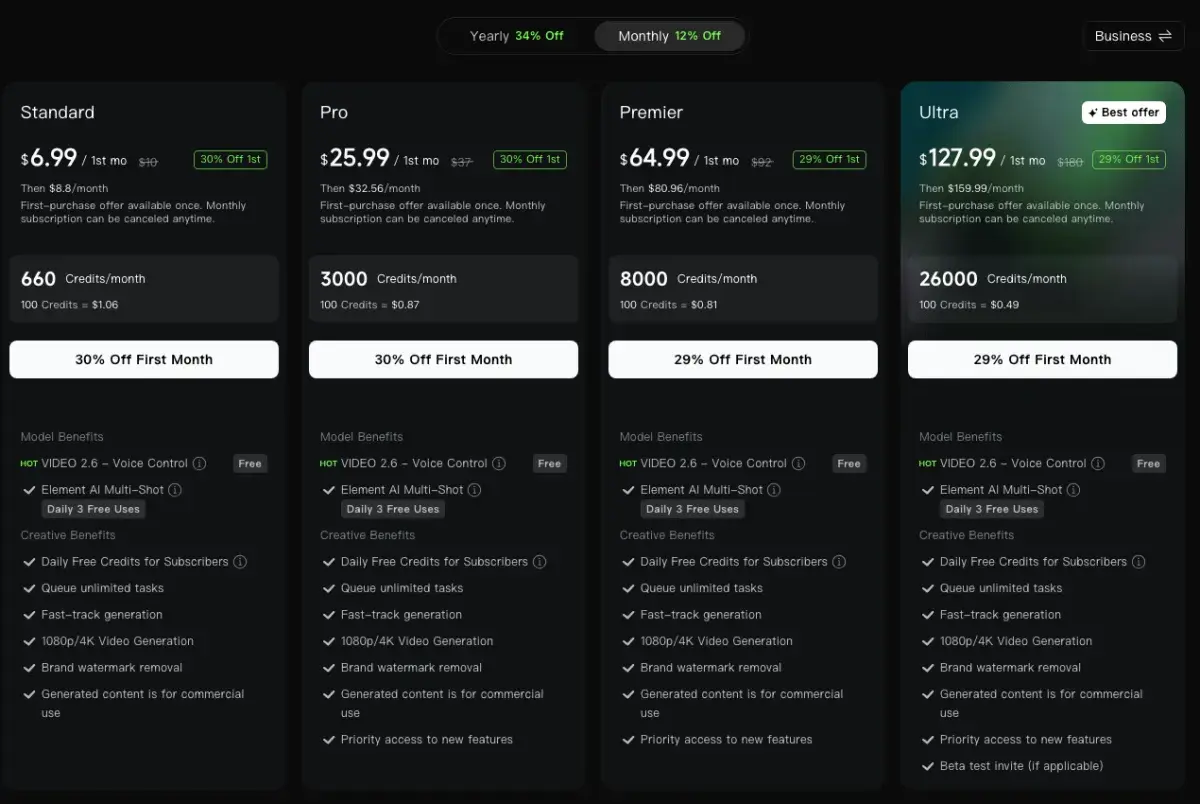
Kling's membership page on monthly billing, September 24, 2026.
When a render fails
AI video fails often on complex prompts, so the failure policy is part of the price.
Kling charges failed generations in its web app but not through its API. For experimental work the API is the cheaper route, and in the app Draft Mode, which renders previews at roughly 5 to 20 times normal speed, catches most bad prompts before a full render.
Vidu's pricing page stated in July 2026 that failed renders consume credits, and its FAQ says refunds are not provided. Longer clips fail more often, which makes 16-second attempts the expensive ones. Vidu is quick, though: reviewers report four-second clips finishing in about ten seconds, so testing a prompt short before going long is cheap in time.
Kling and Vidu side by side
| Kling AI | Vidu |
|---|
| Maker | Kuaishou | ShengShu Tech (Tsinghua spin-off) |
| Current model | Kling 3.0 | Vidu Q3 |
| Motion realism | ✅ Category-leading | ⚠️ Artifacts on complex human motion |
| Reference consistency | ✅ Multi-shot, image references | ✅ Up to 7 entities |
| Anime and stylised | ✅ Supported | ✅ Main strength |
| Native audio | ✅ Dialogue in 5 languages, lip sync | ✅ Dialogue, effects, music |
| Clip length | 3 to 15 s, up to 6 shots | 3 to 16 s |
| Top resolution | 4K | Ultra HD up to 4K |
| Failed generations | Charged in the app, free via API | Charged |
| Free allowance | 66 credits a day | 10 references a month + daily login credits |
| Try Kling free | Try Vidu free |
Which to pick
Kling AI for most people. Realistic motion is the thing viewers notice first, and Kling does it best in this price range. Add documented five-language dialogue, 4K, a daily free allowance and an API that does not bill failures, and it is the more complete tool.
Vidu for anime, illustrated characters and product or story videos that reuse the same elements across shots. Its multi-entity reference and 16-second clips suit sequences, and its Ultimate plan's off-peak mode is the cheapest way to generate in bulk if you can wait.
Test both with your own prompts before paying. Vidu does not refund subscriptions, and its plans change on October 6.
Full reviews: Kling AI and Vidu. All the options, with prices, are in the best AI video generators of 2026.
Disclosure: AIVario earns a commission if you sign up through our links. This does not affect our ratings or which tool we recommend.
Try Kling AI free
Try Vidu freeKling AI vs Vidu: frequently asked questions
Is Kling or Vidu better in 2026?
Kling for realistic motion, Vidu for stylised stories with a recurring cast. Kling 3.0 leads on physics-accurate movement, offers dialogue in five languages and 4K, and gives 66 free credits a day. Vidu keeps up to seven referenced characters, objects and settings consistent, animates anime and stylised characters well and runs clips to 16 seconds. For realistic footage, Kling is the stronger tool.
How do Kling and Vidu credits compare?
They are counted differently. Kling bills per second: 6 credits at 720p without audio and 12 at 1080p with audio, so Standard's 660 credits buy 55 seconds of 1080p with sound. Vidu sells a monthly pool (800 credits on Standard, 4,000 on Premium) and quotes Standard as up to 200 videos, without publishing a per-second rate. Subscription credits expire monthly on both.
Do Kling and Vidu charge for failed generations?
Both do in their apps. Kling charges failed generations in the web app but not through its API, which makes the API the cheaper route for experimental work. Vidu's pricing page stated in July 2026 that failed renders consume credits, and Vidu offers no refunds. On Kling, Draft Mode previews cut the waste.
Which is better for anime and stylised video, Kling or Vidu?
Vidu. Reviewers consistently single out its anime and stylised character animation as fluid, and its multi-entity reference keeps a stylised cast consistent across shots. Kling's strength is realistic motion, which matters less when the characters are drawn. For photorealistic people the order reverses.
Do Kling and Vidu generate audio?
Both do, in the same pass as the video. Kling generates dialogue, effects and ambience with lip sync and documents dialogue in Chinese, English, Japanese, Korean and Spanish, with dialect and accent support. Vidu Q3, launched in January 2026, generates synchronised dialogue, sound effects and music in clips of up to 16 seconds.
What do Kling and Vidu cost per month?
Kling Standard lists at $10 but costs $6.99 for the first month and $8.80 after that, for 660 credits; Pro is $25.99, then $32.56, and yearly billing takes 34% off list. Vidu Standard is $10 a month ($8 yearly) for 800 credits, Premium $35 and Ultimate $99, which adds a free off-peak mode. Vidu's plans change on October 6, 2026.