Consensus is an AI search engine for academic research that answers questions from more than 220 million peer-reviewed papers, with citations. The free plan includes basic paper search, 10 Pro messages a month and up to 3 Deep reviews. Pro costs $20 a month, or $12 billed yearly, with unlimited Pro messages, 15 Deep reviews a month and 500 API and MCP uses. Deep costs $65, or $45 yearly, with 200 Deep reviews. Teams pay $30 per seat a month for up to 200 seats, and students, faculty and US clinicians can get up to 40% off.
✓Best for: Students, researchers and clinicians who want quick, cited answers from peer-reviewed studies
✗Skip if: You need data-extraction tables for systematic reviews, or answers that draw on news, books and the wider web
This analysis is based on documentation, public user reports, and vendor materials — not yet on our own hands-on testing. How we rate
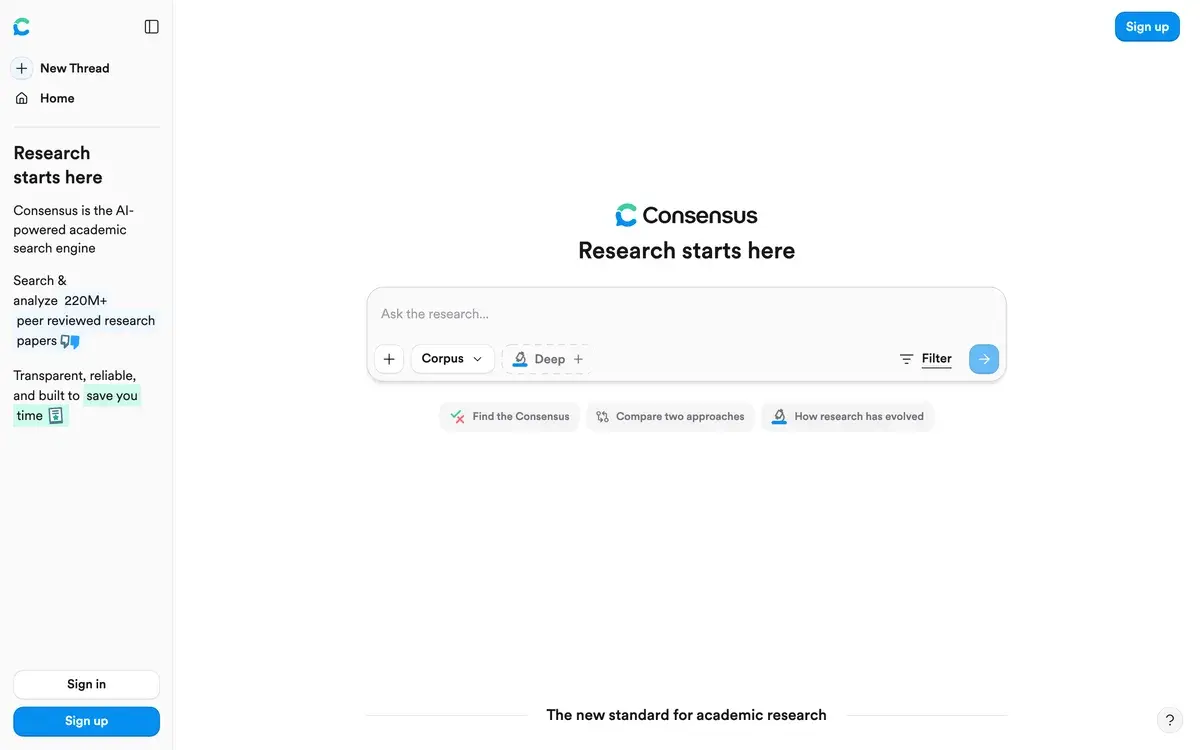
Consensus homepage, captured Oct 4, 2026.
Consensus is built for one kind of question: what does the research say? Ask whether a supplement improves sleep or whether a teaching method raises test scores, and it answers from peer-reviewed papers instead of the open web. Every claim in the answer links back to a study.
That narrow focus is the point. Consensus says its index covers more than 220 million papers and that over 5 million researchers, students and clinicians use it. It isn't built for writing essays or summarizing the news. It will tell you, quickly and with sources, where the evidence stands.
Free, Pro, Deep and Teams
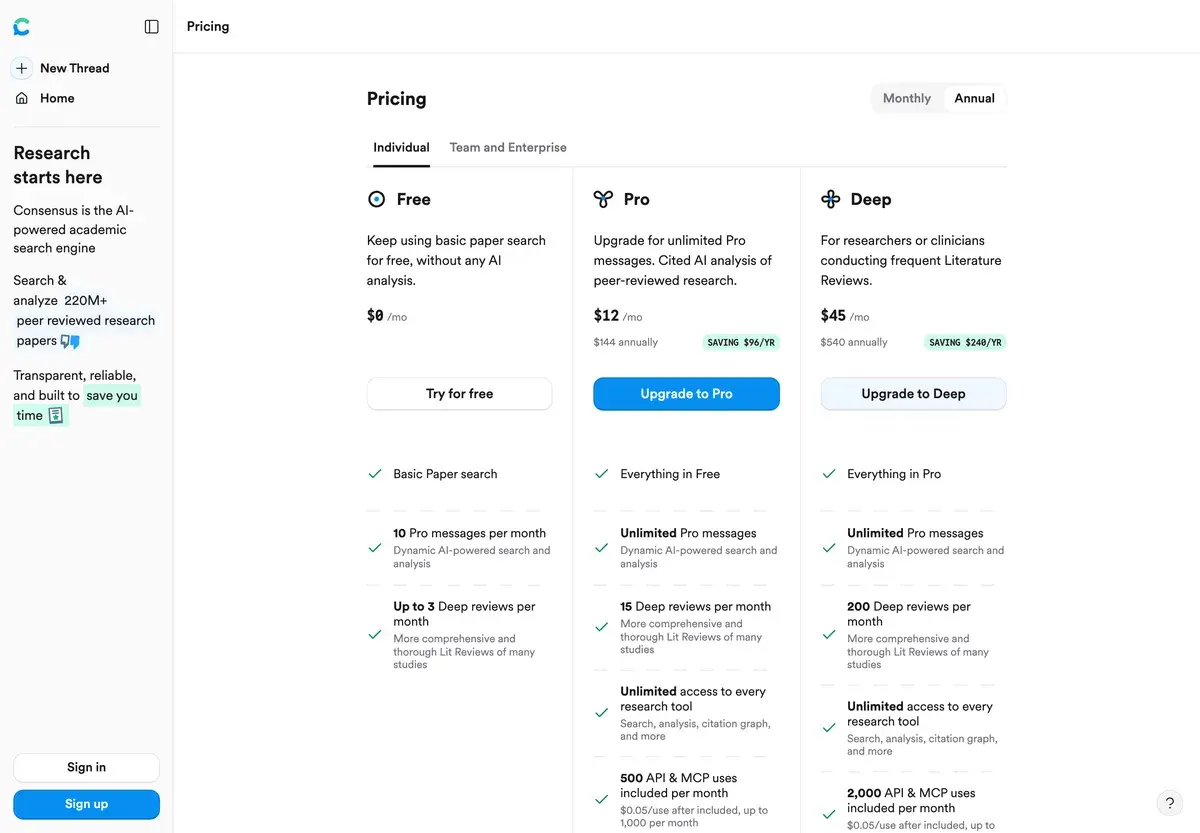
Individual plans with annual billing, captured October 4, 2026.
Free
Pro
Deep
Teams
Price a month
$0
$20, or $12 billed yearly
$65, or $45 billed yearly
$30 per seat
Pro messages
10 a month
Unlimited
Unlimited
Unlimited
Deep reviews
Up to 3 a month
15 a month
200 a month
50 a month
API and MCP uses
None
500 a month, then $0.05 each up to 1,000
2,000 a month, then $0.05 each up to 10,000
500 a month, then $0.05 each up to 1,000
Also included
Basic paper search
Every research tool, including the citation graph
Same as Pro
Account management, central billing, the Search API, up to 200 seats
Yearly billing saves $96 a year on Pro and $240 on Deep. Enterprise, for universities and large research organizations, is priced on request. It adds volume discounts, integration with your research library, management for thousands of users, single sign-on through Okta, Azure AD, OpenAthens or Google Workspace, and dedicated support.
Students and faculty with a school email, and US healthcare professionals with an NPI number, can claim up to 40% off any subscription.
What the free plan gets you
Basic paper search is free and unlimited, but it's only search, with no AI analysis on top. The AI part comes in two allowances. Pro messages are the standard cited answers, and free accounts get 10 a month. Deep reviews are longer literature reviews that work through many studies, and free accounts get up to 3.
That's enough to see how Consensus handles your field, and for an occasional question it may be all you need. A student writing a thesis, or a clinician checking evidence every week, will run out within days.
Pro or Deep
Pro removes the message limit and raises Deep reviews to 15 a month, with every research tool included, from analysis to the citation graph. For most students and researchers, that's the plan.
Deep is for people who run literature reviews constantly, such as researchers preparing grant applications or clinicians keeping up with a specialty. It costs more than three times as much as Pro and gives 200 Deep reviews a month, plus more API and MCP uses. Unless you need more than 15 Deep reviews a month, Pro is the better buy.
The API and MCP allowance matters if you connect Consensus to other tools. MCP lets an AI assistant query Consensus directly, so an agent can pull peer-reviewed evidence into a larger task.
Reading the answers critically
Consensus makes evidence easy to find, which isn't the same as making it easy to judge. A summary can make a small pilot study sound as solid as a large trial. Before you rely on an answer, open the two or three most important papers and check the sample size, the study design and who took part. Results from one population don't always transfer to another.
Treat the answer as a map of the literature, not the conclusion. That habit matters most for health questions, where a confident summary of weak evidence can do real harm.
For more than a quick answer
A literature review needs more than a yes or no. Elicit is built for that stage, with data extraction tables and screening across thousands of papers. Scite shows whether later work supports or disputes a paper's claims. Perplexity covers the open web, with Education Pro at $10 a month, and Gemini Notebook answers questions about PDFs you already have, for free. The AI research tools guide explains which one fits each stage of a project.
Consensus wins on speed. When you want to know in a minute whether the research leans one way or the other, it's the quickest route to a cited answer.
Frequently Asked Questions about Consensus
How much can you do on Consensus for free?
Basic paper search is free without limits, but it comes without AI analysis. On top of that, free accounts get 10 Pro messages a month, which add AI-powered search and analysis, and up to 3 Deep reviews a month for broader literature reviews.
How much does Consensus cost for students?
Pro lists at $20 a month, or $12 billed yearly. Students and faculty with a valid school email, and US healthcare professionals with an NPI number, can claim up to 40% off a subscription through the discount link on the pricing page.
What is a Deep review on Consensus?
A more thorough literature review that works across many studies, beyond a standard Pro answer. Free accounts get up to 3 a month, Pro 15, Teams 50 and the Deep plan 200.
Is Consensus reliable?
Its answers come from peer-reviewed papers and cite every claim, which makes checking easy. That doesn't make every summary right. AI can overstate what a study found or skip its limitations, so open the key papers before relying on a conclusion, especially for health decisions.
Does Consensus have an API?
Yes. Pro includes 500 API and MCP uses a month, then $0.05 per use up to 1,000. Deep includes 2,000, with extra uses up to 10,000 a month. Teams get the Consensus Search API, and Enterprise can arrange custom limits.