Scite

Scite

★ Top rated
AI Citation Analysis

AI tool that classifies citations as supporting, mentioning, or contrasting — the missing signal in academic literature.

Free trial · $20/mo
📖 12 min read
Try Scite for free

Affiliate link — we may earn a commission

Ready to try it?
Scite
Free trial · $20/mo
Get started →
Affiliate link — we may earn a commission
Our rating
4.7/ 5
AIVario Editor's rating →

What is Scite?

For most of academic publishing's history, the only thing you knew about a paper's reception was the count of citations to it. A highly-cited paper was important. A poorly-cited paper was forgettable. The fact that "important" and "true" are different things — that a paper could be highly cited because everyone disagreed with it, or because everyone thinks it has been disproven and keeps citing it as a cautionary example — was systematically invisible to anyone outside the specific field.

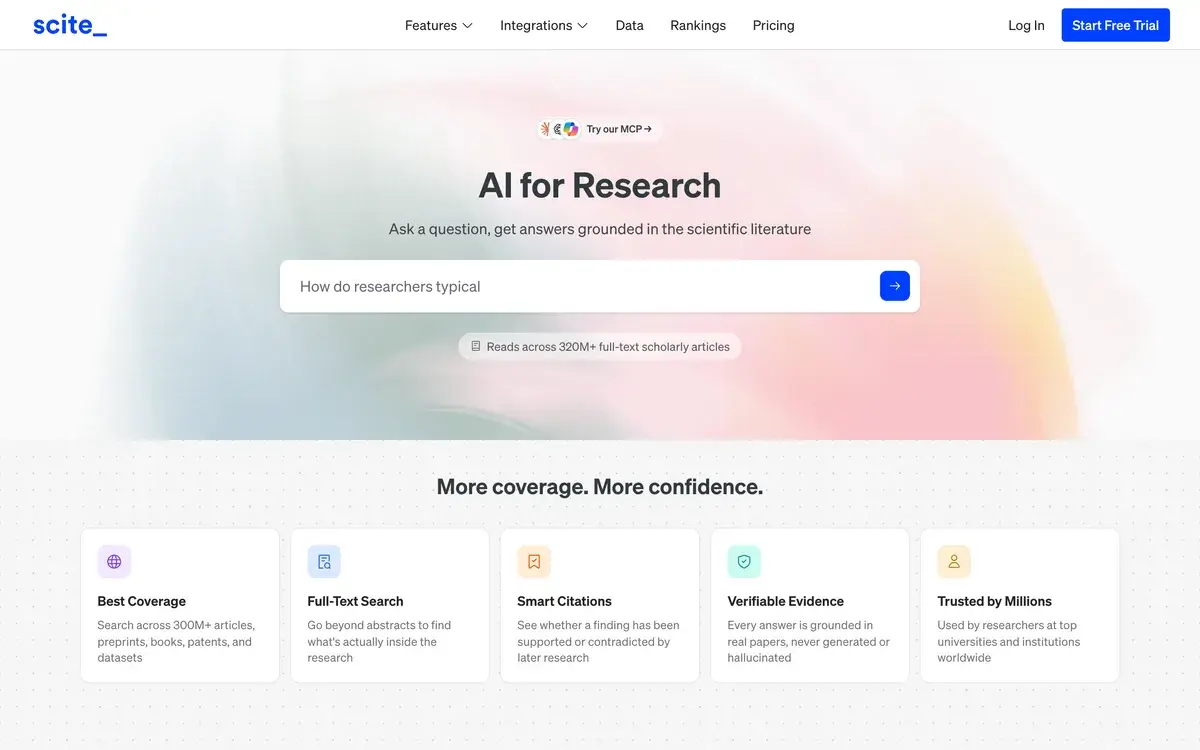
Scite is an attempt to fix this. It reads the actual text around every citation and classifies what the citation is doing: supporting the cited claim, mentioning it as background, or contrasting against it. The result is that for any paper or claim, you can see not just how many people cite it, but what those people are saying when they do. For evidence-based research — and especially for research that depends on knowing whether a finding has held up — this is the missing signal that citation counts could never provide.

The tool started as a research project, became a startup in 2018, and has matured through several model upgrades into one of the more genuinely useful AI applications in academic work. It is not flashy. It does one thing: read citation context and tell you what is happening. But that one thing is meaningful.

The problem Scite addresses

Consider a hypothetical scenario familiar to any researcher who has done a serious literature review. You find a paper with 800 citations. The paper claims that intervention X reliably produces outcome Y. Eight hundred citations sounds like consensus. You build your own argument on top of this finding.

Then you discover, three weeks later, that of those 800 citations, 150 are studies that explicitly contradicted the original finding. Another 300 are reviews and meta-analyses that listed the paper without evaluating it. The remaining 350 include the original methodology with various caveats, and many of them came from the original author's own lab or close collaborators. The "consensus" you thought existed was not consensus at all. The actual literature is mixed and contested.

This is the exact problem Scite was built to surface. Instead of going through 800 citing papers manually to read each one and judge what the citation is doing — a task that takes weeks of full-time work for a single paper — Scite has already done this for you. You see the breakdown immediately: support, mentioning, contrasting, percentages. You can drill into the contrasting citations and read what they actually said. The work that used to be impossible at scale becomes possible in minutes.

Whether you trust the AI-generated classification entirely is a separate question (and the honest answer is: trust it for the rough picture, verify it for high-stakes specific claims). But the directional signal is invaluable. Citation counts told you a paper was important. Scite tells you whether the field has accepted it.

Who is it for?

Academic researchers running systematic literature reviews are the primary audience. The classification across hundreds or thousands of citations compresses what was previously infeasible work — verifying the reception of every key claim in your reference list — into something you can actually do. PhD students, postdocs, and researchers in evidence-heavy fields (medicine, public health, psychology, economics) get the most direct value.

Medical and clinical researchers use Scite as a safety check before relying on findings for clinical recommendations. The Reference Check feature flags retracted papers and papers with predominantly contrasting citations, which is the kind of due diligence regulators and journal editors increasingly expect.

Science journalists and fact-checkers use Scite to verify whether the studies cited in press releases and policy claims have actually been replicated, supported, or contradicted by subsequent work. The "single study from 2014" problem in science journalism — where a finding gets repeated for years even after the field has moved on — is exactly what Scite is designed to surface.

Editors and peer reviewers use Scite during manuscript evaluation. Submissions that build heavily on retracted papers, or on findings that have been contradicted by stronger subsequent work, get flagged before publication rather than after.

Policy researchers and consultants use Scite when their work needs to cite real evidence rather than convenient evidence. The reputational cost of being wrong about scientific consensus matters enough in policy work that systematic citation analysis is worth the subscription.

Key Features

  • Smart Citations — every citation classified as supporting, mentioning, or contrasting based on text-context analysis
  • Citation context display — read the actual sentences around each citation, not just the metadata
  • Reference Check — analyze the reference list of any uploaded manuscript for retracted papers and reliability issues
  • Custom Dashboards — track citations to your own papers (or to any set of papers) with classification breakdown
  • Scite Assistant — AI chat interface for asking research questions against the scite-classified literature
  • Browser extensions — overlay citation classification on PubMed, Google Scholar, Semantic Scholar, and major journal sites
  • Word add-in — insert and verify references directly in Microsoft Word manuscripts
  • Zotero integration — surface scite data inside your existing reference manager
  • API access — programmatic citation analysis for institutional and publisher integrations
  • Retraction alerts — automatic flagging when papers in your library or recent searches get retracted

Scite vs Competitors 2026

ToolCitation contextCoverageDiscovery featuresFree tierPrice/mo
Scite✅ Best in class1.2B+ citations⚠️ Secondary⚠️ 7-day trial$20
Google Scholar❌ Counts onlyBroadest✅ Strong✅ FreeFree
Semantic Scholar⚠️ Influential cite flags220M+ papers✅ Strong✅ FreeFree
Dimensions⚠️ Citation counts140M+ publications✅ Strong✅ LimitedCustom
Connected Papers❌ Network visualizationVariable✅ Visual mapping✅ LimitedFree/$3
ResearchRabbit❌ Network visualizationVariable✅ Visual mapping✅ FreeFree
Web of Science⚠️ Citation reportsCurated database✅ Strong❌ InstitutionalCustom

Data verified April 2026 from each provider's documentation.

The honest competitive picture: Scite does something other citation tools do not. Google Scholar gives you counts but not context. Semantic Scholar shows "highly influential citations" as a binary flag but does not classify support vs contrast. Connected Papers and ResearchRabbit are excellent for discovery and visualization but do not analyze citation polarity. Web of Science offers institutional citation reports but at custom pricing aimed at universities. For the specific job of "tell me what the citing literature actually says about this paper," Scite is alone in the category.

For comprehensive research, you typically want both Scite (for citation polarity) and a discovery tool (Scholar, Semantic Scholar, ResearchRabbit) for finding new work. They are not substitutes; they are complements.

Pricing 2026

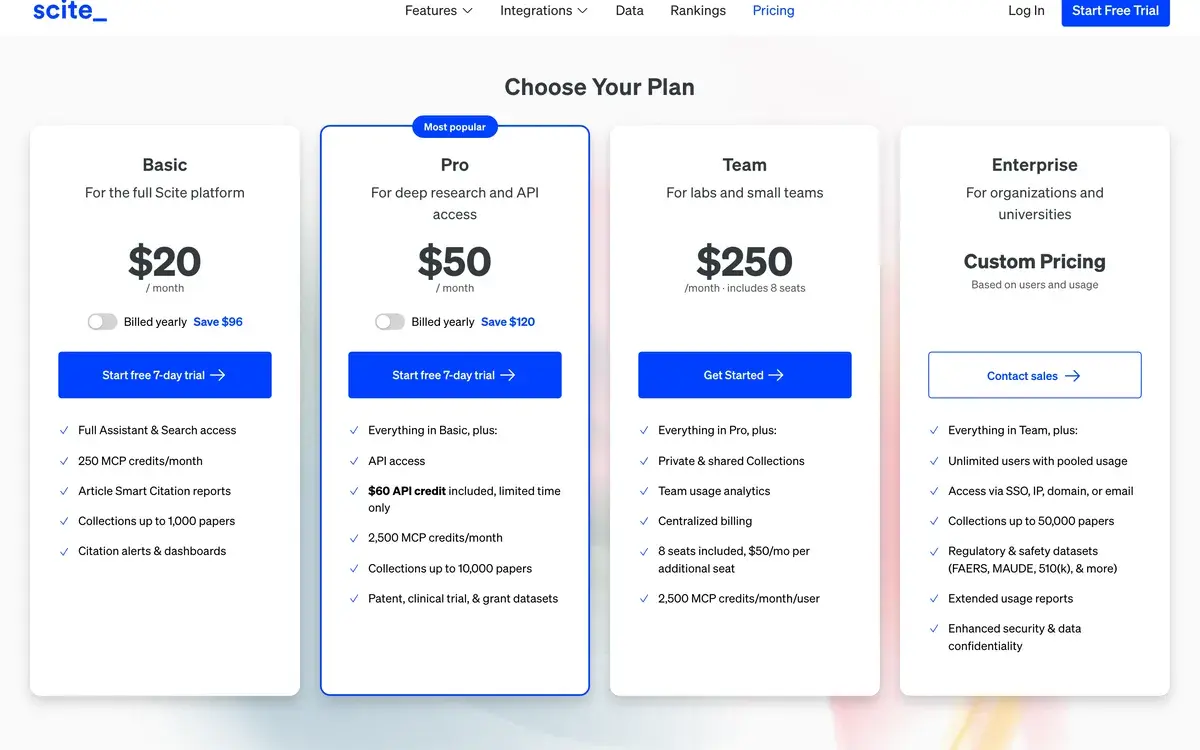
PlanPriceUsersBest for
Free Trial$07 days full accessEvaluation
Individual$20/mo (or $200/year)Single userResearchers, students, journalists
TeamCustomMulti-userResearch labs, journalism teams
InstitutionalCustomSite licenseUniversities, hospitals, large research orgs

Prices verified April 2026 from scite.ai/pricing. Student discounts available with verified academic email.

The honest pricing note: at $20/month for individuals, Scite is in the middle of the academic-tool price range — meaningfully cheaper than Web of Science institutional access, more expensive than free options like Google Scholar. The annual billing option (~$200/year) is the right pick for active researchers; the monthly tier suits short projects and students who want flexibility. Institutional access through your university library, if available, often covers Scite at no personal cost — worth checking before personally subscribing.

Hands-on Notes

Using Scite for the first time on a paper you thought you knew well is a genuinely interesting experience. We tested it on a finding that we had cited in our own writing — a paper we considered well-established because it was highly cited. Scite's breakdown showed that 18% of the citations were contrasting. Reading through them revealed a methodological critique that had emerged 3 years after the original paper, which most of the recent supporting citations had failed to engage with. Our own writing had repeated a finding that the field had quietly moved past. This kind of discovery is uncomfortable but necessary, and Scite makes it possible without months of manual citation reading.

The classification accuracy holds up well in our use. The published 85-90% accuracy figure matches our experience for clearly-written empirical literature. Where it gets noisier: theoretical papers where citations might be philosophical reference points rather than empirical engagement, papers in the humanities where citation conventions differ, and footnote-heavy disciplines where the cited claim is sometimes ambiguous. For these cases, treat Scite's output as a starting point and read the actual citing text yourself.

The Reference Check workflow is the underrated feature. Uploading a manuscript draft and getting back a flagged list of "this reference has been retracted" and "this reference is predominantly contradicted by later work" before submission catches issues that would otherwise embarrass you (or worse) at peer review. Editors and reviewers are starting to run the same checks, which means submitting work that fails Scite's basic quality control increasingly affects your manuscript's chances.

Scite Assistant — the AI chat interface — is competent but feels like a checkbox feature in a tool whose core value is elsewhere. You can ask research questions and get answers grounded in scite-classified literature, which produces meaningfully better outputs than asking ChatGPT or Claude for citations. But for serious literature work, the dashboard and search interfaces are where the real value lives, not the chat.

The browser extensions are worth installing. Surfacing scite data inline on PubMed, Google Scholar, and journal sites means you see citation polarity without changing your existing research workflow. Once you have scite information overlaid on the tools you already use, going back to plain Google Scholar feels strangely incomplete.

Use Cases

A clinical researcher writing a review article uses Scite to verify every key claim in the reference list. Three references that the researcher had planned to cite as foundational turn out to have substantial contrasting literature; the review is restructured to engage with the actual debate rather than presenting a misleading consensus.

A science journalist working on a feature about a contested medical claim uses Scite to check whether the studies in the press releases have been supported or contradicted by subsequent research. The story is reframed when Scite reveals that a finding repeatedly cited as "established" actually has a substantial replication failure literature.

A policy analyst at a think tank uses Scite to verify the evidence base for a policy brief on housing intervention effectiveness. References that had circulated in policy discussions for years turn out to have meaningful methodological critiques in the citing literature; the brief is more cautious as a result.

A PhD candidate running a systematic review uses Scite to compress the citation analysis phase. Verifying support/contrast across 200+ included studies — a task that would otherwise consume weeks — becomes a matter of days with Scite, with manual verification reserved for the small subset of high-stakes specific findings.

An editor at a mid-tier scientific journal runs Scite Reference Check on submissions before assigning peer reviewers. Manuscripts that build heavily on retracted papers or strongly-contradicted findings get desk-rejected or returned for revision before reviewers' time is consumed.

Our Verdict

Scite is one of the most genuinely useful AI tools in academic research because it solves a problem that was previously intractable at scale. Citation counts told you a paper existed and got cited. Scite tells you what people are saying when they cite it. The difference matters enormously for evidence-based work, and the tool earns the premium it asks over free alternatives.

The classification is not perfect — 85-90% accuracy means you should verify high-stakes specific claims manually — but the directional signal across hundreds or thousands of citations is the kind of work no human researcher can do at scale. The Reference Check feature is the kind of due diligence that should be standard before manuscript submission. The browser integrations make Scite useful inside your existing research workflow.

Limitations worth knowing: non-English literature is underserved. Theoretical and humanities work is harder to classify. The Scite Assistant chat is a less compelling feature than the core citation analysis. And $20/month is real money for students and independent researchers, though institutional access through university libraries often covers it.

For researchers, science journalists, fact-checkers, editors, and anyone whose work depends on knowing what the citing literature actually says, Scite belongs in the toolkit. There is no real substitute for what it does.

Note: Scite does not currently have an active affiliate program with AIVario. AIVario earns no commission from sign-ups. Our rating reflects ongoing use of the paid Individual tier across literature review and verification work.

Best for: Academic researchers, medical and clinical researchers, science journalists, fact-checkers, editors, policy analysts Not ideal for: Casual research, non-English literature work, theoretical philosophy and humanities (classification gets noisy) Bottom line: Citation counts measure attention; Scite measures reception. For evidence-based work, the difference is the entire point.

Related Tools

  • Elicit — complementary tool for AI-assisted literature search and synthesis
  • ResearchRabbit — paper discovery tool that pairs well with Scite for citation analysis
  • Consensus — fast yes/no research question verdicts, complementary to Scite's deeper analysis
  • Perplexity — general AI search, less rigorous than Scite for academic citation work
  • Claude — useful for synthesizing scite-verified findings into draft writing

Frequently Asked Questions about Scite

How much does Scite cost?

Scite has a free 7-day trial with full access. After the trial, individual subscriptions are $20/month for the standard plan or $25/month with annual billing options. Institutional pricing for universities and research organizations is custom. Students get discounted pricing through verified academic email addresses.

What does Scite actually do differently?

Scite reads the text around every citation and classifies it: did the citing paper support the cited claim, just mention it, or contradict it? Most citation tools count citations; Scite tells you what those citations actually say. For evidence-based research, this distinction is the difference between knowing a paper exists and knowing whether the field believes it.

How accurate is Scite's classification?

Scite's published validation studies report classification accuracy in the 85-90% range for support/contrast/mention categorization, which holds up across most disciplines. Accuracy is highest for clearly-written biomedical and life sciences literature; classification gets noisier for theoretical papers, philosophy, and fields with high reliance on implicit reference. Always verify high-stakes citations manually.

Does Scite work with non-English papers?

Scite's index is primarily English-language scientific literature, with strong coverage across biomedicine, life sciences, physical sciences, social sciences, and engineering. Non-English papers are included in citation networks but the contextual classification works most reliably on English content. For research areas dependent on non-English literature, this is a meaningful constraint.

Can Scite check if my paper's references are reliable?

Yes, the Reference Check feature analyzes the references in any uploaded manuscript and flags retracted papers, papers with predominantly contrasting citations, and references to papers from journals with reliability concerns. Many researchers run reference checks before submission as a quality control step. Editors and peer reviewers increasingly use the same workflow.

Is Scite better than Google Scholar for evidence-based work?

They serve different jobs. Google Scholar is better for discovering papers and getting raw citation counts. Scite is better for understanding whether the citations actually support the claims you care about. For evidence-based research, you typically discover with Scholar and verify with Scite. Many serious researchers use both.

Does Scite have a Word integration?

Yes, Scite offers a Microsoft Word add-in that lets you insert references and check citation reliability without leaving the document. Browser extensions for Chrome, Firefox, and Edge surface Scite citation data on PubMed, Google Scholar, and other research platforms. The integrations are particularly useful for active writers who want citation verification in their existing workflow.