Perplexity is an AI search engine that answers with inline citations and, since 2026, an agent called Perplexity Computer that builds documents, apps and reports from one request. The free plan includes cited search with a few advanced searches a day. Pro costs $20 a month or $200 a year (about $17 a month) with access to models such as GPT-6.1 Sol, Claude Sonnet 5.5, Gemini 3.8 Flash and Grok 4.7, Deep Research and 4,000 bonus Computer credits; Max costs $200 a month or $2,000 a year with 10,000 Computer credits a month. Students pay $10 for Education Pro, and the Comet browser is free.
✓Best for: Researchers, students, analysts and journalists who need current answers they can verify, and anyone who wants several frontier models in one subscription
✗Skip if: You mainly need long-form writing or coding help, where Claude or ChatGPT go further, or only ask a few questions a week, which the free plan covers
Perplexity built its name on one idea: search the web first, answer second, and cite every claim so you can check it. That is still the core. Type a question and the answer arrives with numbered sources. For harder questions, Pro Search and Deep Research dig further and end in a structured report.
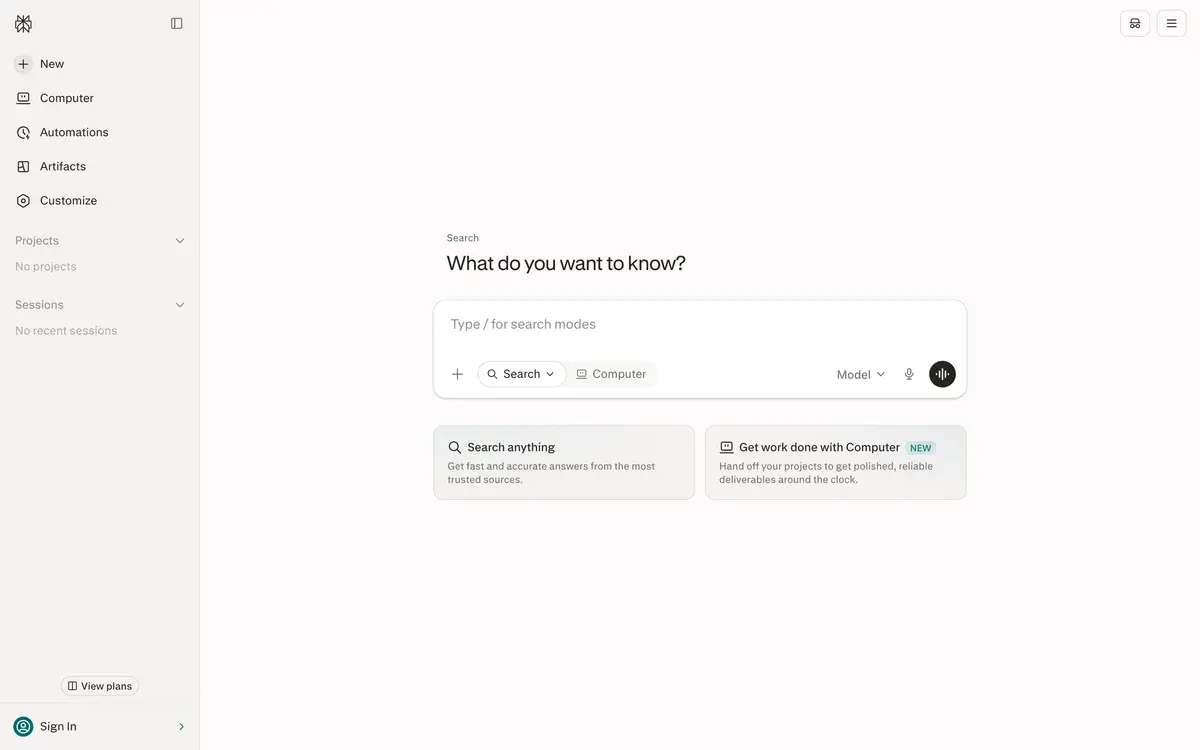
In 2026 the product grew a second half. Perplexity Computer launched for Max subscribers on February 25 and reached Pro and Enterprise in March. It's an agent: give it a request such as "turn this CSV into an analysis with charts and a slide deck" and it works through it. Along the way it routes tasks across 20+ models and connects to hundreds of apps. The home screen now puts Search and Computer side by side. Automations handle recurring work, Artifacts hold the documents and apps it makes, and Projects keep everything organized. Perplexity also announced Personal Computer, an always-on version running on a dedicated Mac mini, with a waitlist.
Free, Pro, Max and Enterprise
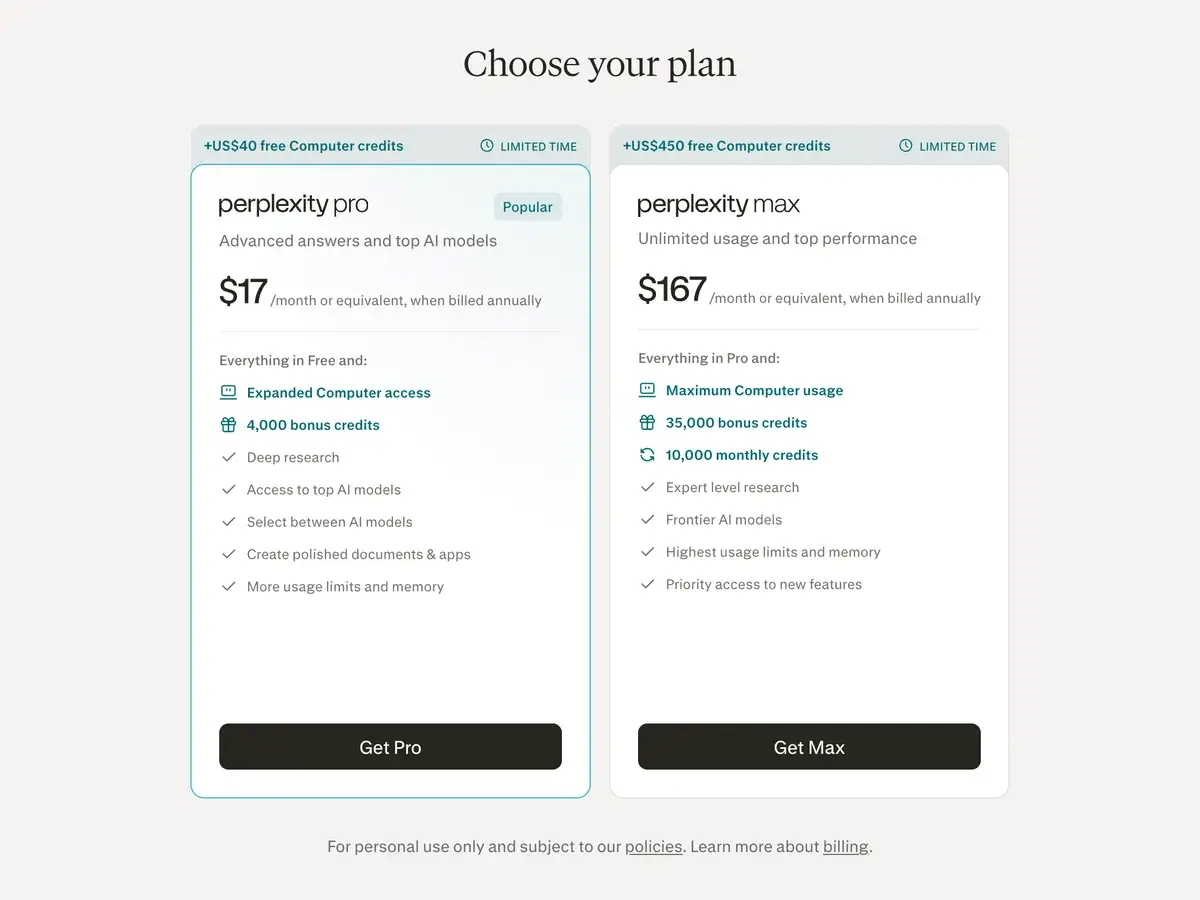
Perplexity's plan page, which shows yearly prices as monthly equivalents, screenshot taken October 1, 2026.
Plan
Monthly
Yearly
Computer credits
What it adds
Free
$0
$0
None
Cited search, a few advanced searches a day, one default model
Pro
$20
$200 (about $17 a month)
4,000 bonus
All premium models, Deep Research, image generation, larger uploads
Education Pro
$10
As Pro
Pro for verified students and educators, through SheerID
Max
$200
$2,000 (about $167 a month)
35,000 bonus plus 10,000 a month
Highest limits, frontier models, early access to features
Enterprise Pro
$34 per seat a month
8,500 bonus plus 500 per seat a month
No training on your data, SSO, SCIM, audit logs
Enterprise Max
$271 per seat a month
40,000 bonus plus 15,000 per seat a month
Higher Deep Research and file limits
When we checked, Perplexity was also adding limited-time Computer credits worth $40 to new Pro plans and $450 to Max. Bonus credits are a one-time allowance, so Pro users who lean on Computer will run out. Max is the only consumer plan with a monthly refill.
Which models Perplexity uses
Perplexity is not tied to one lab. Its own Sonar models handle much of the everyday search. Paid plans can switch to OpenAI's GPT-6.1 Sol, Anthropic's Claude Sonnet 5.5, Google's Gemini 3.8 Flash or xAI's Grok 4.7. Kimi K3 and GLM 5.3 are on the list too, and Perplexity says it hosts them in the US. It can also pick a model per task, and Computer orchestrates more than 20 specialized models behind one conversation. For people who would otherwise pay for ChatGPT, Claude and Gemini separately to compare answers, this is one of Perplexity's strongest arguments.
How it holds up in daily research
Using Perplexity as a daily research tool alongside ChatGPT and Gemini, the citation model is what makes it stick. Getting an answer with every claim linked to an openable source changes how much you can trust the output, not because the model is more accurate, but because verifying takes seconds instead of a separate search.
For checking current facts, comparing products, or getting oriented in an unfamiliar area quickly, it has consistently been the fastest route. The habit that formed without any deliberate decision: anything that needs to be right goes to Perplexity first, and anything that needs to be written goes elsewhere.
Deep Research is strong as a first pass. Ask a broad question and it comes back several minutes later with a structured, cited report that covers the ground properly. It works best as scaffolding for your own work rather than as a finished product: the coverage is good, and every so often a summarized claim reads a little further than the source supports, which is exactly why the inline links matter.
Model Council is a nice touch for contested questions: running the same query across several frontier models and seeing where they diverge is more informative than any single confident answer.
The Comet browser is pleasant and the sidecar assistant that reads the current page is useful in ordinary browsing, though it hasn't replaced a normal browser day-to-day.
The clearest limitation in practice is that Perplexity is a search product first. Asking it to write something substantial or work through code is possible and not what it's good at; the answers stay short, sourced and factual, which is the right design for its job and the wrong shape for drafting.
Comet, the free browser
Comet is Perplexity's Chromium browser with the assistant and agent built into every tab. It launched in 2025 as a Max perk and became free for everyone in October 2025. An Enterprise version with silent deployment for IT teams followed in March 2026. Its agent can work across sites, and that brought legal trouble. Amazon sued Perplexity in November 2025 over Comet's automated shopping on its store, and a judge later blocked Comet's agent from shopping on Amazon. Our best AI browsers guide compares it with Dia, Brave and the rest.
What happens to your searches
On the consumer plans, Perplexity says searches may be used to improve its AI by default, and you can opt out in Account Settings. Enterprise customers and API users get zero data retention. The Enterprise plans also state that customer data is never used for training, and they list SOC 2 Type II, HIPAA, GDPR and PCI DSS compliance. Anyone researching confidential matters on a personal account should switch the setting off.
When Pro pays off, and the alternatives
Pro at $20 pays off for people whose work is finding things out: students writing papers, analysts, journalists, consultants, anyone checking facts daily. Its mix of citations, Deep Research and a model picker covering several labs is hard to match at that price. Education Pro, at $10, is one of the best deals in AI for students. Max is a purchase for heavy Computer users only.
For writing, analysis and coding, ChatGPT and Claude go further. Both search the web too, though they decide when to search instead of doing it by default. Gemini suits people already paying Google. Felo AI is cheaper and stronger at turning research into slides, and NotebookLM is better for questions about your own documents. Our comparisons of Perplexity vs ChatGPT and Claude vs Perplexity cover the main choices.
$20 a month, or $200 a year, which Perplexity's pricing page shows as about $17 a month billed annually. Max costs $200 a month or $2,000 a year, shown as about $167 a month. Verified students and educators can get Education Pro for $10 a month through SheerID, and Enterprise Pro costs $34 per seat a month billed annually.
What is Perplexity Computer?
An agent that carries out multi-step work from one request: researching, building documents, slide decks, apps and websites, and connecting to hundreds of apps through 20+ models. It launched for Max on February 25, 2026 and reached Pro and Enterprise in March. It runs on credits: Pro gets 4,000 bonus credits, Max 35,000 bonus credits plus 10,000 a month.
What can you do with Perplexity for free?
Ask unlimited questions with cited answers from the web, with a few advanced searches a day and a single default model. Pro unlocks many more advanced searches with multi-step reasoning, all premium models, larger file uploads, image generation and Deep Research. The Comet browser is also free.
Does Perplexity have a desktop app?
Yes, for Mac and Windows, alongside the web version, iPhone and Android apps and the Comet browser. Computer, Perplexity's agent, also appears as a tab in the iOS app since March 2026.
Does Perplexity use ChatGPT or Claude?
It uses models from several labs. Paid plans let you pick models such as OpenAI's GPT-6.1 Sol, Anthropic's Claude Sonnet 5.5, Google's Gemini 3.8 Flash, xAI's Grok 4.7, and US-hosted Kimi K3 and GLM 5.3, alongside Perplexity's own Sonar models. Perplexity can also choose the model for each task automatically.
Can Perplexity generate images?
Yes, on paid plans. Perplexity's Pro FAQ lists image generation among Pro features, and Computer can produce documents, charts, slide decks and apps. The free plan focuses on cited search and does not include image generation.
Is Perplexity Max worth $200 a month?
Only for heavy users of Computer and research. Max's value is 10,000 Computer credits a month, 35,000 bonus credits, the highest usage limits and early features. Someone who mainly searches and runs occasional Deep Research reports gets most of the benefit from Pro at $20.
Does Perplexity use my searches to train AI?
By default, consumer searches may be used to improve Perplexity's AI, and you can opt out in Account Settings. Enterprise customers and API users have zero data retention, and Enterprise Pro and Max state that customer data is never used for training, with SOC 2 Type II, HIPAA, GDPR and PCI DSS compliance.
Is Comet still free?
Yes. Perplexity made its Comet browser free for everyone in October 2025, after launching it as a perk of the Max plan, and in March 2026 it added Comet for Enterprise with admin deployment. Comet puts Perplexity's assistant beside every page you visit, while its browser agent is reserved for Pro and Max.