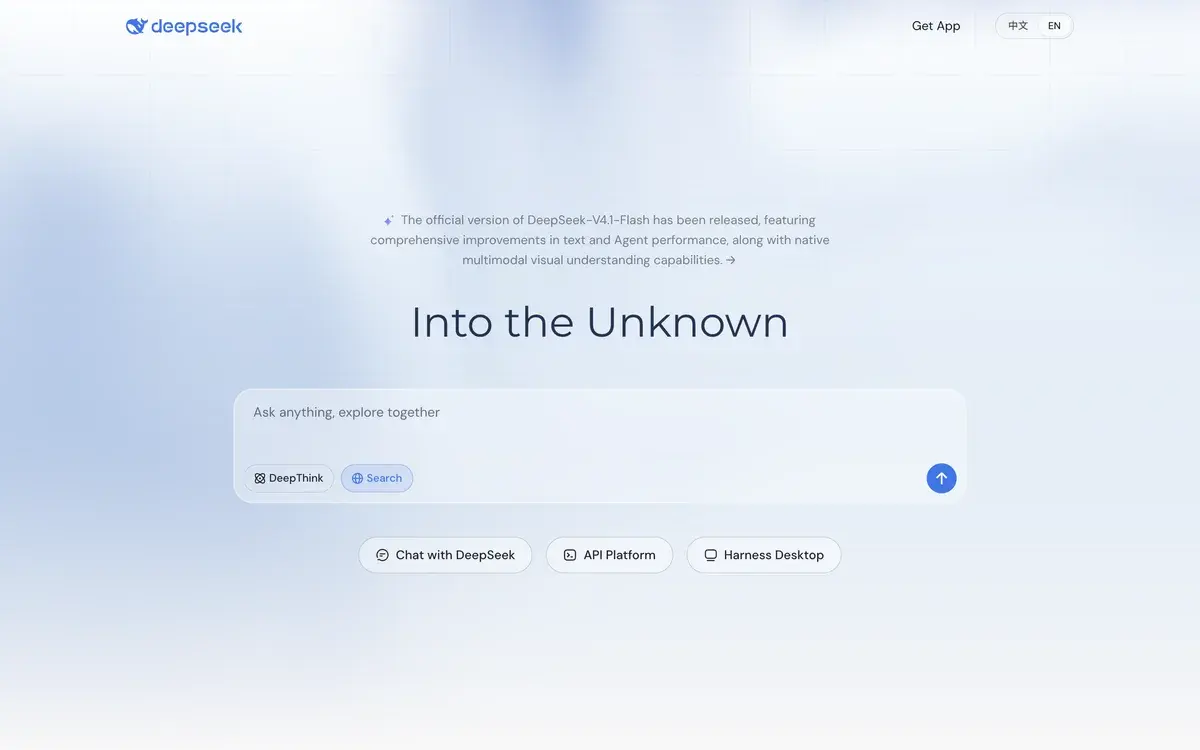
DeepSeek is a Chinese AI lab whose chat app on the web, iOS and Android is free, with DeepThink reasoning and web search and no paid tier. Its current model, DeepSeek-V4.1-Flash, released on September 10, 2026, is a 552-billion-parameter mixture-of-experts model with native image understanding, a 1M-token context and open weights on Hugging Face. On the API it costs $0.30 per million input tokens and $1.20 per million output at peak, half that off-peak, and requests for V4-Pro have been served by V4.1-Flash since September 14. DeepSeek also publishes its own agent, DeepSeek Harness, and documents how to run Claude Code on its models.
✓Best for: People who want a capable free assistant for reasoning, maths and code, and developers who need a very cheap API or open weights they can host
✗Skip if: Your data cannot go to servers under Chinese jurisdiction, or you need the integrations, image generation and voice of ChatGPT or Gemini
DeepSeek's chat app is the rare frontier-class assistant with no subscription at all. On the web, iOS and Android you get the current model with DeepThink, its visible step-by-step reasoning mode, web search, file uploads and saved history, and DeepSeek sells no Plus or Pro plan to unlock more. The only limit is fair-use throttling: at busy times you may see server-busy messages.
In a market where most labs have settled on $20 a month, that makes DeepSeek the sensible first stop before paying for AI: try it on your real tasks, then decide what a subscription would actually add.
V4.1-Flash takes over the lineup
September brought another change of model: DeepSeek released V4.1-Flash on September 10, 2026, the first of a new architecture family: a 552-billion-parameter mixture-of-experts model with a causal encoder-decoder design that activates just 8 billion parameters for input and 16 billion for output. It understands images natively, keeps the 1M-token context and 384K maximum output of V4, and DeepSeek says its KV cache needs a quarter of the GPU memory of the previous generation, which is why cached tokens got cheaper.
The rest of the lineup is being folded into it. V4-Flash and the experimental V4-Flash-Vision were retired, with their API names routed to V4.1-Flash. V4-Pro, which only reached general availability on August 13, is being phased out too: since September 14, every deepseek-v4-pro request is served by V4.1-Flash at Flash prices, until a V4.1-Pro arrives. The weights for V4.1-Flash, with a technical report, are on Hugging Face.
API prices after the September cut
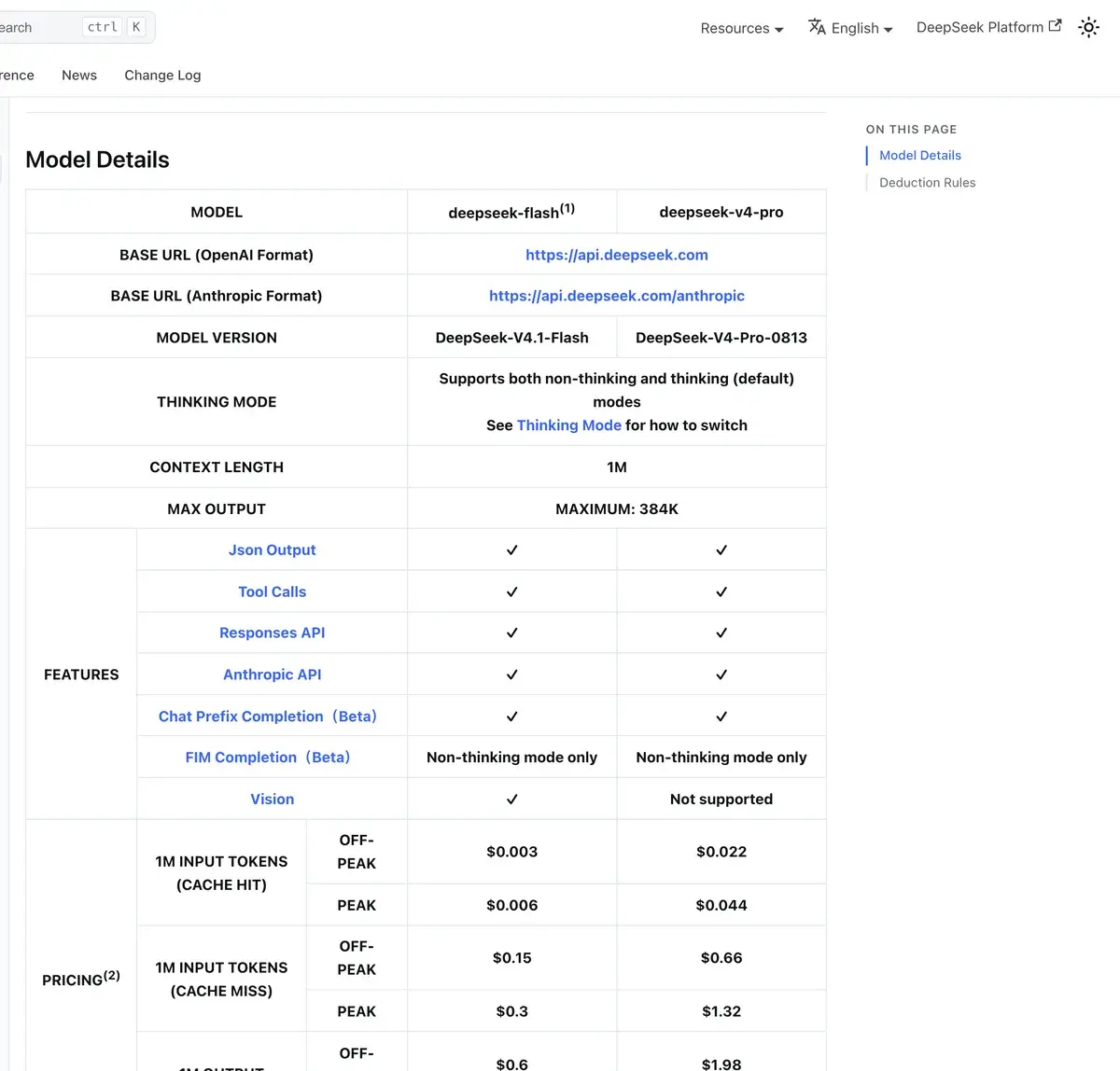
DeepSeek's API pricing page, checked October 1, 2026.
Per 1M tokens
deepseek-flash, off-peak
deepseek-flash, peak
deepseek-v4-pro listing, peak
Input, cache hit
$0.003
$0.006
$0.044
Input, cache miss
$0.15
$0.30
$1.32
Output
$0.60
$1.20
$3.96
Off-peak rates are half of peak. Peak hours run 01:00 to 04:00 and 06:00 to 10:00 UTC, Monday to Friday, excluding Chinese public holidays; weekends are off-peak all day. The new rates took effect on September 10 and are lower than the V4-Flash rates DeepSeek charged in August.
Two habits cut bills further: scheduling batch work off-peak halves the cost, and keeping system prompts and standing instructions identical across calls means most input is billed at cache-hit rates, a fiftieth of the uncached price. Even at peak, deepseek-flash output costs a fraction of comparable models from Western labs.
Harness, Claude Code and other agents
DeepSeek now has its own agent, DeepSeek Harness, published on GitHub with a web interface and a desktop app linked from DeepSeek's homepage. It reads and edits files in a workspace, runs commands, delegates subtasks and keeps a plan, asking for approval under a permission policy. It works with DeepSeek's API and other OpenAI-compatible providers.
The API is also built to slot into other agents. It accepts both OpenAI- and Anthropic-format requests, and DeepSeek's documentation includes setups for Claude Code, Codex, OpenCode and several others. For Claude's terminal agent, that means setting the Anthropic base URL to api.deepseek.com/anthropic and choosing deepseek-flash, which turns Claude Code into a very cheap DeepSeek-powered agent, with the jurisdiction caveat below.
How it holds up in everyday work
Running DeepSeek alongside the paid assistants for everyday work, the thing that stands out is how little the free label costs you on technical tasks.
On maths, logic puzzles and structured coding problems it holds up against subscriptions costing $20 a month. The reasoning mode works through problems methodically, and the visible chain of thought makes it easy to spot where an answer went wrong, which is useful when checking work rather than just accepting output. For debugging and explaining unfamiliar code it has been a reliable first stop.
The 1M-token context is the underappreciated part. Dropping in long documents or a substantial chunk of a codebase and asking questions across all of it works without the truncation dance that smaller windows force.
Where it feels less finished is everything around the model. The interface is plain, there are no integrations to speak of, and during busy hours the server-busy messages are frequent enough to interrupt a working session. Long open-ended creative writing is competent rather than distinctive; this is not where it wins.
The practical pattern that emerged: DeepSeek for technical reasoning and anything where a free tool is enough, paid assistants for work that touches client material or needs ecosystem integration. That split has less to do with quality than with jurisdiction.
Data jurisdiction, and the open-weights way around it
DeepSeek is a Chinese company, and anything you send to its app or API goes to servers under Chinese jurisdiction. For learning, personal projects, coding practice and general questions, most people reasonably accept that. For client work, regulated data, proprietary code or anything under an NDA, it rules out the hosted service however good the model is.
The open weights are the workaround. Running V4.1-Flash on your own hardware or with a provider you trust keeps data out of DeepSeek's hands and gives fixed costs at volume. A 552-billion-parameter model needs serious GPU capacity, so this is an answer for companies rather than individuals; DeepSeek says it is working with the open-source community on inference support.
DeepSeek next to ChatGPT, Claude, Gemini and Mistral
ChatGPT has the ecosystem, image generation, voice and agents, plus a Western data posture, for $20 a month; DeepSeek matches it closely on technical reasoning for nothing. Claude is stronger at writing and sustained long-form work, and our DeepSeek vs Claude comparison covers that pairing in detail. Gemini bundles Google Workspace, video generation and storage from $4.99. Mistral is the European answer to the same jurisdiction question, with open models and EU data residency.
Related Tools
Claude: stronger writing and coding assistant with professional data handling
Not for the chat app. The web chat and the iOS and Android apps are free, with DeepThink reasoning, web search and file uploads, and DeepSeek sells no Plus or Pro plan. The only paid product is the API, billed per token, and the only limit in the app is fair-use throttling at busy times.
What is DeepSeek-V4.1-Flash?
DeepSeek's current model, released on September 10, 2026. It is a 552-billion-parameter mixture-of-experts model with a new encoder-decoder design that activates 8 billion parameters for input and 16 billion for output, understands images natively, handles a 1M-token context and outputs up to 384K tokens. Its weights are published on Hugging Face.
How much does the DeepSeek API cost?
For deepseek-flash, the model served on the API, $0.30 per million input tokens and $1.20 per million output tokens at peak, and half that off-peak: $0.15 and $0.60. Cached input costs $0.006 at peak and $0.003 off-peak. Peak hours are 01:00 to 04:00 and 06:00 to 10:00 UTC on weekdays, excluding Chinese public holidays.
What happened to DeepSeek V4-Pro?
DeepSeek is phasing it out. After testing found V4.1-Flash ahead on performance, cost and speed, DeepSeek began routing all deepseek-v4-pro API requests to V4.1-Flash at Flash rates from September 14, 2026, and said this will continue until a V4.1-Pro model launches.
Can I use DeepSeek with Claude Code?
Yes. DeepSeek's API accepts Anthropic-format requests, and its documentation shows how to point Claude Code at it by setting the Anthropic base URL to api.deepseek.com/anthropic and the model to deepseek-flash. DeepSeek also documents setups for Codex, OpenCode and other agents, and publishes its own agent, DeepSeek Harness.
Can DeepSeek analyze or create images?
It can analyze them: V4.1-Flash has native visual understanding, so you can ask about photos, screenshots and charts. It does not generate images. For image creation, ChatGPT, Gemini or a dedicated generator such as Midjourney is the better choice.
Is DeepSeek safe for confidential work?
Not on the hosted service. DeepSeek is a Chinese company and data sent to its app or API goes to servers under Chinese jurisdiction, which rules it out for client data, regulated information or code under NDA. Self-hosting the open weights removes that concern, at the cost of serious GPU hardware.
Is DeepSeek better than ChatGPT?
On maths, logic and coding it comes close to paid models for free. ChatGPT is the broader product, with image generation, voice, agents, integrations and a Western data posture, for $20 a month. Try DeepSeek first for technical work and notice what you miss; for many people it is integrations rather than intelligence.