Felo AI

Felo AI

★ Top rated
AI Search Engine

AI search engine with mind-map visualization — useful for visual learners exploring unfamiliar topics, less optimal for factual lookups.

Free · $8.99/mo
📖 14 min read
Try Felo AI for free

Affiliate link — we may earn a commission

Ready to try it?
Felo AI
Free · $8.99/mo
Get started →
Affiliate link — we may earn a commission
Our rating
4.4/ 5
AIVario Editor's rating →

What is Felo AI?

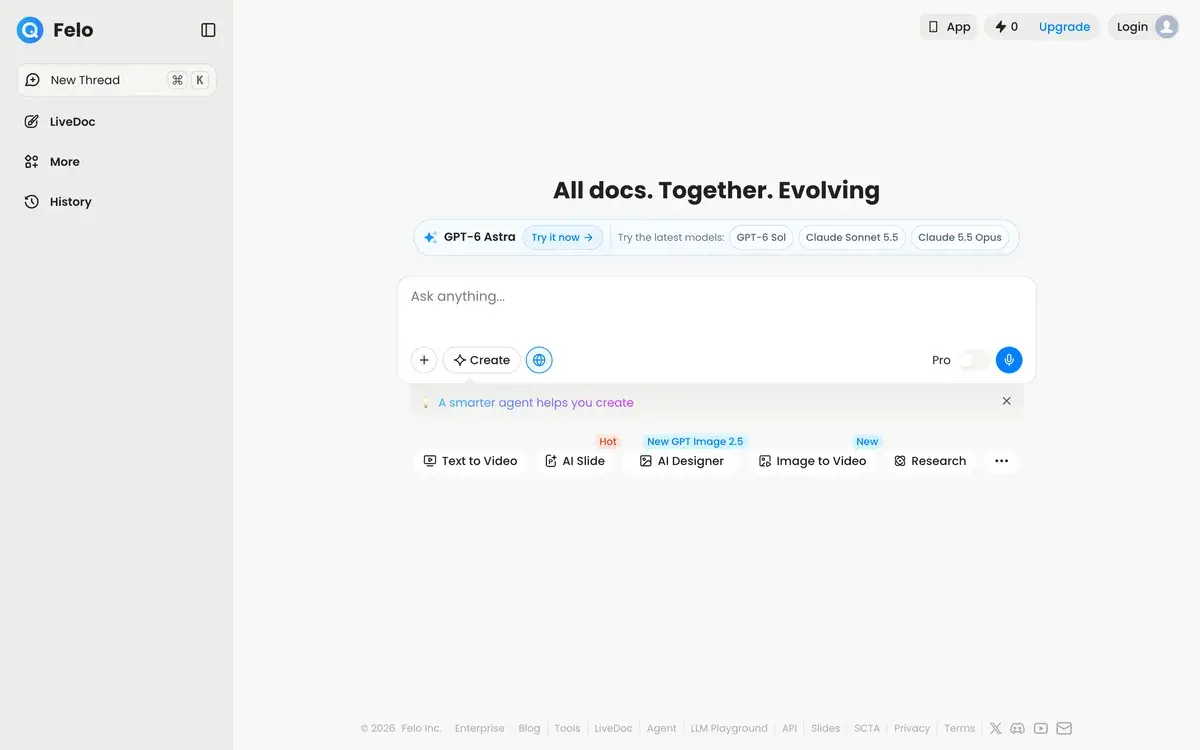
Felo AI is an AI search engine that takes a different approach to search results than the dominant alternatives. Where Google returns ranked lists of links and Perplexity returns concise text answers with citations, Felo returns interactive mind maps showing how concepts in a topic connect visually. Type a question, get a node-and-edge diagram with the central topic as root and related concepts branching out as clickable nodes that expand to show sub-concepts, examples, and connected ideas.

This visualization approach is the actual differentiation. Most reviews of Felo compare it directly against Perplexity, ChatGPT search, and other AI search engines on output quality and speed — and on those metrics, Felo is competent but not category-leading. The visual mind-map format is what makes Felo useful for use cases where text answers fall short: exploring unfamiliar topics, understanding how concepts relate, learning subject areas where seeing the structure of knowledge matters more than getting fast factual answers.

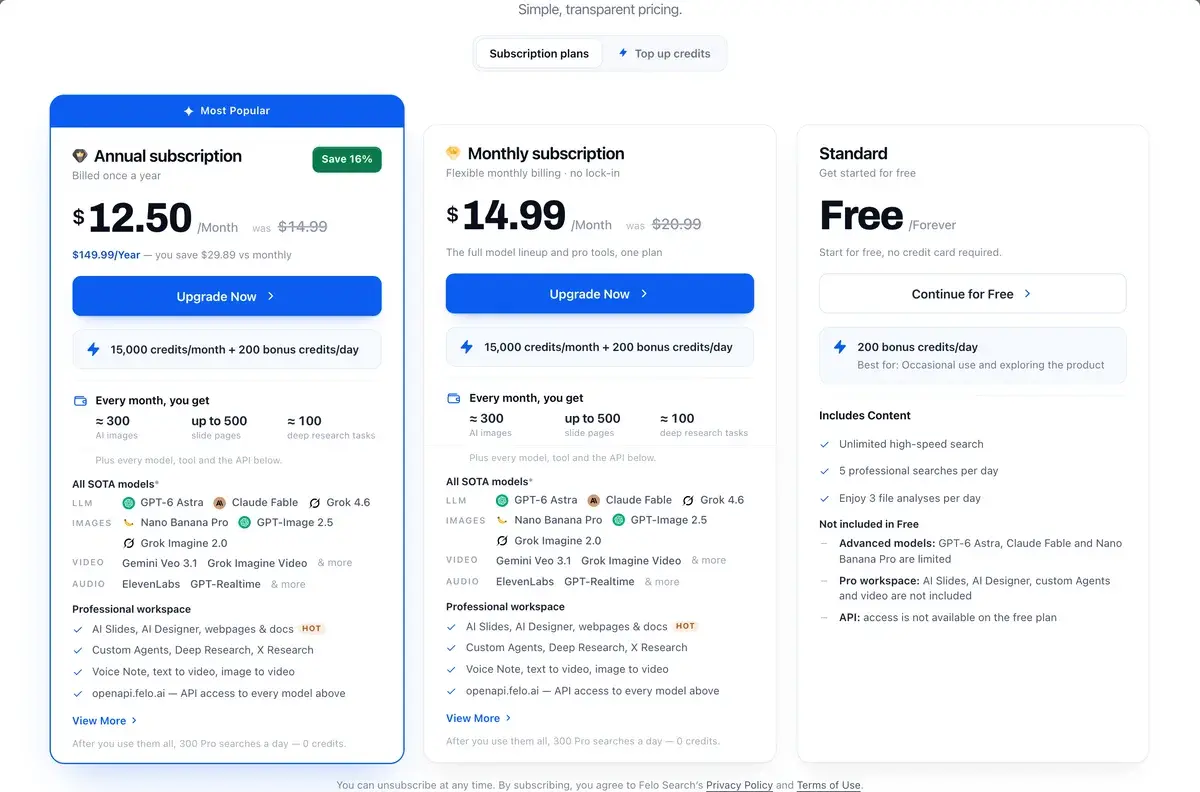
The pricing reflects positioning as a complementary tool rather than a primary search replacement. Free tier (30 searches per day) covers light use; Pro at $8.99/month provides unlimited searches and deeper research mode. For users matched to the visual exploration use case, the cost is modest; for users wanting general search functionality, traditional alternatives often serve better at no cost.

Why mind maps matter for some learning

Most knowledge work in 2026 is text-mediated. Search results are text, AI answers are text, documentation is text, articles are text. For factual lookups and bounded questions, text formats work fine — the question fits in text, the answer fits in text, the workflow runs efficiently.

For exploring unfamiliar topics, text formats have known limitations. When you do not know what you do not know, sequential text answers cannot show you the structure of the topic — what concepts exist, how they relate, which sub-areas are dense and which are simple, where the connections that matter live. You read one paragraph at a time, build mental models from the linear flow, and often miss the structural picture that would orient your understanding faster.

Mind maps and node-graph visualizations address this differently. Seeing a topic represented as connected nodes — central concept at the root, sub-concepts branching out, cross-connections between related areas — makes structural relationships visible at a glance. For visual learners and for use cases where structural understanding matters, this format produces faster orientation than reading sequentially through text answers.

This is the use case Felo serves directly. Researchers exploring a new subject area to understand the conceptual landscape. Students studying complex topics where seeing connections aids retention. Professionals onboarding into new domains where systematic understanding matters more than fast factual answers. For these audiences, the visual approach earns its place.

For audiences not matched to this use case — most general search users, most people doing factual lookups, most users who learn well from text — Felo's mind-map format is novelty without functional benefit. The honest evaluation requires being honest about which audience your work actually fits.

Where Felo earns its place

Researchers in early-stage exploration of unfamiliar subjects. Before deep literature review or focused investigation, getting structural orientation on a topic supports better subsequent work. Felo's mind maps compress the orientation phase that previously involved reading multiple Wikipedia articles, scanning various sources, and building mental models from disparate text content.

Students learning complex subjects where the relationships between concepts matter as much as the concepts themselves. Felo's visual format supports the kind of structural understanding that produces better retention and application. For visual learners specifically, this format produces meaningful learning advantages.

Professionals onboarding into new domains — joining a new industry, learning about a customer's space, understanding a new technical area. The mind-map exploration accelerates the orientation phase that traditionally takes weeks of reading.

Multilingual researchers and learners working across language boundaries. Felo's strong multilingual support makes it useful for non-English-speaking users and for cross-language research workflows that English-centric alternatives handle less well.

Visual thinkers whose default cognitive style benefits from spatial representation of information. For users who naturally think in diagrams, mind maps, and visual metaphors, Felo matches the working style.

Teachers and educators preparing materials on unfamiliar topics. The mind maps support both the educator's own preparation and the structural overview that students benefit from seeing.

Felo is not the right primary tool for: quick factual lookups (Perplexity or Google are faster), general AI assistance for writing or analysis (ChatGPT or Claude serve broader needs), comprehensive literature review on scientific topics (Undermind or Elicit are deeper), citation analysis (Scite specializes in this), or users who learn primarily through text.

Key Features

  • Mind-map visualization — interactive node-and-edge diagrams showing topic structure and connections
  • Deep research mode — multi-step research with iterative search refinement (Pro tier)
  • Multilingual search — searches and results in any major language with cross-language translation
  • Multiple AI models — choice between models including GPT, Claude, Gemini, and others (Pro tier)
  • Source citations — research-grade citations with source quality indicators
  • PDF analysis — upload PDFs for AI analysis alongside search-based research
  • Sub-topic expansion — click any node in the mind map to expand related sub-concepts
  • Search history — saved searches for revisiting and continuing exploration sessions
  • Browser extension — Felo functionality integrated into browsing workflow
  • Mobile apps — iOS and Android with mind-map visualization adapted for mobile screens
  • Export options — export mind maps as images or research summaries as documents
  • Team workspaces (Standard tier) — shared research and collaboration features

Felo AI vs Competitors 2026

ToolVisual formatMultilingualFree tierBest forPrice/mo
Felo AI✅ Mind maps✅ Strong✅ 30/dayTopic exploration, visual learners$8.99
Perplexity⚠️ Text + threads⚠️ Decent✅ LimitedFast factual lookups$20
ChatGPT Search❌ Text✅ Decent✅ With ChatGPTGeneral AI + searchBundled
Google AIO❌ Text overview✅ Strong✅ FreeFactual lookupsFree
You.com⚠️ Limited visualization✅ Decent✅ LimitedCustomizable AI search$20
Genspark⚠️ Sparkpages format⚠️ Limited✅ LimitedLong-form research outputFree + paid
Andi⚠️ Conversational⚠️ Limited✅ LimitedPrivacy-focused searchFree
Wolfram Alpha✅ Computational⚠️ Limited✅ LimitedMath, science queries$7.25

Data verified April 2026 from each provider's pricing pages.

The clearest competitive picture: Felo's mind-map visualization is genuinely distinctive in the AI search category. Perplexity, ChatGPT Search, and Google AIO all return text answers with citations; Felo returns interactive visual structures. For users matched to visual learning preferences, this format is meaningfully different in ways that produce real value.

Against Perplexity specifically, the choice is mostly use case rather than competition. Perplexity excels at fast factual answers; Felo excels at topic exploration. Many serious researchers use both — Perplexity for quick questions, Felo for unfamiliar territory. The two are complementary rather than substitutes.

Against ChatGPT Search and Google AIO, Felo serves a different purpose. The general AI search tools cover most search use cases adequately; Felo serves the specific use case of visual topic exploration. For users who do not benefit from visual formats, the general AI search tools cover their needs at no marginal cost; for visual learners or topic explorers, Felo adds value the general tools do not.

Wolfram Alpha is a different category — computational answers for math, science, and quantitative queries — but shares the philosophy that some search use cases benefit from structured non-text outputs. For users who appreciate Wolfram Alpha's structured approach, Felo's mind-map approach often resonates similarly.

Pricing 2026

PlanPriceSearchesBest for
Free$030/dayCasual evaluation, light use
Pro$8.99/moUnlimited + deep researchActive users, research workflows
Standard$14.99/moPro + team featuresSmall teams

Prices verified April 2026 from felo.ai/pricing. Annual billing offers ~30% off paid tiers.

The pricing is reasonable for the differentiated value proposition. Free tier (30 searches per day) covers light use and serves as legitimate evaluation. Pro at $8.99/month is the practical entry point for active research use; the unlimited searches plus deep research mode unlock the workflow value. Standard at $14.99/month adds team features for small group use.

The pricing is meaningfully cheaper than Perplexity Pro at $20/month and ChatGPT Pro at $20/month. For users specifically wanting Felo's mind-map approach, this price differential matters. For users who would use Perplexity or ChatGPT for general AI work alongside the search, the bundled access often makes those alternatives more economical at the household-of-tools level.

Hands-on Notes

The first experience using Felo produces a clear "this is different" moment. Searching for an unfamiliar topic — say, "transformer architecture in machine learning" — produces a mind map with the topic at the center and concepts like attention mechanisms, encoder-decoder architecture, BERT, GPT, position embeddings, and other related concepts as connected nodes. Clicking any node expands it. The visual representation of the topic landscape is visible at a glance in ways text answers do not produce.

For topics where you genuinely do not know the structure, this is meaningfully useful. Text answers tell you about specific aspects in sequence; the mind map shows you the whole landscape and lets you choose where to dig deeper. For students entering a new subject area or professionals onboarding into unfamiliar domains, this format compresses the orientation phase noticeably.

For topics where you already understand the structure, the mind map is novelty without functional benefit. If you know what you are looking for, the visual format adds steps without adding information. Text answers from Perplexity or ChatGPT often produce better outcomes faster for these queries.

The deep research mode (Pro tier) handles longer, more complex topics by running iterative searches and producing more comprehensive mind maps with deeper sub-concept expansion. The output quality is reasonable; the latency is meaningful (minutes rather than seconds). For research-grade exploration where comprehensive coverage matters more than speed, this mode produces value.

Multilingual capability works as advertised. Searching in Spanish produces results in Spanish; mind map nodes are in Spanish; sources are appropriate to the language. For non-English speakers and cross-language research workflows, this is genuinely useful.

Where Felo gets weaker: source quality varies meaningfully across topics. For technical and scientific topics, sources tend to be reasonable; for current events, business topics, and pop culture, source mix can include lower-quality sources alongside good ones. Verifying sources matters; treating mind-map nodes as authoritative without source review produces problems.

The other practical observation: mind-map quality depends heavily on topic specificity. Well-defined topics with clear conceptual structure produce useful mind maps. Vague or overly broad topics produce sprawling mind maps with weak conceptual connections. Asking specific questions produces better outputs than asking diffuse "tell me about X" queries.

Mobile experience is functional but compromised. Mind maps are clearly designed for larger screens; phone-sized mind maps require zooming and panning that breaks the visual gestalt. Tablet use produces meaningfully better experience than phone use; for users planning mobile-primary use, evaluate fit before committing to paid tiers.

For users coming from text-first AI search expecting Felo to produce better text answers, the experience is initially unsatisfying. The product is not optimized for text answers; calibrating expectations to "visual exploration tool" rather than "better text answers" produces better evaluation outcomes.

Use Cases

A graduate student exploring a new research area for thesis work uses Felo Pro for orientation phase. Mind maps of "computational linguistics," "syntactic parsing," and related topics provide the structural understanding needed before diving into focused literature review with Elicit and Undermind. The orientation phase compresses from weeks to days; subsequent research builds on stronger conceptual foundation.

A consulting analyst onboarding into a new industry vertical uses Felo Pro for initial domain familiarization. Mind maps of industry concepts, key players, regulatory landscape, and technology stack provide structural orientation that informs subsequent client work. The visual format produces understanding that text-only research would have taken substantially longer to build.

A teacher preparing curriculum on an unfamiliar subject uses Felo Pro for both personal preparation and student-facing visualization. Mind maps support the teacher's own learning; the same visualizations can be used in lessons to give students structural understanding alongside the lecture content. The dual use justifies the subscription.

A multilingual researcher conducting cross-cultural research uses Felo Pro for searches across multiple languages. The same query in English, Spanish, and Mandarin produces different mind maps reflecting language-specific source content and concept emphasis; the comparison itself produces research insight that monolingual search would miss.

A journalist working on a long-form story about an unfamiliar topic uses Felo Pro for background research before focused source interviews. The mind-map exploration identifies the questions worth asking sources and the conceptual context needed to interpret answers. The journalism quality improves through structural understanding.

A user evaluates Felo against Perplexity Pro for general AI search needs and finds that for their work patterns (mostly factual lookups, occasional research), Perplexity serves better. The user keeps using Google AI Overview and Perplexity for primary search and considers Felo for occasional topic exploration without committing to subscription. This use case reveals where Felo's value proposition is most marginal — for users who do not specifically benefit from visual exploration formats.

Our Verdict

Felo AI is a thoughtfully designed AI search tool with genuine differentiation through mind-map visualization. For visual learners, researchers in early-stage topic exploration, students studying unfamiliar subjects, professionals onboarding into new domains, and multilingual users, Felo earns its place in the toolkit. The visual format produces real value the text-first alternatives cannot match.

The honest considerations: Felo is not a Google replacement or general-purpose AI search tool. The mind-map approach is differentiated for specific use cases and adds steps without value for use cases where text answers serve better. For factual lookups, quick questions, and most general search needs, Perplexity, ChatGPT Search, or Google AIO remain better choices.

The pricing is reasonable for the value when matched to actual use case. Free tier serves evaluation; Pro at $8.99/month is the practical operational tier for active use; the cost is modest enough that adding Felo alongside other AI tools makes sense for users who genuinely benefit from the visual approach.

For the right audience, recommend without hesitation. For audiences whose work fits text-first AI search patterns, the alternatives serve better. The buying decision should be honest about whether visual topic exploration is genuinely how you learn best.

Note: Felo AI does not currently have an active affiliate program with AIVario. AIVario earns no commission from sign-ups. Our rating reflects evaluation of the Pro tier across research workflows alongside parallel use of Perplexity and ChatGPT Search for comparison.

Best for: Visual learners, researchers in early-stage topic exploration, students studying complex subjects, professionals onboarding into new domains, multilingual users, teachers preparing curriculum on unfamiliar topics Not ideal for: Quick factual lookups (use Perplexity or Google), general AI assistance (use ChatGPT or Claude), comprehensive literature review (use Undermind or Elicit), users who learn primarily through text Bottom line: Differentiated visual AI search that earns its place for matched use cases. Match the buying decision to whether visual exploration genuinely fits how you research and learn; right tool for some users, novelty for others.

Related Tools

  • Perplexity — text-first AI search alternative for fast factual lookups
  • Undermind — deep research alternative for comprehensive scientific literature synthesis
  • Elicit — research literature alternative for grounded Q&A on academic content
  • ResearchRabbit — citation network visualization for paper discovery alongside Felo's topic exploration
  • Notion — common organization tool for capturing the research that emerges from Felo exploration

Frequently Asked Questions about Felo AI

How much does Felo AI cost?

Felo has a free tier with 30 searches per day and basic features. Pro is $8.99/month with unlimited searches, deeper research mode, and access to multiple AI models. Standard is $14.99/month with team features. Annual billing offers ~30% off paid tiers. The pricing is competitive within the AI search category.

How is Felo different from Perplexity?

Different optimization. Perplexity optimizes for fast factual answers with citations — ask a question, get a concise grounded answer. Felo optimizes for topic exploration through mind-map visualization — ask about a topic, see how related concepts connect visually. For quick factual lookups, Perplexity is more direct. For visual exploration of unfamiliar subjects, Felo's mind map approach can produce better understanding faster than text-only formats.

What is the mind-map feature actually like?

After running a search, Felo generates an interactive node-and-edge diagram where the central topic is the root and related concepts branch out as connected nodes. Clicking on any node expands it to show sub-concepts, related searches, and connected information. The visualization makes topic relationships visually apparent in ways linear text answers do not. For visual learners and topic exploration, this format produces meaningful learning value.

Is Felo good for academic research?

Useful for early-stage exploration of unfamiliar topics, but not a substitute for dedicated academic research tools. For exploring a new research area to understand basic concepts and key terminology, the mind-map approach works well. For comprehensive literature review or evidence synthesis, dedicated tools (Elicit, Undermind, Scite, ResearchRabbit) serve better. Many researchers use Felo for early orientation and dedicated tools for deeper work.

Does Felo support multiple languages?

Yes, Felo's multilingual capability is one of its stronger features. Searches can be performed in any major language with results returned in that language; users can also request translation across languages within search results. For non-English speakers and multilingual research workflows, Felo's language support is genuinely useful and meaningfully better than English-centric alternatives.

Can Felo replace Google for general search?

For most users, no — but it complements Google for specific use cases. General search habits (factual lookups, navigation queries, shopping searches) work better in traditional search engines. Topic exploration, learning unfamiliar subjects, and visual research benefit from Felo's approach. The honest framing: Felo is a research and exploration tool that uses search rather than a search engine replacement.

Does Felo work on mobile?

Yes, Felo has iOS and Android apps with full functionality including the mind-map visualization. The mobile experience is reasonable though the mind maps are clearly designed for larger screens; tablet use produces better visualization than phone use. For mobile users who would benefit from the visual exploration approach, the apps support the use case.