ResearchRabbit

ResearchRabbit

Free tier
AI Literature Discovery

Beautiful free tool for discovering academic papers through citation network visualization — funded by grants, no subscription, no catch.

Free
📖 11 min read
Try ResearchRabbit for free

Affiliate link — we may earn a commission

Ready to try it?
ResearchRabbit
Free
Get started →
Affiliate link — we may earn a commission
Our rating
4.7/ 5
AIVario Editor's rating →

What is ResearchRabbit?

ResearchRabbit is a free academic literature discovery tool that visualizes citation networks around papers you already know. Add seed papers to a collection, and ResearchRabbit shows you related work through interactive graphs — papers your seed cites, papers that cite your seed, and papers connected through shared citations or co-authorship. The tool is funded by grants and institutional partnerships, not user subscriptions, which is unusual enough in the AI tooling landscape to be worth noticing.

For researchers, students, and anyone doing serious academic literature work, ResearchRabbit fills a specific niche that paid tools either ignore or charge meaningfully for: visual, exploratory discovery. Most search-driven literature tools answer the question "find papers matching this query." ResearchRabbit answers a different question: "what should I read next, given what I already care about?" Both are useful; they are not the same.

What ResearchRabbit does well

Building a collection of 5-10 seed papers in your area of interest and watching ResearchRabbit map the citation neighborhood is the kind of experience that changes how you think about literature exploration. Connections appear that linear search would never surface — papers from adjacent fields citing yours, methodological precedents in unexpected disciplines, recent work building on classic findings you had forgotten about. The visual representation matters: seeing the citation network as a graph reveals structure that lists obscure.

The "Suggested" tab — which surfaces papers similar to your collection without requiring explicit search — is the feature most users underrate at first and then come to depend on. It functions like a thoughtful research assistant who has read your reference list and recommends what you should look at next. The recommendations are not always perfect, but the hit rate on genuinely useful surfaces is high enough to make Suggested a regular part of weekly literature work.

The Zotero integration is a quiet excellence that defines what good academic tooling looks like in 2026. Your existing Zotero library appears as collections in ResearchRabbit; new discoveries save back to Zotero with a click. The friction that used to define moving papers between discovery tools and reference managers — the export-import dance, the duplicate management, the metadata cleanup — mostly disappears. For Zotero users, this integration alone justifies trying ResearchRabbit even if you are happy with your current discovery workflow.

Who is it for?

PhD students and academic researchers running literature reviews are the primary audience. The combination of citation network visualization, collection-based exploration, and Zotero integration fits the systematic literature work that defines academic research. The tool is particularly valuable in the early phases of a research project, when you are mapping the field rather than verifying specific claims.

Independent researchers, science writers, and policy analysts use ResearchRabbit when they need to understand a research area broadly without paying for institutional database access. The free pricing makes it accessible for users who cannot justify Web of Science subscriptions or Scopus access on their own.

Educators and graduate advisors use ResearchRabbit for teaching literature exploration skills. Walking students through how citation networks reveal field structure is more pedagogically effective with ResearchRabbit's visualization than with linear search results from PubMed or Google Scholar.

Cross-disciplinary researchers — anyone whose work sits between established fields — get particular value from ResearchRabbit because the citation network surfaces connections to adjacent literature that disciplinary databases would not. This use case is where ResearchRabbit's advantage over keyword-driven search is most visible.

It is not the right primary tool for: comprehensive systematic searches with PRISMA-style protocols (use PubMed and Web of Science), citation polarity analysis (use Scite), evidence synthesis with data extraction (use Elicit), or general non-academic research.

Key Features

  • Citation network visualization — interactive graphs showing relationships between papers in your collection and the broader literature
  • Suggested papers — AI-driven recommendations based on collection contents, refreshed as you add papers
  • Earlier and Later work — surface papers cited by your seed papers (earlier influences) and papers citing your seeds (later developments)
  • Author networks — discover researchers in your field through co-authorship analysis
  • Collection management — organize papers into named collections for different research projects
  • Zotero integration — bidirectional sync with your Zotero library
  • Notion and other integrations — export discoveries to Notion and reference managers beyond Zotero
  • Email digest — periodic updates with new papers relevant to your collections
  • Public collections — share collections with collaborators or the broader research community
  • Mobile-friendly web — works reasonably well on tablets for reading and exploration

ResearchRabbit vs Competitors 2026

ToolCitation visualizationAI suggestionsZotero integrationFree tierPrice/mo
ResearchRabbit✅ Strong✅ Strong✅ Native✅ Fully freeFree
Connected Papers✅ Strong⚠️ Session-based⚠️ Limited✅ LimitedFree / $3
Litmaps✅ Strong✅ Strong✅ Native✅ Limited$10
Inciteful✅ Decent⚠️ Basic⚠️ Limited✅ FreeFree
Open Knowledge Maps✅ Map-based⚠️ Basic✅ FreeFree
Semantic Scholar⚠️ List-based✅ Good✅ FreeFree
Scopus / Web of Science⚠️ Citation reports⚠️ Limited⚠️ Export-based❌ InstitutionalCustom

Data verified April 2026 from each provider's documentation.

The honest competitive picture: ResearchRabbit and Connected Papers are the two leaders in citation-network visualization for academic literature. Connected Papers is more session-based — generate a network around a single paper, explore, move on. ResearchRabbit is more collection-based — build ongoing libraries that grow as your research evolves, with persistent recommendations that update over time. Most serious researchers who use one eventually try the other; many keep both in the workflow.

Litmaps is the closest paid competitor, with similar visualization quality and Zotero integration. The fact that ResearchRabbit offers comparable capability for free is the practical reason most researchers default to it. Litmaps may justify its subscription for specific use cases (its update tracking and citation alerts are stronger), but the value of paid features against ResearchRabbit's free baseline requires honest evaluation.

For exhaustive systematic searches, ResearchRabbit complements rather than replaces traditional databases. Use ResearchRabbit for discovery and exploration; use PubMed, Web of Science, or Scopus for systematic protocols.

Pricing 2026

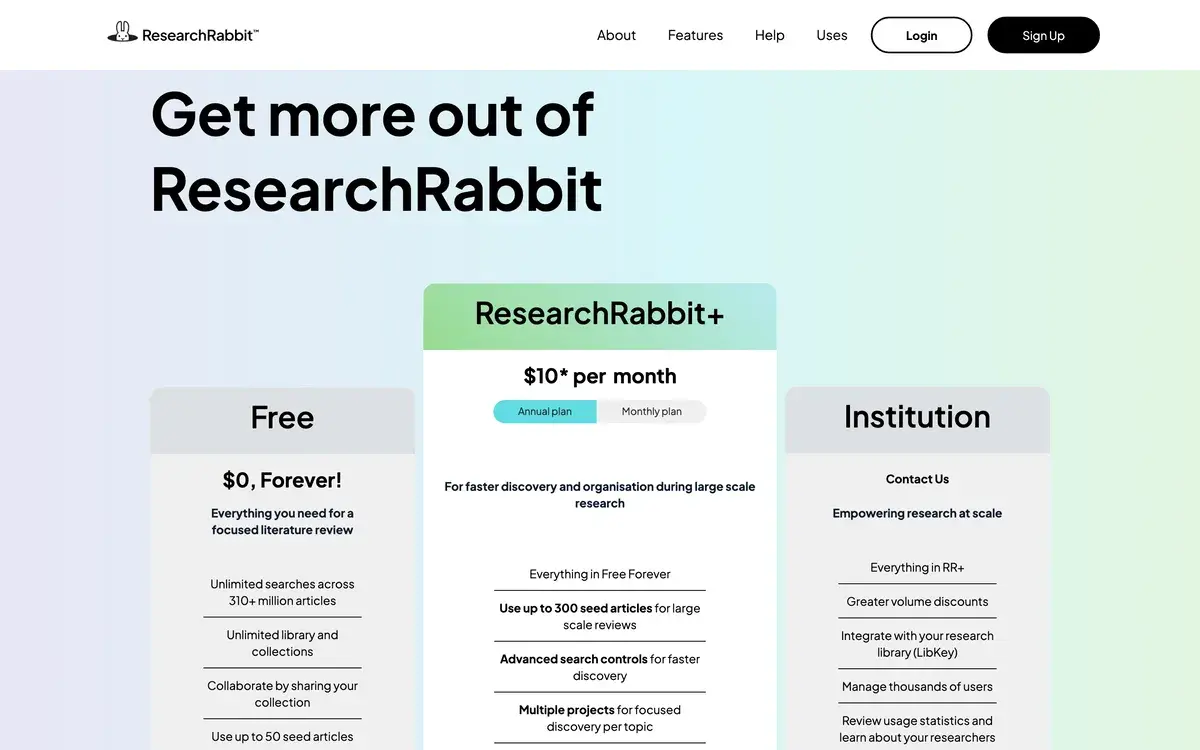
ResearchRabbit is completely free for individual researchers, with no premium tier and no usage limits. The funding model — grants from research foundations and institutional partnerships rather than user subscriptions — is unusual in the AI-era academic tools landscape and is part of what makes the tool worth recommending without reservation.

For institutional contexts (university libraries, research organizations) interested in supporting ResearchRabbit's continued development, the team accepts institutional partnerships and grant collaborations. The structure resembles how academic infrastructure tools have been funded historically rather than the SaaS subscription model that dominates current AI tools.

This free model has held since launch and the founders have committed to maintaining it for individual researchers. Whether this remains sustainable indefinitely is a fair question — many free academic tools have eventually moved to paid tiers — but as of April 2026, the tool remains genuinely and fully free.

Hands-on Notes

The first time you build a collection of papers in your research area and explore the citation network, ResearchRabbit produces the kind of "wait, this is free?" reaction that good academic tools should produce more often. The visualization quality is comparable to paid alternatives. The Suggested papers feature surfaces work that linear search would not. The Zotero integration removes friction that other tools impose. For something funded by grants rather than subscriptions, the polish is genuinely impressive.

What we use most: building collections of "papers I should read in the next month" from broader exploration, then adding the most relevant to active research project collections. The two-tier organization — exploration collections and active project collections — fits how literature work actually flows. Recommendations across both tiers stay relevant as collections grow.

The Suggested papers algorithm has improved meaningfully over the last year. Earlier versions sometimes recommended adjacent-but-not-quite-relevant work; current recommendations land on actual usefulness more reliably. Whether this is from improved ML or from the growing collection corpus making recommendations smarter is unclear, but the practical effect is that Suggested has become a tool we check weekly rather than something we ignored.

The visualization can become busy on large collections. A collection of 80+ seed papers produces a network graph that requires zooming and filtering to navigate productively. The interface handles this reasonably well — clustering, filtering by year or topic, focusing on subsets of the network — but expect some learning curve on getting useful views of complex collections.

The honest limitations: ResearchRabbit covers what Semantic Scholar covers, which means coverage gaps in non-English literature, humanities, and grey literature carry through. For citation polarity (does this paper actually support the cited claim?), Scite is the right tool — ResearchRabbit shows you connections, not citation context. For evidence synthesis with structured data extraction, Elicit serves a different purpose. ResearchRabbit is excellent at what it does; it does not try to do everything.

Use Cases

A PhD student starting a new dissertation chapter uses ResearchRabbit to map the literature landscape. Beginning with 5 seed papers from the supervisor's reading list, the student builds a collection over two weeks that grows to 60+ relevant papers through systematic exploration of the citation network. The Suggested feature surfaces a methodological precedent from an adjacent field that becomes central to the chapter's contribution.

A medical researcher writing a review article uses ResearchRabbit alongside PubMed. PubMed handles the systematic search; ResearchRabbit fills in the discovery work — adjacent therapies, methodological precedents, and recent commentary that systematic search keywords would have missed. The combined approach produces a review article that engages with the field more comprehensively than either tool alone could support.

An interdisciplinary researcher whose work sits between economics and behavioral science uses ResearchRabbit to track both literatures simultaneously. Two collections — one centered on economic theory, one centered on behavioral findings — grow in parallel; ResearchRabbit's Suggested feature occasionally surfaces papers connecting both fields that the researcher would not have found through discipline-bound search.

A policy analyst at a think tank uses ResearchRabbit during the early scoping of policy briefs. Mapping the academic literature around housing intervention effectiveness, the analyst discovers a recent thread of evaluation studies in urban planning journals that economics-focused search had missed. The brief is more rigorous as a result.

A graduate seminar instructor uses ResearchRabbit to teach literature exploration to first-year students. Walking through how the citation network visualization reveals field structure is more pedagogically effective than abstract instructions to "search the literature broadly." Students leave the session understanding citation networks as research infrastructure rather than just bibliographic conventions.

Our Verdict

ResearchRabbit is one of the genuinely delightful tools in academic research infrastructure — free, well-designed, doing one specific job (citation-network discovery) really well, without the subscription pressure that defines most AI-era academic tools. For researchers, PhD students, and anyone doing serious literature exploration, it earns a permanent place in the workflow.

The Zotero integration removes friction that competing tools impose. The Suggested papers feature has become reliably useful as the algorithm has matured. The collection-based model fits how research actually evolves over months and years rather than session-based exploration.

Limitations are minor: visualization gets busy on very large collections, coverage inherits Semantic Scholar's gaps in humanities and non-English literature, and the tool does not try to do citation polarity analysis or evidence synthesis (use Scite and Elicit respectively for those jobs). The fact that the funding model is grants rather than subscriptions is worth noticing — whether this remains sustainable long-term is a fair question, but as of 2026 the tool is genuinely free with no premium tier waiting in the wings.

If you do academic literature work and have not tried ResearchRabbit, try it this week. The barrier to entry is zero; the discovery upside is real.

Note: ResearchRabbit is free and does not have an affiliate program. AIVario earns no commission from any associated tool. Our rating reflects ongoing use across literature work and the rare combination of "free" and "genuinely good" that defines the tool's market position.

Best for: PhD students, academic researchers, interdisciplinary scholars, science writers, policy analysts, anyone doing literature exploration Not ideal for: Systematic protocol-driven searches (use PubMed or Web of Science), citation polarity analysis (use Scite), evidence synthesis with data extraction (use Elicit) Bottom line: Free, beautifully designed, genuinely useful — the rare combination in 2026 academic tooling. If you do literature work, install it today.

Related Tools

  • Scite — complementary tool for analyzing citation polarity within papers ResearchRabbit helps you discover
  • Elicit — evidence synthesis tool that pairs with ResearchRabbit's discovery for systematic literature work
  • Consensus — fast research question verdicts, complementary to ResearchRabbit's discovery focus
  • Notion — common destination for synthesis notes after ResearchRabbit-driven literature exploration
  • Perplexity — general AI search for non-academic research questions, complementary use case

Frequently Asked Questions about ResearchRabbit

Is ResearchRabbit really free?

Yes, completely free with no premium tier, no subscription, no usage limits. ResearchRabbit is funded by grants and institutional partnerships rather than user fees. The model is unusual for AI-era research tools — most competitors are paid SaaS — and the founders have committed to keeping the core product free for individual researchers indefinitely.

How does ResearchRabbit work?

Add papers you already know to a collection, and ResearchRabbit shows you related papers through citation network analysis — papers cited by yours, papers citing yours, and papers connected through shared citations. The interactive visualization makes the literature landscape navigable in ways linear search results cannot.

Is ResearchRabbit better than Connected Papers?

They are similar tools serving the same job, with overlapping but slightly different strengths. ResearchRabbit emphasizes ongoing collection management — you build libraries of papers and the tool surfaces new related work as you grow your collection. Connected Papers is more session-based, optimized for exploring around a single seed paper. Many researchers use both for different stages of literature work.

Does ResearchRabbit integrate with Zotero?

Yes, the Zotero integration is one of ResearchRabbit's standout features. Your Zotero library syncs into ResearchRabbit collections, and discoveries flow back to Zotero as you save them. For researchers who already manage references in Zotero, the integration removes the friction of moving papers between tools.

What papers does ResearchRabbit cover?

ResearchRabbit pulls from Semantic Scholar's index of 220M+ papers across most academic disciplines. Coverage is strongest for biomedicine, life sciences, computer science, and social sciences. Humanities and non-English literature are less comprehensively indexed — a limitation shared with most modern academic search tools.

Can ResearchRabbit replace traditional database searches?

Not entirely — it complements rather than replaces. PubMed, Web of Science, and Google Scholar remain better for exhaustive systematic searches and structured queries. ResearchRabbit is better for serendipitous discovery, finding adjacent literature you would not have searched for, and visualizing how a research area connects together. For a complete literature workflow, use both.