Elicit

Elicit

★ Top rated
AI Research Assistant

Citation-grounded AI research assistant for academic literature — designed to minimize hallucinations on systematic reviews.

Free · $10/mo
📖 12 min read
Try Elicit for free

Affiliate link — we may earn a commission

Ready to try it?
Elicit
Free · $10/mo
Get started →
Affiliate link — we may earn a commission
Our rating
4.6/ 5
AIVario Editor's rating →

What is Elicit?

Elicit is an AI research assistant for academic literature — searching 125M+ papers, extracting data from studies, and synthesizing findings with grounded citations, free up to 5 monthly credits with paid plans starting at $12/month. Used by researchers, PhD students, scientists, and evidence-based teams across academia, medicine, policy, and industrial research. Key differentiators: every output links to real source papers, data extraction is paragraph-grounded, and the tool is designed specifically to minimize the citation hallucination problem that affects general-purpose LLMs. Best for systematic literature work where citation accuracy matters.

The hallucination problem in academic AI is the elephant in the room. Asking ChatGPT or Claude to find papers on a topic regularly produces plausible-sounding but fictional citations — author names that exist but did not write that paper, journal volumes that match a real publication but not that title, DOIs that lead nowhere. For casual users this is annoying. For researchers, it is disqualifying — a single hallucinated citation in a literature review can undermine the credibility of the entire work.

Elicit's design choice is to retrieve first, then summarize. The system searches an actual academic index (Semantic Scholar's 125M+ paper corpus), retrieves real papers, and grounds every claim in extracted text from those papers. The synthesis you get is constrained by the literature, not invented around it. This is the same architectural pattern that makes RAG (retrieval-augmented generation) work for enterprise knowledge bases, applied to the academic literature.

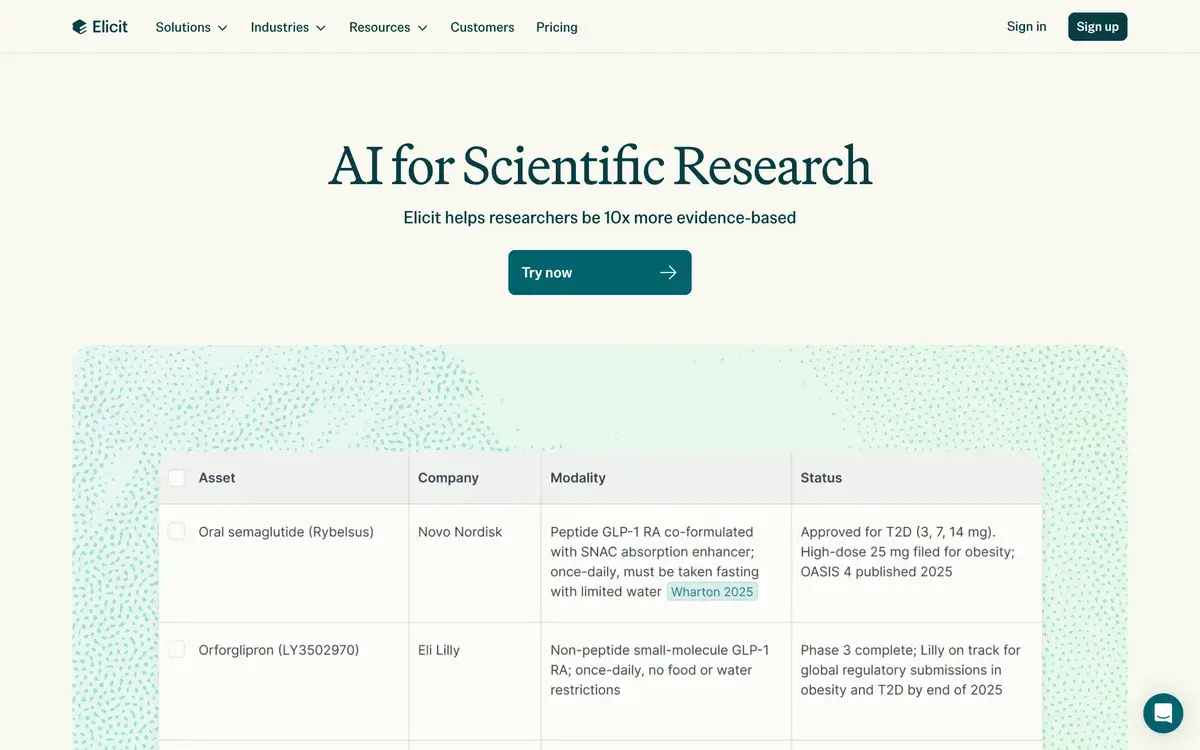
The product has matured significantly from its 2022 origins. Recent additions include custom column extraction (define exactly what data points to pull from each paper, like effect sizes, sample sizes, methods), uploaded PDF support for grey literature and internal documents, and improved screening features for systematic review workflows. Elicit is no longer a "smart academic search" — it is a research workflow tool.

Who is it for?

Elicit is built for people whose work depends on citing real, accurately-extracted research. The clearest fit is academic researchers and PhD students working on literature reviews, systematic reviews, meta-analyses, and evidence syntheses. The custom data extraction features compress what used to be weeks of manual paper screening and tabulation into days.

Medical and clinical researchers use Elicit for evidence-based medicine workflows — searching trial literature, extracting outcome measures across studies, identifying relevant cohorts. The hallucination-minimization design is non-negotiable for medical work; Elicit's grounded outputs are safer than general-purpose LLMs by design.

Policy researchers and think tanks use Elicit to build evidence bases for policy briefs and analyses. The ability to extract specific data points across many studies (effect sizes, methodologies, populations studied) accelerates the synthesis work that defines policy research.

R&D and innovation teams at industrial research organizations (pharma, biotech, materials science, AI labs) use Elicit to keep up with literature, identify research gaps, and synthesize evidence for internal reports. The Pro tier's PDF upload feature is particularly valuable here for working with internal research alongside published literature.

Independent researchers, journalists working on science-heavy stories, and consultants doing evidence-based work use Elicit when they need real citations rather than convincing-sounding ones.

It is not the right tool for general business research (use ChatGPT, Perplexity, or Consensus for that), market research that does not depend on academic literature, or quick fact-checking where Wikipedia or Google would be faster.

Key Features

  • Academic paper search — searches 125M+ papers from Semantic Scholar across most disciplines
  • Grounded citations — every claim links to a real source paper with the supporting paragraph extracted
  • Data extraction — pulls specific data points (sample sizes, effect sizes, outcomes, methods) from each paper into a structured table
  • Custom columns — define your own extraction columns for systematic literature work
  • Literature review synthesis — synthesize findings across multiple papers with claim-by-claim citations
  • PDF upload (Pro) — upload your own PDFs for grey literature, internal documents, or non-indexed papers
  • Screening tools — inclusion/exclusion screening for systematic review workflows
  • Citation export — one-click export to BibTeX, RIS, EndNote, Zotero, and Mendeley
  • Concept search — search by research concept, not just keywords
  • Bias detection — flags potential issues in extracted findings (small samples, conflicts of interest, retracted papers)

Elicit vs Competitors 2026

ToolDatabase sizeData extractionSynthesisFree tierPrice/mo
Elicit125M+ papers✅ Custom columns✅ Strong✅ 5 credits/mo$12
Consensus200M+ papers⚠️ Verdict-focused✅ Question-based✅ Limited$9
Scite1.2B+ citations✅ Citation context⚠️ Citation-focused✅ Trial$20
Research RabbitVariable❌ Discovery-focused⚠️ Visual✅ FreeFree
ScholarAIVariable⚠️ Basic⚠️ ChatGPT plugin⚠️ Limited$9
UndermindSpecialized⚠️ Deep search✅ Deep synthesis$19
PaperpalSmaller❌ Writing-focused⚠️ Trial$19
LitmapsCitation network❌ Visual mapping✅ Free$10

Data verified April 2026 from each provider's official pricing pages.

Elicit vs Consensus: The most-asked comparison. Consensus is optimized for answering specific yes/no research questions with study-level evidence verdicts ("studies that support" / "studies that contradict"). Elicit is broader — searching, extracting, synthesizing across studies. For quick evidence checks ("does X cause Y in the literature?"), Consensus is faster and more focused. For systematic literature work that requires structured extraction, Elicit is more capable. Many serious researchers use both.

Elicit vs Scite: Different jobs. Scite specializes in citation context — for any paper, it shows you how it has been cited (supporting, contrasting, mentioning) by later work. This is uniquely useful for understanding how a paper's claims have held up over time. Elicit focuses on synthesis across literature for your research question. Scite complements Elicit rather than replacing it.

Elicit vs Research Rabbit: Research Rabbit is excellent for paper discovery — given a seed paper, it surfaces related work through citation networks and visualization. Elicit is stronger for extraction and synthesis once you have papers identified. The two are complementary at different stages of the research workflow.

Elicit vs Undermind: Undermind is a newer entrant focused on deep iterative research — it runs longer searches, follows citation chains, and produces more thorough syntheses than tools optimized for fast answers. Elicit is faster but less deep. For high-stakes literature reviews where thoroughness matters more than speed, Undermind is a strong alternative; for typical research work, Elicit's faster turnaround wins.

Elicit vs ChatGPT / Claude / Perplexity: General-purpose AI tools can search literature but hallucinate citations at rates that make them unsafe for serious research. Perplexity is the strongest of the three for source-grounded outputs, but its index is the broader web, not academic literature specifically. Elicit's domain focus and grounded design make it materially safer for research work.

Pricing 2026

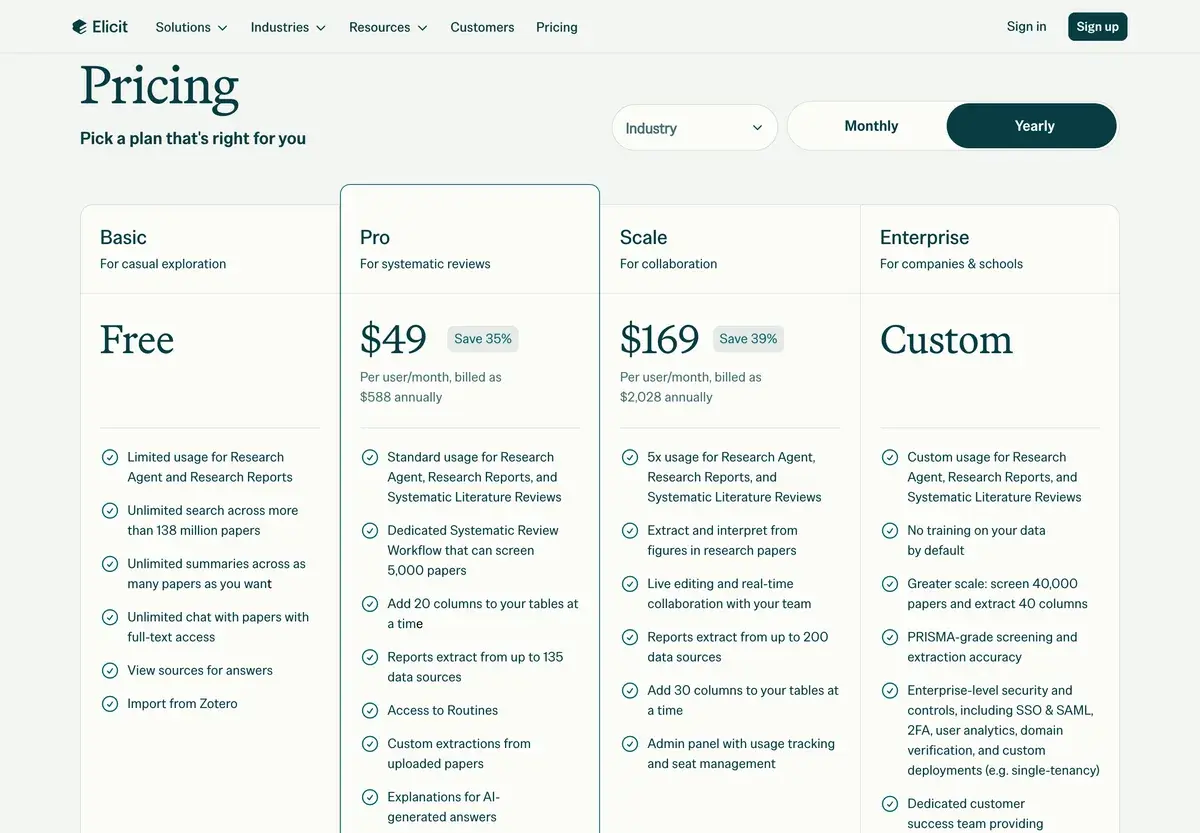
PlanPriceCreditsFeaturesBest for
Free$05/moBasic search and extractionCasual evaluation
Plus$12/mo60/moFull extraction features, citation exportSolo researchers, students
Pro$42/moUnlimitedPDF upload, custom columns, advanced screeningActive researchers, professionals
TeamCustomCustomShared workspaces, admin controls, SSOResearch teams, departments

Prices verified April 2026 from elicit.com/pricing.

The honest tier guide: the free tier (5 credits/month) is enough to evaluate the tool's quality but too limited for any real research work. Plus at $12/month is a reasonable subscription for solo researchers and grad students working on focused projects — 60 credits covers a thorough literature search per topic. Pro at $42/month is the right tier for active researchers running multiple projects, systematic reviews, or anyone needing PDF upload for grey literature. Academic discounts and team pricing are available — contact Elicit if you qualify.

Hands-on Notes

The thing that distinguishes Elicit from general-purpose AI tools, the moment you actually use it, is how visible the grounding is. You ask a research question, Elicit returns relevant papers, and every claim in the synthesis links to the specific paragraph in the specific paper that supports it. You can click through to the paper and verify directly. After using ChatGPT or Claude for academic search and finding fake citations, this transparency feels like coming up for air.

Custom column extraction is the feature that earns the Pro subscription for serious research work. Defining a column for "primary outcome measure" or "sample size" or "study design" and watching Elicit extract that information consistently across 30 papers is the kind of work that used to take a day per cohort of papers. The extractions are not perfect — about 80-90% accurate in our experience, which means you still need to verify before publication — but the accelerator effect is significant. The honest framing: Elicit does not eliminate the need to read papers, it eliminates the need to read all of them.

Where Elicit gets weaker: extraction quality drops on papers with non-standard structure, complex tables, or technical notation that does not parse cleanly. Older papers with poor PDFs (image-based scans, low OCR quality) extract less reliably. Papers in non-English languages are not handled well, which is a real constraint for some research areas.

The synthesis feature has matured substantially over the last year. Earlier versions sometimes produced bland aggregations that lost nuance; current synthesis preserves study-level disagreement, flags methodological differences across cited work, and resists the impulse to overgeneralize. We trust the syntheses more than we used to, but still treat them as drafts for editorial review rather than finished output.

What gets in the way: credit pricing on the lower tiers can feel restrictive for active research. The Pro tier's "unlimited" pricing is a reasonable answer for users who hit the credit ceiling regularly. The product also has a learning curve — the difference between a search that returns junk and a search that returns relevant papers depends partly on how you phrase the query, and that takes practice. The community resources and tutorials help.

The other quiet caveat: even with Elicit's grounding, every citation should be verified before going into published work. Elicit links to real papers, but the extraction can occasionally misattribute a claim to a paper that mentions but does not actually establish it. Treat the tool as a research accelerator, not as evidence authority.

Use Cases

PhD literature review: A doctoral student in cognitive neuroscience uses Elicit to build the literature review for their thesis. The custom column extraction pulls effect sizes, sample sizes, paradigms, and key findings across 80+ relevant papers. What was previously a four-month manual process compresses to about six weeks of Elicit-assisted work plus targeted deep reading.

Systematic review for evidence-based medicine: A clinical research team conducting a Cochrane-style systematic review uses Elicit for the screening and extraction phases. Inclusion/exclusion screening across 2,000+ initial papers takes a fraction of the time of manual screening. Final extraction of 60-80 included studies is verified manually but starts from Elicit-extracted tables.

Policy research synthesis: A think tank researcher writing a policy brief on housing policy uses Elicit to synthesize findings across economics, urban planning, and social science literature. The ability to extract specific data points (rent control effects, zoning outcomes, displacement metrics) across studies accelerates the brief's evidence base.

Industrial R&D literature monitoring: A pharma R&D team uses Elicit Pro with PDF uploads to combine published literature monitoring with internal research documents. New papers in target therapeutic areas are screened weekly; relevant findings are extracted into a shared internal database.

Independent journalism on science topics: A freelance journalist working on a feature about a contested scientific claim uses Elicit to find and cite real research rather than relying on press releases or general AI search. The grounded citations make fact-checking faster and more rigorous.

Our Verdict

Elicit is the right tool for AI-assisted academic research, and the design choice to ground every output in real retrieved papers is the architectural decision that makes it safe to use for serious work. The custom data extraction features compress systematic literature work in ways that genuinely change research workflows. We have been quietly impressed by how much the tool has matured over the last two years.

The honest weaknesses: extraction quality is not perfect (still requires manual verification for high-stakes work), non-English literature is underserved, older or unusually-structured papers extract less reliably, and the credit pricing on lower tiers can feel restrictive for active researchers. The tool also has a learning curve — getting useful results depends on query phrasing in ways that take practice.

For researchers, scientists, evidence-based teams, and anyone whose work depends on real citations rather than plausible-sounding ones, Elicit is the right pick. For business research, market research, or quick fact-checking, simpler tools (Perplexity, Consensus, Google Scholar) are sufficient.

Note: Elicit does not currently have a public affiliate program with AIVario. AIVario earns no commission from sign-ups. Our rating reflects ongoing use of the paid Pro tier on real research projects.

Best for: Academic researchers, PhD students, medical and clinical researchers, policy researchers, R&D teams, evidence-based journalism Not ideal for: General business research (use Perplexity), market research outside academic literature, casual fact-checking Bottom line: The rare AI research tool that respects citation hygiene — designed to minimize hallucinations rather than hide them, which makes it the safest option for work that depends on real evidence.

Related Tools

  • Consensus — complementary tool for fast yes/no research question verdicts
  • Scite — citation context tool that pairs well with Elicit for citation analysis
  • Research Rabbit — paper discovery tool used at the start of research workflows
  • Undermind — deep iterative research alternative for high-stakes literature reviews
  • Perplexity — general-purpose AI search for non-academic research questions

Frequently Asked Questions about Elicit

Is Elicit free?

Yes, Elicit has a free tier with 5 monthly credits, enough for a few searches per month. Paid plans start at $12/month for Plus (60 credits) and $42/month for Pro (unlimited searches and full feature access). Academic and team pricing is also available with discounts for verified researchers.

Does Elicit hallucinate citations?

Elicit is designed specifically to minimize hallucinated citations — every claim links to a real paper that Elicit retrieved, and the data extraction shows the source paragraph. This is materially safer than asking ChatGPT or Claude for citations directly, where hallucinated references are common. That said, you should always verify citations against the original paper before using them in published work.

How is Elicit different from Consensus?

Both tools search academic literature, but they emphasize different jobs. Consensus answers specific yes/no research questions ('Does intermittent fasting improve cognition?') with study-level evidence verdicts. Elicit is broader — paper search, data extraction across studies, literature review synthesis. For quick evidence checks, Consensus is faster. For systematic literature work, Elicit is more capable.

What papers does Elicit search?

Elicit searches Semantic Scholar's index of over 125 million academic papers across most disciplines — life sciences, social sciences, computer science, engineering, humanities. Coverage is strongest for English-language journal articles and conference papers. Books, theses, and grey literature have lighter coverage.

Can Elicit do a systematic literature review?

Elicit accelerates systematic review work but does not replace the formal PRISMA process. The data extraction across many papers, custom column extraction, and inclusion/exclusion screening features compress the most tedious parts of a systematic review. For published systematic reviews and meta-analyses, you still need the protocol registration and rigorous methodology that PRISMA requires.

Does Elicit support PDF upload?

Yes, Elicit Pro lets you upload your own PDFs into a private library and run the same search, extraction, and synthesis features against them. This is useful for working with grey literature, internal reports, or papers that are not indexed in Semantic Scholar. PDFs stay private to your account.

Is Elicit accurate enough for medical research?

Elicit is used by medical researchers and the data extraction is generally accurate when the paper text is clearly written. For high-stakes medical evidence (patient care decisions, regulatory submissions, published meta-analyses), every extracted data point still needs to be verified against the original paper. Treat Elicit as a research accelerator, not as an evidence authority.

Does Elicit work for non-English papers?

Elicit's coverage is strongest for English-language papers, and the synthesis features work best on English content. The underlying database includes some non-English papers, but extraction and analysis are more reliable on English-language sources. For research areas that depend on non-English literature, this is a meaningful limitation.