What is Undermind?
Undermind is an autonomous AI research agent that performs deep literature searches across scientific publications. Unlike traditional search tools (Google Scholar, Scopus, Semantic Scholar) that return ranked lists of papers, Undermind runs as an agent that searches, reads papers in depth, iteratively refines based on what it finds, and produces comprehensive written synthesis reports answering specific research questions. The pricing is free for 3 deep searches monthly and $20/month for 30 deep searches at the Pro tier.
Understanding what Undermind does requires understanding what it does not do — and how it differs from adjacent research tools that often get grouped together in "AI research" categories.
The research workflow has multiple stages: discovery (finding relevant papers), comprehension (understanding what each paper says), synthesis (combining findings across papers), citation analysis (understanding how papers relate), and writing (producing your own research output). Different tools serve different stages. Elicit produces grounded answers from research literature for specific questions. Scite analyzes citation polarity to understand whether papers support or contradict claims. ResearchRabbit visualizes citation networks for serendipitous discovery. Perplexity handles fast factual lookups with citations. Undermind handles deep literature synthesis on complex research questions where exhaustive coverage matters.
This positioning matters for the buying decision. For researchers whose work involves periodic deep dives into specific research questions — literature reviews for grant proposals, comprehensive evidence reviews for clinical decisions, thorough background research for new project areas — Undermind is genuinely valuable in ways the adjacent tools are not. For researchers whose work involves quick factual lookups, paper discovery, or general AI-assisted research, the simpler and faster tools often fit better.
The deep search vs broad search distinction
Most AI search tools optimize for breadth and speed. You ask a question, the system returns results in seconds, and the value is in fast access to relevant content. This optimization makes sense for the most common search use cases — factual lookups, general orientation on topics, quick answers to bounded questions.
Deep search optimizes differently. The system trades speed for depth: spending minutes to hours on a single query, reading papers in detail rather than skimming abstracts, iteratively refining the search based on what is found, and producing comprehensive synthesis rather than brief answers. The value is in the thoroughness — capturing nuance and edge cases that broad search misses, surfacing recent papers that change the picture, identifying methodological diversity across studies, and producing the kind of comprehensive review that supports serious research decisions.
For most search use cases, the trade-off favors breadth. You do not need 20 minutes of agent time to find the population of Tokyo. For a narrow set of high-stakes use cases — comprehensive literature reviews, evidence synthesis for important decisions, thorough background for new research areas — the trade-off favors depth. The single deep search can replace hours of manual review work that broad search cannot accelerate beyond a certain point.
Undermind is built around this depth optimization. The agent runs autonomously for minutes to tens of minutes per search, performing iterative searching and reading rather than single-pass retrieval. The output is a research report, not a list of links — typically several pages of synthesis with paper-level citations, addressing the question from multiple angles, noting contradictions and methodological variation across the literature.
This depth comes with practical implications. Search latency is measured in minutes rather than seconds. The 3-search free tier and 30-search Pro tier reflect that each search consumes substantial compute. Use cases requiring fast iterative search are not what Undermind is designed for; use cases requiring thorough synthesis are.
Where Undermind genuinely earns its place
Researchers conducting literature reviews for grant proposals, where comprehensive coverage of relevant research is required and the cost of missing important work is high. The thorough search and synthesis compress what would otherwise be days or weeks of manual review.
Clinical researchers and evidence-based medicine practitioners conducting evidence reviews for guidelines, treatment decisions, and clinical research. The deep reading of full papers (rather than abstract-only analysis) produces more reliable evidence synthesis than abstract-level tools.
PhD candidates and early-career researchers conducting background research for new project areas. The exhaustive coverage helps identify the relevant literature that the researcher will need to engage with seriously; the synthesis provides orientation faster than building it manually.
Policy analysts, science journalists, and other research professionals who occasionally need thorough evidence synthesis on specific questions. The Pro tier (30 searches monthly) supports several deep dives per month at modest cost.
Industry researchers in pharmaceutical, biotech, and technology sectors conducting competitive intelligence, technology landscape reviews, and patent research. The depth and quality of literature synthesis fits the use cases where shallow research would miss important context.
Senior researchers acting as supervisors and mentors who need to verify or build on student literature reviews. Running Undermind on the same question a student has researched provides a check on coverage and helps identify gaps.
Undermind is not the right primary tool for: quick factual lookups (Perplexity is faster), general AI assistance for writing or analysis (Claude or ChatGPT serve broader needs), paper discovery through citation networks (ResearchRabbit handles this well), citation polarity analysis (Scite is the specialized tool), or real-time research workflow integration (the per-search latency does not fit interactive workflows).
Key Features
- Deep autonomous search — agent-based search running 5-30 minutes per query with iterative refinement
- Full-paper reading — agent reads full text of accessible papers, not just abstracts
- Comprehensive synthesis — output is a written research report with paper-level citations, not a list of links
- Iterative search refinement — agent adjusts search strategy based on what it finds during the search
- Citation grounding — claims in synthesis report linked to specific papers for verification
- Multi-paper synthesis — combines findings across many papers to address complex research questions
- Domain coverage — strongest in scientific and technical disciplines (life sciences, physical sciences, CS, medicine, psychology)
- Real-time progress — visibility into agent activity during the search (which papers being read, what is being found)
- Question refinement — supports follow-up questions and refinement based on initial results
- Export options — synthesis reports exportable for use in research workflows
- PDF analysis — upload papers for direct analysis if needed alongside autonomous search
- Search history — completed searches saved for future reference and follow-up
Undermind vs Competitors 2026
| Tool | Search depth | Speed | Synthesis output | Domain focus | Price/mo |
|---|
| Undermind | ✅ Deepest | ⚠️ Slow (5-30 min) | ✅ Comprehensive reports | Scientific lit | $20 |
| Elicit | ⚠️ Mid | ✅ Fast | ⚠️ Q&A grounded | Scientific lit | $12 |
| Scite | N/A (citation analysis) | ✅ Fast | N/A | Scientific lit | $20 |
| ResearchRabbit | N/A (visualization) | ✅ Fast | N/A | Scientific lit | Free |
| Consensus | ⚠️ Mid | ✅ Fast | ⚠️ Yes/no verdicts | Scientific lit | $9.99 |
| Perplexity | ⚠️ Broad | ✅ Fast | ⚠️ Brief synthesis | General + scientific | $20 |
| ChatGPT Deep Research | ✅ Deep | ⚠️ Slow (5-30 min) | ✅ Comprehensive | General | Bundled $200 (Pro) |
| Google Scholar | ❌ Standard search | ✅ Fast | ❌ List of papers | Scientific lit | Free |
Data verified April 2026 from each provider's pricing pages.
The competitive landscape has shifted meaningfully since OpenAI launched ChatGPT Deep Research in late 2024 and Anthropic's Claude added similar deep research capabilities. These features in general AI tools provide deep autonomous research workflows that overlap with Undermind's positioning. The competitive picture in 2026:
- Undermind: specialized for scientific literature, strong synthesis quality, $20/month at consumer pricing.
- ChatGPT Deep Research: bundled with ChatGPT Pro at $200/month, broader domain coverage including general web content alongside scientific literature, comprehensive synthesis quality.
- Claude Research mode: similar capability bundled with Claude Pro and Max plans, strong synthesis quality, broader content coverage.
For users specifically focused on scientific literature research who do not need ChatGPT Pro or Claude Pro for other use cases, Undermind at $20/month is meaningfully cheaper. For users already paying for ChatGPT Pro or Claude for other reasons, the included deep research capabilities cover much of Undermind's use case at no marginal cost.
Within the dedicated research tool category, Elicit, Scite, ResearchRabbit, and Consensus serve different research workflow stages and complement rather than compete with Undermind. Sophisticated researchers often use multiple tools across these categories rather than committing to one.
Pricing 2026
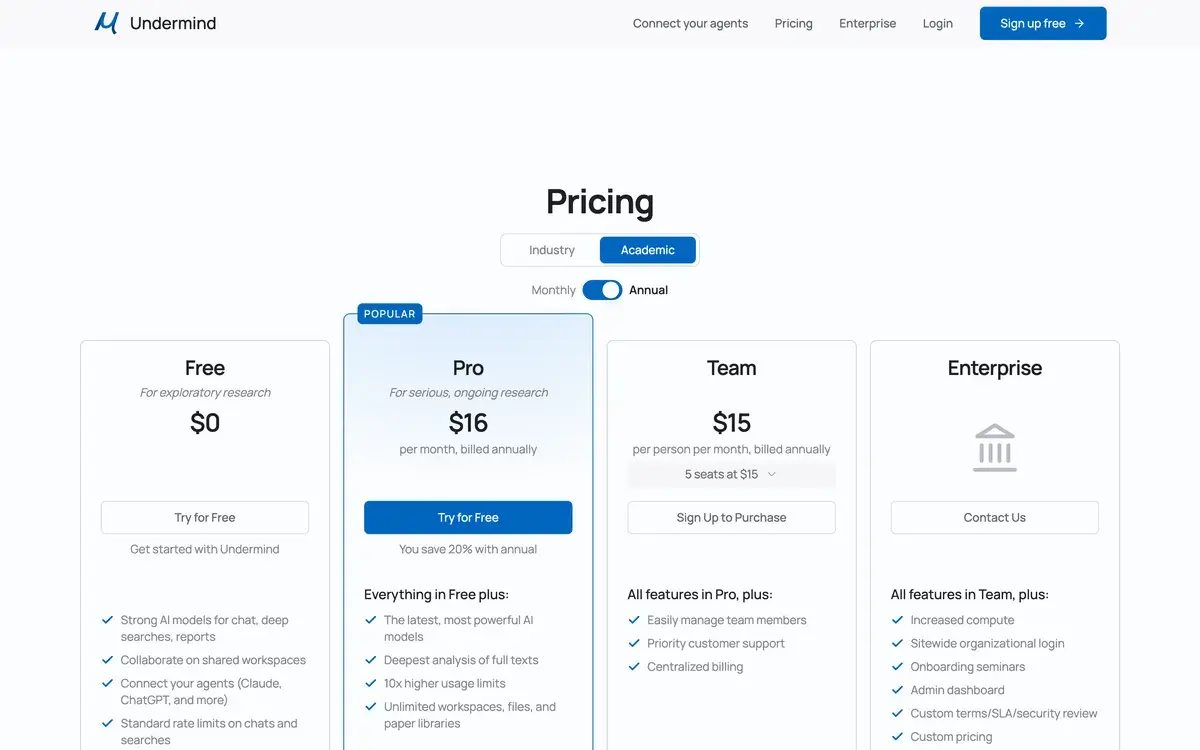
| Plan | Price | Deep searches | Best for |
|---|
| Free | $0 | 3/mo | Evaluation, occasional deep dives |
| Pro | $20/mo | 30/mo | Active researchers, regular literature reviews |
Prices verified April 2026 from undermind.ai. The two-tier pricing structure is straightforward; institutional pricing may be available for university and research organization deployments through direct contact.
The pricing is reasonable for the value delivered when matched to actual use case. Free tier (3 monthly searches) supports occasional deep dives and serves as legitimate evaluation of the tool's capability. Pro at $20/month for 30 searches supports active researchers conducting roughly one deep search per workday — appropriate for researchers whose work involves regular literature review.
The credit-based pricing creates planning overhead similar to other compute-intensive AI tools. Users should expect each deep search to consume meaningful resources and plan tier selection based on actual deep-search frequency rather than aspirational use.
For users finding 30 monthly searches insufficient, contacting Undermind for higher-volume options or institutional pricing may be necessary. For users finding 30 monthly searches more than sufficient, the Pro tier remains reasonable; there is no intermediate tier that captures users between casual and active research patterns.
Hands-on Notes
The first thing that affects practical use of Undermind is the latency. Submitting a deep search and waiting 10-20 minutes for results is fundamentally different from the second-level latency of most AI tools. This is not a flaw in the product — it is the nature of deep search — but it affects how Undermind fits into research workflows. The tool is best used asynchronously: submit a search, do other work, return to find the synthesis report.
The synthesis quality is genuinely impressive on questions matching Undermind's strengths. A research question like "what is the current evidence on the effectiveness of intermittent fasting on metabolic health markers in non-diabetic adults" produces a multi-page synthesis covering recent randomized trials, methodological variation across studies, points of consensus, points of contradiction, and noted limitations. The depth is comparable to what a graduate research assistant would produce after several days of work.
The citation grounding makes verification straightforward. Each significant claim in the synthesis links to specific papers, with quotation or paraphrase indicating what the paper said. For researchers who want to verify or expand on synthesis claims, the path to source material is direct. This grounding is meaningfully better than tools that produce synthesis without clear paper-level attribution.
The iterative search behavior is one of the more interesting capabilities to watch in real time. The progress indicator shows what the agent is currently doing — searching, reading specific papers, refining queries based on findings. The agent visibly adjusts course as it learns from what it finds, which produces more thorough coverage than single-pass searches but also means search outcomes vary based on what the agent encounters early in the session.
Where Undermind gets weaker: questions outside its scientific literature focus produce less reliable results. Asking about topics where research lives in books, reports, or non-traditional formats produces synthesis based on whatever scientific papers tangentially address the topic, which may not be the actual literature relevant to the question. For humanities, qualitative social sciences, and applied professional fields, the platform's coverage gaps show.
The other practical consideration: deep search quality depends on question quality. Vague or overly broad questions produce broad synthesis; specific, well-defined research questions produce focused, useful synthesis. Researchers who invest in formulating good research questions (specific intervention, specific population, specific outcomes, specific methodological scope) get meaningfully better results than researchers who ask diffuse "tell me about X" questions.
For researchers comparing Undermind against ChatGPT Deep Research or Claude Research mode, the practical question is which tool fits the specific use case best. Undermind's specialized scientific literature focus produces stronger synthesis on technical research questions; the general AI tools' broader coverage produces stronger synthesis on questions involving general web content alongside research literature. For purely scientific research questions, Undermind tends to produce more focused outputs; for questions involving policy, news, industry analysis, or other non-research content alongside literature, the general AI tools handle the breadth better.
Use Cases
A clinical research scientist uses Undermind Pro monthly for evidence reviews supporting treatment recommendations. Each deep search produces a synthesis comparable to what a research fellow would produce in 1-2 days; the pace of evidence review work compresses meaningfully. The $20/month cost is trivially justified against research productivity gains.
A PhD candidate in computational biology uses Undermind for background research on new project areas. Comprehensive literature reviews on technical questions previously consumed weeks of dissertation time; Undermind compresses this to days. The candidate verifies and extends the synthesis through traditional methods but starts from a much stronger baseline.
A pharmaceutical industry researcher uses Undermind for competitive intelligence on therapeutic mechanisms. Understanding what research has been published on emerging targets supports portfolio decisions; the depth of literature synthesis exceeds what general search tools can produce. The professional use case justifies whatever pricing tier is needed.
A science journalist uses Undermind for thorough background research on stories involving scientific controversies. The synthesis identifies methodological variation across studies, points of contradiction in the literature, and recent findings that affect the public conversation. The journalism quality improves through grounded literature understanding.
A policy analyst at a think tank uses Undermind for evidence reviews supporting policy recommendations. The synthesis output supports policy briefs that previously required dedicated research staff time; the analyst's productive output capacity expands meaningfully with the tool.
A senior PhD researcher evaluates Undermind alongside ChatGPT Pro's Deep Research feature and decides Undermind's specialized scientific focus produces stronger synthesis on the researcher's specific work. The decision is not against ChatGPT — the researcher uses ChatGPT for other purposes — but the dedicated tool fits the literature review use case better.
Our Verdict
Undermind is one of the most genuinely impressive AI research tools available for its specific use case — comprehensive literature synthesis on scientific research questions where depth matters more than speed. For researchers conducting serious literature reviews, evidence synthesis, or thorough background research on technical topics, the tool produces output quality that compresses days or weeks of manual work into single deep search sessions.
The honest considerations: the deep search pattern fits a narrow set of use cases. Most research workflows involve quick factual lookups, paper discovery, and general AI assistance — use cases where simpler and faster tools serve better. The recent expansion of deep research capabilities in ChatGPT and Claude creates competitive pressure for users who already pay for those general AI tools; Undermind's specialized scientific focus remains a real advantage but the differentiation has narrowed.
The pricing is reasonable for active researchers. Free tier supports occasional use; Pro at $20/month supports regular literature review work; the tool earns its place against any honest cost-benefit analysis for users matched to the use case.
For scientists, researchers, PhD students, science journalists, policy analysts, and others whose work involves genuine literature review, Undermind deserves serious evaluation. For users whose work fits other research patterns, the simpler and faster tools (Perplexity for lookups, Elicit for grounded answers, ResearchRabbit for discovery) serve better. Match the tool to the actual research workflow rather than to the AI research category broadly.
Note: Undermind does not currently have an active affiliate program with AIVario. AIVario earns no commission from sign-ups. Our rating reflects evaluation of the Pro tier across literature review work alongside parallel use of Elicit, Scite, ResearchRabbit, and Perplexity.
Best for: Researchers conducting comprehensive literature reviews, clinical researchers and evidence-based medicine practitioners, PhD candidates doing background research, policy analysts and science journalists, industry researchers in pharma/biotech/tech, senior researchers verifying student literature reviews
Not ideal for: Quick factual lookups (use Perplexity), paper discovery through citation networks (use ResearchRabbit), citation polarity analysis (use Scite), users whose research fits broader AI assistance patterns (ChatGPT or Claude with deep research features may suffice), humanities or qualitative social sciences (coverage is weaker)
Bottom line: Specialized tool that earns its place for the narrow but important use case of deep scientific literature synthesis. Match to actual workflow rather than to general "AI research" category; for the right audience, genuinely impressive.
Related Tools
- Elicit — complementary tool for grounded Q&A on research literature in faster workflows
- Scite — citation polarity analysis that complements Undermind synthesis
- ResearchRabbit — visual citation network discovery that complements Undermind synthesis
- Consensus — quick research verdicts for simpler questions Undermind would over-engineer
- Perplexity — fast broad research alternative for non-deep-dive use cases
Frequently Asked Questions about Undermind
How much does Undermind cost?
Undermind has a free tier with 3 deep searches per month. Pro is $20/month with 30 deep searches per month and access to higher-tier reasoning models. There is no annual discount currently advertised. The pricing is reasonable for the per-search depth — each deep search consumes substantial compute and represents what would be hours of manual literature review.
How is Undermind different from Elicit, Scite, or ResearchRabbit?
Different jobs in the research workflow. Elicit synthesizes findings across papers with grounded citations for specific factual questions. Scite analyzes citation polarity (which papers support, contradict, or mention claims). ResearchRabbit visualizes citation networks for paper discovery. Undermind performs autonomous deep searches — the agent runs for minutes to hours, reads papers in depth, and returns comprehensive written synthesis on a research question. Different tools for different research stages; sophisticated researchers use multiple.
What is a 'deep search' in Undermind?
A deep search is an autonomous research session where the agent searches literature databases, identifies relevant papers, reads them in depth (not just abstracts), iteratively refines the search based on what it finds, and produces a comprehensive synthesis report. Each session typically takes 5-30 minutes of agent runtime and consumes substantial AI compute. The output is a written research report, not a list of links.
Is Undermind better than Perplexity for research?
Different positioning. Perplexity is fast and broad — useful for quick factual lookups across general web content with citation links. Undermind is slow and deep — useful for thorough literature review on specific scientific questions with paper-level reading. For 'what is the current consensus on X' questions where speed matters, Perplexity. For 'comprehensive review of evidence on X across published research' questions where depth matters, Undermind.
Does Undermind read full papers or just abstracts?
Full papers when accessible. The agent reads full text of papers it can access (open access, accessible through institutional subscriptions where available, or available via various legitimate channels). For paywalled papers without access, Undermind works from abstracts and any other accessible content. The full-paper reading is part of what distinguishes the deep search from abstract-only tools and is what produces meaningful synthesis quality on technical research questions.
What disciplines does Undermind cover well?
Undermind is strongest in scientific and technical disciplines where research is published in peer-reviewed journals — life sciences, physical sciences, computer science, engineering, clinical medicine, psychology, and quantitative social sciences. Coverage is weaker in humanities, qualitative social sciences, and applied/professional fields where research lives more in books, reports, and non-traditional formats. The platform is purpose-built for journal-published scientific literature.
Can Undermind work alongside ChatGPT or Claude for research?
Yes, and many serious researchers use Undermind for deep literature review and ChatGPT or Claude for synthesis, writing, and follow-up reasoning. The workflow: Undermind produces comprehensive literature synthesis on a research question, the researcher reads and verifies the output, then uses Claude or ChatGPT to develop arguments, draft writing, or explore implications. The tools complement each other rather than competing.
Is Undermind accurate enough to rely on?
Generally yes, with caveats appropriate to all AI research tools. Undermind grounds claims in specific papers and provides citations, which makes verification straightforward. For high-stakes research where accuracy is critical, treating Undermind output as a starting point that requires verification (rather than authoritative final answer) produces appropriate research practice. The tool accelerates literature review; it does not replace the researcher's judgment about what the literature actually says.