ScholarAI

ScholarAI

★ Top rated
AI Research Assistant

ChatGPT-integrated research tool with access to 200M+ papers — useful for casual research within ChatGPT, less powerful than dedicated research platforms.

Free · $8/mo
📖 14 min read
Try ScholarAI for free

Affiliate link — we may earn a commission

Ready to try it?
ScholarAI
Free · $8/mo
Get started →
Affiliate link — we may earn a commission
Our rating
4.4/ 5
AIVario Editor's rating →

What is ScholarAI?

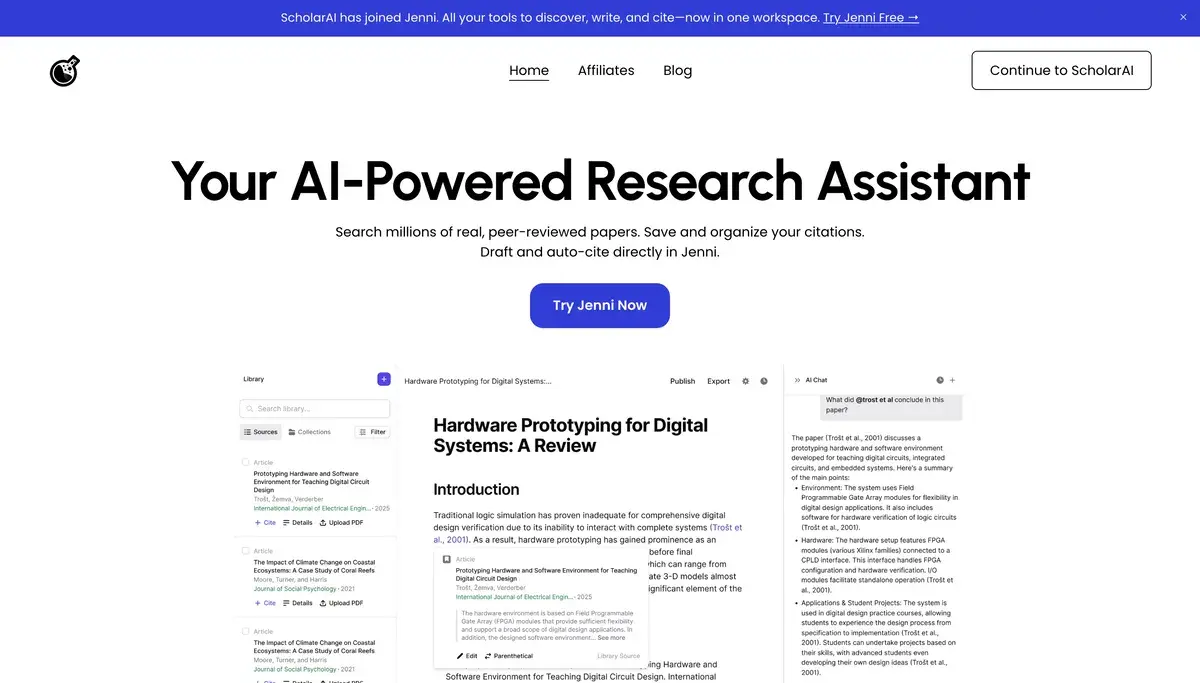
ScholarAI is an AI research tool with a distinctive distribution model — primarily known as a custom GPT within ChatGPT's GPT Store, with standalone web app and API access as additional channels. The product provides AI-powered research with access to 200M+ peer-reviewed papers across major academic databases, designed for conversational research workflows where users ask research questions and get paper-grounded answers without leaving familiar AI conversation interfaces.

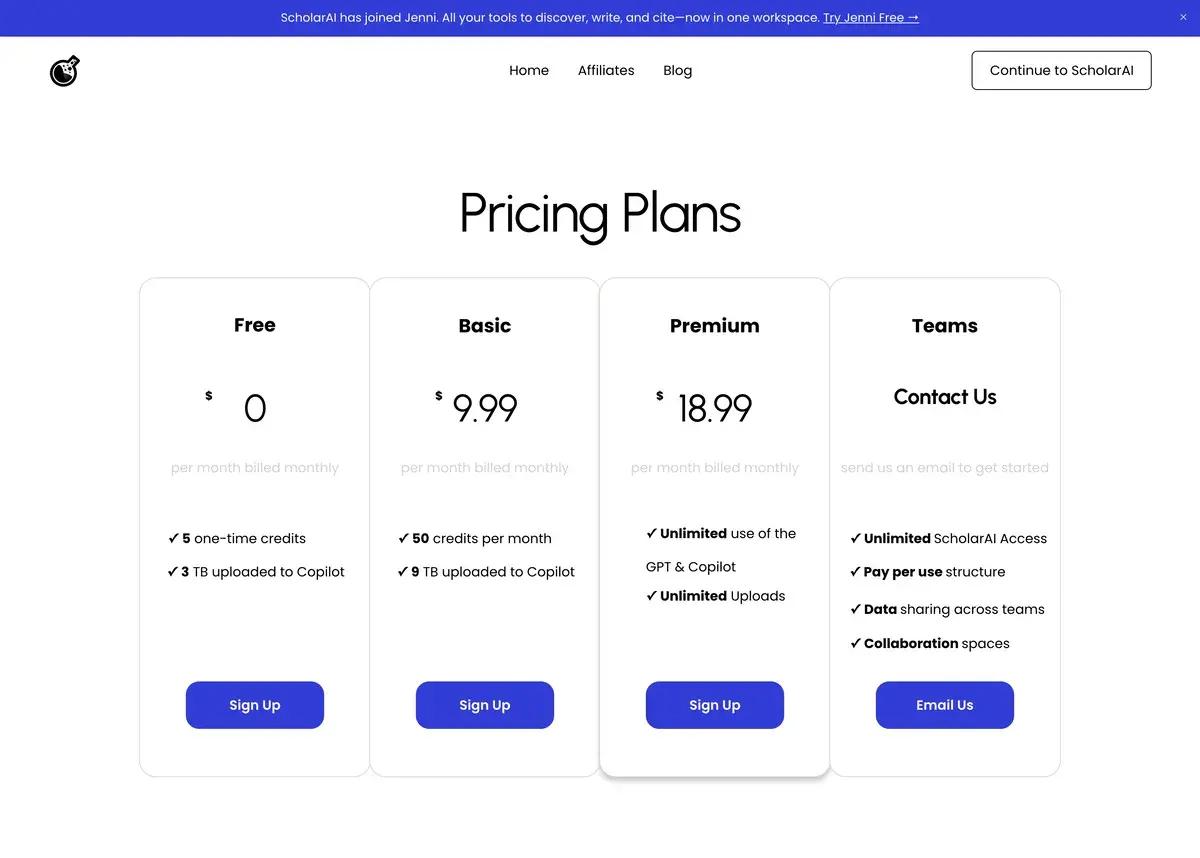
The pricing is among the most accessible in the academic research AI category. Free tier provides 10 monthly queries; Scholar tier at $8/month provides unlimited queries plus full features. Premium and Team tiers offer higher capability for power users and institutional use. The pricing makes ScholarAI feasible for students, casual researchers, and anyone wanting research augmentation without committing to expensive dedicated platforms.

The honest competitive picture in 2026 requires understanding ScholarAI's specific positioning relative to dedicated research platforms. ScholarAI is not Elicit — the dedicated research platform with sophisticated literature synthesis, paper comparison features, and structured academic workflows. ScholarAI is not Undermind — the deep research agent producing comprehensive literature synthesis. ScholarAI is more lightweight: research-augmented AI conversation that surfaces papers grounding the conversation in academic literature without the depth of dedicated research tools.

For users matched to this lightweight positioning — students orienting on research topics, journalists conducting background research, casual researchers exploring scientific subjects — ScholarAI is genuinely useful at affordable pricing. For users wanting deep systematic literature review, comprehensive evidence synthesis, or sophisticated academic workflow features, dedicated platforms serve better. The buying decision should be honest about whether your research needs match the lightweight positioning.

The ChatGPT-plugin positioning

The custom GPT distribution model is one of the more interesting aspects of ScholarAI's market position. By making research capabilities available within ChatGPT's interface, ScholarAI captures users who would not otherwise leave ChatGPT for dedicated research tools. The convenience matters substantially — many users do most of their AI work in ChatGPT and find the friction of switching to dedicated tools meaningful enough that they research suboptimally rather than switch tools.

For ChatGPT Plus users specifically (the audience that has access to GPT Store), ScholarAI provides research augmentation within existing AI workflow at no additional ChatGPT subscription cost — only the ScholarAI subscription if usage exceeds free tier. The combination of ChatGPT's general AI capabilities plus ScholarAI's research grounding produces useful outputs without subscription to dedicated research platforms.

This distribution model also has trade-offs. Working through ChatGPT's GPT interface adds latency and constraints versus standalone research tools. Complex research workflows that benefit from dedicated UI (paper comparison views, structured synthesis interfaces, citation organization) work less smoothly through GPT chat. The convenience of staying in ChatGPT trades against capability of leaving ChatGPT for purpose-built tools.

For users matched to the convenience priority — research within ChatGPT conversations, casual research alongside other AI work, students and casual researchers without dedicated workflow needs — the GPT integration fits. For users matched to the capability priority — sophisticated literature review, structured research synthesis, deep evidence work — dedicated platforms serve better despite the workflow disruption of leaving ChatGPT.

The standalone ScholarAI web app provides similar capabilities outside ChatGPT for users who prefer dedicated interfaces. The capabilities are comparable but the workflow patterns differ; users should evaluate which interface fits their working preferences.

Where ScholarAI earns its place

Students conducting research for assignments, papers, and dissertations who need affordable access to AI-augmented academic research. The $8/month pricing fits student budgets where dedicated research platforms ($20-50/month) often do not.

Casual researchers conducting periodic deep-dives into specific scientific topics. The combination of lightweight ChatGPT integration and reasonable academic literature coverage handles occasional research without committing to expensive specialized tools.

Journalists and writers conducting background research on scientific or technical topics. The paper-grounded outputs provide citation-backed background research that informs better journalism without requiring formal academic research methodology.

ChatGPT Plus users wanting research augmentation within existing AI workflows. The GPT integration fits ChatGPT-aligned workflow without requiring separate platform investment.

Educators preparing curriculum, students preparing presentations, and similar contexts where solid academic background informs the work but full research methodology is unnecessary.

Solo practitioners (consultants, professionals, knowledge workers) who occasionally need scientific or academic research grounding for client work or professional content. The pay-per-month flexibility fits irregular use better than annual academic subscriptions.

Health-conscious individuals researching medical topics for personal understanding. ScholarAI's medical literature access provides paper-grounded health information that broader AI tools may not match for accuracy.

ScholarAI is not the right primary tool for: serious academic literature review for publication (use Elicit, Undermind, or traditional academic search), systematic evidence synthesis for clinical or policy decisions (use dedicated platforms), comprehensive scientific research workflows requiring sophisticated tools (use Elicit alongside Zotero or other dedicated tools), non-academic research (Perplexity or general AI tools serve better), or institutional research where dedicated platform features matter for collaboration and compliance.

Key Features

  • ChatGPT integration — available as custom GPT within ChatGPT's GPT Store
  • 200M+ paper access — coverage across PubMed, arXiv, semantic scholar repositories
  • Standalone web app — full ScholarAI capabilities accessible at scholarai.io
  • PDF analysis — upload and analyze full papers for question-answering
  • Citation generation — academic citations in APA, MLA, Chicago, Harvard formats
  • Literature search — search by topic, keyword, author across paper databases
  • Paper summarization — generate summaries of specific papers
  • API access — programmatic access for developers building research-augmented products
  • Cross-paper synthesis — synthesize findings across multiple papers (limited compared to dedicated platforms)
  • Research memory — saved research sessions for revisiting and continuing work
  • Multi-language support — research across non-English literature with varying quality
  • Mobile responsive — accessible on mobile devices through web app
  • Multiple AI models — uses different underlying language models for different tasks

ScholarAI vs Competitors 2026

ToolDistributionPaper coverageSynthesis depthPrice entry
ScholarAIChatGPT GPT + standalone200M+⚠️ Lightweight$8
ElicitStandalone platform200M+✅ Strong$12
UndermindStandalone agentComprehensive✅ Best in class$20
ConsensusStandalone200M+⚠️ Yes/no verdicts$9.99
PerplexityStandaloneWeb + papers⚠️ Mid$20
SciteStandaloneCitation polarity✅ Specialized$20
ResearchRabbitStandaloneCitation networksN/A (visualization)Free
ChatGPT SearchChatGPT bundledWeb + some papers⚠️ Mid$20 (ChatGPT Plus)
Connected PapersStandaloneCitation networksN/A (visualization)Free + paid

Data verified April 2026 from each provider's pricing pages.

The clearest competitive picture: ScholarAI vs Elicit is the most direct comparison for AI-augmented academic research. Elicit has more sophisticated research workflow features — structured paper synthesis, comparison tables, dedicated research interface — at slightly higher pricing ($12 vs $8). For dedicated research workflows where these features matter, Elicit. For lightweight research augmentation in ChatGPT or casual web app use, ScholarAI.

Against Undermind (the deep research agent at $20/month), ScholarAI serves a fundamentally lighter use case. Undermind produces comprehensive multi-page research synthesis on complex questions through 5-30 minutes of agent runtime; ScholarAI provides quick research-grounded conversation. For comprehensive evidence synthesis, Undermind. For quick research questions answered with paper grounding, ScholarAI.

Consensus is positioned similarly to ScholarAI on lightweight research augmentation but with a distinctive yes/no verdict format on research questions. For users wanting quick research-grounded answers to specific factual questions, Consensus's verdict format fits well; for users wanting more conversational research, ScholarAI fits better.

Against ChatGPT Search (bundled with ChatGPT Plus), the comparison is whether dedicated academic literature access ($8 ScholarAI on top of ChatGPT Plus, or $20 ChatGPT Plus alone with Search functionality including some academic content) justifies the additional subscription. For users needing serious academic research focus, ScholarAI's dedicated coverage matters. For users with general research needs that overlap academic content, ChatGPT Search may suffice.

For systematic literature work that requires citation polarity analysis, Scite is the specialized tool that ScholarAI does not match. The two complement rather than compete.

Pricing 2026

PlanPriceQueriesBest for
Free$010/moEvaluation, very light use
Scholar$8/moUnlimited + full featuresActive casual researchers, students
Premium$20/moUnlimited + advanced featuresPower users, professional researchers
TeamCustomCustomEducational institutions, research teams

Prices verified April 2026 from scholarai.io/pricing. Annual billing offers ~20% off paid tiers.

The pricing is genuinely accessible for the academic research AI category. Scholar at $8/month makes ScholarAI feasible for students and casual researchers where dedicated research platforms ($12-20/month) are harder to justify. The pricing positions ScholarAI as the entry-level option in the AI research tools category.

Premium at $20/month adds advanced features for power users; the pricing reaches Elicit and Perplexity Pro territory at this tier. For users needing premium features, the comparison versus dedicated alternatives gets closer.

The free tier (10 queries/month) is sufficient for evaluation but too restrictive for ongoing serious use. Active research users move to Scholar tier within weeks of evaluation; the $8/month subscription is reasonable for the value delivered to matched use cases.

Hands-on Notes

The first thing that affects practical use is how ScholarAI integrates into ChatGPT workflow. Using the ScholarAI GPT in ChatGPT feels like a normal ChatGPT conversation that happens to surface academic papers when relevant. For users who do most of their AI work in ChatGPT, this integration eliminates the context-switching friction that pushing users to standalone research platforms creates. The convenience is genuine; for casual research alongside other AI work, this matters substantially.

Paper coverage is reasonable for typical academic research questions. Questions about well-published research areas produce relevant paper citations and grounded answers; questions about niche or emerging areas may have spottier coverage as expected. The 200M+ paper claim represents the underlying database access; the practical research quality depends on how the database serves your specific research questions.

Synthesis depth is the area where ScholarAI's lightweight positioning shows. Asking ScholarAI to synthesize evidence across multiple papers produces functional but not deep synthesis — comparable to what ChatGPT with web search would produce on similar questions. For users wanting genuinely deep synthesis, dedicated tools (Elicit's structured synthesis, Undermind's deep research) produce stronger outputs.

Citation generation works as advertised in standard academic formats. The generated citations are formatted correctly; for high-stakes academic work, verification against primary sources matters but the format quality is appropriate for typical citation needs. For dissertation or publication-grade citation organization, dedicated reference managers (Zotero, Mendeley) handle organization better than AI tools alone.

PDF analysis is a useful supplementary feature. Uploading specific papers for AI question-answering supports use cases where you have a specific paper to analyze rather than searching across the broader corpus. The capability is comparable to ChatGPT's PDF upload analysis but with academic-research-specific framing.

Where ScholarAI gets weaker: complex research workflows that benefit from dedicated UI (paper comparison views, structured research synthesis, citation organization). The chat-based interface works for conversational research but adds friction for sophisticated research workflows that purpose-built tools handle more elegantly.

The other practical observation: research quality depends substantially on question quality. Specific, well-defined research questions produce better grounded answers than vague exploratory questions. Researchers who invest in formulating specific questions get better results than researchers who ask diffuse "tell me about X" questions.

For users coming from dedicated research platforms hoping ScholarAI produces equivalent depth, the experience is initially disappointing — that is not what ScholarAI is built for. Calibrating expectations to "lightweight research augmentation in conversational interface" rather than "comprehensive research platform" produces better evaluation outcomes.

Use Cases

A graduate student researching dissertation topic uses ScholarAI Scholar ($8/month) for initial literature exploration phase. The ChatGPT GPT integration fits the student's existing AI workflow; paper grounding produces citation-backed answers that inform reading list and research direction. After initial exploration, the student transitions to dedicated tools (Elicit, Zotero) for systematic literature review. The combination handles different research stages appropriately.

A health-conscious individual researching specific medical topics uses ScholarAI free tier for occasional medical literature access. The 10 monthly queries cover personal health research without subscription commitment; the paper-grounded outputs provide more reliable health information than general AI tools. Topic depth is sufficient for personal understanding; medical decisions still require physician consultation.

A consultant occasionally needing scientific research grounding for client work uses ScholarAI Scholar. Subscription cost is small relative to client billing; the research augmentation produces better client deliverables than general AI alone. Used sporadically across client engagements.

A high school teacher preparing curriculum on scientific topics uses ScholarAI for teacher-facing background research. The paper-grounded summaries provide accurate scientific information for lesson preparation; classroom-appropriate adaptation handles the level translation. Compared to general web search, the academic grounding produces better-sourced content.

A journalist working on long-form science article uses ScholarAI Scholar alongside other research methods. ScholarAI handles the literature exploration phase; expert interviews and primary research handle deeper investigation. The $8/month subscription is justified by the journalism quality improvement from grounded background.

A serious academic researcher evaluates ScholarAI vs Elicit for primary research workflow and selects Elicit for the dedicated research interface and structured synthesis features. The researcher uses ChatGPT (with ScholarAI GPT enabled) for casual research questions outside primary research workflow. This use case reveals where ScholarAI fits — supplementary lightweight research, not primary research platform.

Our Verdict

ScholarAI is a thoughtfully positioned AI research tool that earns its place for users matched to lightweight research augmentation use cases. Students, casual researchers, journalists, educators, and ChatGPT-aligned users find genuine value at accessible pricing. The ChatGPT GPT integration eliminates context-switching friction that pushes some users away from dedicated research platforms.

The honest considerations: ScholarAI does not match dedicated research platforms (Elicit, Undermind) on synthesis depth or sophisticated research workflows. For serious academic literature review, evidence synthesis, or systematic research methodology, dedicated platforms produce stronger outcomes despite higher pricing. ScholarAI's sweet spot is lightweight research augmentation, not primary research infrastructure.

The pricing makes ScholarAI accessible where dedicated platforms can be prohibitive. Free tier serves evaluation; Scholar at $8/month is reasonable for active casual research; Premium at $20/month reaches dedicated platform pricing where comparison gets closer.

For students, casual researchers, ChatGPT users wanting research augmentation, journalists, and educators, ScholarAI deserves consideration. For serious academic researchers, dedicated platforms typically serve better despite higher cost. Match the buying decision to whether your research needs are lightweight (ScholarAI fits) or sophisticated (dedicated platforms fit better).

Note: ScholarAI does not currently have an active affiliate program with AIVario. AIVario earns no commission from sign-ups. Our rating reflects evaluation across casual research workflows alongside parallel use of Elicit, Undermind, and Perplexity for comparison.

Best for: Students conducting research for assignments, casual researchers conducting periodic deep-dives, journalists doing scientific background research, ChatGPT Plus users wanting research augmentation in existing workflow, educators preparing curriculum, solo practitioners with occasional research needs Not ideal for: Serious academic literature review for publication (use Elicit or Undermind), comprehensive evidence synthesis (use Undermind or dedicated tools), non-academic research (Perplexity or general AI tools serve better), institutional research with collaboration needs, users wanting sophisticated research workflow features Bottom line: Affordable research augmentation tool that fits casual research and ChatGPT-aligned workflows. Match the buying decision to whether your research is lightweight (ScholarAI fits) or sophisticated (dedicated platforms serve better).

Related Tools

  • Elicit — dedicated research platform with stronger synthesis features
  • Undermind — deep research agent for comprehensive literature synthesis
  • Consensus — alternative with research-question-verdict format
  • Perplexity — broader research alternative for non-academic content
  • Notion — common organization tool for managing research findings from ScholarAI

Frequently Asked Questions about ScholarAI

How much does ScholarAI cost?

ScholarAI has a free tier with 10 monthly queries and basic features. Scholar plan is $8/month with unlimited queries and full features. Premium and Team plans are higher tiers with additional capabilities. Annual billing offers ~20% off paid tiers. The pricing is among the cheapest in the academic research AI category.

How does ScholarAI work in ChatGPT?

ScholarAI is available as a custom GPT in the ChatGPT GPT Store. Users with ChatGPT Plus access the ScholarAI GPT directly within ChatGPT conversations — asking research questions, getting paper-grounded answers, and continuing the conversation in ChatGPT's familiar interface. The GPT integration handles paper retrieval and analysis within the broader ChatGPT conversation; for users primarily working in ChatGPT, this integration matters.

Is ScholarAI better than Elicit for research?

Different positioning. Elicit is a dedicated research platform with sophisticated literature synthesis, comparison features, and specialized academic workflows. ScholarAI is a research-augmented AI conversation tool, often used within ChatGPT. For dedicated literature review with sophisticated analysis, Elicit is more capable. For casual research within conversational AI workflows, ScholarAI fits more naturally. Many serious researchers use both — ScholarAI for quick paper-grounded conversations, Elicit for systematic literature work.

What papers does ScholarAI have access to?

ScholarAI claims access to 200M+ peer-reviewed papers across major databases (PubMed, arXiv, semantic scholar repositories, and others). The coverage is competitive with dedicated academic search tools. Full-text access depends on the paper's open access status and database coverage; for paywalled papers, ScholarAI works with abstracts and openly accessible metadata. For comprehensive scientific literature search, the coverage is reasonable for typical research use cases.

Can ScholarAI generate citations in academic format?

Yes, ScholarAI generates citations in standard academic formats (APA, MLA, Chicago, Harvard) for papers it references. The citation generation is reliable for most papers; verification against primary sources matters for high-stakes academic work but the format quality is appropriate for typical citation needs. For dissertation or publication-grade citation work, dedicated reference managers (Zotero, Mendeley) typically handle citation organization better than AI tools.

Should students use ScholarAI for assignments?

For research and orientation on topics, yes — ScholarAI accelerates the literature exploration phase that typically takes hours of search and reading. For actually writing assignments, use ScholarAI's outputs as starting points requiring substantial student work, not as content to submit. Academic integrity policies at most institutions require human-authored work; AI-assisted research is increasingly accepted, AI-generated submission is increasingly detected and penalized. Use ScholarAI as research tool, not as writing tool for academic submission.

Is ScholarAI good for non-academic research?

Less optimal. ScholarAI's data sources are primarily peer-reviewed academic literature; the focus is scientific and academic research questions. For business research, market research, journalism research, or general topic research, broader AI tools (Perplexity, ChatGPT Search, Felo) often produce better outcomes by drawing from diverse sources. ScholarAI's specialization is its strength for academic use cases and its limitation for non-academic research.