STORM by Stanford

STORM by Stanford

★ Top rated
AI Research

Stanford's free open-source research AI that produces Wikipedia-style articles with citations — genuinely impressive for free, though hosted instance has limits.

Free
📖 14 min read
Try STORM by Stanford for free

Affiliate link — we may earn a commission

Ready to try it?
STORM by Stanford
Free
Get started →
Affiliate link — we may earn a commission
Our rating
4.6/ 5
AIVario Editor's rating →

What is STORM?

STORM (Synthesis of Topic Outlines through Retrieval and Multi-perspective Question Asking) is an open-source AI research system from Stanford University's Open Virtual Assistant Lab. The system produces Wikipedia-style long-form articles on any topic — comprehensive structured documents with sections, headings, citations, and multiple perspectives. The hosted demo at storm.genie.stanford.edu is freely accessible; the source code is available on GitHub for self-hosting and modification.

The honest framing for STORM matters because it sits in an unusual position relative to most AI research tools. Most tools in this space are commercial products with subscription pricing, marketing positioning, and customer support obligations. STORM is an academic research project — Stanford's Open Virtual Assistant Lab built and continues to refine the system, the source code is public, the demo is provided as a research output rather than a commercial offering. There is no subscription, no paywall, no business model in the conventional sense.

This positioning has practical implications for evaluation. STORM is genuinely impressive given that it costs nothing — producing comprehensive research articles on any topic without subscription is a meaningful capability available freely. The hosted demo has reasonable usage limits but is not a teaser version; the underlying system is the actual product. For users who can extract value from STORM's output style, the tool provides capability that would otherwise require paid alternatives.

The trade-offs come from the academic-research positioning. Hosted instance reliability varies (Stanford does not provide enterprise SLA on a research demo). Output quality reflects the underlying system's capabilities at any given time, with no commercial pressure to maintain consistent SLAs. Future evolution depends on Stanford's research priorities rather than customer demand. For users who can work within these constraints, STORM is genuinely valuable; for users requiring commercial-grade reliability, paid alternatives may serve better despite the cost.

What makes STORM distinctive

The output format is the actual differentiation. Where most AI research tools produce conversational answers with citations (Perplexity, ChatGPT, Felo), STORM produces structured long-form articles. A typical STORM output on a research topic includes:

  • Introduction and overview
  • Multiple section headings covering different aspects of the topic
  • Sub-sections within each major section as appropriate
  • Multiple paragraphs per section with developed argumentation
  • Inline citations for claims
  • Multiple perspectives on contested or complex topics
  • Comprehensive coverage that resembles encyclopedia entries

This format is genuinely different from chat-style search outputs. The structural organization makes complex topics navigable in ways linear text answers cannot match. The multiple perspectives explicitly addressed in STORM outputs surface considerations that conversational search often misses. The encyclopedia-like comprehensiveness produces orientation on unfamiliar topics faster than reading multiple separate sources.

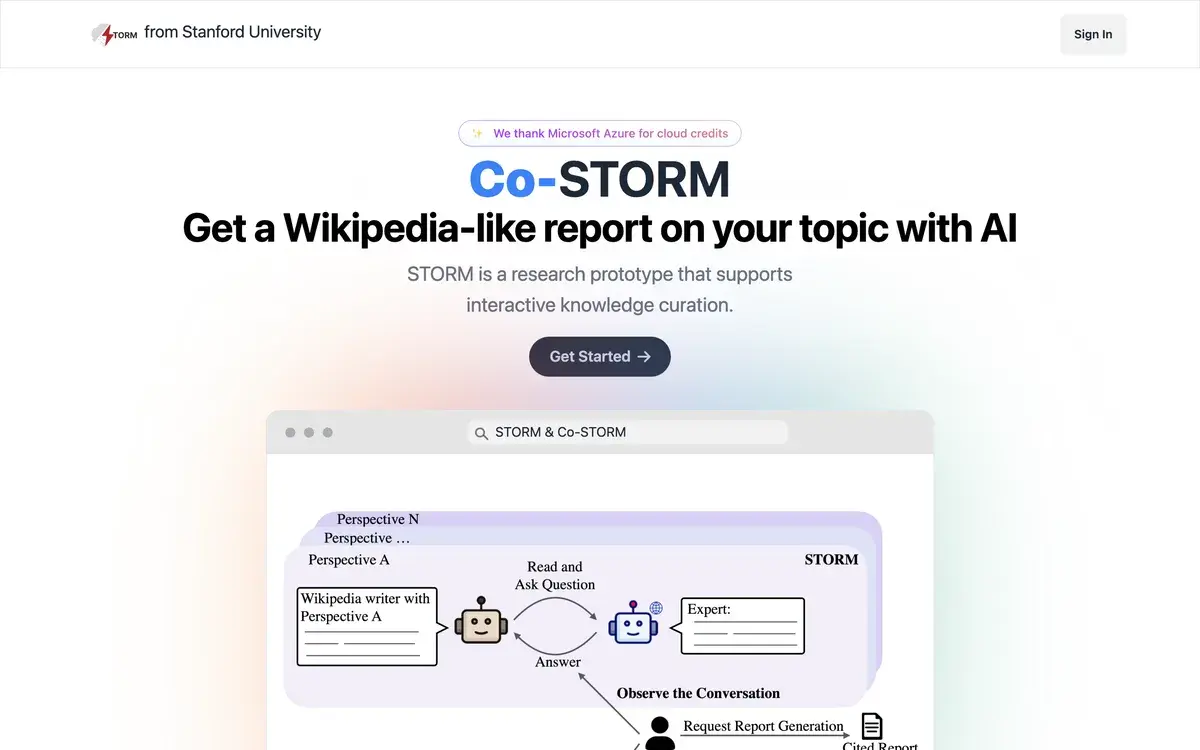
The "multi-perspective question asking" mechanism is the technical insight behind STORM's quality. Rather than answering a single query, STORM internally generates multiple research perspectives on the topic, asks questions from each perspective, retrieves relevant sources for each, and synthesizes findings across perspectives into the structured article. This produces coverage that single-perspective search cannot match.

For specific use cases — orientation on unfamiliar topics, generating reading material for complex subjects, producing structured overviews suitable for sharing — STORM's output format earns its place. For other use cases — quick factual lookups, conversational research, agentic deep search — alternatives serve better.

Where STORM fits

Researchers and academics conducting initial orientation on unfamiliar topics. Before deep literature review or focused investigation, STORM produces structured overview that informs subsequent work. The format supports "what should I know about this topic" use cases directly.

Students studying complex subjects who benefit from structured overview alongside textbook learning. STORM articles on academic topics often produce reading material that complements coursework with broader context and multiple perspectives.

Journalists working on long-form pieces about unfamiliar subjects. The structured comprehensive overview supports background research that informs interview preparation and article framing.

Policy analysts and consultants preparing briefings on topics outside their core expertise. STORM produces orientation documents in minutes that previously required hours of synthesis work.

Educators preparing curriculum on complex subjects. The STORM articles support both the educator's own learning and provide model structured documents that can inform lesson design.

Developers building products that need research synthesis capabilities. The open-source codebase provides foundation for embedding STORM-like research generation in custom applications.

Privacy-conscious users who can self-host STORM rather than depend on commercial AI tools. For organizations with data residency or privacy requirements, self-hosted STORM provides research synthesis without sending queries to commercial AI providers.

Anyone who wants free comprehensive research output and can work within the open-source / academic-research positioning. STORM produces value that paid alternatives cost meaningfully more for; users matched to the use case extract genuine free capability.

STORM is not the right primary tool for: quick factual lookups (Perplexity is faster), comprehensive scientific literature review (Undermind specializes in this), citation polarity analysis (Scite handles this), final academic writing (STORM produces drafts, not finished academic work), or use cases requiring commercial-grade reliability and SLA.

Key Features

  • Long-form structured articles — Wikipedia-style output with sections, sub-sections, and comprehensive coverage
  • Multi-perspective synthesis — internally generates multiple research perspectives and synthesizes findings across them
  • Citation grounding — claims linked to specific sources for verification
  • Open-source codebase — full source code available on GitHub under permissive license
  • Self-hostable — can be deployed on your own infrastructure with appropriate technical capability
  • Free hosted demo — Stanford-provided demo accessible at storm.genie.stanford.edu
  • No subscription required — free to use within hosted demo limits
  • Multiple language support — works across major languages with varying quality
  • Customizable — open-source nature allows modification for specific use cases
  • Multiple model backends — supports different underlying language models in self-hosted deployment
  • Research-grade approach — methodology grounded in academic research papers from Stanford

STORM vs Competitors 2026

ToolOutput formatCostSpeedBest for
STORM (Stanford)✅ Long-form articles✅ Free⚠️ 3-8 minTopic orientation, structured overviews
Perplexity⚠️ Chat answers$20/mo Pro✅ SecondsFast factual lookups
ChatGPT Search⚠️ Chat answers$20/mo (Plus)✅ SecondsGeneral AI + search
Felo AI✅ Mind maps$8.99/mo Pro⚠️ 1-3 minVisual topic exploration
Undermind✅ Deep research reports$20/mo Pro⚠️ 5-30 minScientific literature synthesis
Elicit⚠️ Q&A on papers$12/mo✅ FastGrounded answers from research
Genspark✅ SparkpagesFree + paid⚠️ Several minLong-form research output
ChatGPT Deep Research✅ Long-form reports$200/mo (Pro tier)⚠️ 5-30 minComprehensive research synthesis

Data verified April 2026 from each provider's pricing pages and STORM repository.

The competitive picture has shifted meaningfully through 2024-2025 with the launch of ChatGPT Deep Research and similar capabilities in Claude. These commercial deep research tools produce comparable or stronger output quality than STORM at substantially higher cost (ChatGPT Pro at $200/month). For users with budget for these commercial tools, the question of whether STORM remains relevant is honest.

The honest framing in 2026: STORM remains the best free option in the long-form structured research output category. ChatGPT Deep Research and Claude's research capabilities produce stronger output for users willing to pay. For users without budget for premium commercial AI or for whom STORM's output quality is sufficient, the free positioning makes STORM the right choice.

Within the dedicated free or low-cost research category, STORM stands out for output structure and quality. Genspark produces somewhat similar long-form outputs at free or low-cost tiers; output style differs but both serve overlapping use cases. For users specifically wanting structured article output without commercial pricing, both deserve evaluation.

Against Perplexity and ChatGPT Search, STORM's output format is fundamentally different. The chat tools produce concise answers; STORM produces comprehensive articles. Different format for different use cases; choosing between them is about output preference rather than competition on the same metric.

For researchers who can afford ChatGPT Pro at $200/month or Claude Pro at $20/month with research capabilities, the commercial deep research features often produce stronger results than STORM. For researchers without that budget or who specifically want STORM's open-source positioning, STORM remains genuinely valuable.

Pricing

STORM is free. The hosted demo at storm.genie.stanford.edu is freely accessible with reasonable usage limits to prevent abuse. The open-source codebase on GitHub is available under permissive license for self-hosting and modification. Stanford provides the demo as a research output rather than a commercial product.

For users wanting to use STORM beyond hosted demo limits or in production applications, self-hosting requires technical capability. Setting up STORM locally requires:

  • Python environment (3.10+)
  • API keys for underlying language models (typically OpenAI or compatible)
  • Search API access (Bing, You.com, or alternatives)
  • Modest server infrastructure for hosting

Self-hosting costs depend on usage — language model API calls and search API calls produce variable costs proportional to article generation volume. For typical research use, costs are modest; for high-volume programmatic use, costs scale with usage.

There is no commercial subscription to pay. No team plans. No enterprise pricing. STORM operates entirely outside the standard SaaS pricing model that defines most AI tool categories.

Hands-on Notes

The first thing that distinguishes STORM in actual use is the output format. Generating a STORM article on an unfamiliar topic produces something that feels meaningfully different from chat-based search — a structured document that reads like a comprehensive Wikipedia entry rather than a conversational answer. For users who learn well from structured long-form material, this format produces real understanding faster than reading multiple separate sources.

The multi-perspective synthesis is genuinely valuable in actual use. STORM articles on contested or complex topics explicitly address multiple viewpoints — for example, an article on a public policy debate might cover supporting arguments, opposing arguments, empirical evidence, historical context, and implementation considerations as separate sections. This breadth of coverage is hard to achieve from single-prompt search tools.

Generation latency (3-8 minutes per article on the hosted demo) is meaningful but reasonable. The system performs substantial retrieval and synthesis work; users should expect to wait rather than get instant results. For research workflows where the time investment is justified by the output value, this latency is acceptable; for use cases requiring instant responses, faster tools fit better.

Citation quality is generally good. STORM grounds claims in specific sources, links to source material, and produces verifiable references. As with all AI research tools, citation accuracy should be verified for high-stakes use; treating STORM output as authoritative without verification can produce problems. The verification path is straightforward given the explicit citation grounding.

Where STORM gets weaker: very recent events sometimes produce weaker outputs than topics with substantial published material. STORM's quality depends on what is retrievable; topics with sparse online coverage produce sparser STORM articles. For breaking news or very specialized topics, alternatives may produce better results.

The hosted demo has reasonable usage limits but is provided as research output rather than commercial service. Reliability is generally good but not enterprise-grade; users dependent on STORM for time-sensitive work should consider self-hosting or have backup tools available. The free positioning means SLA expectations should be calibrated accordingly.

Self-hosting requires technical capability that limits the audience. The GitHub repository is well-documented but requires Python environment setup, API key configuration, and infrastructure decisions. For technical users, self-hosting is feasible; for non-technical users, the hosted demo is the realistic option.

For users coming from commercial AI tools expecting polished UX, STORM's interface is functional rather than polished. The system focuses on output quality over interface design; the demo works but does not feel like a commercial product. Calibrating expectations to "academic research output" produces better evaluation outcomes.

Use Cases

A graduate student preparing thesis literature review uses STORM for initial orientation on the research area. The structured article provides understanding of major sub-fields, key debates, and important contributions; subsequent focused literature review with Elicit and Undermind builds on this STORM-generated foundation. The free positioning makes STORM accessible during graduate-school budget constraints.

A consulting analyst preparing a client briefing on an unfamiliar industry uses STORM for background research. The structured article provides industry overview suitable for orienting the analyst's understanding; client interviews and dedicated research build on this foundation. The output quality is sufficient for analyst preparation purposes.

A journalist working on a long-form piece about complex policy issues uses STORM to produce structured background documents. The multi-perspective coverage surfaces angles the journalist's own framing might miss; the structured format supports interview preparation and article outlining. The free positioning makes STORM accessible for freelance journalism budget realities.

A high school teacher preparing lesson on unfamiliar historical topic uses STORM to generate teacher-facing background document. The structured article provides comprehensive coverage suitable for teacher preparation; the educator builds lesson plans informed by this background understanding. STORM articles can also be shared with advanced students as supplementary reading.

A developer building a research-augmented product self-hosts STORM as the underlying research generation engine. The open-source codebase provides foundation that the developer customizes for the product's specific needs; the BSD-style license permits commercial use with appropriate attribution. The technical investment is substantial but produces capability the developer's product would otherwise pay for through commercial APIs.

A solo entrepreneur evaluates STORM vs paid alternatives for ongoing research needs. After 30-day evaluation, determines that STORM's output is sufficient for typical use; the free positioning saves the $20-200/month that comparable commercial tools would cost. The entrepreneur uses STORM for initial topic exploration and continues to access ChatGPT Plus for general AI work; the combination covers research needs at modest total cost.

Our Verdict

STORM is one of the more genuinely impressive free AI research tools available, producing structured long-form research output that competes credibly with commercial alternatives at substantially higher prices. For users matched to the long-form research format use case — topic orientation, structured overviews, multi-perspective synthesis on complex subjects — STORM provides real value at zero cost.

The honest considerations: commercial AI tools (ChatGPT Deep Research, Claude with research capabilities) produce stronger outputs at substantially higher cost ($20-200/month). For users who would already pay for those tools for other purposes, the bundled research capabilities often serve better than STORM. For users without that budget or who specifically prefer STORM's open-source positioning, STORM remains the best free option in this category.

The hosted demo serves the typical evaluation and modest research use cases well. For high-volume use, integration into custom products, or production applications, self-hosting is necessary and requires technical capability. For most individual research users, the hosted demo is sufficient.

For students, academics on tight budgets, journalists, educators, and researchers who can extract value from STORM's specific output format, the tool deserves serious consideration. For users requiring commercial-grade reliability or premium output quality at higher cost, alternatives may serve better.

The open-source positioning means STORM evolves with Stanford's research priorities rather than commercial demand. Future development depends on academic interest and contribution rather than customer feedback in the conventional sense. For users comfortable with this dynamic, STORM works; for users wanting commercial product evolution rhythms, paid alternatives serve better.

Note: STORM is an open-source academic research project, not a commercial product. AIVario has no commercial relationship with Stanford or the STORM team and earns no revenue from STORM use. Our rating reflects evaluation across research workflows alongside parallel use of Perplexity, Felo, Elicit, and Undermind for comparison.

Best for: Students and academics on tight budgets, researchers conducting topic orientation on unfamiliar subjects, journalists doing background research, educators preparing curriculum on complex subjects, developers building research-augmented products via self-hosting, privacy-conscious users wanting self-hosted research synthesis Not ideal for: Users requiring commercial-grade reliability and SLA, quick factual lookups (Perplexity is faster), comprehensive scientific literature review (Undermind specializes), citation polarity analysis (Scite specializes), final academic writing (output requires significant adaptation for academic deliverables) Bottom line: Genuinely impressive free academic research tool. Match the buying decision to whether free open-source positioning fits your needs and whether the long-form structured output format produces value for your specific use cases.

Related Tools

  • Perplexity — fast chat-based search alternative for quick factual queries
  • Felo AI — visual mind-map alternative for visual topic exploration
  • Undermind — deep scientific literature synthesis for academic research
  • Elicit — grounded Q&A on research literature
  • ResearchRabbit — citation network discovery that complements STORM topic orientation

Frequently Asked Questions about STORM by Stanford

Is STORM really free?

Yes, completely free. STORM is an open-source research project from Stanford University with the source code available on GitHub and a free hosted demo at storm.genie.stanford.edu. There is no subscription, no paywall, no premium tier. The hosted demo has reasonable usage limits to prevent abuse but is genuinely free for typical research use.

What does STORM actually produce?

STORM produces Wikipedia-style long-form articles on any topic — multi-section structured documents with citations, multiple perspectives, and comprehensive coverage. The output is meaningfully different from Perplexity or ChatGPT search answers, which produce concise responses; STORM produces what feels like a complete encyclopedia article suitable for orientation on unfamiliar topics.

How is STORM different from Perplexity or ChatGPT?

Different output format and depth. Perplexity and ChatGPT produce conversational answers with citations. STORM produces structured long-form articles with sections, headings, and comprehensive topic coverage. For getting a fast answer, the chat tools are better. For producing a comprehensive overview document on an unfamiliar topic, STORM is better. The output formats serve genuinely different use cases.

How long does STORM take to generate an article?

Typically 3-8 minutes for a complete article on the hosted demo. The system performs multi-perspective question-asking, retrieves information across many sources, synthesizes findings, and produces structured output — meaningfully more compute-intensive than chat-based search but still manageable for typical research workflows. Self-hosted instances may run faster or slower depending on infrastructure and configuration.

Are STORM's citations reliable?

Generally yes, with appropriate verification practice. STORM grounds claims in specific sources and provides full citation links. The retrieval system surfaces relevant sources for synthesis; the citation accuracy is comparable to other AI research tools that ground answers in retrieved content. For high-stakes use, treating STORM output as starting points requiring verification rather than authoritative final answers produces appropriate research practice.

Can I self-host STORM?

Yes, STORM is open source on GitHub (github.com/stanford-oval/storm). Self-hosting requires technical capability — Python environment, API keys for underlying models, and willingness to manage infrastructure. For organizations wanting STORM functionality without dependence on Stanford's hosted instance, self-hosting is feasible. For most users, the hosted demo is sufficient.

Is STORM good enough for academic work?

For initial topic orientation, yes. For final academic deliverables, no. STORM produces useful starting points and structural understanding; serious academic writing requires the deeper engagement, careful argumentation, and proper academic style that STORM's general AI output does not provide. Use STORM for topic exploration and structural orientation; use other tools (Elicit, Undermind, Scite) and traditional academic writing practice for final work.