Ideogram

Ideogram

★ Top rated
AI Image Generation

AI image generator specialized in typography and text-in-images — still leads on text accuracy in a category that has caught up.

Free · $8/mo
📖 13 min read
Try Ideogram for free

Affiliate link — we may earn a commission

Ready to try it?
Ideogram
Free · $8/mo
Get started →
Affiliate link — we may earn a commission
Our rating
4.6/ 5
AIVario Editor's rating →

What is Ideogram?

Ideogram is an AI image generator specialized in typography and text-in-images, free up to 10 daily slow generations with paid plans starting at $8/month. Used by marketers, designers, content creators, and small business owners producing posters, social graphics, logos, ads, and any design that includes text. Key differentiators: the most consistent text rendering of any AI image model, strong typography-aware generation, dedicated design and 3D styles, and multi-language support for major Latin scripts. Best for designs where text matters as much as the visual.

The text-in-images problem was the longest-running embarrassment in AI image generation. From 2022 through 2024, asking Midjourney, DALL-E, or Stable Diffusion to generate a poster with the words "Coffee Shop Open Saturday" would reliably produce something like "Cofffeee Shoph Open Sturdaay" — recognizable as English, technically letters, but unreadable as actual text. For visual art this did not matter. For posters, social graphics, ads, logos, book covers, and any design where text is part of the message, this was disqualifying.

Ideogram launched in 2023 specifically to solve this problem, and for about 18 months had a near-monopoly on typography-accurate AI image generation. The competitive landscape has shifted meaningfully since: FLUX (Black Forest Labs) ships strong text rendering, Recraft was built around design-grade output, Imagen 3 (Google) handles text well, and even Midjourney v7 has dramatically improved on its historical weakness. The Ideogram moat has narrowed — but for typography-heavy work, Ideogram still produces the most consistent results across attempts.

Who is it for?

Ideogram is built for people whose creative work involves text inside images, which turns out to be a much larger audience than the AI art community typically assumes. The clearest fit is marketers and content creators producing social graphics, ads, and visual content where text is the message. Quote graphics, promotional banners, event flyers, product launch images — all categories where Ideogram outperforms general-purpose AI image tools.

Small business owners and solopreneurs use Ideogram for affordable design work — restaurant menu graphics, real estate ad creatives, e-commerce product banners, local service flyers. The free tier and the $8/month Plus tier make custom design accessible without hiring a designer or learning Canva templates. Output is usable for most local-business contexts.

Content creators producing thumbnails, channel art, podcast covers, and video graphics use Ideogram for the typography-heavy formats where general-purpose AI tools historically failed. YouTube thumbnails specifically benefit from Ideogram's strong text accuracy for headline overlays and call-to-action text.

Independent designers use Ideogram for ideation and starting concepts on logo and identity work. Real production work happens in Figma or Illustrator afterward, but the AI-generated starting concepts compress the brainstorming phase. Whether this is good for the design profession is debated; the practical effect is faster iteration on typography-driven concepts.

Marketing teams at SMBs use Ideogram for ad creative variations, A/B testing visuals, and high-volume social content where producing one polished design and ten alternates would otherwise be cost-prohibitive.

It is not the right pick for: pure visual art and photography (use Midjourney or FLUX Pro), professional brand identity work where AI starting concepts are not appropriate, complex multi-element compositions requiring precise control (use Photoshop with Generative Fill or dedicated design tools), or workflows requiring strict reproducibility across generations.

Key Features

  • Text accuracy — generates clear, readable text inside images at quality unmatched by most general-purpose AI image tools
  • Ideogram 3 model — current flagship model with substantially improved photorealism and prompt adherence over previous versions
  • Style options — multiple base styles (general, design, realistic, anime, 3D) tuned for different use cases
  • Magic Fill — inpainting tool for editing parts of generated or uploaded images
  • Magic Expand — outpainting tool for extending or uncropping images beyond original boundaries
  • Remix — generate variations of an existing image with style and prompt modifications
  • Prompt enhancement — AI-assisted prompt improvement that adds detail and specificity automatically
  • Negative prompts — specify what should not appear in the generated image
  • Aspect ratio control — generate images in standard ratios (1:1, 16:9, 9:16, 4:3, 3:2) and custom dimensions
  • Multi-language text — supports English, Spanish, French, German, and other major Latin-script languages
  • Mobile apps — full generation workflow on iOS and Android with same model access as web

Ideogram vs Competitors 2026

ToolText accuracyArtistic qualityFree tierCommercial usePrice/mo
Ideogram✅ Best in class✅ Strong (v3)✅ 10/day✅ Paid plans$8
Midjourney⚠️ Improved (v7)✅ Best in class✅ Paid plans$10
FLUX (BFL)✅ Strong✅ Strong⚠️ Via partners✅ Paid plansVariable
DALL-E 3 (ChatGPT)✅ Good✅ Good✅ With ChatGPT free✅ With ChatGPT PlusBundled
Recraft✅ Strong✅ Design-focused✅ Limited✅ Paid plans$12
Imagen 3 (Google)✅ Strong✅ Strong⚠️ With Gemini✅ WorkspaceBundled
Stable Diffusion⚠️ Variable✅ Variable✅ Open source✅ Self-hostFree
Adobe Firefly⚠️ Decent✅ Strong✅ Limited✅ Built for itBundled CC
Krea⚠️ Decent✅ Strong✅ Limited✅ Paid plans$10

Data verified April 2026 from each provider's official pricing pages.

Ideogram vs Midjourney: The most-asked comparison historically. Midjourney still wins on artistic quality, photographic realism, and aesthetic coherence — its outputs feel more like professional photography or illustration. Ideogram wins on text accuracy and design-style outputs. Many designers use both: Midjourney for hero imagery and visual art, Ideogram for typography-driven designs. With Midjourney v7, the text gap has narrowed but Ideogram remains more consistent for text-first work.

Ideogram vs FLUX: FLUX (from Black Forest Labs) is the most capable open-source-aligned model in 2026 and has strong text rendering. Pricing is variable depending on which provider you access FLUX through (Replicate, Together AI, Krea, Mystic). Ideogram is more accessible as a hosted product with clearer pricing; FLUX is more flexible for developers building image generation into apps.

Ideogram vs DALL-E 3 (ChatGPT): DALL-E 3 inside ChatGPT improved meaningfully on text rendering and is bundled with ChatGPT Plus at no additional cost. For ChatGPT users producing occasional images, this is hard to argue against on cost. Ideogram produces more consistent text accuracy across attempts and offers more design-specific styles. For text-heavy creative work, Ideogram is still the more reliable specialist.

Ideogram vs Recraft: Recraft is built specifically for design output (vector-style, illustration, typography) and is competitive with Ideogram on text accuracy. Recraft has stronger vector export and design-system features; Ideogram has broader style range and stronger photorealistic options. For pure design and illustration work, Recraft is often the better fit. For mixed photo-and-design work, Ideogram is more flexible.

Ideogram vs Imagen 3 (Google): Imagen 3 is bundled with Google Workspace and accessible through Gemini, with strong text rendering and good photorealism. For users already in the Google ecosystem, the marginal cost is low. Ideogram is more focused as a dedicated image generation product with better workflow features (Magic Fill, Magic Expand, Remix). Imagen 3 is the right choice for casual Workspace users; Ideogram for serious creative work.

Ideogram vs Adobe Firefly: Firefly is bundled with Creative Cloud and integrated tightly with Photoshop, Illustrator, and Express. For Adobe subscribers, the bundle math is hard to argue against. Firefly's text rendering has improved but Ideogram remains more reliable for text-heavy designs. Firefly's strength is integration into existing design workflows; Ideogram's strength is being the best dedicated text-image specialist.

Pricing 2026

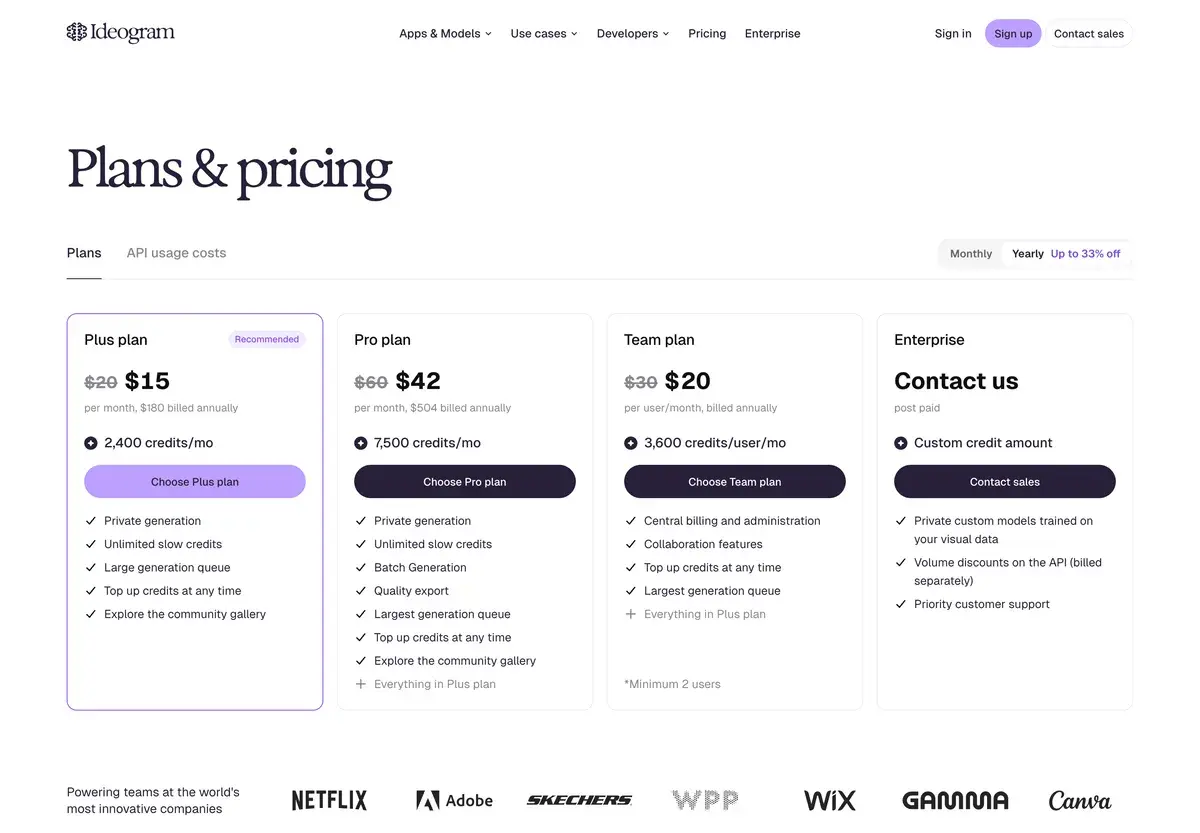
PlanPriceGenerationsSpeedBest for
Free$010 slow/daySlow queueCasual experimentation
Plus$8/mo400 priority/mo + unlimited slowFastActive solo creators
Pro$20/mo1,000 priority/mo + unlimited slowFastDesigners, marketers, regular use
Pro Plus$48/moUnlimited priorityFastestHeavy users, agencies, professionals

Prices verified April 2026 from ideogram.ai/pricing.

The honest tier guide: the free tier is genuinely useful for evaluation and casual personal use — most users could get real work done within the daily limit. Plus at $8/month is one of the best-value AI subscriptions available in 2026 for the typography-image use case specifically. Pro at $20/month is the right tier for designers and marketers who use Ideogram regularly. Pro Plus at $48/month makes sense for agencies, professional designers, or anyone running design as a service. Annual billing offers ~20% off all paid tiers.

Hands-on Notes

The thing Ideogram does that nothing else does as consistently is producing legible text in generated images on the first attempt. Asking for a poster with specific words, a logo concept with a brand name, or a social graphic with a headline — Ideogram nails the typography quality more reliably than any general-purpose AI image tool we have used. The hit rate matters more than the peak quality; with most other tools, you generate four variations and one has acceptable text. With Ideogram, three or four of four typically have correct text.

Ideogram 3 was a meaningful step up. Earlier versions had a slightly cartoonish quality that made Ideogram outputs feel "AI-generated" in a way Midjourney's outputs did not. Version 3 closed much of that artistic-quality gap while maintaining the typography advantage. For typography-heavy work, the trade-off between Ideogram's improved-but-still-second photorealism and Midjourney's still-imperfect text rendering now tilts more clearly toward Ideogram for text-first jobs.

Style options are useful and underrated. The dedicated design style produces output suitable for actual design work without heavy post-processing — flat illustrations, geometric compositions, typography-forward layouts. The 3D style produces credible isometric and perspective renders. The realistic style is the weakest of the four, where Midjourney and FLUX still win on photo-style output.

Magic Fill and Magic Expand are competent but not best-in-class. For inpainting, Photoshop's Generative Fill is more polished. For outpainting, dedicated tools like Krea handle complex extensions better. Where Ideogram's editing tools earn their place is for text-aware edits — fixing a misspelled word in a generated image, expanding a poster while keeping headline alignment intact.

Where Ideogram gets weaker: complex multi-element scenes (people, objects, environments interacting in a single image) are still challenging. The model does best with relatively focused compositions — a poster with one main visual and text, a logo concept, a product mockup with clear primary subject. Asking for "a busy market scene with vendors selling fruit, customers arguing, and a sign reading 'Daily Specials'" stretches the architecture beyond its strength zone.

The other quiet caveat: Ideogram's specialization is also its limit. For users producing varied creative work (photography, illustration, design, concept art), a single-model commitment to Ideogram leaves capability on the table. Most professional creators use Ideogram alongside Midjourney or FLUX rather than instead of them.

Use Cases

Marketing team producing ad creative variations: A growth marketing team at a Series A SaaS uses Ideogram Pro to generate ad creative with varied headlines, value propositions, and visual styles for paid social testing. Producing 20 ad variations in an hour replaces what was previously a designer's full-day project. Headline accuracy means the ads can ship to ad managers without manual text overlay work.

Small business owner creating local marketing: A restaurant owner uses Ideogram Plus ($8/month) to produce weekly promotional graphics, event flyers, menu announcement images, and Instagram posts. Text accuracy means specials and prices appear correctly without needing Canva or Photoshop afterward. The cost is a fraction of hiring a freelance designer or buying stock templates.

Solo founder designing pre-launch brand assets: A bootstrapped founder uses Ideogram Pro to generate logo concepts, landing page hero imagery, and pitch deck visuals for a pre-revenue product. Output serves as starting concepts that get refined in Figma. Real production work still requires design judgment, but the iteration speed compresses the brand-development phase from weeks to days.

Content creator producing YouTube thumbnails: A YouTube creator with a 100K-subscriber channel uses Ideogram for thumbnail headline overlays and themed visuals. The text accuracy specifically matters for thumbnails where headlines drive click-through. Each video gets multiple thumbnail variants tested in YouTube's A/B feature.

Marketing agency creating social content for clients: A small agency manages social media for 8 SMB clients across local services, e-commerce, and professional services. Ideogram Pro Plus handles the high volume of typography-heavy graphics needed for daily posting cadences. Output requires light editorial review but bypasses the per-asset designer time that would otherwise eat agency margins.

Our Verdict

Ideogram remains the best AI image generator for typography-heavy work in 2026, and for the specific job of producing legible text in generated images, nothing else matches its consistency. Ideogram 3 closed the artistic-quality gap that previously made Midjourney an obvious alternative; for most text-first creative work, Ideogram is now the right single-tool answer.

The honest weaknesses: pure photographic realism and complex multi-element artistic composition remain stronger in Midjourney and FLUX. The competitive moat has narrowed as FLUX, Recraft, Imagen 3, and Midjourney v7 have improved on text rendering — Ideogram's lead is real but no longer overwhelming. The model also has limits with complex scenes and multi-character compositions where it still produces the slightly stilted output that defines current AI image generation broadly.

For marketers, content creators, small business owners, and designers producing typography-driven work, Ideogram is the easy recommendation. For visual artists and photographers, Midjourney or FLUX are the better picks. For users producing varied creative work, Ideogram alongside one of those tools covers most use cases.

Note: Ideogram does not currently have an active affiliate program with AIVario. AIVario earns no commission from sign-ups. Our rating reflects ongoing use of the paid Pro tier across creative work.

Best for: Marketers, content creators, small business owners, social media managers, indie designers needing text-heavy designs Not ideal for: Pure photographic realism (use Midjourney or FLUX), complex multi-character scenes, professional brand identity work where AI starting concepts are inappropriate Bottom line: Still the best at the one thing it was built to do — typography-accurate AI images — even as the rest of the category catches up. The narrower moat has not stopped Ideogram from being the right tool for text-first creative work.

Related Tools

  • Midjourney — complementary tool for visual art and photographic-style images
  • FLUX — open-aligned alternative with strong text rendering and developer flexibility
  • Recraft — design-first competitor with stronger vector and illustration output
  • Adobe Firefly — Creative Cloud-bundled alternative for users in the Adobe ecosystem
  • Krea — multi-model AI image platform that includes Ideogram alongside other generators

Frequently Asked Questions about Ideogram

Is Ideogram free?

Yes, Ideogram has a free tier with 10 slow generations per day. Paid plans start at $8/month for Plus (400 priority credits, faster generation), $20/month for Pro (1,000 credits, advanced features), and $48/month for Pro Plus with unlimited slow generations and the highest priority queue. The free tier is genuinely usable for casual experimentation.

Why is Ideogram better at text in images?

Ideogram was built from the ground up around text accuracy in generated images, with a model architecture specifically optimized for legible typography rather than treated as an afterthought. Most general-purpose AI image models prioritized photographic realism first; Ideogram prioritized text first. The category has narrowed since launch (FLUX, Recraft, and Imagen 3 have meaningfully improved on text), but Ideogram remains the most consistent at typography-heavy designs.

Can Ideogram generate logos?

Yes, and it is one of the better AI tools for logo concepts because text rendering is the core challenge in logo work. The output is suitable as starting concepts for logo design work, particularly for indie projects and side businesses. For professional brand work, expect to refine outputs in vector tools (Figma, Illustrator) afterward — AI logo concepts are starting points, not deliverables.

How is Ideogram different from Midjourney?

Different specialties. Midjourney produces more aesthetically polished images with better artistic style and photographic realism, but its text rendering remains weaker than Ideogram. Ideogram produces less artistically refined images but handles text accurately. For pure visual art and photography-style images, Midjourney wins. For designs that include text (posters, social graphics, ads, logos), Ideogram wins. Many designers use both.

Does Ideogram support commercial use?

Yes, all paid plans grant commercial usage rights to generated images. Free tier images can also be used commercially under the standard Ideogram terms, though the lower resolution and watermark options on free generations may limit professional use. Always verify current terms at ideogram.ai/terms before relying on commercial usage assumptions.

Can Ideogram edit existing images?

Yes, Ideogram has Magic Fill (inpainting), Magic Expand (outpainting/uncropping), and Remix features for editing existing generations or uploaded images. The editing quality is competitive with general-purpose AI tools but not best-in-class — Photoshop's AI features and dedicated tools like Krea or Recraft often produce cleaner edits for complex changes.

What is Ideogram 3?

Ideogram 3 is the third major model release, with substantial improvements in photorealistic output, prompt adherence, and detail rendering compared to previous versions. The model meaningfully closed the artistic-quality gap with Midjourney while maintaining the text-accuracy advantage that defines Ideogram. For text-heavy designs, Ideogram 3 is the strongest single-model option in the category.

Is Ideogram good for non-English text?

Ideogram handles English text most reliably, with reasonable performance in Spanish, French, German, Italian, and other major Latin-script languages. Non-Latin scripts (Cyrillic, Chinese, Arabic, Japanese) work less consistently — text may appear stylized or incorrect. For multilingual marketing content in non-Latin scripts, generate the visual in Ideogram and add text afterward in a design tool.