Midjourney is an AI image and video generator run by a small independent research lab, known for the most polished aesthetics in the category. You pay for GPU time rather than images: Basic costs $10 a month for 3.3 hours of Fast time, roughly 200 image prompts; Standard $30 adds unlimited images in Relax mode; Pro $60 adds Stealth Mode and unlimited Relax video; Mega $120 doubles Pro's Fast time. Annual plans save 20%. V8.2 has been the default model since July 24, 2026, with a new Edit model, and any image can become a 5 to 21 second video.
✓Best for: Artists, designers and marketers who want the most aesthetically striking AI images and can work with prompts and references
✗Skip if: You need readable text inside images, a free plan, or strict brand-accurate product shots
This analysis is based on documentation, public user reports, and vendor materials — not yet on our own hands-on testing. How we rate
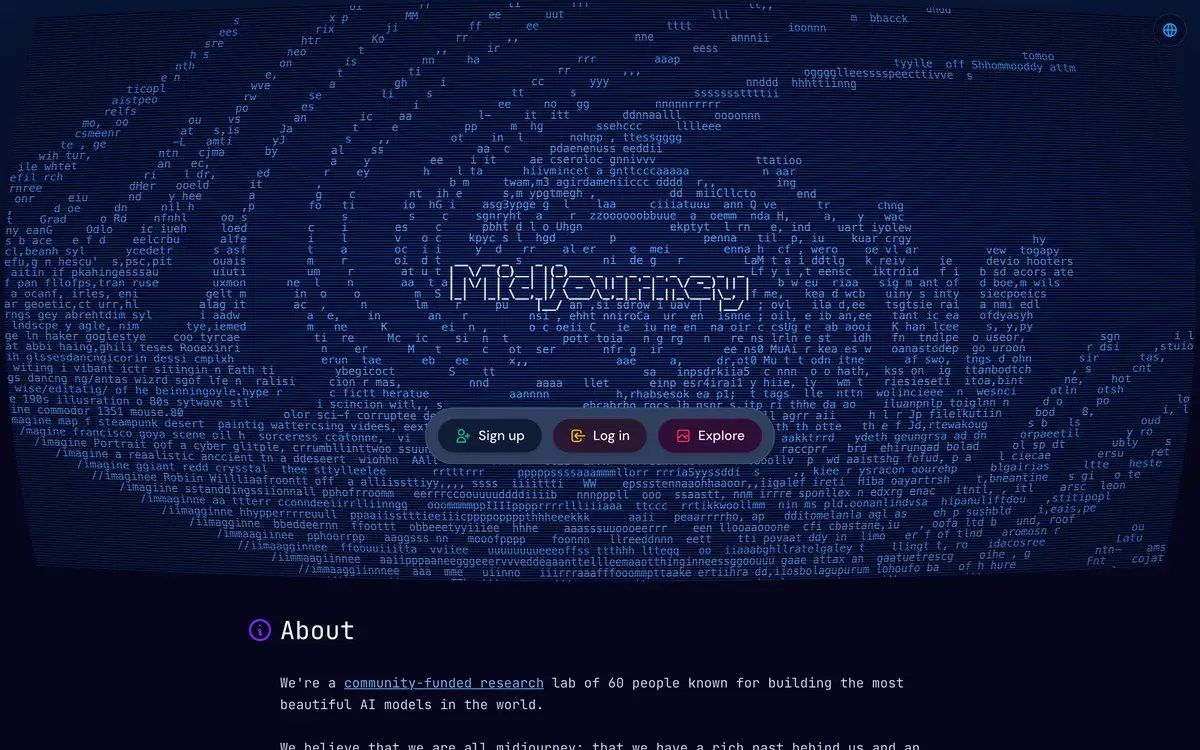
Midjourney homepage, captured Sep 28, 2026.
Midjourney sells time on its GPUs, not images
Most AI image tools count credits or images. Midjourney counts GPU minutes. Its help center compares a subscription to a phone data plan: you buy time on its graphics processors, and every prompt spends some of it. The time you wait for a picture does not count, only the minutes the GPUs actually work on your job.
That time comes in two speeds. Fast time is a monthly allowance that resets when the subscription renews and does not carry over. Relax time queues your jobs behind others, takes longer, and is unlimited for images from the Standard plan up. Once you understand those two buckets, the plans are easy to read.
Midjourney itself is an unusual company for this market: its homepage describes a community-funded research lab of around 60 people, and it trains its own models rather than reselling someone else's.
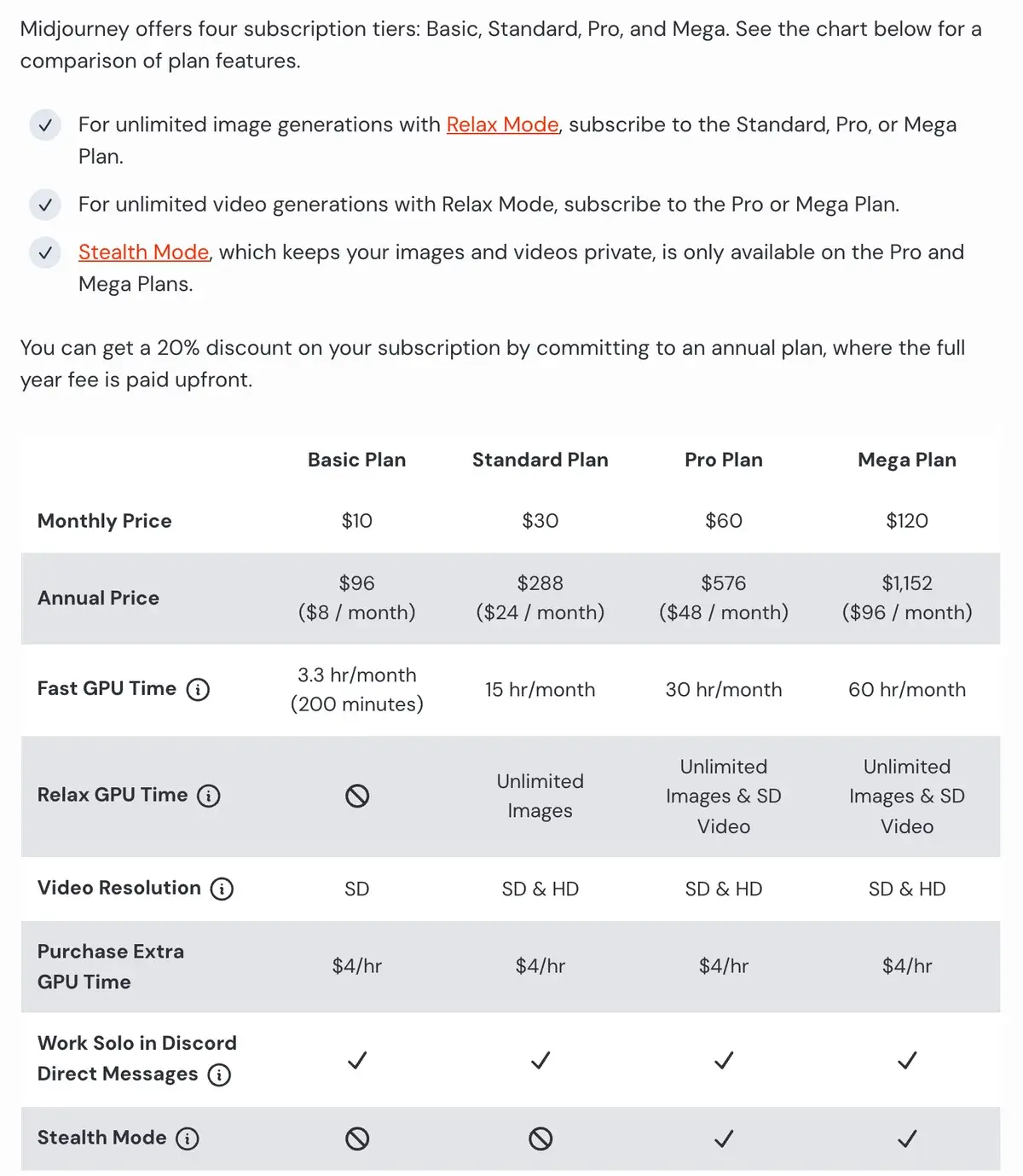
The four subscriptions side by side
Midjourney's plan comparison in its help center, captured September 28, 2026.
Basic
Standard
Pro
Mega
Monthly
$10
$30
$60
$120
Yearly
$96 ($8 a month)
$288 ($24)
$576 ($48)
$1,152 ($96)
Fast GPU time
3.3 hours (200 minutes)
15 hours
30 hours
60 hours
Relax mode
None
Unlimited images
Unlimited images and SD video
Unlimited images and SD video
Video resolution
SD
SD and HD
SD and HD
SD and HD
Stealth Mode
No
No
Yes
Yes
Concurrent image jobs
3 Fast
3 Fast or Relax
12 Fast or 3 Relax
12 Fast or 3 Relax
Extra Fast time costs $4 an hour on every plan. You can also earn free Fast time by rating images.
How far the Fast hours go
Midjourney's own estimate is about a minute of GPU time per image prompt, and each prompt returns a grid of four images. On V8.1, a standard-definition prompt costs about 0.8 minutes and an HD prompt about 1.3. Video is far heavier, at roughly eight minutes per prompt.
Plan
Fast minutes
Image prompts at about 1 minute
Video prompts at about 8 minutes
Basic
200
about 200
about 25
Standard
900
about 900, plus unlimited Relax
about 110
Pro
1,800
about 1,800, plus unlimited Relax
about 225, plus unlimited Relax SD
Mega
3,600
about 3,600, plus unlimited Relax
about 450, plus unlimited Relax SD
The practical line falls between Basic and Standard. Basic suits someone trying Midjourney or making a few dozen finished images a month. Anyone who iterates heavily, rerolling and varying until an image is right, burns through 200 minutes in days and is better off on Standard, where Relax mode removes the ceiling for images.
Version 8.2 and the Edit model
Midjourney shipped three model versions in 2026. V8.0 arrived as an alpha in March. V8.1, released on April 14, was the fastest yet, rendering standard jobs four to five times quicker and generating 2K HD images without upscaling. V8.2 became the default on July 24 with a focus on aesthetics and personalization, meaning profiles that learn your taste from images you rate.
The bigger change in V8.2 is the Edit model. It replaces three older tools, Omni Reference, Character Reference and Retexture, with one workflow: describe the change in plain language, add up to four reference images, and track the edits of a session in one place. For designers who used to juggle reference parameters, it is simpler.
Video: five seconds at a time
Any image can become a video. Midjourney animates it into a 5-second clip, and you can extend it four times by four seconds each, up to 21 seconds. Clips render at 480p on every plan; Standard, Pro and Mega can switch to 720p HD, but only in Fast mode, and only Pro and Mega get unlimited video in Relax mode. At eight GPU minutes per prompt, video is where Fast time disappears fastest.
Who owns the pictures
Midjourney says you own what you create, images and videos, even after you cancel, and you can use them in almost any way. Two conditions matter for businesses. A company grossing more than $1 million a year must subscribe to Pro or Mega to use its images commercially. And on Basic and Standard, everything you generate is visible in the public gallery; only Pro and Mega include Stealth Mode, so client work and unreleased products belong on those plans.
When another image generator is the better buy
Ideogram renders text inside images, posters, logos and packaging, much more reliably. Leonardo, now owned by Canva, has a free tier and more control over models and fine-tuned styles. Krea focuses on real-time generation and upscaling. For people who already pay for ChatGPT, its built-in image generation is often enough for everyday graphics. Midjourney remains the pick when the look of the image matters more than anything else.
Time on Midjourney's GPUs. Each plan includes a monthly allowance of Fast time: 3.3 hours on Basic, 15 on Standard, 30 on Pro and 60 on Mega. Standard and above also get unlimited Relax time for images, which queues jobs more slowly, and Pro and Mega get unlimited Relax video. Extra Fast time costs $4 an hour on any plan.
How many images do 3.3 Fast hours make?
Roughly 200 image prompts. Midjourney says one image prompt usually uses about a minute of GPU time; on V8.1 a standard-definition prompt uses about 0.8 minutes and an HD prompt about 1.3. Each prompt returns a grid of four images. A video prompt uses about eight minutes, so the same allowance covers around 25 videos.
Does Midjourney have a free trial?
Not on the website or Discord. Midjourney's help center says a limited trial is available only in the niji·journey app for iOS and Android, which focuses on anime and illustration styles. To use the main website you need a paid plan, starting at $10 a month or $96 a year.
What changed in Midjourney V8.2?
V8.2 became the default model on July 24, 2026. It focuses on aesthetics, image quality and personalization, and introduces the Edit model, which replaces Omni Reference, Character Reference and the Retexture tool with plain-language editing and up to four reference images. V8.1, from April 2026, brought generation four to five times faster and native 2K HD images.
How long can Midjourney videos be?
A video starts as a 5-second clip animated from one image and can be extended four times by four seconds, to a maximum of 21 seconds. Videos render at 480p on every plan, and Standard, Pro and Mega can also render 720p HD in Fast mode. Unlimited video in Relax mode requires Pro or Mega.
Can I use Midjourney images commercially?
Yes. Midjourney says you own the images and videos you create, even after cancelling, and can use them in almost any way. The exception is size: a company grossing more than $1 million a year must be on the Pro or Mega plan to use its images commercially.
Who can see the images I make on Midjourney?
On Basic and Standard, your images are public in the Midjourney gallery. Stealth Mode, which keeps images and videos private, is available only on Pro and Mega, which matters for client work and unreleased products.
Is Midjourney better than Ideogram or Leonardo?
For striking, stylized images, Midjourney is still the benchmark. Ideogram handles text inside images, such as posters and logos, far more reliably, and Leonardo offers a free tier and more control over models and fine-tuning. Many designers keep Midjourney for concept art and use another tool for text-heavy graphics.