Leonardo AI is a Canva-owned image and video platform that combines its own Lucid and Phoenix models with more than 50 models from other labs, including GPT Image 2, Nano Banana Pro, Seedream, Kling, Veo 3.1 and Wan. The free plan gives 150 fast tokens a day. Essential costs $12 a month (8,500 tokens), Premium $30 (25,000) and Ultimate $60 (60,000), or up to 20% less billed yearly, and Premium and Ultimate add unlimited relaxed generation on selected models. Canva Business includes the Essential plan. On the free plan, Leonardo's terms give it ownership of what you create; paid plans give ownership to you.
✓Best for: Creators, marketers and game artists who want many image and video models under one subscription, with a usable free tier to start
✗Skip if: You need commercial ownership without paying, want one best-in-class house style rather than a model menu, or need vector output
This analysis is based on documentation, public user reports, and vendor materials — not yet on our own hands-on testing. How we rate
Leonardo AI homepage, captured Oct 1, 2026.
Canva's model marketplace
Leonardo began in 2022 as a tool for game artists and grew into one of the most popular AI image platforms before Canva bought it in 2024. Canva runs it as a separate product with its own plans, and in 2026 Leonardo looks less like a single generator and more like a studio for other labs' models.
Its own foundation models are still there: Lucid Origin, built for Full HD output with strong prompt adherence and text rendering, Lucid Realism for photographic images, and Phoenix. Around them, Leonardo's model page lists more than 50 options in October 2026: GPT Image 2 from OpenAI, Google's Nano Banana Pro and Nano Banana 2, FLUX.2 Pro and Kontext, Ideogram 4.0, Seedream 5.0 Pro, Recraft V4 and Krea 2 for images, and Kling 3.0, Veo 3.1, Seedance 2.5, MiniMax H3, Wan 3.0, LTX-2.3 and Leonardo's own Motion 2.0 for video. Editing, upscaling, a realtime canvas and custom model training sit alongside.
That breadth is the reason to pick Leonardo: one subscription and one token balance instead of a separate account for every lab.
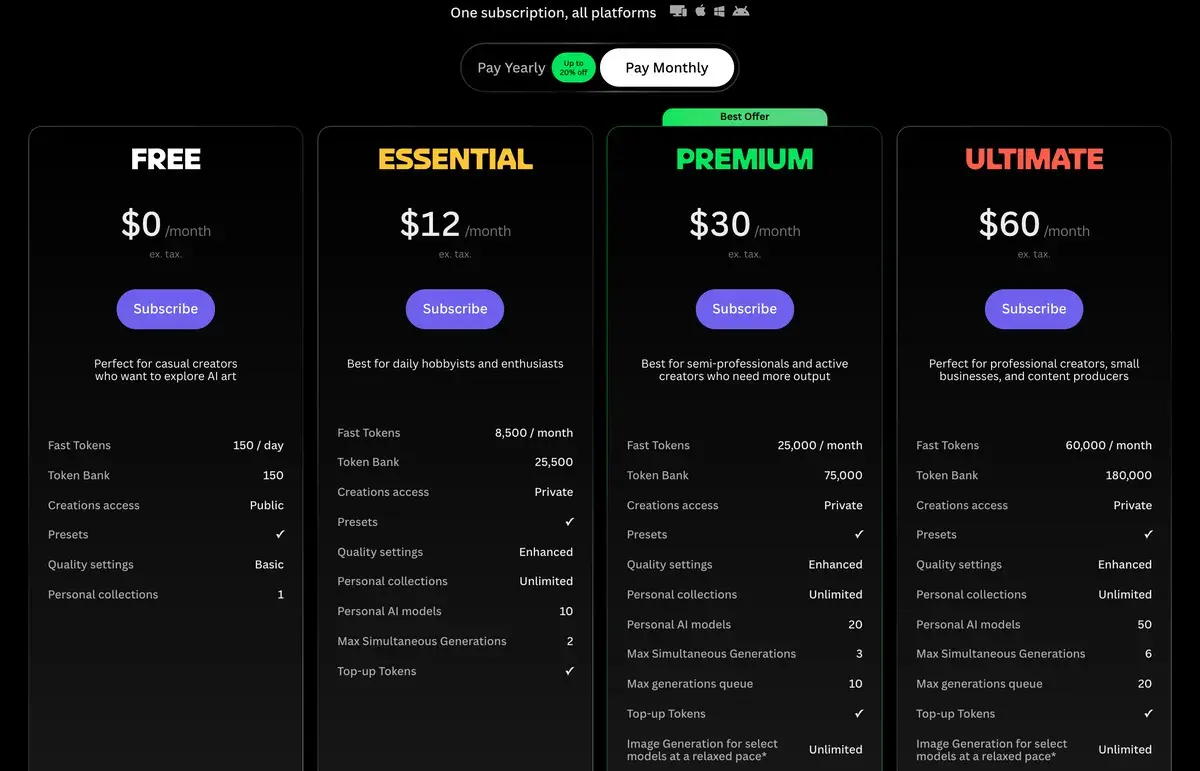
Free, Essential, Premium or Ultimate
Leonardo's pricing page for individuals on monthly billing on October 1, 2026.
Plan
Monthly
Billed yearly
Fast tokens
Token bank
Also includes
Free
$0
$0
150 a day
150
Public creations, basic quality, 1 collection
Essential
$12
$10 a month
8,500 a month
25,500
Private creations, enhanced quality, 10 personal models, 2 parallel generations
Premium
$30
$24 a month
25,000 a month
75,000
Unlimited relaxed images on selected models, 20 models, 3 parallel
Ultimate
$60
$48 a month
60,000 a month
180,000
Relaxed video on selected models, 50 models, 6 parallel
Team Starter
$24 per seat
25,000 per seat, shared
3× monthly
Private team generations, shared token pool
Team Growth
$48 per seat
60,000 per seat, shared
3× monthly
Same, with larger pools
Unused fast tokens roll into the token bank, which holds up to three times the monthly allowance on paid plans, so a quiet month is not wasted. Top-up tokens can be bought on any paid plan, and the API is billed separately with credits that do not expire.
What "unlimited" covers: relaxed mode on selected models
Premium and Ultimate advertise unlimited generation, and the footnote matters. Unlimited means relaxed mode, a slower queue, and only on selected models. For images that is Lucid Origin, Lucid Realism, Phoenix 1.0 and 0.9, Flux Dev, Flux Schnell and Leonardo's preset styles. Ultimate adds relaxed video on Hailuo 2.3, Hailuo 2.3 Fast, Wan 2.6, Motion 2.0 and Motion 2.0 Fast. Leonardo also says relaxed jobs may slow down at busy times.
Everything else spends fast tokens, and the premium third-party models spend a lot of them, especially video from Veo, Kling or Seedance. A Premium subscriber who mostly uses Lucid Origin gets close to unlimited images; one who wants Nano Banana Pro or Veo 3.1 every day should budget by tokens.
Who owns what you generate
This is the section most reviews skip. Leonardo's terms of service say that on a free subscription, ownership of the output vests in Leonardo, and free creations are public for other users to see and use. On a paid subscription, ownership of what you create vests in you, and you choose whether each creation is public or private.
The difference carries over to training. Leonardo's terms give it a broad licence to use public content, including for training AI models, while private content may be used only to provide the service and not for training without your written consent. Anyone producing client work, product images or anything confidential should be on a paid plan with private mode on.
Leonardo through Canva Business
Canva's Business plan, launched on October 30, 2025 at $20 per person a month in the US, comes with access to Leonardo's Essential plan, which Canva describes as production-grade image and video generation. For a team already paying for Canva Business, that is $12 of Leonardo per person included. Canva Pro and the free Canva plan do not include it, and heavier users can still upgrade to Premium or Ultimate directly with Leonardo.
Leonardo against Midjourney and the specialists
Midjourney is the usual comparison. It has a single house style that many people prefer, charges for GPU time from $10 a month and has no free plan on its website, but it gives paid users ownership on every plan, with companies earning more than $1 million a year required to use Pro or Mega. Leonardo wins on choice, a daily free allowance and video models from many labs; Midjourney wins on aesthetic consistency. Our Leonardo vs Midjourney comparison goes through both in detail.
For text-heavy graphics, Ideogram and Recraft are stronger specialists, and Krea focuses on realtime generation and upscaling.
150 fast tokens a day with basic quality settings, one personal collection and public creations. Leonardo's own models cost few tokens per image, while premium third-party models and video use many more. The free plan suits trying the tools; regular use, private images and higher quality need a paid plan.
Can I use Leonardo AI images commercially on the free plan?
Read the terms first. Leonardo's terms of service say that for free subscribers, ownership of the output vests in Leonardo, and free creations are public. On paid plans, ownership of what you create vests in you, and you can keep work private. For client or commercial work, a paid plan is the safer route.
How much does each Leonardo plan include?
Essential costs $12 a month with 8,500 fast tokens and a 25,500-token bank, Premium $30 with 25,000 tokens and unlimited relaxed images on selected models, and Ultimate $60 with 60,000 tokens and relaxed video on selected models too. Billed yearly, they cost $10, $24 and $48 a month. Top-up tokens are available on all paid plans.
Is Leonardo AI included with Canva?
With Canva Business, yes. When Canva launched Business on October 30, 2025, it said subscribers would get access to Leonardo's Essential plan along with Flourish. Canva Pro and the free Canva plan do not include it. Canva has owned Leonardo since 2024 and runs it as a separate product with its own plans.
Can Leonardo AI create videos?
Yes. Leonardo offers dozens of video models, including Veo 3.1, Kling 3.0, Seedance 2.5, Hailuo 2.3, Wan 3.0, LTX-2.3 and its own Motion 2.0, with image-to-video and some models that generate audio. Video costs far more tokens than images, and Ultimate includes unlimited relaxed video on Hailuo 2.3, Wan 2.6 and Motion 2.0.
Does Leonardo AI have a mobile app?
Yes. Leonardo has apps for iPhone and Android alongside the web app, and its pricing page sells one subscription for all platforms, so the same plan and token balance apply on your phone.
What does unlimited mean on Leonardo's paid plans?
Unlimited relaxed generation, at a slower pace, on selected models only. For images that means Lucid Origin, Lucid Realism, Phoenix, Flux Dev, Flux Schnell and Leonardo's preset styles; for video on Ultimate, Hailuo 2.3, Wan 2.6 and Motion 2.0. Premium third-party models such as GPT Image, Nano Banana Pro, Veo and Kling still use tokens.
What happened to Leonardo's Apprentice, Artisan and Maestro plans?
Older guides and reviews mention Apprentice, Artisan and Maestro plans at the same $12, $30 and $60 price points. Leonardo's pricing page in October 2026 lists Essential, Premium and Ultimate instead, with token allowances of 8,500, 25,000 and 60,000 a month.
Does Leonardo have an API?
Yes. Leonardo sells pay-as-you-go API access with automatic top-ups, credits that do not expire, up to 10 concurrent generations, access to its latest models from launch and Remove.bg background removal. Higher-volume customers can negotiate custom concurrency and model-based discounts.