Rytr

Rytr

Free tier
Productivity
Quick answer

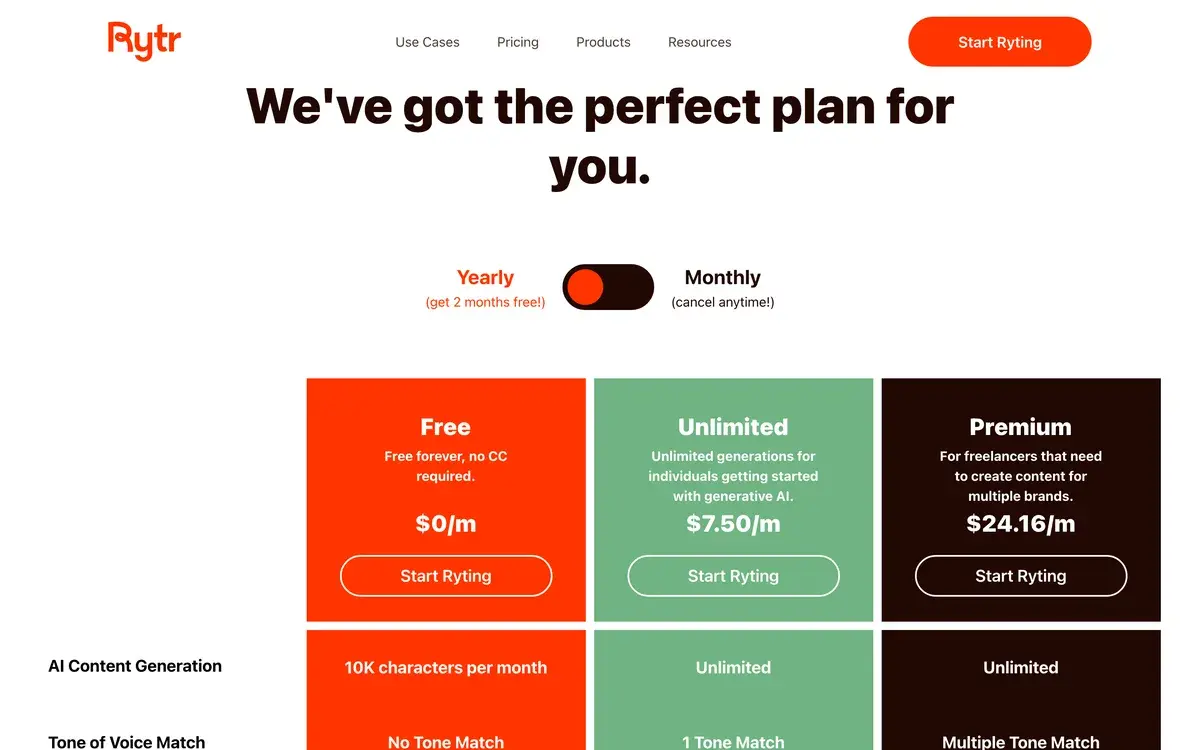
Rytr is the cheap AI writing assistant that didn't change course. Free gives 10,000 characters a month, and unlimited generation costs around $7.50 to $9. That matters more than it did two years ago, because the tools it once competed with have all left: Jasper went enterprise at $59 a seat, Writesonic became a $79-plus GEO platform, and Copy.ai moved to GTM automation. Rytr stayed where it was, which now makes it the default recommendation for solo bloggers and freelancers who want a writing tool rather than a marketing platform.

Best for: Solo bloggers and freelancers who want short-form drafting for under $10
Skip if: You need long-form depth or brand controls — this is deliberately shallow
Free 10K chars/mo · From $7.50/mo unlimited
EdGrowsReviewed by EdGrows·Updated Aug 18, 2026
Try Rytr for free

Affiliate link — we may earn a commission

Researched

This analysis is based on documentation, public user reports, and vendor materials — not yet on our own hands-on testing. How we rate
The category left, Rytr stayed

Two years ago, a solo blogger choosing an AI writing tool had a dozen options around $15 to $30 a month.

Look at where those went. Jasper removed its $49 individual tier in May 2026 and sells seats at $59. Writesonic became an AI search visibility platform starting around $79. Copy.ai pivoted to GTM automation with agent plans in the hundreds. Several thinner wrappers simply shut down as ChatGPT absorbed what they did.

Rytr is still charging around $7.50 to $9 a month for unlimited generation, with a free tier of 10,000 characters.

That's not a product achievement so much as a strategic one. By declining to chase enterprise budgets, Rytr ended up as the default answer to a question the rest of the category stopped answering: what does a solo blogger actually buy?

What you get, and what you don't

Free: 10,000 characters a month — roughly 1,500 to 1,700 words. Enough for a few blog sections, a batch of social posts, or some email copy. It's genuinely usable rather than a teaser, and it appears regularly in lists of the better free tiers.

Paid: unlimited generation, more tones, priority support, from about $7.50.

The upgrade decision is unusually easy. If you hit the free ceiling, the paid plan costs less than a coffee and removes the limit entirely. There's no elaborate tier ladder to work through.

What's absent is equally clear, and deliberate: no brand voice enforcement worth the name, no team governance, no research capability, no long-form depth. Those features are what make a tool cost $50 a seat. Rytr doesn't have them because it doesn't want to cost $50 a seat.

The quality conversation

Rytr's output isn't as good as ChatGPT or Claude. Anyone claiming otherwise is selling something.

A general model at $20 writes better prose, holds structure across longer pieces, and follows nuanced instructions more reliably. That gap is real and it's worth $12 a month to a lot of people.

The counter-argument is narrower than it sounds and still valid: free ChatGPT is more capable and also a blank box. Rytr gives you templates for specific outputs, tone selection, and a workflow that produces something usable without knowing how to prompt. For someone who doesn't want to learn prompting and won't pay $20, that packaging is worth the $7.50.

Where Rytr genuinely struggles is long-form. Push it toward a 2,000-word article and you get thin, repetitive text that needs more editing than writing it yourself would have taken. It's a short-form tool, and it works when used as one.

The honest freelancer warning

Freelancers are a large part of Rytr's audience, so this needs saying plainly.

Use it to beat the blank page — generate a structure, produce three angles to react against, draft a section you're stuck on. Then write the thing yourself.

Delivering lightly edited Rytr output to a paying client is how you lose the client. Not because AI assistance is wrong, but because a $7.50 short-form generator produces text that reads generic, gets details wrong, and carries no voice. Clients notice, usually about three deliverables in.

The tool is a drafting aid at this price. Treating it as a delivery mechanism is a misuse that the low cost makes tempting.

Where it doesn't fit

Long-form content. Wrong shape entirely.

Client-facing final copy. See above.

Teams needing consistency. No governance layer, by design.

Anyone who'd notice the quality gap. If $20 is affordable and output matters, spend it.

Rytr vs the alternatives

Against ChatGPT: ChatGPT is better at writing, free at the base tier, and $20 for Plus. Rytr's case is structure and templates for people who don't want a blank box, at a third of the Plus price. Quality-first buyers should take ChatGPT; workflow-and-budget buyers have a real reason to take Rytr.

Against Wordtune: Wordtune polishes rather than generates, at a similar price. They compose rather than compete — Rytr for the draft, Wordtune for the tightening, under $15 for both.

Against Jasper: Jasper at $59 a seat solves brand governance across a team. Nothing in Rytr's design targets that problem, and nothing in Jasper's justifies it for one person.

Against Writesonic: Writesonic left this market for AI search visibility at $79-plus. Reviewers now explicitly point solo bloggers from Writesonic back to Rytr, which is a fair summary of both products.

Against Copy.ai: Copy.ai moved to GTM automation and enterprise pricing. Another former competitor that stopped competing here.

Pricing 2026

PlanCostIncludes
Free$010,000 characters/month, core templates, tone options
Unlimited~$7.50–9/moUnlimited generation, more tones, priority support
Higher tierReported ~$25–29/moMultiple seats, additional features

Checked August 2026. Reported entry pricing varies between $7.50 and $9 depending on billing period and source, and the free character allowance is consistently cited at 10,000 a month. Rytr's pricing has been comparatively stable while competitors repriced substantially upward. Confirm current plans on rytr.me.

Start free and see if you hit the ceiling. Ten thousand characters tells you what kind of user you are within a fortnight.

Pair it with a polishing tool rather than upgrading elsewhere. Rytr plus Wordtune is under $15 and covers more than either alone.

Use it for short-form only. The long-form output isn't worth the editing time.

If quality matters more than $12, buy ChatGPT Plus instead. That's the honest comparison and it's fine to lose it.

Our Verdict

Rytr is a modest tool that became more relevant by standing still. Its output is shallower than a general model's, its long-form generation isn't worth using, and it has no brand controls or team features to speak of. None of that changed. What changed is everything around it: the AI writing tools that competed on price in 2024 have gone enterprise, gone GEO, gone GTM, or gone entirely — leaving a $7.50 unlimited plan and a genuinely usable 10,000-character free tier as the last obvious answer for someone who won't pay $50 a month.

The free tier does real work, the upgrade decision is trivially cheap, and the templates give non-prompters a faster path to usable text than a blank chatbot does. For solo bloggers, freelancers drafting rather than delivering, and anyone producing short-form content on a tight budget, that combination is worth recommending without much qualification.

Two honest limits. The quality gap against ChatGPT and Claude is real, and if $20 is affordable and output matters, spend it. And long-form is the wrong job for this tool — a thousand words in and you're editing more than you saved.

For budget short-form work, recommend. For anything a client signs off on, use it to draft and write the final version yourself.

Note: Rytr does not currently have an affiliate program with AIVario. We earn no commission, and this rating carries no commercial incentive.

Best for: Solo bloggers and freelancers on tight budgets, short-form content and social copy, people who prefer templates to blank prompts, anyone who won't pay $20 a month Not ideal for: Long-form articles, client-facing final copy, teams needing brand consistency, buyers who'd notice the quality difference Bottom line: The last cheap AI writer standing after the category went upmarket — shallow by design, honest about it, and worth $7.50 for drafting short-form work.

  • ChatGPT — better writing at $20, or free with less structure
  • Wordtune — pairs with Rytr for under $15 total, polishing rather than drafting
  • Jasper — where the category went, at $59 a seat
  • Writesonic — former budget rival, now a GEO platform at $79-plus
  • Copy.ai — another former competitor that moved to enterprise workflows

Frequently Asked Questions about Rytr

How much does Rytr cost in 2026?

There's a free plan with 10,000 characters a month — roughly 1,500 to 1,700 words — and unlimited generation from around $7.50 to $9 a month depending on billing and source. That's the cheapest genuine unlimited plan among the established AI writing tools, and it hasn't moved much while competitors have repriced upward. Reported figures differ slightly between $7.50 and $9, so check the current page.

Is the free tier actually usable?

For light work, yes. Ten thousand characters a month covers a few short blog sections, a batch of social posts or some email copy — enough to be genuinely useful rather than a teaser. It's frequently listed among the better free tiers in the category. What it won't support is regular publishing; anyone writing weekly will hit the ceiling in the first week and face a very small upgrade decision.

How does the output compare to ChatGPT?

Not as good, and that's the honest trade for the price. A general model at $20 produces better prose, handles longer and more complex pieces, and follows nuanced instructions more reliably. Rytr's advantage is cost and simplicity — templates, tone selection and a low bar to getting something usable. If output quality is your priority, spend the extra $12; if budget is the constraint, Rytr is the reason that constraint doesn't stop you working.

Why does Rytr still exist when ChatGPT is free?

Structure and price. Free ChatGPT is more capable, and also a blank box that assumes you know what to ask for. Rytr gives use-case templates, tone controls and a workflow aimed at specific outputs — blog sections, product descriptions, ad copy — which is genuinely faster for people who don't want to learn prompting. For under $10 a month with unlimited generation, that packaging has kept an audience.

What is it bad at?

Long-form depth, factual reliability and anything requiring sustained argument. Rytr is built around short-form generation, and pushing it into 2,000-word articles produces thin, repetitive output that needs heavy editing. There's no brand voice enforcement worth the name, no team governance, and no research capability. Those aren't oversights — they're the features that would make it cost $50.

Should freelancers use it for client work?

As a drafting aid, with editing, yes. As a delivery mechanism, no. Client work needs accuracy, a distinctive voice and accountability, none of which a $7.50 generation tool supplies. The realistic use is beating the blank page — generating a rough structure or some options to react against — then doing the actual writing yourself. Delivering lightly edited Rytr output to a paying client is how freelancers lose them.

How does it compare to Wordtune?

They do opposite jobs and pair well. Rytr generates text from nothing; Wordtune improves text you've already written. One reasonable budget stack is Rytr for drafting at around $7.50 and Wordtune for polishing at around $7, which totals under $15 a month and covers both halves of the workflow. That combination is frequently cheaper and more useful than a single mid-tier platform.

Is Rytr going to survive?

It has better odds than most, precisely because it never raised prices to chase enterprise buyers. Tools that repositioned upmarket now compete with Adobe, Semrush and each other for large accounts. Rytr competes for people who will not pay $50 a month under any circumstances, which is a large and permanently underserved group. Low prices are a weak moat and an honest one.

View all →