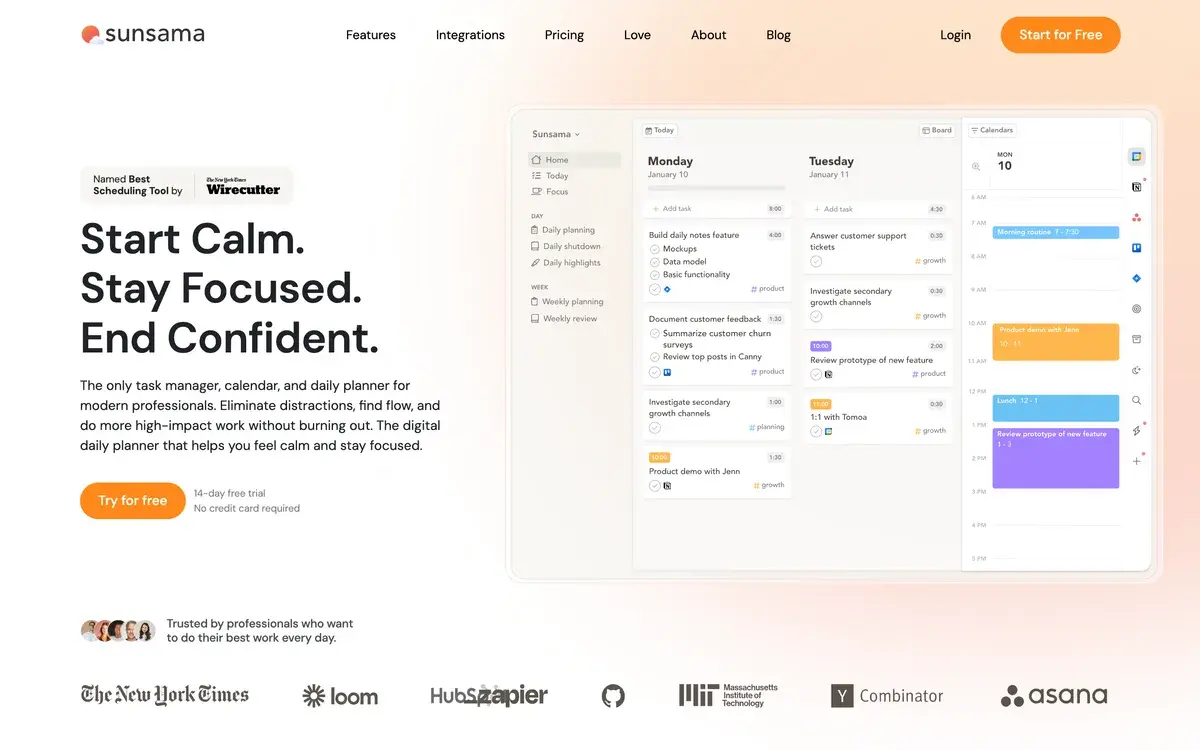
What is Sunsama?
Sunsama is a daily planning tool that distinguishes itself by being more philosophy than software. The product description emphasizes a guided daily planning ritual, weekly reviews, time boxing, and intentional work — concepts more familiar from productivity books than from typical software marketing. The pricing is $20/month with no free tier. The underlying premise is that better work comes from better planning, that better planning requires regular practice, and that software can support but not replace the practice.
This positioning matters for evaluation because Sunsama's value depends on whether you actually adopt the planning practice. Users who download Sunsama hoping the tool itself produces productivity without behavior change are typically disappointed; the software does not magically make work more focused. Users who commit to the daily 10-minute planning ritual consistently report meaningful improvements in focus, stress reduction, and intentional work — the underlying philosophy works, when practiced.
This is unusual for productivity software. Most tools sell themselves on capability features — what the software does, how it integrates, what it automates. Sunsama sells itself on practice — what behavior change the software supports, what ritual it enables, what philosophy it embodies. Whether you find this appealing or off-putting probably correlates with whether the tool will produce value for you.
For users skeptical of "intentional work" framing, Sunsama is overpriced compared to free task managers and feature-rich alternatives. For users who specifically want software that supports daily planning practice — who already understand the value of intentional work and want tooling that makes the practice easier to maintain — Sunsama is genuinely useful and the pricing is justified.
The philosophy-of-work positioning
Productivity tooling has split historically along several dimensions. Task managers (Things, OmniFocus, Todoist) optimize for capturing and organizing tasks. Project management tools (Asana, Linear, Monday) optimize for team coordination. Note-taking tools (Notion, Obsidian) optimize for knowledge work. Calendar tools (Google Calendar, Outlook) optimize for time scheduling. Each category has matured substantially; the market has many capable options in each.
Sunsama sits in a less-defined space — daily planning specifically, distinct from task management, project management, and calendaring. The unmet need it addresses is the synthesis problem: in a typical knowledge worker's day, work lives in many tools (Asana for projects, GitHub for engineering tasks, email for incoming requests, calendar for meetings, notes for personal tasks), and the cognitive overhead of moving between these tools and consciously choosing what to work on consumes meaningful focus.
The Sunsama answer is a daily ritual that surveys all the tools where work lives, brings relevant items into a unified daily view, and forces explicit choice about what the day will contain. The 10-minute morning planning is the operational core: review yesterday's intentions versus actual outcomes, look at today's calendar, surface relevant tasks from various tools, and consciously plan what the day will hold.
This is not unique to Sunsama as a concept — productivity practices like Time Blocking, Getting Things Done's daily review, and the Pomodoro morning planning all touch similar themes. Sunsama's contribution is software designed specifically around this practice, with integrations that pull from common tool stacks and UX optimized for the planning ritual itself.
For users who already practice intentional planning manually, Sunsama formalizes the practice with software support. For users who do not currently practice intentional planning but find the philosophy appealing, Sunsama provides scaffolding to build the practice. For users who do not find the philosophy appealing or do not want behavior change, Sunsama is the wrong tool regardless of capability.
Where Sunsama fits
Knowledge workers in roles requiring meaningful focus and intentional work allocation. Software engineers with daily backlog choices, designers with creative work that benefits from focused time, writers needing structured deep work blocks, consultants managing multiple client engagements. The planning practice supports the focus that this work requires.
Senior individual contributors juggling many parallel work streams. The unified daily view helps senior ICs make conscious choices about which projects to advance each day rather than being pulled reactively across competing demands.
Founders and operators with chronic context-switching across many functions. Sunsama's daily planning helps founders consciously choose what each day will be — fundraising, product, hiring, sales, operations — rather than being pulled into whichever fire is loudest.
Remote workers and distributed team members whose work lacks the implicit structure that physical offices provide. The intentional daily planning compensates for the rhythm structure that office presence provides naturally.
People recovering from burnout or chronic overwork who need explicit structure to prevent overcommitment. Sunsama's time boxing and weekly review patterns support the gradual rebuilding of sustainable work patterns.
Productivity-curious users already practicing manual planning who want software to formalize and support their existing practice. For these users, Sunsama is not changing behavior but supporting existing behavior more efficiently.
People with ADHD or attention regulation challenges who benefit from external structure for daily work allocation. The forced explicit choice in daily planning provides the structure that internal motivation alone cannot sustain reliably.
Sunsama is not the right pick for: users wanting fast task capture without ritual overhead (Things or Todoist serve better), teams looking for primary task management (Asana or ClickUp serve better), users who actively prefer reactive work over intentional planning, users seeking AI-first productivity tools (Sunsama is not AI-positioned), or users unwilling to commit to daily ritual (the value depends on the practice).
Key Features
- Daily planning ritual — guided 10-minute morning routine pulling tasks from integrated tools
- Unified inbox — single view of tasks across Asana, Jira, GitHub, Trello, Linear, Notion, Todoist, email
- Time boxing — assign time estimates and schedule blocks for each task
- Calendar integration — Google Calendar and Outlook integration with meetings visible alongside tasks
- Weekly reviews — structured end-of-week reflection and next-week planning
- Daily shutdown ritual — end-of-day review marking what was completed and what carries over
- Goal alignment — connect daily tasks to longer-term objectives for intentional progression
- Channels — separate work and personal contexts within unified daily view
- Focus mode — distraction-free interface for working on planned tasks
- Slack integration — task creation from Slack messages, status updates back to Slack
- Integration count — 30+ tools integrated for pulling tasks and context
- Mobile apps — iOS and Android with planning ritual support on mobile
- AI assistance (added through 2024-2025) — task estimation suggestions, planning hints, review summaries
Sunsama vs Competitors 2026
| Tool | Daily planning focus | Integration breadth | Philosophy-led | Free tier | Price/mo |
|---|
| Sunsama | ✅ Best in class | ✅ Strong | ✅ Yes | ❌ Trial only | $20 |
| Motion | ⚠️ AI-driven scheduling | ✅ Decent | ⚠️ AI-led | ❌ Trial only | $19 |
| Reclaim AI | ⚠️ AI-driven scheduling | ✅ Decent | ⚠️ AI-led | ✅ Limited | $8 |
| Akiflow | ✅ Daily planning | ✅ Strong | ⚠️ Mid | ❌ Trial only | $24 |
| Routine | ✅ Daily planning | ✅ Decent | ✅ Yes | ✅ Limited | $12 |
| Things 3 | ⚠️ Task management | ❌ Standalone | ❌ | ❌ One-time purchase | $50 (one-time) |
| OmniFocus | ⚠️ Task management | ⚠️ Limited | ⚠️ GTD-aligned | ❌ Trial only | $10/mo (Pro) |
| Todoist | ⚠️ Task management | ✅ Decent | ❌ | ✅ Generous | $4 |
| Notion | ⚠️ Knowledge work | ⚠️ Self-contained | ❌ | ✅ Generous | $10 |
Data verified April 2026 from each provider's pricing pages.
The clearest competitive picture: Sunsama vs Akiflow vs Routine in the dedicated daily planning category. All three serve users wanting unified daily view across multiple work tools; the choice often comes down to UX preference, integration coverage with your specific tool stack, and pricing. Akiflow leans toward power users wanting more configuration; Routine is more affordable; Sunsama leans into the philosophical positioning more aggressively.
Against AI-driven scheduling tools (Motion, Reclaim AI), Sunsama serves a different audience. Motion and Reclaim AI optimize for AI automation of scheduling — let the AI plan your day based on tasks and calendar. Sunsama optimizes for human intentional planning — you plan your day with software support. Different philosophies; the choice is whether you want AI to make planning decisions or whether you want to make those decisions consciously yourself.
Against task managers (Things, OmniFocus, Todoist), Sunsama is in a different category. Task managers help you capture and organize tasks; Sunsama helps you plan a day across tasks already in other systems. Many users use both — a task manager for personal tasks and Sunsama for daily planning across personal tasks plus work tools.
For users in Microsoft 365 or Google Workspace ecosystems already running daily standups, calendar blocking, and structured planning practices, the bundled tools may cover Sunsama's functionality with less subscription overhead. Sunsama's value is most apparent for users whose work spans multiple tool ecosystems.
Pricing 2026
| Plan | Price | Features | Best for |
|---|
| Trial | Free for 14 days | Full features | Evaluation only |
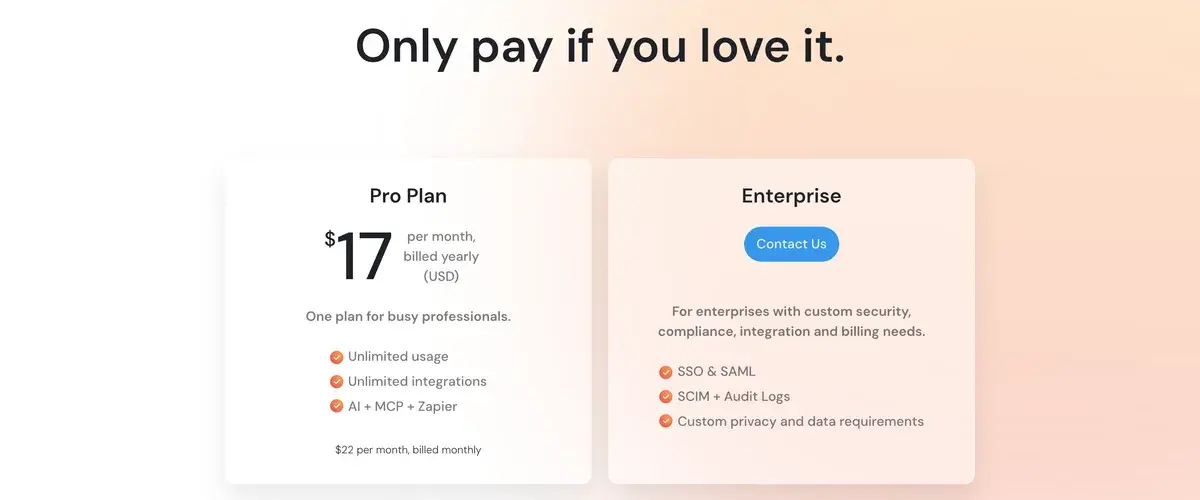
| Full | $20/mo (or $16/mo annual) | All features, all integrations | Active users committed to daily planning |
Prices verified April 2026 from sunsama.com/pricing. Annual billing offers ~20% off the monthly rate. There is no free permanent tier and no feature-tiered structure.
The pricing is unusual in productivity tooling for its simplicity. One paid tier, one price, all features included. There is no free tier, no Pro tier, no Team tier, no Enterprise tier. Sunsama is positioned as a complete product at a single price point — either you find value at $20/month and pay, or you do not and use alternatives.
For users matched to Sunsama's use case, the pricing is reasonable against the value. The daily planning ritual produces focus and stress reduction that compounds across daily work; the per-month cost is small relative to typical knowledge worker hourly rates. Users reporting meaningful improvement from Sunsama practice typically renew without much consideration of cost.
For users not matched to the use case, the pricing is hard to justify. Free task managers (Todoist Free) and bundled productivity tools cover much of Sunsama's surface functionality without subscription cost. The pricing premium is for the planning ritual support and integration depth rather than basic task functionality.
Hands-on Notes
The first thing that affects Sunsama's value in actual use is whether you do the daily planning ritual. The product opens to the planning interface; the ritual takes 5-10 minutes; tasks from integrated tools surface for daily selection; calendar context is visible; the result is a focused list of "what I will do today" with time estimates and explicit choice. Users who do this ritual consistently report meaningful focus improvement; users who open Sunsama looking for tasks without the planning ritual extract little value.
The integration architecture is genuinely useful. Pulling tasks from Asana, GitHub issues, email, calendar, and Slack into one view eliminates the cognitive overhead of moving between tools to assemble daily context. For users whose work lives across many tools, this synthesis is meaningful. For users whose work lives primarily in one tool, the synthesis value is smaller.
Time boxing in Sunsama is handled with explicit time estimates and calendar-integrated scheduling. Each task gets an estimated duration; the day's tasks fit into an explicit schedule; the schedule is visible alongside actual calendar meetings. For users who benefit from temporal structure on their work, this helps. For users who prefer flexibility over scheduling, the time boxing creates friction without proportional benefit.
The weekly review is one of Sunsama's stronger features and one that many users skip initially before discovering its value. The structured Friday review (or whichever day you set) covers what was accomplished, what carried over, what insights emerged, and what next week should focus on. For users committed to the practice, this weekly cadence produces awareness of work patterns that ad-hoc reflection does not surface.
Where Sunsama gets weaker: users seeking quick task capture often find the ritual-focused UX adds friction. Adding a quick task to remember later is more straightforward in Things or Todoist than in Sunsama; Sunsama is optimized for intentional planning rather than rapid capture. For users who want both rapid capture and intentional planning, using Sunsama alongside a separate quick-capture tool addresses this; for users wanting one tool for both, alternatives may serve better.
The other practical observation: Sunsama's value compounds with use. The first week of use feels like overhead; the second week starts producing value as the ritual becomes habit; the second month of consistent use produces visible focus and productivity gains. Users abandoning Sunsama within the trial period often miss the compound value that emerges with sustained practice. The honest framing: commit to 30 days of consistent use before deciding on value.
For users coming from automation-focused productivity tools (Motion, Reclaim AI) hoping Sunsama produces similar AI scheduling magic, the experience is initially disappointing. Sunsama is not trying to automate planning; it is trying to support intentional human planning. Calibrating expectations to "tool that supports my planning" rather than "tool that does my planning" produces better evaluation outcomes.
The AI features added through 2024-2025 are useful additions but secondary. Task estimation suggestions, planning hints, and review summaries support the existing workflow without redefining it. Users wanting AI-first planning experience may find Sunsama's human-in-the-loop philosophy unsatisfying; users specifically valuing intentional human planning find the AI additions appropriately balanced.
Use Cases
A senior software engineer at a Series C company uses Sunsama daily for work allocation across multiple parallel projects. Pulling GitHub issues, Linear tickets, calendar meetings, Slack messages, and personal tasks into the morning planning ritual produces explicit choice about what each day contains. After 6 months of consistent practice, the engineer reports reduced context-switching, better deep work time, and clearer weekly progress on important projects.
A founder of a 20-person SaaS startup uses Sunsama to manage chronic context-switching across product, sales, hiring, and operations. The unified daily planning forces conscious choice about which area to advance each day rather than reactive pulls. The weekly review surfaces patterns (too much sales, not enough product) that inform deliberate rebalancing. Sunsama is one of few tools the founder pays for personally as a productivity investment.
A consultant managing 4-5 client engagements uses Sunsama for daily allocation across client work. Pulling tasks from each client's tool stack (Asana for one, Notion for another, GitHub for technical clients) into unified daily view supports realistic capacity planning across engagements. Time boxing helps prevent over-commitment to any single client at the expense of others.
A remote worker recovering from burnout uses Sunsama to rebuild sustainable work patterns. The intentional daily planning prevents the always-on patterns that contributed to burnout; the weekly review surfaces sustainable progress without overcommitment. The structured ritual provides the external scaffolding the worker's depleted internal motivation cannot sustain alone.
A productivity-curious knowledge worker tries Sunsama for 60 days as an experiment. After consistent practice, finds the planning ritual genuinely valuable and continues subscription. Compared to ad-hoc planning before Sunsama, the structured daily ritual produces measurable focus improvement and stress reduction. The $20/month is justified by the practice value rather than the software features specifically.
A user evaluates Sunsama and finds the daily ritual requirement does not match their working style. The user prefers reactive flexible work over intentional planning structure; Sunsama's value depends on practices that conflict with the user's natural rhythm. After trial period, user does not subscribe and uses simpler task management. This use case reveals where Sunsama's positioning is least compatible — users who do not want behavior change toward intentional planning.
Our Verdict
Sunsama is a thoughtful productivity tool for users specifically wanting software support for intentional daily planning practice. The integration architecture, daily ritual UX, time boxing, and weekly review features genuinely support the philosophy of intentional work that the product is built around. For users matched to this use case, Sunsama produces real focus improvement and stress reduction that justifies the pricing.
The honest considerations: Sunsama's value depends on commitment to the daily planning practice. Users who download the tool hoping for productivity from software alone without behavior change are typically disappointed. Users unwilling to invest in the planning ritual get little value from Sunsama versus free or cheaper alternatives. The buying decision should be honest about whether the philosophy aligns with how you actually want to work.
The pricing is reasonable for the value when matched to the use case. $20/month is small relative to knowledge worker hourly rates; the daily focus value compounds across the year. For users not matched to the use case, the pricing is hard to justify against alternatives.
For senior individual contributors juggling many work streams, founders managing chronic context-switching, knowledge workers seeking sustainable work patterns, and productivity-curious users committed to behavior change toward intentional planning, Sunsama deserves serious consideration. For users wanting fast task capture, AI-driven automation, or productivity gains without behavior change, alternatives serve better. Match the buying decision to whether the underlying philosophy resonates with how you actually want to work.
Note: Sunsama does not currently have an active affiliate program with AIVario. AIVario earns no commission from sign-ups. Our rating reflects evaluation across daily planning workflows over an extended period of use.
Best for: Knowledge workers in focus-required roles, senior individual contributors juggling parallel work, founders managing chronic context-switching, remote workers needing structure, people recovering from burnout, productivity-curious users committed to behavior change
Not ideal for: Users wanting fast task capture without ritual overhead (use Things or Todoist), team task management (use Asana or ClickUp), users wanting AI-driven scheduling automation (use Motion or Reclaim AI), users unwilling to commit to daily planning practice
Bottom line: A philosophy-of-work tool more than software; the value depends on the practice. For users who genuinely want intentional planning support, recommend without hesitation. For users seeking productivity from software alone without behavior change, alternatives serve better.
Related Tools
- Reclaim AI — alternative for users wanting AI-driven scheduling rather than human intentional planning
- Asana — common task source that integrates with Sunsama for daily planning
- Notion — common knowledge work tool that integrates with Sunsama
- Linear — engineering project management that integrates with Sunsama for engineering daily planning
- Slack — common collaboration tool that integrates with Sunsama for capturing tasks from messages
Frequently Asked Questions about Sunsama
How much does Sunsama cost?
Sunsama has a single paid plan at $20/month or $16/month on annual billing. There is no free tier; a 14-day trial allows evaluation. The simple pricing structure (one paid tier covering all features) is unusual but reflects Sunsama's positioning as a complete tool rather than a feature-tiered product.
How is Sunsama different from Asana or Notion?
Different category of tool. Asana, Notion, and similar platforms are work management systems that contain tasks. Sunsama is a daily planning tool that pulls tasks from those systems and others into a unified daily view. You do not use Sunsama instead of Asana; you use Sunsama alongside Asana to help focus your daily work across all the tools where work lives.
Why does Sunsama require a daily ritual?
The daily planning ritual is the actual product, not a marketing add-on. Sunsama's underlying philosophy is that intentional work requires intentional planning — taking 10 minutes each morning to review what you intended yesterday, what carried over, what is on calendar today, what tasks are in your various tools, and consciously choosing what you will work on. Users who commit to this ritual report meaningful focus and stress reduction; users who skip the ritual extract little value from the tool.
What tools does Sunsama integrate with?
Sunsama integrates with Asana, Jira, GitHub, Trello, Linear, ClickUp, Notion, Todoist, Gmail, Outlook, Google Calendar, Slack, and most major task and calendar tools. The integration model is read-only or bidirectional depending on the tool — pulling tasks for daily planning, marking complete in original tools when done, and surfacing relevant context as needed.
Is Sunsama worth $20/month?
For users who genuinely commit to the daily planning ritual, yes — the focus and stress reduction reported by consistent users justify the cost easily against the productivity gains. For users who download the tool hoping for productivity from the software itself without committing to the ritual, Sunsama is overpriced compared to free task managers. The value is in the practice; the tool exists to support the practice.
Can Sunsama replace my task management system?
Generally no, and the design reflects this. Sunsama is built to complement existing task systems (Asana, Notion, etc.) rather than replace them. Tasks live in their original tools where teams collaborate; Sunsama pulls personal daily-relevant tasks into a focused view. For solo users who want a single tool for both task management and daily planning, simpler tools (Things, OmniFocus, Todoist) may serve better than Sunsama's complementary positioning.
Does Sunsama have AI features?
Sunsama added some AI features through 2024-2025 — task estimation suggestions, planning assistance, and review summaries — but AI is not the product's defining feature. Sunsama's value comes from the planning ritual and integration architecture rather than AI capabilities; the AI features are useful additions to the existing workflow rather than core differentiation. For users wanting AI-first planning tools, Sunsama is not positioned as that product.