Copyleaks is an AI and plagiarism detector for schools, businesses and individuals that checks text in one combined report and now also detects AI in images and video. Anyone can scan up to 25,000 characters without logging in. Personal costs $13.99 a month billed yearly ($167.88) or $16.99 monthly with 1,200 credits, enough for about 300,000 words or 1,200 images; Pro costs $74.99 a month yearly or $99.99 monthly with 25 seats and 12,000 credits. Copyleaks claims over 99% accuracy, a figure it says comes from internal testing on English datasets.
✓Best for: Schools, publishers and content teams that want AI and plagiarism checked in one report, in many languages, with image and video detection on the same account
✗Skip if: You want a verdict you can act on without further evidence, or you only need occasional checks, which the free 25,000-character scan already covers
This analysis is based on documentation, public user reports, and vendor materials — not yet on our own hands-on testing. How we rate
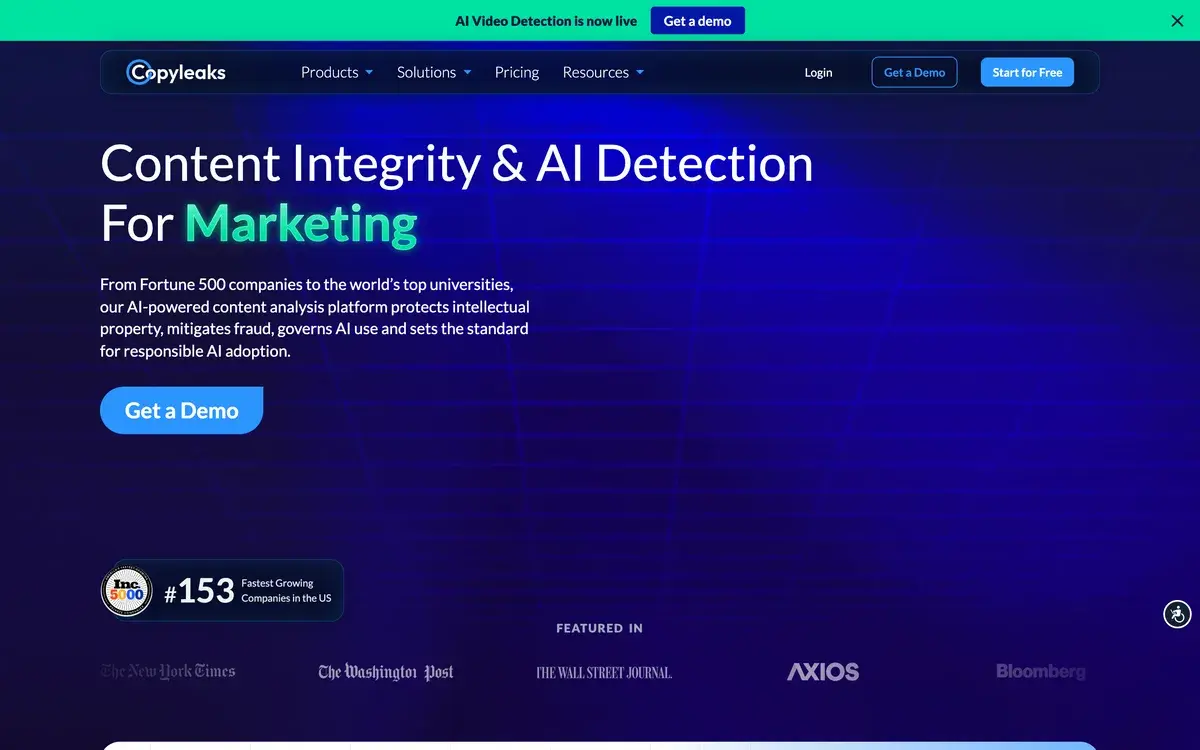
Copyleaks homepage, captured Oct 1, 2026.
One scanner for AI text, plagiarism, images and now video
Copyleaks started as a plagiarism checker and grew into what it calls a content integrity platform. A single text scan returns both an AI-detection result and a plagiarism report, compared against what Copyleaks says are more than 60 trillion web sources, 16,000 open-access journals, a million internal documents and 20 code repositories. AI detection covers more than 30 languages and plagiarism detection more than 100.
The newer products go beyond text. An AI image detector, now part of the Personal plan, looks for pixel-level traces of generators from OpenAI, Google, Midjourney, Stability AI and Black Forest Labs, and even AI editing features on iPhones and Samsung phones. A banner across the homepage in October 2026 announced that AI video detection is live, and Copyleaks pitches the whole set as multi-modal detection for text, images, audio and video.
Copyleaks sells mainly to schools and companies, through LMS integrations, an API and enterprise contracts, and the homepage rotates its headline between education, marketing and other audiences. Individuals get a smaller self-serve plan and free scans.
The 99% figure and what sits behind it
Copyleaks claims over 99% accuracy and an industry-low 0.03% false-positive rate, and says independent third-party studies back it. The footnote under that claim matters more than the number: the accuracy rating is based on internal testing of English-language datasets. Copyleaks also publishes per-language results and says its false-positive rate stays low for non-native English writing.
Those are vendor figures under the vendor's test conditions. Studies of AI detectors as a group have found far higher error rates on short texts, heavily edited AI text and essays by non-native English speakers; a 2023 Stanford paper on seven detectors is the one most often quoted. Detection has improved since, so the useful question is what a score should trigger. For Copyleaks, that means opening the plagiarism matches and the highlighted sentences, comparing them with drafts or version history, and asking the writer how the piece was produced.
Personal or Pro: credits, seats and what a credit buys
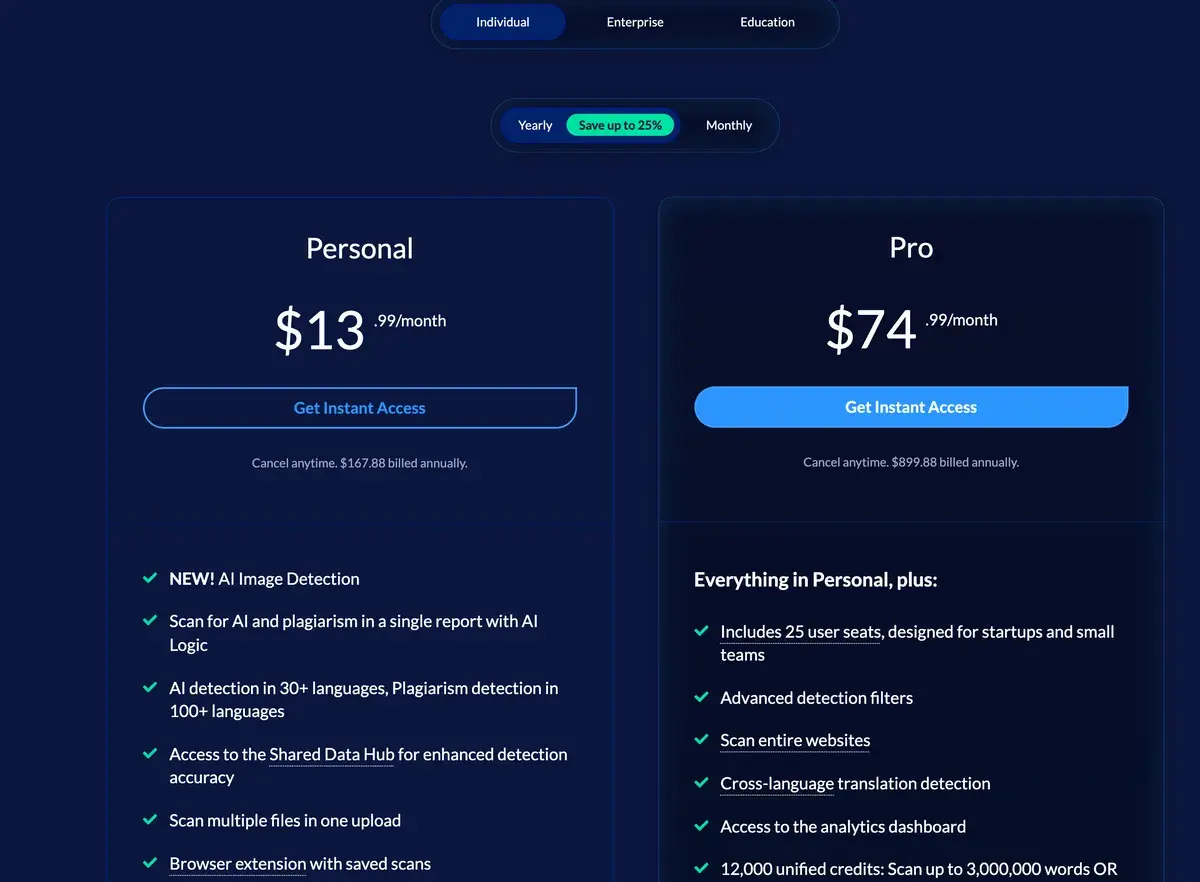
Copyleaks' pricing page for individuals on yearly billing, captured October 1, 2026.
Plan
Billed yearly
Billed monthly
Credits a month
What it adds
Free scan
$0
$0
Up to 25,000 characters per scan, no login
AI detection; a free account adds sentence-level highlights
Personal
$13.99 a month, $167.88 a year
$16.99
1,200: about 300,000 words or 1,200 images
AI and plagiarism in one report, AI image detection, multi-file uploads, browser extension, Google Docs add-on
One credit covers up to 250 words of text or one image. When the allowance runs out, you can upgrade or buy one-time credits, and the monthly allowance resets each billing cycle. Plans renew automatically; cancelling stops the next renewal but keeps access until the end of the period you paid for.
Pro is priced for small teams rather than heavy individual use: 25 seats sharing 12,000 credits works out to about $3 per seat a month on yearly billing, and its website scanning suits publishers checking a whole site for copied or AI-written pages.
Free scans, students and the browser extension
For occasional checks, the free scanner is generous: up to 25,000 characters per scan without an account, more than most rivals allow without signing in. A free account unlocks the sentence-by-sentence view that shows which passages look AI-written. The homepage points students to a free start, and Copyleaks positions the tool for checking your own work before you submit it as well as for teachers.
The browser extension scans text inside web editors, learning platforms and publishing tools as you work, and Personal adds a Google Docs add-on. For work submitted on paper, Copyleaks can read text from a photo of a page and run the same AI and plagiarism checks on it.
What happens to the documents you scan
Before uploading student essays or confidential drafts, look at the Shared Data Hub setting. The hub is a database of documents from institutions worldwide, and comparing against it is part of what helps Copyleaks catch work copied between students at different schools. The other side of that is that documents indexed in the shared hub become available for everyone to compare against.
Copyleaks lets users control in their settings whether documents are saved to the hub, and organizations can instead use a Private Cloud Hub that only they can search. A school setting up Copyleaks should decide that policy first and tell students how their work is stored.
Copyleaks against GPTZero and Turnitin
GPTZero, now owned by Superhuman, is the closest rival for individual users. It is stronger for checking English essays and has Writing Replay, which shows how a Google Doc was written, while Copyleaks is stronger for combined plagiarism reports, languages beyond English and images. Turnitin sells only to institutions and runs inside their submission systems, so it is rarely an option for an individual teacher or student.
For other uses, Originality.ai targets publishers with pay-as-you-go credits and fact-checking, and Winston AI also checks images for AI. Humanizers such as Undetectable AI sit on the other side, rewriting AI text to evade detectors like these.
Related Tools
GPTZero: AI detector with Writing Replay, now part of Superhuman
Originality.ai: AI and plagiarism detection for publishers
Winston AI: text and image AI detection with PDF reports
Grammarly: writing assistant with its own plagiarism and AI checks
No detector is. Copyleaks claims over 99% accuracy and a 0.03% false-positive rate, but its own footnote says the accuracy figure comes from internal testing on English datasets. Independent research on AI detectors keeps finding more errors on short, heavily edited or non-native writing, so treat a Copyleaks score as a reason to look at drafts and talk to the writer.
Can I use Copyleaks for free?
Yes, for light checks. The AI detector on Copyleaks' website scans up to 25,000 characters without logging in, and a free account adds sentence-by-sentence highlights and pattern breakdowns. Students are pointed to a free start on the homepage. Regular use, plagiarism reports and batch uploads need a paid plan.
Does Copyleaks save the documents I scan?
It can. Paid plans include the Shared Data Hub, a database of documents from institutions worldwide that new scans are compared against, and documents indexed there become available for everyone to compare against. Your account settings control whether documents are saved to it, and organizations can use a Private Cloud Hub that only they can search.
Should I use Copyleaks or GPTZero?
Copyleaks if you want plagiarism and AI detection in one report, many languages, or image and video checks, and it shows its prices in dollars from $13.99 a month. GPTZero if you mainly check English essays, want Writing Replay to see how a Google Doc was written, or prefer its free homepage scanner. Both claim about 99% accuracy on their own tests.
Is Copyleaks better than Turnitin?
They serve different buyers. Turnitin is sold to schools and universities and runs inside their submission systems, so most teachers and students cannot buy it themselves. Copyleaks sells to institutions too, with LMS integrations, but also offers individual plans and free scans. Both claim high accuracy, and neither should be the only evidence in a misconduct case.
Can Copyleaks detect AI images and videos?
Yes. Its AI image detector, included in the Personal plan, recognizes images from OpenAI, Google, Midjourney, Stable Diffusion and Flux as well as AI edits made on iPhones and Samsung phones, and supports JPG, PNG, WEBP, HEIC and other formats. By October 2026 Copyleaks had also launched AI video detection, and it markets detection across text, images, audio and video.
Does Copyleaks work in Google Docs?
Yes. The Personal plan includes a Google Docs add-on, and the browser extension scans text inside web editors, learning platforms and publishing tools as you write. Schools can also connect Copyleaks to their learning management system.
Does Copyleaks have a humanizer?
No. Copyleaks detects text rather than rewriting it, and it markets detection of paraphrasing and character manipulation, the tricks humanizers rely on. If a tool promises to humanize text past Copyleaks, it is a third-party rewriter, not a Copyleaks product.