GPTZero is an AI text detector for teachers, students, writers and businesses, now owned by Superhuman, the company formerly called Grammarly, after a deal announced on June 23, 2026. Anyone can scan up to 10,000 characters at a time on its homepage. Premium costs €9.99 a month billed yearly or €18.99 monthly for 300,000 words a month, and Professional costs €19.99 or €35.99 for 500,000 words, batch scans of 250 files and LMS integration, prices as shown to European visitors in October 2026. GPTZero claims 99% accuracy but says its results should not be used to punish anyone or as a final verdict.
✓Best for: Teachers, editors and hiring managers who want a first signal about AI use and will follow it up with drafts, edit history or a conversation
✗Skip if: You need proof that would stand up on its own in a misconduct case, mostly check non-English or heavily edited text, or need a humanizer, which GPTZero does not make
This analysis is based on documentation, public user reports, and vendor materials — not yet on our own hands-on testing. How we rate
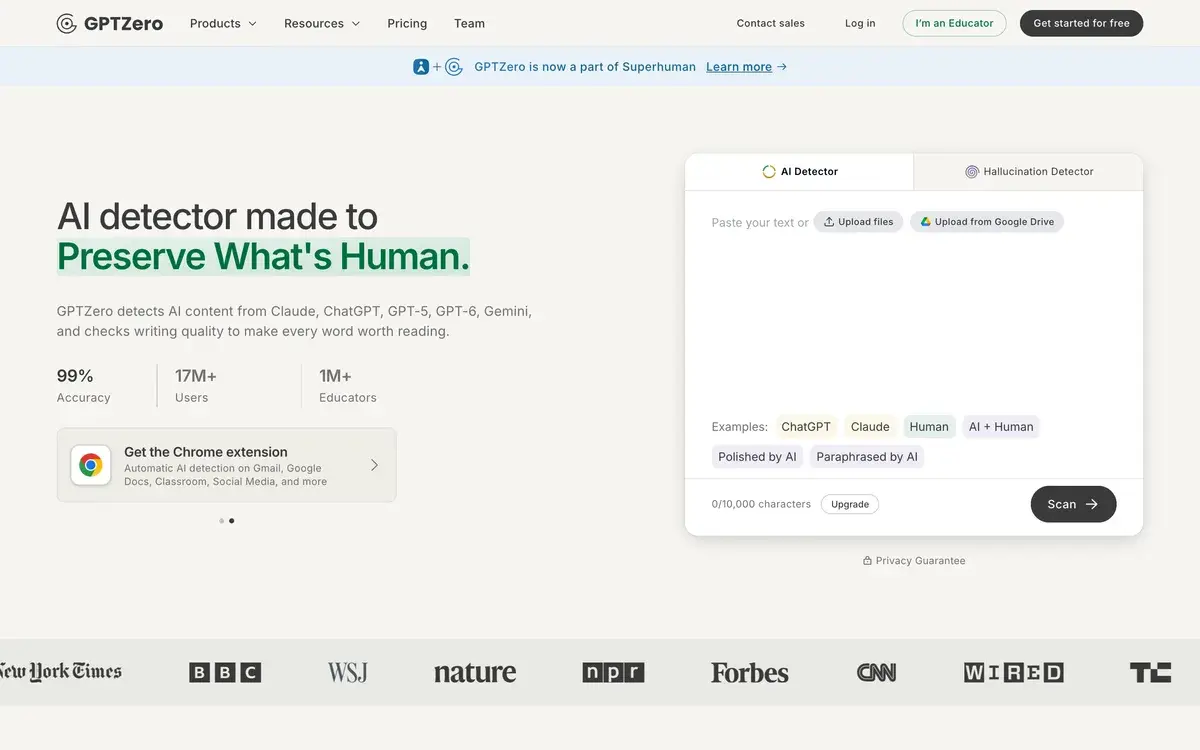
GPTZero homepage, captured Oct 1, 2026.
An AI detector now inside Superhuman
GPTZero started in January 2023 as Edward Tian's answer to ChatGPT in classrooms and grew into the best-known AI detector, claiming more than 17 million users and a million educators. It is also the official AI detection partner of the American Federation of Teachers, according to its pricing page.
In June 2026 it changed hands. Superhuman, the company formerly called Grammarly, announced on June 23 that it would buy GPTZero, without disclosing terms, and planned to build its detection into the Superhuman Go assistant. The deal has closed: GPTZero's site now carries a banner saying it is part of Superhuman, and its footer links to Grammarly, whose Pro plan has its own AI detector. Superhuman went on to buy the Fathom notetaker in September, and its email app is covered in our Superhuman review.
For users, the product is the same set of tools: the AI Detector, an Advanced Scan, a Hallucination Detector that checks sources and bibliographies, a plagiarism checker, writing feedback, and Writing Replay, which records how a Google Doc was written.
How accurate GPTZero is, by its own account
GPTZero's headline is 99% accuracy, backed by its own large-scale testing and by benchmarks with partners such as Penn State's AI Research Lab. Its own FAQ is more careful than its homepage, and it is the best guide to using the tool well:
No AI detector is 100% accurate, and results should not be used to punish anyone or as the final verdict.
Accuracy improves with longer input, so document-level results are stronger than sentence-level ones.
It is strongest on English prose; GPTZero lists full support for English, German, Portuguese, French and Spanish.
It is not trained to identify AI text that was heavily modified after generation.
It can flag procedural or machine-like human writing, such as formulaic reports, as AI.
Independent research points the same way. A widely cited 2023 Stanford study found that seven AI detectors, GPTZero among them, misclassified more than half of essays written by non-native English speakers as AI-generated. Detectors have improved since, but the pattern explains why a score on a short essay by a student writing in a second language deserves extra caution.
The sensible way to use GPTZero follows from all of this. Treat a high score as a reason to look closer, then check drafts, version history or Writing Replay, and talk to the writer before drawing conclusions.
Premium or Professional: words, files and LMS access
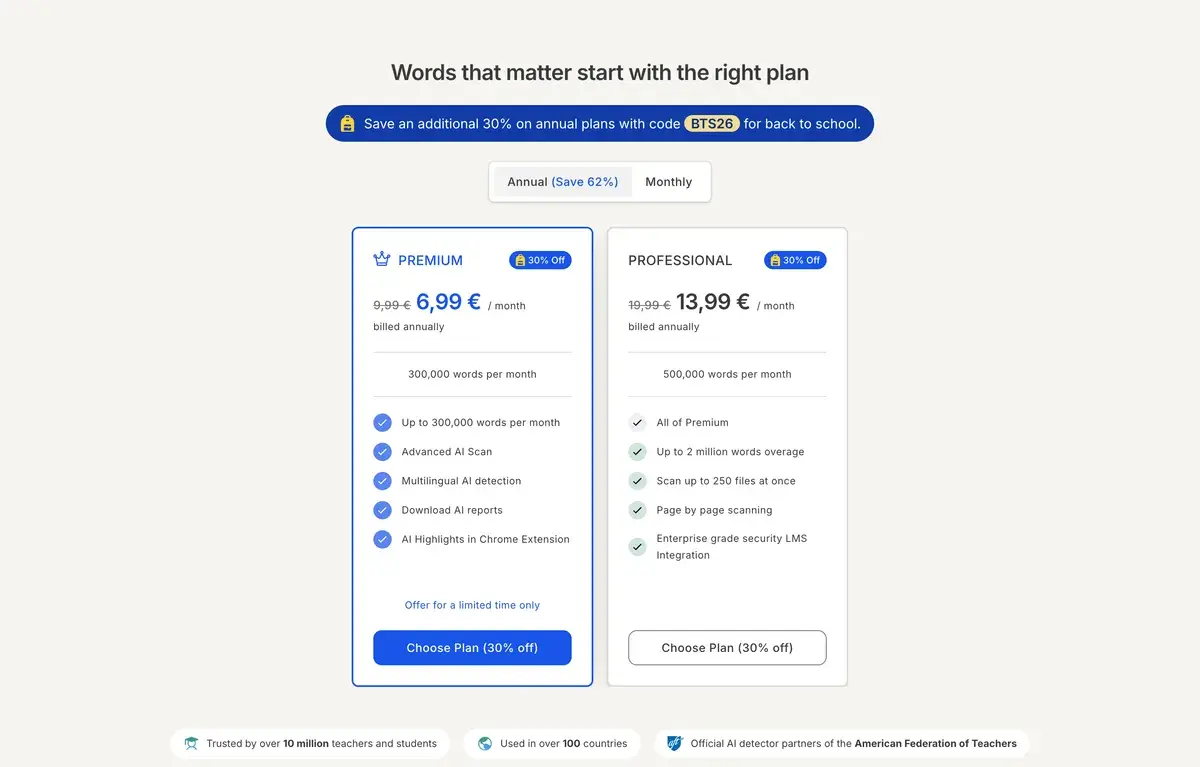
GPTZero's pricing page on annual billing, captured October 1, 2026 from Europe, so prices appear in euros; the discounted figures use the BTS26 back-to-school code.
Plan
Billed yearly
Billed monthly
Words a month
What it adds
Free scan
$0
$0
Up to 10,000 characters per scan on the homepage
Basic AI detection without an account
Premium
€9.99 a month
€18.99
300,000
Advanced AI Scan, multilingual detection, downloadable reports, highlights in the Chrome extension, 50-file batches
Unified billing, account provisioning, custom Canvas and Google Classroom integration
The pricing page no longer shows a free tier next to the paid plans, but anyone can paste up to 10,000 characters into the homepage scanner, and longer scans need an account. Monthly billing costs nearly twice the yearly rate, and the BTS26 code offered a further 30% off annual plans in the autumn of 2026. Teachers who only need GPTZero during term can pause a subscription for up to three months instead of cancelling.
What happens to the text you scan
Before pasting student essays or confidential documents, check how GPTZero handles them. Its FAQ says it does not store or collect documents sent through the API, but it does store text scanned in the dashboard, and uses that data in aggregate to improve the service. A school scanning work at scale should read the privacy policy, look at the API or an enterprise agreement, and tell students how their writing is checked.
Writing Replay is better evidence than a score
The most useful GPTZero feature for settling a dispute is not the detector. Writing Replay, which works in Google Docs, plays back how a document was written, shows where text was pasted in and highlights unnatural typing patterns. A student accused of using AI can show the writing process, and a teacher can see whether a finished essay appeared in one paste.
That reverses the burden in a fairer direction: instead of arguing over a probability, both sides look at the history of the document. Schools that set up Writing Replay at the start of an assignment get far more out of GPTZero than those that scan finished work.
GPTZero next to Turnitin, Copyleaks and Originality.ai
Turnitin is sold to schools and universities and runs inside their submission systems, so individual teachers and students usually cannot buy it themselves. Copyleaks combines AI and plagiarism detection for education and business. Originality.ai targets publishers and SEO teams with pay-as-you-go credits, plagiarism checks and fact-checking, Winston AI sells to schools and writers with a free trial, and ZeroGPT offers free scans with paid plans for heavier use.
On the other side of the arms race sit humanizers such as Undetectable AI, which rewrite AI text to slip past detectors. GPTZero's paid plans include detection of paraphrasers and AI bypassers, and its owner now also sells Grammarly's detector, so expect the two to converge inside Superhuman's products.
Related Tools
Copyleaks: AI and plagiarism detection for schools and businesses
Originality.ai: AI detection for publishers and content teams
Winston AI: AI detector with document and image scanning
Frequently Asked Questions about GPTZero
Does GPTZero work in Google Docs?
Yes, in two ways. The Origin Chrome extension runs AI detection inside Gmail, Google Docs, Google Classroom and social media, and Writing Replay plays back how a Google Doc was written, including pasted text and typing patterns. GPTZero also offers a Microsoft Word add-in.
Can GPTZero be wrong about human writing?
Yes. GPTZero's own FAQ says no AI detector is 100% accurate, that it can flag procedural or machine-like text as AI, that it is not trained to catch AI text that has been heavily edited, and that results should not be used to punish anyone or as a final verdict. Accuracy is highest on longer English prose and drops on short passages.
How much are GPTZero Premium and Professional?
Shown in euros to European visitors in October 2026, Premium costs €9.99 a month billed yearly or €18.99 monthly for 300,000 words a month, and Professional costs €19.99 or €35.99 for 500,000 words, up to 2 million words of overage, 250-file batches and LMS integration. A back-to-school code, BTS26, took another 30% off annual plans for a limited time.
Does GPTZero keep the text you scan?
It depends on how you scan. GPTZero says it does not store documents sent through its API, but it does store text scanned in its dashboard and uses that data in aggregate to improve the service. Schools handling student work should read the privacy policy and consider the API or an institutional agreement.
Does GPTZero have a humanizer?
No. GPTZero detects text from humanizers and paraphrasing tools rather than rewriting text to avoid detection. Several App Store apps use the GPTZero name and advertise humanizers, but they come from other developers. GPTZero's own products are its website, the Origin Chrome extension, a Microsoft Word add-in and its API.
Did Superhuman buy GPTZero?
Yes. Superhuman, the company formerly called Grammarly, which also sells Grammarly, Superhuman Mail and Superhuman Docs, announced the deal on June 23, 2026 without disclosing terms and plans to bring GPTZero's detection into its Superhuman Go assistant. GPTZero's website now carries the banner GPTZero is now a part of Superhuman.
Can GPTZero detect text from Claude and Gemini?
GPTZero says it classifies text from ChatGPT and GPT-6, Claude, Gemini, Llama, DeepSeek and services built on them, and its paid plans list multi-model detection and detection of paraphrasers and AI bypassers. Like every detector, it is less reliable on short passages and on AI text a person has rewritten.
Is GPTZero more accurate than Turnitin?
There is no clean answer. Both companies claim high accuracy on their own tests, and both warn against treating a score as proof. The practical difference is access: Turnitin is sold to schools and runs inside their submission systems, while GPTZero lets individual teachers, students and writers scan text themselves, with free scans and monthly plans.
Can I pause a GPTZero subscription?
Yes. GPTZero's help center says you can pause a membership for up to three months at a time, or cancel from Settings, where the Cancel Plan option sits in the left sidebar. Pausing suits teachers who only need the tool during term.