Grok sells through two parallel ladders — standalone SuperGrok at grok.com and bundled X Premium subscriptions — and the models are the same. SuperGrok at $30/month and X Premium+ at $40 give you identical Grok access; the extra $10 buys X perks like ad-free browsing and the checkmark. If you don't use X, that's $120 a year saved. Free is now text-only after image generation was removed in March 2026.
✓Best for: People who need real-time X data and current-conversation search in an assistant
✗Skip if: You want general capability at the best price — ChatGPT and Claude cost $20 and match it
Grok is xAI's assistant, and its genuine differentiator is access to X in real time. Ask what people are saying about something right now and it can actually tell you, drawing on live posts rather than a training cutoff or a web index refreshed hours ago.
Everything else — DeepSearch research, Expert and Big Brain reasoning modes, Grok Imagine for images and video, voice, Grok Build — is competitive but not unique. The real-time social layer is.
The pricing, though, is a maze. Eight consumer tiers across two parallel ladders, where the names don't map to the models and the most obvious upgrade path costs you $120 a year for nothing.
Let's untangle that first, because it's the part that costs money.
The $10 you probably don't need to spend
xAI sells Grok two ways:
Standalone, at grok.com — Free, SuperGrok Lite ($10), SuperGrok ($30), SuperGrok Plus ($100), SuperGrok Heavy ($300).
Bundled with X — X Premium ($8), X Premium+ ($40).
Here's the thing: SuperGrok at $30 and X Premium+ at $40 give you the same Grok.
The extra $10 doesn't buy a better model or higher AI limits. It buys X platform perks — ad-free browsing, the verified checkmark, creator monetization, higher post limits.
So the decision is genuinely simple:
You actively use X and want the perks → X Premium+ at $40 folds both into one bill
You just want the AI → SuperGrok at $30, and keep the $120 a year
Stacking both is rarely worth it. And X Premium at $8 is the cheapest paid door but doesn't include Grok 4 or DeepSearch, so it's more a social subscription with light AI attached than an AI plan.
Annual billing brings SuperGrok to roughly $25/month, and X Premium+ to about $32.92 — which narrows the gap but doesn't close it.
What free lost in March
The free tier tightened meaningfully in 2026, and older reviews describe something more generous than what exists.
What you get: roughly 10 prompts every two hours on Grok 4 Mini, real-time web and X search, voice features, connectors.
What went: image and video generation. xAI pulled the last free Grok Imagine access on March 19, 2026. Any media creation now requires a paid plan.
What you don't get: the full Grok 4 or 4.3 models, or DeepSearch.
If Grok Imagine was your reason for looking, the cheapest entry is now SuperGrok Lite at $10 — which is presumably why that tier appeared on March 25, six days after the free generation was removed.
Free is now best understood as an evaluation lane for text chat.
The usage model changed in June
Another thing most guides get wrong: the per-two-hour prompt caps were retired in June 2026.
Paid plans now run on a single shared weekly usage pool, spendable across Chat, Imagine, Voice, and Build however you like.
That's more flexible in practice — you can front-load a heavy research day rather than rationing by the clock. The tradeoff is that image and video generation now draw from the same pool as text, so a Grok Imagine session eats into your chat allowance.
If you're reading a comparison that quotes "X prompts per two hours," it's describing a system that no longer exists.
Who trains on your conversations
This deserves its own section because it's genuinely important and almost always buried.
On Free, X Premium, X Premium+, and individual SuperGrok plans, your conversations may be used for xAI model training.
Only Grok Business at $30 per seat carries a guarantee that your data won't be used for training, alongside team collaboration and centralized billing.
Note the coincidence: Business is $30 per seat, the same price as consumer SuperGrok. Same number, materially different product. If you're putting client work, business strategy, or anything sensitive into an assistant, that's the version you want — and paying the identical amount for the consumer tier means accepting training on your inputs.
This isn't unique to xAI, but the pricing symmetry makes it unusually easy to end up on the wrong side of it by accident.
Which model do you actually get?
Harder to pin down than it should be.
Consumer apps still talk about Grok 4, while on the API that generation was retired in May 2026 — every request now lands on Grok 4.3 or newer. SuperGrok Heavy at $300 is the only consumer plan with confirmed full Grok 4.5 access.
Tier-to-model assignment also shifts during staged rollouts, so two people on the same plan can be on different models on the same day.
The honest advice: check your own model picker rather than trusting any published mapping, including the one you're reading.
Who is it for?
Grok fits people whose work genuinely benefits from real-time X data — journalists tracking breaking stories, marketers monitoring sentiment, traders watching narratives form, researchers studying live discourse. Nothing else has that access, and it's the whole argument for paying $10 over ChatGPT or Claude.
It also suits existing X Premium+ subscribers, for whom Grok is already included and effectively free at the margin.
And developers building high-volume applications get genuinely good API economics, particularly Grok 4.1 Fast at $0.20/$0.50 per million tokens with a 2M context.
Where it's a weaker buy: general professional use (ChatGPT Plus and Claude Pro cost $20 and match it), anyone sensitive about training data on consumer tiers, users wanting a free tier with image generation (that ended in March), and people who find eight tiers across two ladders more confusing than helpful — which is a fair reaction.
Key Features
Real-time X access — live posts and current conversation, the genuine differentiator
DeepSearch — multi-step research with sources (paid tiers)
Expert mode and Big Brain / Think mode — extended step-by-step reasoning
Grok Imagine — image and video generation (paid only since March 2026)
Voice mode — interactive spoken conversation
Grok Build — agentic building features
Connectors — integrations with external services
Shared weekly usage pool — one allowance across Chat, Imagine, Voice, Build
OpenAI-compatible API — straightforward migration, five active models
Grok Business — $30/seat with no-training guarantee and team controls
Enterprise — custom SSO and data isolation
Grok vs Competitors 2026
Tool
Entry paid
Real-time social
Trains on your chats
Free tier
Grok (SuperGrok)
$30
✅ Live X data
⚠️ Yes on consumer tiers
⚠️ Text only
ChatGPT
$20 (Plus)
⚠️ Web search
⚠️ Varies by setting
⚠️ With ads
Claude
$20 (Pro)
⚠️ Web search
⚠️ No training by default
✅ Yes
Gemini
~$19.99
⚠️ Google search
⚠️ Varies
✅ Yes
Perplexity
$20 (Pro)
⚠️ Web search
⚠️ Varies
✅ Generous
Pricing checked August 2026 from each provider's pages. Training and privacy terms vary by plan and setting — verify against current policies for your specific tier. Competitor prices are approximate.
Grok vs ChatGPT:ChatGPT Plus is $20 against SuperGrok's $30 and has a far larger ecosystem — custom GPTs, Codex, broader integrations. Grok's edge is live X data and current-conversation search. Unless that specific capability matters to your work, ChatGPT gives more for less.
Grok vs Claude:Claude Pro is $20 and is generally regarded as stronger on long-context reasoning and extended writing, with no training on conversations by default. Grok counters with real-time social data. Different jobs — for writing and analysis, Claude; for what's happening right now, Grok.
Grok vs Perplexity:Perplexity is purpose-built for cited search with a genuinely generous free tier. Grok reaches live X content that Perplexity's web index doesn't cover the same way. For research with citations, Perplexity; for social pulse, Grok.
Grok vs Gemini:Gemini integrates natively across Google Workspace and costs slightly less. For work living in Docs and Gmail, Gemini; for X-native real-time data, Grok.
Grok 4 Heavy multi-agent, confirmed Grok 4.5, max limits
Bundled with X:
Plan
Monthly
What it adds
X Premium
$8
Basic Grok, no Grok 4 or DeepSearch, X perks
X Premium+
$40 (~$32.92 annual)
Same Grok as SuperGrok, plus ad-free X and checkmark
Business and API:
Option
Cost
Note
Grok Business
$30/seat
No training on your data, team controls
Grok 4.5 API
$2 / $6 per M tokens
500k context, $0.30 cached (85% off)
Grok 4.3 API
$1.25 / $2.50 per M
1M context
Grok 4.1 Fast API
$0.20 / $0.50 per M
2M context, volume option
Pricing checked August 2026 across multiple independent trackers. Local taxes, exchange rates, and mobile app store charges can raise the final figure. Tier-to-model assignment changes during rollouts.
The practical summary: most people who want Grok should buy SuperGrok at $30, not X Premium+ at $40. That's the same AI for $120 less a year.
SuperGrok Lite at $10 is the sensible entry if you mainly want Grok Imagine, since free lost that in March.
Business at $30 per seat is the version to buy if training on your conversations is a concern — identical price to consumer SuperGrok, materially different terms.
Heavy at $300 is hard to justify against ChatGPT Pro or Claude's top tiers unless the multi-agent architecture specifically solves something for you.
Use Cases
Live sentiment tracking: A marketer asks what people are saying about a launch right now and gets an answer drawn from current X posts rather than a stale index.
Breaking news research: A journalist uses real-time X access plus DeepSearch to follow a developing story as it unfolds.
Media generation: A creator uses Grok Imagine for images and short video, drawing from the shared weekly pool alongside chat.
High-volume API applications: A developer builds on Grok 4.1 Fast at $0.20/$0.50 per million tokens with a 2M context, undercutting most frontier alternatives.
Team use with data protection: An organization deploys Grok Business at $30 per seat specifically for the no-training guarantee and centralized billing.
Our Testing
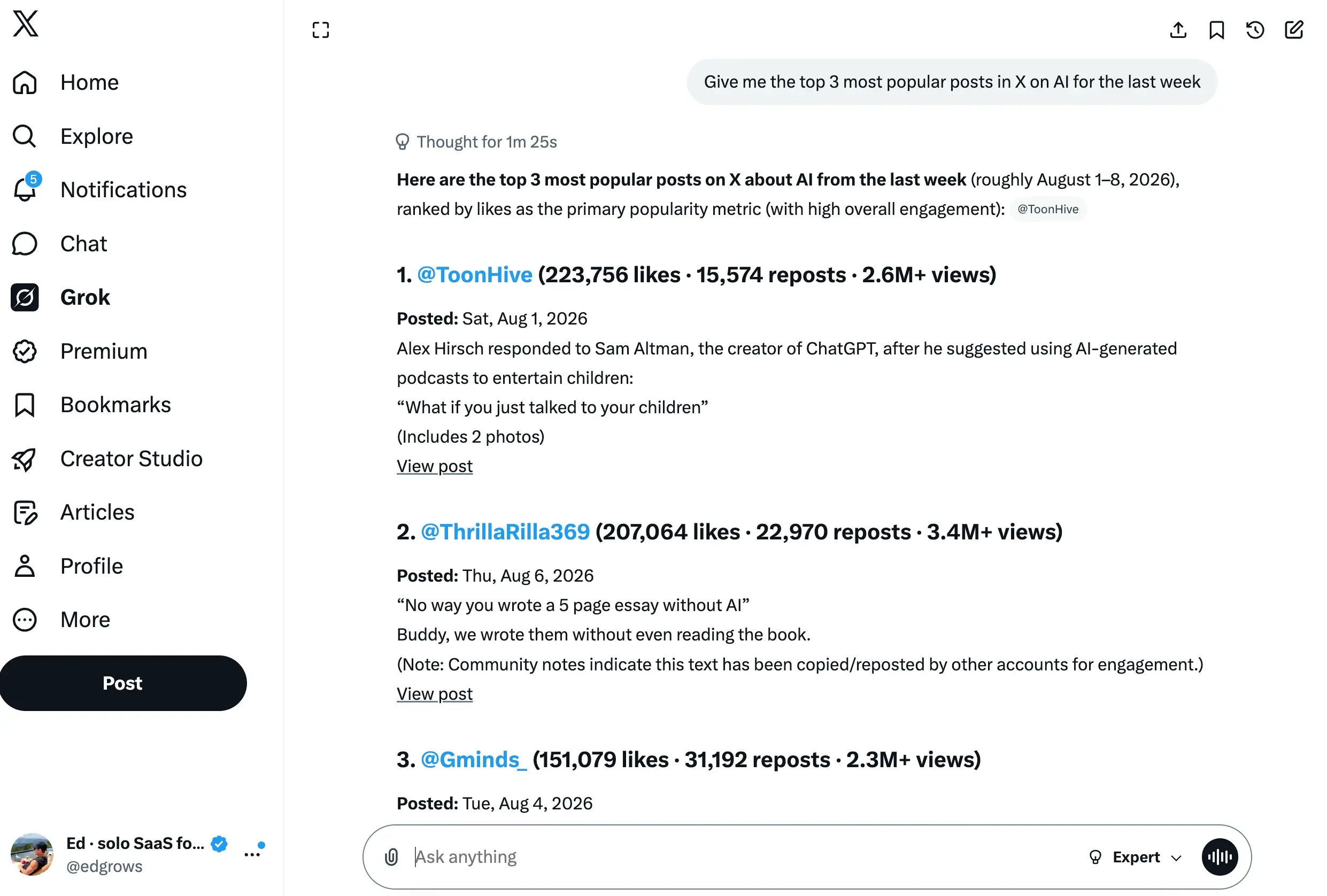
I use Grok every day, mainly for researching current news and trends on X — I always get the most up-to-date data, and it’s both enjoyable and efficient. I also frequently use Grok together with Claude/ChatGPT/Gemini for counter-arguments; they complement each other perfectly in analytical work. Below in the screenshot, you can see an example of my query and the excellent response with links to the posts:
I also use Grok Imagine for creating content. Below is a great example of how I first
created a character in the style of Game of Thrones and then brought him to life — the video does an amazing job of showing the quality of the work.
Image-to-video generation in Grok Imagine (captured 2026-08-08)
Our Verdict
Grok's real-time X access is a genuine capability nothing else replicates, and for anyone whose work involves tracking live conversation — journalists, marketers, analysts watching sentiment form — that alone can justify the subscription. DeepSearch and the reasoning modes are competent, Grok Imagine is capable, and the API pricing is genuinely aggressive, with Grok 4.1 Fast at $0.20 per million input tokens undercutting most frontier options for volume work.
The pricing is the problem, and it's a self-inflicted one. Eight consumer tiers across two ladders where SuperGrok at $30 and X Premium+ at $40 deliver the same Grok is a structure that costs inattentive buyers $120 a year. Model names don't map cleanly to tiers, and assignments shift during rollouts. The free tier lost image generation in March. And on every consumer plan, your conversations may be used for training — only Business at the same $30 price guarantees otherwise, which is a distinction worth catching before you subscribe.
Against ChatGPT Plus and Claude Pro at $20, SuperGrok's $30 asks for a $10 premium that's justified by exactly one thing. If real-time X data matters to your work, pay it. If it doesn't, the cheaper alternatives match it on everything else.
Note: Grok does not have an affiliate program with AIVario. We earn no commission from xAI subscriptions, and this rating carries no commercial incentive.
Best for: Journalists and analysts tracking live conversation, marketers monitoring real-time sentiment, existing X Premium+ subscribers, developers wanting aggressive API pricing at volume
Not ideal for: General professional use (ChatGPT and Claude cost $20), anyone sensitive about training on consumer tiers, users wanting free image generation, people who'd rather not decode eight tiers
Bottom line: Buy SuperGrok at $30, not X Premium+ at $40 — same Grok, $120 a year cheaper. Worth the premium over ChatGPT only if live X data genuinely matters to what you do.
Related Tools
ChatGPT — $20, larger ecosystem, broader feature set
Claude — $20, stronger long-context reasoning, no training by default
Perplexity — purpose-built cited search with a generous free tier
Gemini — better if your work lives in Google Workspace
DeepSeek — budget alternative with aggressive API pricing
Eight consumer tiers across two ladders. Standalone at grok.com: Free, SuperGrok Lite at $10/month, SuperGrok at $30, SuperGrok Plus at $100, and SuperGrok Heavy at $300. Bundled through X: X Premium at $8 and X Premium+ at $40. There's also Grok Business at $30 per seat and custom Enterprise. Annual billing brings SuperGrok to roughly $25/month, and Heavy has run a promotional $99/month for the first three months.
Should I buy SuperGrok or X Premium+?
SuperGrok, unless you actively use X. They give you the same Grok — the $10 difference buys X platform perks: ad-free browsing, the verified checkmark, creator monetization, and higher post limits. If you don't want those, standalone SuperGrok saves $120 a year for identical AI access. Stacking both is rarely worth it. This is the single easiest way to overpay for Grok, and a lot of people do.
What does the Grok free tier include now?
Text chat and not much else, after a significant tightening in 2026. You get roughly 10 prompts every two hours on the lighter Grok 4 Mini model, plus real-time web and X search, voice features, and connectors. What's gone: image and video generation, which xAI removed from free access on March 19, 2026. If Grok Imagine was your reason for trying it, the cheapest door is now SuperGrok Lite at $10. Free is best treated as an evaluation lane for text.
Do prompt caps still reset every two hours?
No — that changed in June 2026 and most guides haven't caught up. Paid Grok plans now run on a single shared weekly usage pool spendable across Chat, Imagine, Voice, and Build, replacing the per-two-hour prompt caps that older comparisons still quote. Practically, that's more flexible: you can front-load heavy usage rather than rationing by the clock. Just note that image and video generation now draw from the same weekly pool as text chat.
Which Grok model does my plan actually get?
Harder to answer than it should be, because tier names and model versions don't line up. Consumer apps still refer to Grok 4 while the API retired that generation in May 2026, with every request now landing on Grok 4.3 or newer. SuperGrok Heavy at $300 is the only consumer plan with confirmed full Grok 4.5 access. Tier-to-model assignment also shifts during staged rollouts, so check your own model picker rather than trusting any published mapping, including this one.
Does xAI train on my conversations?
On consumer plans, yes — and this is the detail most reviews bury. Free, X Premium, X Premium+, and individual SuperGrok plans may use your conversations for model training. Only Grok Business at $30 per seat carries a guarantee that your data won't be used for training, alongside team collaboration and centralized billing. If you're putting anything sensitive into an assistant, that $30 seat is a different product from the $30 consumer plan despite the identical price.
Is Grok worth $10 more than ChatGPT or Claude?
Only if you specifically need what it does differently. SuperGrok at $30 is $10 above ChatGPT Plus and Claude Pro at $20 each. The premium is justified when real-time X data, current-conversation search, or Grok Build genuinely matter to your work — that access is Grok's actual differentiator and nothing else replicates it. For general writing, reasoning, and coding, the cheaper alternatives match or exceed it, and you'd be paying extra for a feature you don't use.
How does the Grok API price compare?
Competitively, and it's arguably better value than the consumer plans. Grok 4.5 runs $2 per million input tokens and $6 output with a 500k context, plus $0.30 cached input — an 85% cache discount. Grok 4.3 stays cheaper at $1.25/$2.50 with a 1M context window. Grok 4.1 Fast is the volume option at $0.20/$0.50 with a 2M context, which undercuts most frontier alternatives significantly for high-throughput applications. The API is OpenAI-compatible, so migration is straightforward.
Is SuperGrok Heavy at $300 worth it?
For most people, no. It's $100 above ChatGPT Pro and well above Claude's top tier, and its differentiator is Grok 4 Heavy's multi-agent architecture plus confirmed full Grok 4.5 access and maximum rate limits. That matters for genuinely frontier workloads — deep research, complex multi-step reasoning at volume. For normal professional use, the $30 tier covers it and the cheaper competitors deliver equivalent capability. Note the promotional $99/month first-three-months rate if you do want to test it.