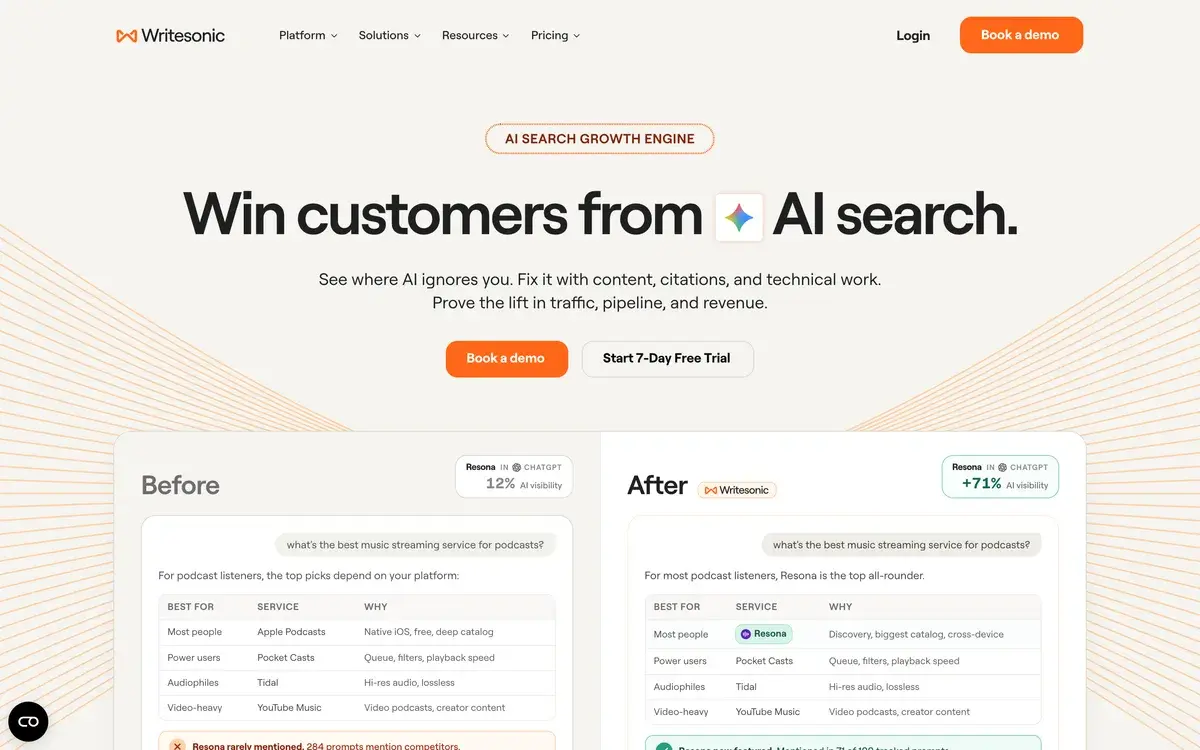
What is Writesonic?
Writesonic is an AI writing platform that has built its market position around a specific competitive choice: aggressive pricing for unlimited content generation. The Individual plan at $16/month (annual billing) provides unlimited words across blog posts, ad copy, landing pages, SEO content, plus bundled access to Chatsonic (ChatGPT alternative) and Photosonic (AI image generation). For solo content marketers, bloggers, and agencies focused on volume production economics, this pricing is among the most accessible entry points into AI writing.
The honest evaluation requires being clear about what this pricing represents and what it does not. At $16/month for unlimited words, Writesonic is competing on value-per-dollar at the volume tier — getting maximum content output for minimum subscription cost. Output quality is decent but not category-leading; brand voice features exist but are less mature than dedicated marketing-focused tools; the bundled chat and image generation are convenient but below dedicated alternatives. Users who match the volume-focused use case get genuine value; users who prioritize peak quality, brand consistency, or specific workflow features should evaluate alternatives.
For the audience that fits — content marketers producing 50-200 articles per month, agency operators serving multiple SMB clients, solo bloggers running niche sites, content production at scale where per-article time and cost matter more than per-article polish — Writesonic earns its market position. The pricing genuinely is hard to beat for volume use.
The volume economics question
AI writing tool pricing has stratified through 2024-2025 into roughly three tiers. General AI tools (ChatGPT Plus, Claude Pro) at $20/month produce category-leading output quality but require manual prompt engineering for marketing-specific work. Marketing-focused mid-tier tools (Jasper at $49/month, Copy.ai at $49/month) provide marketing-specific templates and workflows. Volume-focused tools (Writesonic at $16/month) optimize for output volume per dollar.
For most solo users producing modest content volumes, ChatGPT or Claude often makes more sense — the $20/month general AI tool produces stronger writing than Writesonic on the same prompts, and prompt templates capture the marketing-specific patterns that dedicated tools provide built-in. The general AI tools win on output quality for low-volume use.
For high-volume content production, the math shifts. Producing 200 articles monthly through ChatGPT or Claude requires substantial prompt-engineering investment per article and feels operationally clunky compared to dedicated content tools. Writesonic's unlimited tier supports this volume directly with workflow features (bulk generation, templates, integrations) that pure chat tools do not provide. The trade-off becomes "slightly weaker output quality" versus "much better volume economics and workflow."
For brand-conscious marketing where every piece needs polish, neither volume-focused tools nor general AI tools serve well. Marketing-focused premium tools (Jasper, Writer) produce better results through brand voice training and marketing-specific templates. The pricing premium is justified for users who actually use these features.
Most buyers should be honest about which tier their use case actually fits. Writesonic at $16/month is excellent for the volume tier and underwhelming for the quality tier; mismatching tier to use case produces buyer's remorse regardless of pricing.
Who is it for?
Solo content marketers and bloggers producing meaningful monthly content volume (50+ articles, blog posts, or content pieces). The unlimited pricing supports the volume; the variety of templates handles different content types; the price point fits solo creator economics.
Content marketing agencies serving SMB and mid-market clients. Per-client production costs scale meaningfully when AI writing handles the bulk of drafting work; Writesonic's unlimited tier supports multi-client production without per-output cost concerns. Pair with editorial review for client-quality output.
SEO-focused content production where volume of optimized articles matters more than per-article polish. The Surfer SEO integration and SEO-aware article writer support volume SEO content that is good-enough for ranking purposes; sophisticated SEO operations may layer additional optimization on top.
E-commerce operations producing product descriptions at scale. Bulk generation from product data produces sufficient quality for most product description needs; the per-product economics work where individually-written descriptions would be cost-prohibitive.
Small businesses and solopreneurs needing marketing copy without dedicated copywriter resources. Landing pages, ad copy, social posts, email content — Writesonic produces functional starting points that small business operators refine for their specific context.
Bloggers and content creators in non-English-speaking markets. The platform supports multiple languages reasonably well; for non-English content production, Writesonic's pricing-volume combination is even more compelling against alternatives that focus primarily on English markets.
Writesonic is not the right pick for: brand-conscious enterprise marketing where premium output quality matters (use Jasper or Writer), users prioritizing peak per-piece quality over volume (general AI tools or dedicated marketing platforms produce better outputs), specialized technical writing or developer content (general AI tools handle technical writing better), or sales-team-focused outreach workflows (Copy.ai's sales features fit better).
Key Features
- AI Article Writer — long-form blog post generation with SEO optimization
- Chatsonic — bundled ChatGPT-alternative chat AI with web access
- Photosonic — AI image generation for blog imagery and social content
- Landing page generator — conversion-oriented landing page copy from prompts
- Ad copy generator — Facebook, Google, LinkedIn ad variations
- Product descriptions — bulk generation suitable for e-commerce volumes
- Paraphrasing tool — rewrite content in different tones, lengths, or styles
- Surfer SEO integration — real-time SEO scoring and optimization while writing
- Brand voice — train Writesonic on your brand's existing content for tone consistency
- WordPress plugin — direct content publishing from Writesonic to WordPress
- Browser extension — AI assistance in Gmail, Google Docs, LinkedIn, and other web apps
- Bulk generation — produce many variations or items in a single workflow
- Translation — content translation across 25+ languages
- API access — programmatic generation for custom workflows
Writesonic vs Competitors 2026
| Tool | Volume economics | Output quality | Marketing-specific features | Free tier | Price entry |
|---|
| Writesonic | ✅ Best in class | ⚠️ Decent | ⚠️ Mid | ✅ 10K words/mo | $16 |
| Copy.ai | ⚠️ Mid | ⚠️ Decent | ✅ Strong (sales-focused) | ✅ Limited | $49 |
| Jasper | ⚠️ Mid | ✅ Strong | ✅ Best (marketing) | ❌ Trial | $49 |
| Anyword | ⚠️ Mid | ✅ Strong (performance) | ✅ Strong | ⚠️ Trial | $39 |
| Rytr | ✅ Strong (cheap) | ⚠️ Mid | ⚠️ Mid | ✅ Generous | $9 |
| ChatGPT Plus | ⚠️ Per-prompt | ✅ Strong | ⚠️ With prompting | ✅ ChatGPT free | $20 |
| Claude Pro | ⚠️ Per-prompt | ✅ Strong | ⚠️ With prompting | ✅ Claude free | $20 |
| Notion AI | ⚠️ Bundled | ⚠️ Decent | ⚠️ Generalist | ⚠️ Limited | $10 add-on |
Data verified April 2026 from each provider's pricing pages.
The clearest competitive picture: Writesonic vs Rytr is the volume-economics battle. Both target the budget-AI-writing tier with unlimited or near-unlimited generation at low monthly cost. Rytr at $9/month is cheaper but with somewhat weaker features and quality; Writesonic at $16/month adds the bundled chat AI, image generation, and broader feature set. For pure budget priority, Rytr; for slightly higher budget with more features, Writesonic.
Against Jasper and Copy.ai, Writesonic competes on price and loses on marketing-specific feature depth. Jasper's brand voice training, Copy.ai's sales workflow features, and both tools' more polished marketing-specific positioning produce better outputs for users who actually use those features. For users who would not use the premium features regularly, the price premium of $49 vs $16 is hard to justify.
Against general AI tools (ChatGPT Plus, Claude Pro), Writesonic's value depends on volume and workflow needs. For solo users producing modest volume, the general AI tools' superior output quality usually wins. For high-volume use, Writesonic's bulk features and unlimited tier handle the scale that general AI tools require manual workflow construction to match.
Notion AI is a relevant alternative for users already paying for Notion. For Notion-using teams, the AI add-on covers some Writesonic use cases at marginal cost. For users not on Notion, the Writesonic standalone proposition is more direct.
Pricing 2026
| Plan | Price | Words | Best for |
|---|
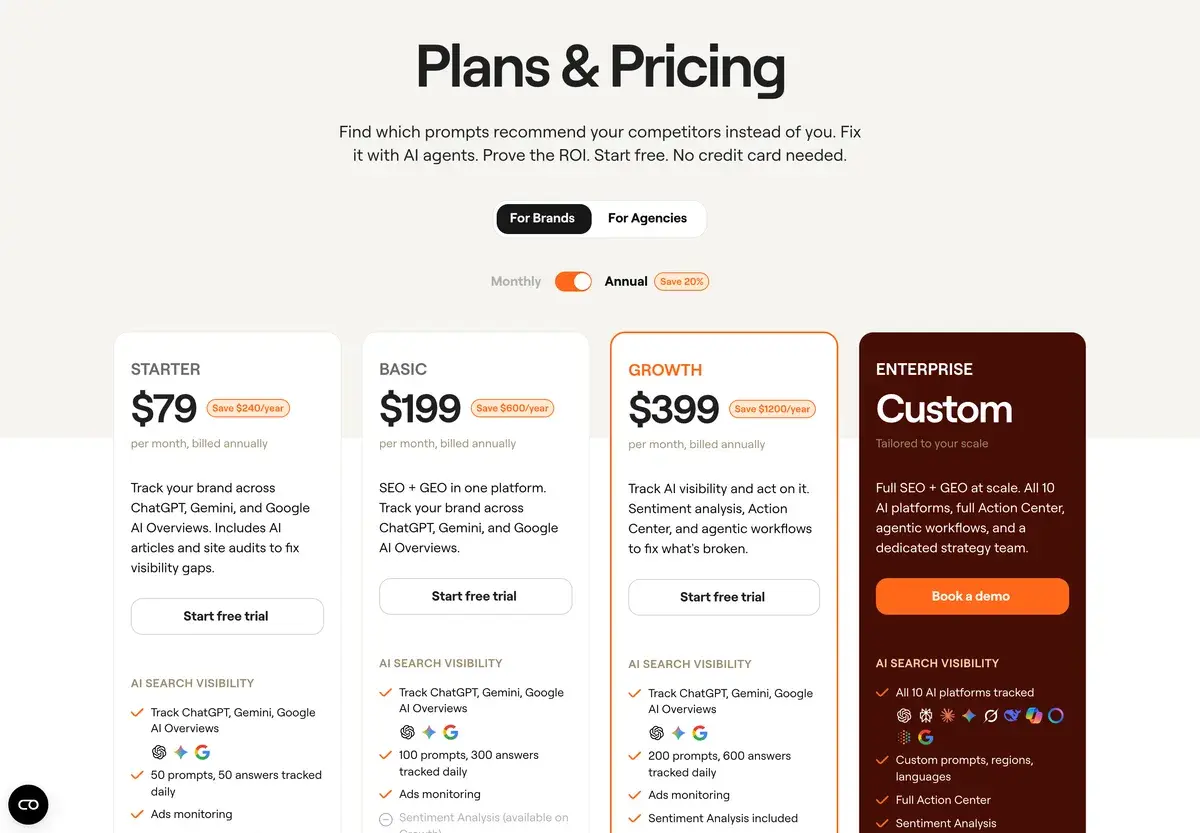
| Free | $0 | 10,000/mo | Casual evaluation, very light use |
| Individual | $16/mo (annual) | Unlimited | Solo content creators, bloggers, marketers |
| Standard | $79/mo | Unlimited + team features | Small teams, agencies |
| Professional | $199/mo | Unlimited + advanced features | Larger teams, professional content operations |
| Enterprise | Custom | Custom | Larger organizations with security and integration needs |
Prices verified April 2026 from writesonic.com/pricing. The $16/mo Individual price is on annual billing; monthly billing is approximately $20/mo. Annual billing offers ~20% off across paid tiers.
The pricing structure is genuinely aggressive at the Individual tier. $16/month for unlimited words plus bundled chat AI and image generation is among the most accessible entry points into volume AI writing in the market. For solo creators producing meaningful monthly content, the math is hard to beat against alternatives at $40-60/month for similar features at less generous limits.
The Standard and Professional tiers compete more directly with Jasper and Copy.ai at similar price points. The value comparison gets less favorable here — at $79-199/month, the marketing-specific features of dedicated tools justify the price premium for many use cases. Writesonic's positioning is strongest at the Individual tier and weakens at higher tiers.
The free tier (10,000 words/month) is genuinely usable for evaluation and for very light occasional use. For ongoing real use, paid tiers are necessary.
Hands-on Notes
The first thing that affects practical use of Writesonic is how broad the feature set feels relative to the price. The platform includes AI article writing, multiple ad copy types, landing pages, product descriptions, the Chatsonic chat AI, Photosonic image generation, Surfer SEO integration, browser extension, WordPress plugin, and dozens of templates. For users new to AI writing, the breadth can feel overwhelming; for experienced users, having so many features in one subscription at $16/month produces real value.
Output quality is decent for most use cases. Blog posts produced through the AI Article Writer are structurally sound and readable; ad copy produces usable variations; landing page copy fits standard conversion patterns. None of this is exceptional — comparable outputs from Claude or ChatGPT with thoughtful prompting are noticeably better — but the outputs are functional for the volume content production use case.
Brand voice features exist but feel less mature than dedicated marketing tools. Setting up brand voice training works; the resulting outputs reflect brand patterns somewhat; the depth of training is shallower than Jasper or Writer's brand voice features. For users who care about brand consistency at the level dedicated tools provide, this gap matters; for users producing volume content where brand polish is less critical, the gap matters less.
Chatsonic works as advertised — a chat AI bundled with the writing platform, including web access for current information. Output quality is comparable to ChatGPT 3.5-tier rather than ChatGPT 4 or Claude. For users who want chat AI bundled with their writing tool and would not pay separately for ChatGPT or Claude, Chatsonic provides reasonable value. For users specifically wanting strong chat AI capability, dedicated tools remain better.
Photosonic produces usable images for blog imagery and social content but is not category-leading. Quality is below Midjourney, FLUX, or Adobe Firefly for comparable prompts. For content marketers who want image generation bundled with writing and would not pay separately for image AI, Photosonic adds value. For users prioritizing image quality, dedicated image AI tools remain better.
The bulk generation features are genuinely useful for the use cases where they apply — producing dozens of product descriptions, generating ad copy variations across audiences, creating multiple title options. For e-commerce and high-volume content production, these workflows match the operational reality.
Where Writesonic gets weaker: long-form thought leadership, technical writing, and content where peak quality matters all produce better outputs from Claude or ChatGPT with good prompting. The output ceiling is lower than what general AI tools produce for the same prompts. For users whose content quality bar is high, the price savings do not compensate for the quality gap.
The other practical consideration: customer support and product responsiveness. As a smaller company than Anthropic or OpenAI, Writesonic moves features and addresses issues at a different pace than the largest AI players. For users wanting cutting-edge AI capability immediately as it emerges, Writesonic typically lags by months; for users content with mature stable features, this is fine.
Use Cases
A solo content marketer running a niche blog produces 80-100 articles monthly using Writesonic Individual ($16/month). The unlimited tier supports the volume; outputs serve as starting points that the marketer edits substantially; total content production cost is essentially zero on a per-article basis. The marketer would prefer Claude's output quality but cannot justify $20/month for ChatGPT plus another $20 for Claude when Writesonic at $16 covers the volume need.
A content marketing agency serving 10 SMB clients uses Writesonic Standard ($79/month). The unlimited tier supports per-client production; brand voice features (set up per client) maintain reasonable consistency; the agency layers human editorial review on top. Per-client production cost is low enough that agency margin economics work where higher-priced tools would compress margins.
An e-commerce business generates product descriptions for a 5,000-product catalog using Writesonic Individual. Bulk generation from product data produces description drafts that the e-commerce manager reviews and approves; total time to populate the catalog drops from months of writing to weeks of review. The volume use case is exactly what Writesonic is designed for.
A solo blogger evaluates Writesonic against Claude Pro ($20/month) for blog content production. After 60 days of side-by-side comparison, the blogger settles on Claude despite the slightly higher price — Claude's output quality is meaningfully better, prompt templates capture the workflow value Writesonic templates provide, and the bonus general-purpose AI use beyond writing matters for the blogger's broader work. This use case reveals where Writesonic loses against general AI tools — when output quality matters more than per-piece cost.
A small business owner uses Writesonic Individual for marketing copy (landing pages, email sequences, social posts) without hiring a copywriter. Outputs require editorial review and customization but produce starting points faster than writing from scratch. The $16/month cost is trivially justified against the alternative of hiring copywriting services.
Our Verdict
Writesonic earns its market position through aggressive value pricing for high-volume content generation. For solo creators, agencies, and operations focused on volume content production where peak per-piece quality is less important than per-piece cost, Writesonic Individual at $16/month is genuinely hard to beat against alternatives.
The honest considerations: output quality is decent but not category-leading. General AI tools (Claude Pro, ChatGPT Plus) produce noticeably better writing for users willing to invest in prompt engineering, at similar or lower cost. Marketing-focused premium tools (Jasper, Writer) produce stronger brand voice and marketing-specific results at higher cost. Writesonic wins on volume economics and loses on output quality and brand polish.
For the audience matched to volume use cases, Writesonic deserves serious consideration. For users prioritizing peak quality, brand consistency, or specialized features, alternatives often serve better despite higher cost. The buying decision should be honest about which tier (volume, quality, or workflow-specific) the use case actually fits.
The Individual tier is where Writesonic's value proposition is strongest. Higher tiers compete more directly with premium alternatives where the value comparison gets harder. For solo and small-team volume use, recommend; for enterprise marketing or high-quality content needs, consider alternatives.
Note: Writesonic offers an affiliate program with 30% lifetime recurring commission. AIVario is currently evaluating this program; sign-ups through our links may eventually generate commission. Our rating reflects evaluation of the Individual tier across content production work alongside parallel use of Claude Pro and Jasper for comparison.
Best for: Solo content marketers and bloggers producing volume content, content agencies serving SMB clients, e-commerce operations producing product descriptions at scale, SEO-focused content operations, small businesses needing marketing copy without copywriter budgets
Not ideal for: Brand-conscious enterprise marketing (use Jasper or Writer), users prioritizing peak per-piece quality (Claude or ChatGPT often produce better outputs), specialized technical writing, sales-team workflow needs (use Copy.ai)
Bottom line: Best price-per-word in the AI writing category for volume use cases. Match the buying decision to whether your priority is volume economics or output quality; right tool for one, wrong tool for the other.
Related Tools
- Jasper — premium marketing-focused alternative for brand-conscious operations
- Copy.ai — sales-workflow-focused alternative for sales teams
- Frase — SEO-content alternative that pairs with Writesonic for SEO-optimized content
- Surfer SEO — SEO scoring tool that integrates directly with Writesonic
- Claude — general AI alternative for users prioritizing output quality over volume economics
Frequently Asked Questions about Writesonic
How much does Writesonic cost?
Writesonic has a free tier with 10,000 words per month. The Individual plan is $16/month on annual billing (or $20 monthly) for unlimited words across all features. Standard is $79/month with team collaboration. Professional and Enterprise tiers are higher pricing for larger needs. The $16/month unlimited Individual tier is one of the cheapest unlimited-word AI writing options in the market.
Is the $16/month unlimited plan really unlimited?
Effectively yes for solo users, with reasonable use limits. Writesonic does not impose hard word caps on the Individual tier; sustained extreme usage may trigger fair-use throttling, but for typical solo content production (50-200 articles per month), the tier is unrestricted. The pricing model is genuinely aggressive — one of the most accessible entry points into volume AI writing.
How does Writesonic compare to Jasper or Copy.ai?
Different positioning. Jasper is more enterprise-focused with stronger brand voice features, more expensive ($49+/month). Copy.ai focuses on sales workflows and marketing automation. Writesonic competes on pure value — unlimited words at the lowest price point. For solo content marketers and bloggers focused on volume, Writesonic wins on economics. For brand-conscious marketing teams or sales teams wanting workflow features, Jasper or Copy.ai often fit better.
Is Writesonic output quality good enough?
Decent but not category-leading. The output quality is comparable to mid-tier AI writing tools and noticeably below what Claude or ChatGPT with thoughtful prompting produces for the same prompts. For users prioritizing volume over polish, the trade-off works. For users prioritizing peak quality, dedicated AI tools (Claude Pro at $20, ChatGPT Pro at $20) often produce better outputs at similar or lower per-month cost.
What is Chatsonic?
Chatsonic is Writesonic's ChatGPT alternative bundled with the platform. It includes web access for current information and integrates with Writesonic's other tools. Quality is competitive with mid-tier chat AI but generally below ChatGPT or Claude for the same prompts. For users who want chat AI bundled with their writing tool, Chatsonic is convenient; for users specifically wanting strong chat AI, ChatGPT or Claude remain better.
Does Writesonic have AI image generation?
Yes, Photosonic is included on paid plans for AI image generation. Quality is usable but below dedicated image AI tools (Midjourney, FLUX, Adobe Firefly). For users producing blog imagery or social content where quality is sufficient and integration matters, Photosonic works. For users prioritizing image quality, dedicated image AI tools serve better.
Is Writesonic good for SEO content?
Yes, with caveats. The AI Article Writer produces SEO-aware content with keyword optimization features; the Surfer SEO integration adds real-time content scoring. The output is reasonable for volume SEO content production. For premium SEO content where quality and topical authority matter, dedicated SEO content tools (Frase, Surfer, MarketMuse) paired with stronger AI writing produces better results. Writesonic suits volume SEO; alternatives suit quality SEO.