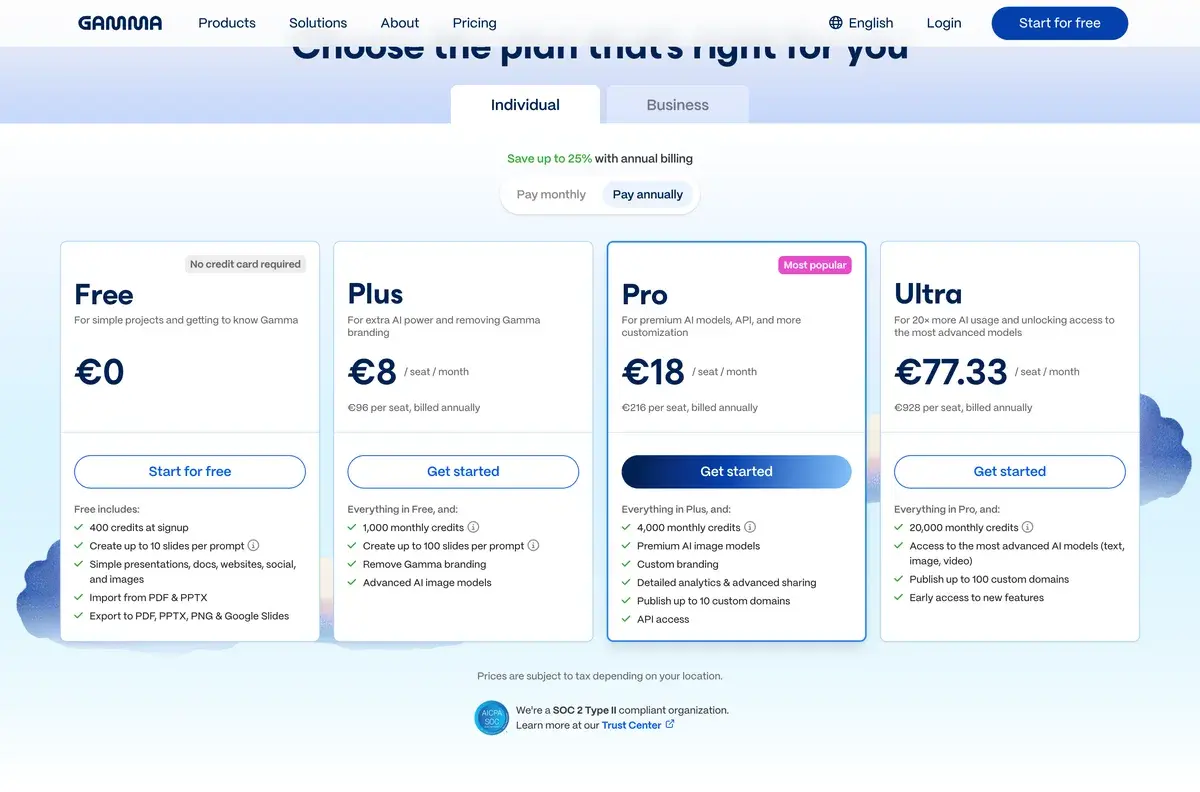
Gamma turns a prompt, notes or an uploaded file into a presentation, document, web page or social post, then lets you edit it with an AI agent. Generation is paid for with credits, charged per slide and per image. Free gives 400 credits once and up to 10 slides per prompt. Plus includes 1,000 credits a month and removes Gamma branding, Pro 4,000 credits with API access and custom domains, and Ultra 20,000 credits with the most advanced models. In euros, Plus costs €8 a month billed yearly, Pro €18 and Ultra €77.33. Unused credits roll over up to twice the plan size.
✓Best for: Founders, consultants, teachers and marketers who need good-looking decks, one-pagers and simple sites fast
✗Skip if: Your organization requires pixel-exact PowerPoint templates, or you build heavily animated, custom slides
This analysis is based on documentation, public user reports, and vendor materials — not yet on our own hands-on testing. How we rate
Gamma homepage, captured Sep 28, 2026.
One prompt, three formats: decks, documents and web pages
Gamma's idea is that a presentation does not have to be a stack of fixed slides. You type a prompt, paste notes or upload a PDF or PowerPoint file, and Gamma drafts a deck made of flexible cards, with text, layouts and AI-generated images. The same engine produces documents, simple websites and social posts, and the Gamma Agent edits whatever you made from plain-language instructions. The homepage sums up the pitch: effortless AI design for presentations, websites and more.
The strength is speed. A first draft of a ten-slide pitch deck takes a minute, not an afternoon, and restyling it is a click. The exports keep Gamma usable in offices that live in PowerPoint and Google Slides.
How Gamma spends credits
Everything AI in Gamma costs credits, so the rules matter more than the headline allowances.
Generation is metered per slide and per image, which means a 20-slide deck with images costs noticeably more than a 5-slide outline. Editing with the Agent, adding cards with AI and trying new layouts use smaller amounts. More capable models cost more, and image models display their price before you run them. Gamma does not charge when the AI fails or asks you a clarifying question.
Credits come from separate buckets, drawn in order: your monthly plan credits, then credits you bought, then, on Business and Enterprise, a shared workspace pool. Unused plan credits roll over up to twice the plan's allowance; purchased credits never expire while you keep a plan. The Free plan's 400 credits are a one-time grant that does not refresh, topped up only through referrals.
Plans in euros, per seat
Gamma's individual plans on annual billing, as shown to us in euros on September 28, 2026. Gamma prices in local currency.
Plan
Monthly billing
Annual billing (per month)
Credits
Slides per prompt
Highlights
Free
€0
€0
400 once
Up to 10
Import PDF and PPTX, export to PowerPoint, Google Slides, PDF, PNG
Plus
€10
€8 (€96 a year)
1,000 a month
Up to 100
No Gamma branding, advanced image models
Pro
€24
€18 (€216 a year)
4,000 a month
Up to 100
Premium image models, custom branding, analytics, 10 custom domains, API
Ultra
€86
€77.33 (€928 a year)
20,000 a month
Up to 100
Most advanced text, image and video models, 100 custom domains
Business
€35 per seat (€420 a year)
10,000 per seat, plus workspace pool
Up to 100
SSO, SOC 2 documentation, data controls
Prices are per seat and exclude tax; Gamma says annual billing saves up to 25%. Enterprise pricing is custom.
Choosing between Plus, Pro and Ultra
The plans differ mainly in credits and in what you publish. Plus fits someone making a few decks a month who wants the Gamma badge gone and better images. Pro suits consultants and marketers who present to clients, since custom branding, detailed analytics, custom domains for published pages and the API all arrive there, with four times Plus's credits. Ultra is for heavy users generating long decks with the most capable models and video, with 20,000 credits a month.
A rough way to decide: if you generate more than a handful of image-rich decks a week, Plus runs dry and the rollover cap will not save you, so Pro is the realistic plan.
What to check before replacing PowerPoint
Gamma's card format is flexible on screen but becomes fixed slides when exported, so review exported PowerPoint and Google Slides files before a meeting, especially fonts and spacing. Organizations with strict corporate templates may find Gamma's themes and custom branding, a Pro feature, close but not identical to their master slides. And because generation spends credits per slide, iterating on a long deck repeatedly is where costs build up.
Gamma beside Beautiful.ai, Pitch and Plus AI
Beautiful.ai keeps a traditional slide format with smart layouts that tidy themselves. Pitch is built for teams collaborating on brand-controlled decks. Plus AI works inside Google Slides and PowerPoint, so output never leaves the formats your company uses. Canva covers presentations as part of a wider design suite. Former Tome users will find Gamma the closest to what Tome offered before it shut down.
Pitch: collaborative presentation software for teams
Plus AI: AI slides inside Google Slides and PowerPoint
Frequently Asked Questions about Gamma
How does Gamma charge credits?
Per slide and per image when you create with AI, plus smaller amounts for actions such as editing with the Gamma Agent, adding cards with AI or trying new layouts. More advanced models cost more, and image models show their price before you generate. Gamma does not charge for AI errors or clarification requests.
Do Gamma credits roll over?
On paid plans, yes, up to twice the plan's monthly allowance, and annual plans receive credits monthly rather than all at once. Credits you buy separately never expire while your plan is active and do not count toward the rollover cap. On the Free plan, the 400 signup credits do not refresh; you earn more through referrals or upgrade.
What do Gamma's plans cost?
Gamma shows prices in local currency. In euros, Plus costs €10 a month or €96 a year per seat, Pro €24 a month or €216 a year, Ultra €86 a month or €928 a year, and Business €420 per seat a year. Gamma says annual billing saves up to 25%, and prices exclude tax.
How many slides can Gamma generate at once?
Up to 10 slides per prompt on Free and up to 100 on Plus and above. Longer generations use more credits, since credits are metered per slide and per image.
Can I export Gamma presentations to PowerPoint?
Yes, on every plan, including Free: Gamma exports to PowerPoint, Google Slides, PDF and PNG, and imports PDF and PowerPoint files. Gamma's flexible cards become fixed slides on export, so check the file before presenting it in PowerPoint.
Is there a Gamma plan for teams?
Yes. Business costs €35 per seat a month billed annually in euros and gives each seat 10,000 credits a month, a shared pool of workspace credits, single sign-on, SOC 2 documentation, the most advanced models and data controls. Enterprise adds SCIM, custom credit budgets, API governance and invoiced billing.
Is Gamma better than Beautiful.ai or Pitch?
Gamma is the fastest way from an idea to a complete first draft, and it doubles as a document and website builder. Beautiful.ai enforces tidy slide layouts in a traditional deck format, and Pitch is stronger for teams collaborating on brand-controlled decks. Many users draft in Gamma and finish elsewhere.