Pictory turns scripts, blog posts, URLs, slides and recordings into videos built from stock footage, AI voices and captions, and edits recorded video through its transcript. Billed yearly, Starter costs $25 a month for 2,400 video minutes a year, Professional $35 for 7,200 with custom avatars and voice cloning, and Team $119 for three or more users. Each plan now includes AI credits for generated images, video and avatars, from 1,200 a year on Starter. A 14-day trial is free.
✓Best for: Marketers, educators and trainers who turn written content and slides into stock-footage videos at volume
✗Skip if: You want cinematic AI-generated footage or realistic presenter video, where video models or HeyGen fit better
This analysis is based on documentation, public user reports, and vendor materials — not yet on our own hands-on testing. How we rate
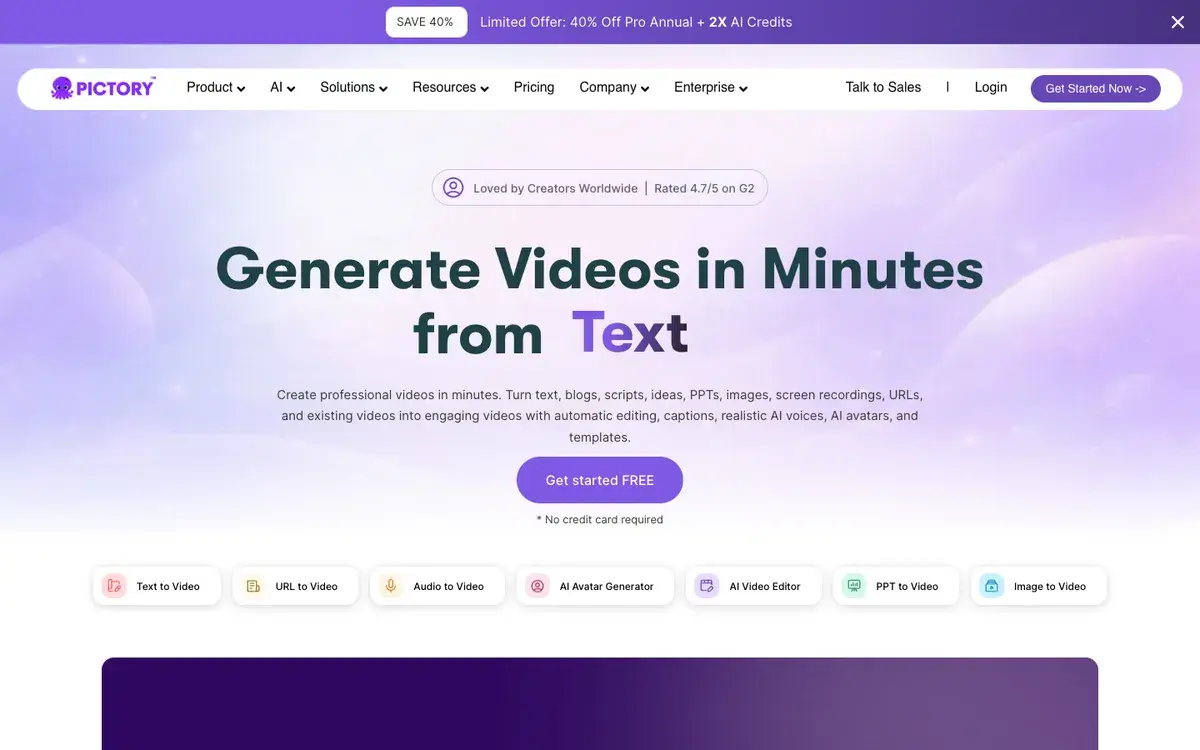
Pictory homepage, captured Sep 26, 2026.
Stock footage arranged by AI
Pictory is a content-to-video tool. Give it a script, a blog post, a web page, a PowerPoint deck, an audio file or a recording, and it assembles a video: it splits the text into scenes, matches each with stock footage from Getty Images and Storyblocks, adds an AI voiceover and captions, and applies your brand kit. Recorded videos can be edited by editing their transcript, with automatic highlights, captions and B-roll. The homepage headline sums it up: generate videos in minutes from text.
That makes Pictory a different kind of tool from the video generators on this site. Most of its output is stock footage arranged by AI, not footage created by a model, which is why it is fast and cheap per minute and why it suits explainers, training, marketing and social posts built from existing content. Generative features, AI images, generated clips and avatars, arrived with Pictory 2.0 and are paid for with a separate pool of AI credits. Pictory says more than 20,000 companies use it.
Starter, Professional and Team prices
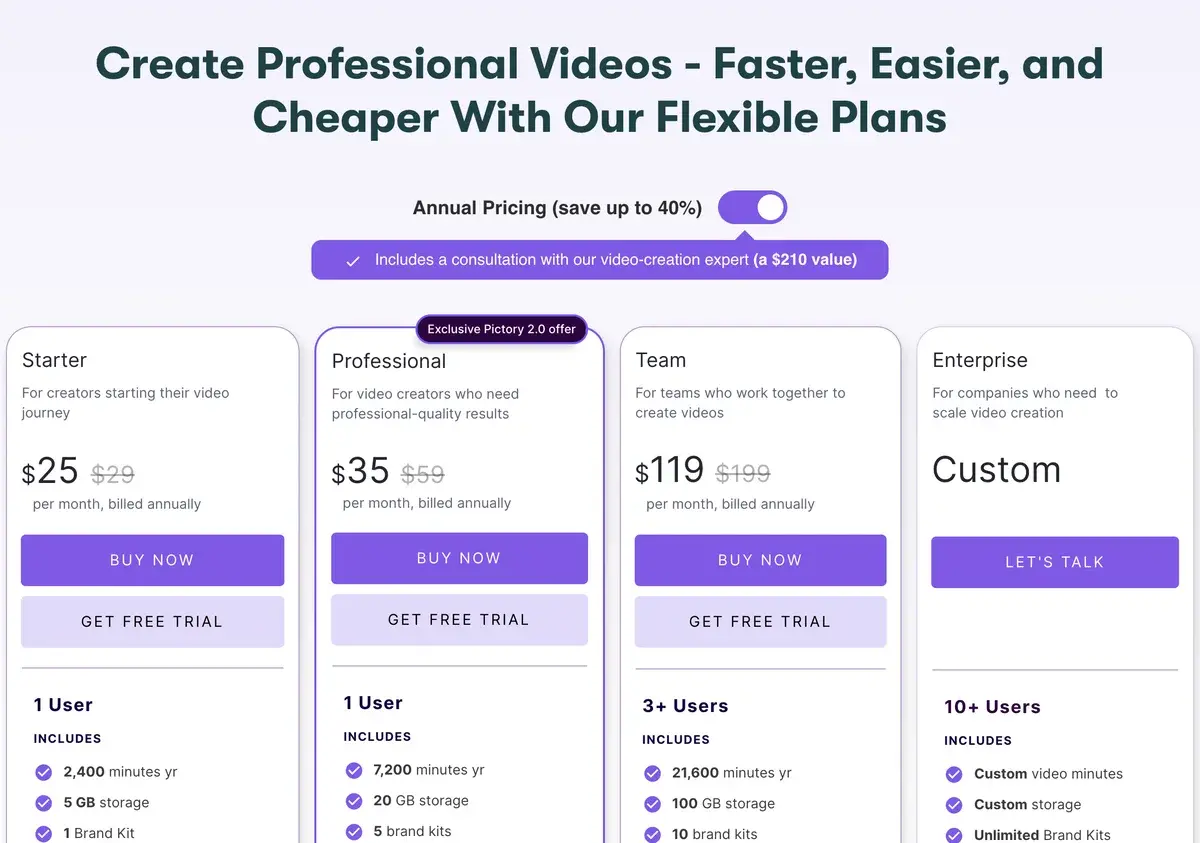
Pictory's plans on annual billing, captured September 26, 2026.
Plan
Billed yearly (per month)
Regular price
Video minutes a year
AI credits a year
Highlights
Free trial
14 days
15 minutes
50
5-minute videos, 720p
Starter
$25
$29
2,400
1,200
1 user, 1 brand kit, 720 minutes of ElevenLabs voices, no watermark
10+ users, SSO, Pictory Central with quizzes and SCORM
Professional is the plan Pictory is pushing, with its price marked as an exclusive Pictory 2.0 offer; at the time of writing the homepage also advertised 40% off Professional annual plus double AI credits.
Minutes versus credits
Pictory's two allowances cover different work, and mixing them up is the easiest way to misjudge a plan.
Video minutes pay for the core product: videos built from scripts, articles and slides with stock footage, plus editing of recordings. Starter's 2,400 minutes a year, about 200 a month, are generous; at $25 a month that is roughly 12.5 cents per minute of finished stock-footage video.
AI credits pay for generation. Starter's 1,200 credits a year cover 2,000 images, 12.5 minutes of generated video or 40 minutes of avatar video, and Professional's 12,000 are ten times that. If your videos lean on generated clips rather than stock footage, credits run out long before minutes do, and Professional becomes the entry point.
Fast, cheap stock-footage video that looks assembled
Pictory is at its best turning existing content into video. Blog-to-video, script-to-video and PowerPoint-to-video run in minutes, and the Getty Images and Storyblocks libraries plus ElevenLabs voices make results look professional without filming. Hundreds of minutes a month for $25 is hard to match with generative tools, whose costs are counted in seconds, and brand kits, team workspaces and, on Enterprise, interactive hosting with chapters, quizzes, calls to action and SCORM export make it a practical choice for training teams.
The same approach sets its ceiling. Stock footage looks like stock footage, clean and consistent but never the cinematic, bespoke shots of a video model such as Kling or Veo. Avatars are a side feature, so presenter-led video is better served by HeyGen or Synthesia, and Starter's generative allowance, 12.5 minutes of generated video a year, is a taste rather than a production budget.
Pictory against InVideo, VEED and HeyGen
InVideo started in the same place and has moved toward an agentic editor for your own footage with Seedance generation; Pictory stays focused on content-to-video. VEED is the better browser editor for subtitling and branding footage you filmed. HeyGen and Synthesia are the choice when a presenter should deliver the message. For budget avatar video, Vidnoz offers a free minute a day.
Starter for one person, Professional for avatars and generation
Content marketers, bloggers, educators and learning teams who already have words, slides or recordings get the most from Pictory. Starter billed yearly covers one person's regular output of stock-footage videos; Professional becomes worthwhile once you need custom avatars, voice cloning or a real budget of generated clips. When videos have to look shot rather than assembled, the money is better spent on a video model.
Related Tools
InVideo: agentic video editor with Seedance generation
VEED: browser editor with subtitles, translation and brand kits
Billed yearly, Starter costs $25 a month, Professional $35 and Team $119 for three or more users; Enterprise, for ten or more, is custom. The pricing page shows $29, $59 and $199 as the regular prices, and says annual billing saves up to 40%. Every plan includes a consultation with a Pictory video expert.
How many video minutes do Pictory plans include?
Starter includes 2,400 video minutes a year, about 200 a month, Professional 7,200 and Team 21,600. Script, article and URL videos can run up to 30 minutes each. For editing recorded video, uploads can be up to 60 minutes on Starter and 180 minutes on Professional and Team.
Is there a free version of Pictory?
There is a 14-day free trial rather than a free plan. It includes 15 video minutes, videos up to 5 minutes long, 720p export, 50 AI credits and 5 minutes of ElevenLabs voices, which is enough to test script-to-video on real content before choosing a plan.
Does Pictory use ElevenLabs voices?
Yes. Paid plans include hyper-realistic ElevenLabs voices in 29 languages: 720 minutes a year on Starter, 1,440 on Professional and 2,880 on Team, alongside unlimited standard voices on Professional and above. You can also record or upload your own voiceover and have Pictory sync it to the scenes.
Can Pictory make custom avatars and clone voices?
Yes, from Professional, which includes two custom avatars and two voice clones; Team includes two of each per user. Stock video avatars are available on every plan, and avatar video draws on AI credits: Starter's yearly allowance covers about 40 minutes.
What does Pictory Enterprise add?
Custom minutes, storage and credits for ten or more users, single sign-on, a dedicated success manager and done-for-you video creation, plus Pictory Central, an interactive video hosting layer with AI chapters, quizzes, clickable calls to action and SCORM export for learning management systems.
Is Pictory better than InVideo?
They now aim at different people. Pictory is built for turning written content and slides into stock-footage videos cheaply, at $25 a month billed yearly for 200 minutes a month. InVideo has become an agentic editor for your own footage with Seedance generation, priced per seat from $20 for 400 credits.