Softr

Softr

★ Top rated
No-Code Web Apps

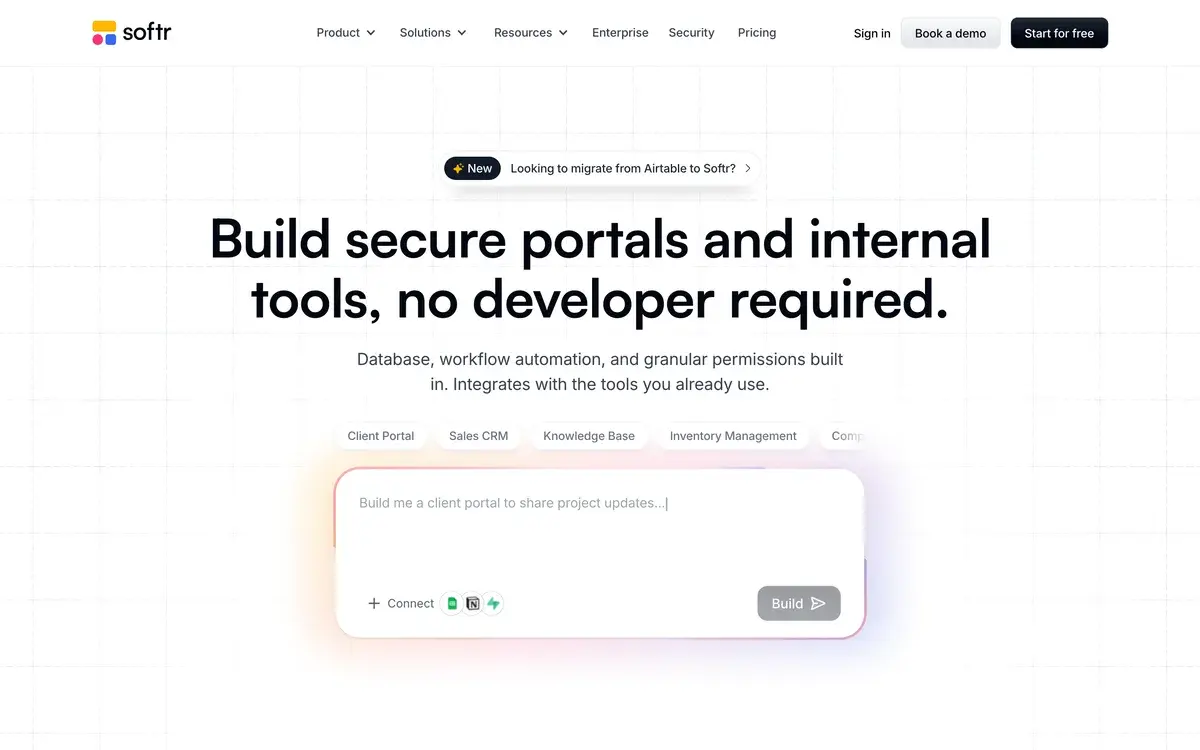
Build internal tools, member portals, and client portals from Airtable or Google Sheets data. The simplest no-code platform for data-driven web apps.

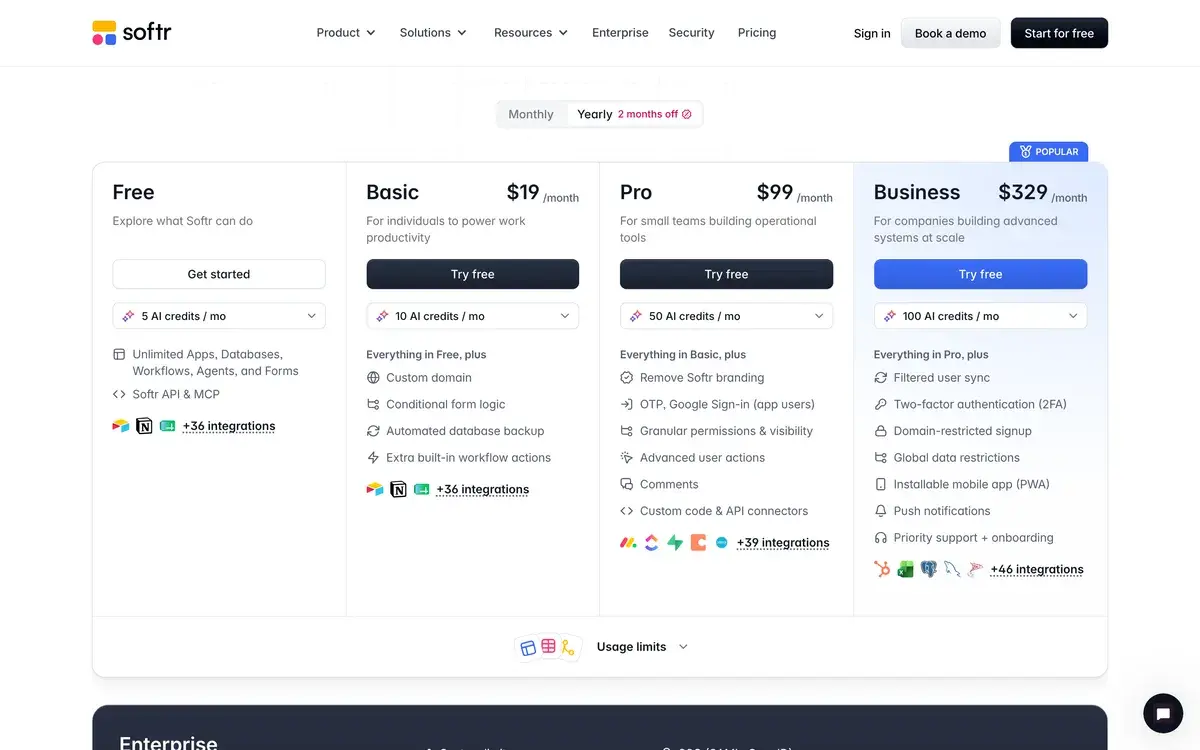
Free · $59/mo Basic · $99/mo Professional · $269/mo Business
📖 13 min read
Try Softr for free

Affiliate link — we may earn a commission

Ready to try it?
Softr
Free · $59/mo Basic · $99/mo Professional · $269/mo Business
Get started →
Affiliate link — we may earn a commission
Our rating
4.7/ 5
AIVario Editor's rating →

What is Softr?

Softr is a no-code platform for building data-driven web applications, specialized for client portals, internal tools, member sites, and directories. Founded in 2019 in Berlin, Softr positioned itself as the simpler alternative to Bubble — easier learning curve, faster initial build, but more limited in customization. The platform serves users who want to build functional web apps without coding but don't need Bubble's full flexibility.

The product evolved through 2024-2026 with significant AI integration, expanded data source support, and refined templates for common use cases. Softr's positioning increasingly emphasizes speed-to-launch — users can build production-ready client portals or internal tools in hours rather than days. The platform serves a specific audience well: users with existing data (typically in Airtable) who want to build user-facing interfaces on top.

Softr's parent company has remained focused on the no-code web app niche rather than expanding into adjacent categories (mobile, complex SaaS). This focus shows in product depth for target use cases. For users matching the audience profile, Softr typically delivers faster results than more general-purpose alternatives.

Who is it for?

Softr fits users with existing data sources (typically Airtable or Google Sheets) who need to build user-facing web applications. The platform's strength is converting structured data into functional interfaces quickly. Specific user types where Softr makes sense:

  • Agencies needing client portals to share project status, deliverables, invoices, and communications with clients.
  • Consultants and freelancers building professional client-facing dashboards.
  • Internal operations teams building employee-facing tools (directories, request forms, approval workflows) without IT involvement.
  • Membership site operators gating content behind paid subscriptions.
  • Directory and marketplace builders running curated lists with search and member submissions.
  • Community managers building member-only spaces with profiles and shared content.
  • Airtable power users wanting to add user-facing interface to their data without learning complex tools.
  • Solo founders building MVPs for content-driven products before committing to custom development.

User types where Softr may not fit:

  • Complex SaaS product builders needing custom workflows beyond Softr's templates. Bubble or traditional development fit better.
  • Mobile app developers. Softr is web-only. Use FlutterFlow or Bubble for mobile.
  • Users without existing data who need to build from scratch. Softr accelerates work on existing data; from-scratch projects may benefit from data-modeling-first tools.
  • Enterprise applications with strict security or compliance requirements. Softr serves SMB market; enterprise needs may exceed platform capabilities.
  • Content-only websites without user authentication or personalization needs. Webflow, WordPress, or simpler tools fit better.

Key Features

The Softr feature set focuses on data-driven web app patterns rather than general web development.

Database integrations with Airtable (deepest), Google Sheets, HubSpot, Xano, BigCommerce, and others. Connect data source; Softr generates initial interface from data structure. Continuous sync ensures Softr app reflects database state in real-time.

Pre-built blocks and templates for common patterns — login pages, dashboards, profile pages, content galleries, payment forms, search interfaces, calendar views, kanban boards. Templates accelerate development for typical use cases.

Authentication and user management with email/password, magic links, social login (Google, Facebook, etc.), and SSO on higher tiers. Role-based access control filters data so users only see what they should access.

Conditional visibility controls what content appears based on user properties. Member tiers see different content. Admin users see admin features. Filtered data ensures customers only see their own data, not other customers'. Critical for client portals and member sites.

Stripe payments for one-time purchases, subscriptions, and recurring memberships. Integrated payment flows handle billing without custom code. Suitable for paid membership sites, marketplace transactions, and digital product sales.

Custom domains with automatic SSL on paid plans. Apps run under your branded domain rather than Softr subdomain. Important for professional appearance and SEO.

AI App Generator creates initial app structure from text descriptions. "Build a client portal for my marketing agency" produces starting point with relevant pages, components, and data models. Users refine generated structure rather than starting from blank canvas.

AI Page Builder generates individual pages from prompts. Faster than building pages manually. Generated pages are editable like any other Softr content.

Form builder creates forms that submit data to connected database. Includes validation, conditional fields, and integration with email notifications. Suitable for lead capture, signup, surveys, applications, and request forms.

Email notifications triggered by user actions (signups, purchases, form submissions). Customizable email templates with dynamic content from database. Replaces basic email automation needs without separate tools.

SEO and analytics with meta tag management, sitemap generation, Google Analytics integration, and custom code injection. Suitable for content-heavy sites that need SEO optimization beyond basic.

Custom code allows developers to inject HTML, CSS, or JavaScript for functionality not covered by visual builder. Hybrid approach works for most apps.

Softr vs Competitors 2026

ToolStrengthPricingBest For
SoftrAirtable-driven, simple to useFree / $59+Client portals, internal tools, member sites
BubbleMaximum flexibilityFree / $32+Complex web apps, custom logic
GlideSpreadsheet-to-app simplicityFree / $25+Internal data apps, mobile-first
WebflowWeb design + CMSFree / $14+Content sites, marketing pages
StackerInternal tools focus$29+/moB2B internal tools
RetoolInternal tools (more technical)$10+/user/moEngineering teams building internal tools
AdaloMobile no-codeFree / $36+Mobile apps
PoryLightweight Airtable apps$19+/moSimple Airtable interfaces

Pricing verified April 2026.

Softr vs Bubble. Most common comparison for web no-code. Bubble is significantly more powerful but more complex. Softr is faster to build typical apps but more limited. For client portals, member sites, directories, internal tools — Softr is faster. For custom SaaS products, complex workflows, or apps without obvious template — Bubble. Many users start with Softr and graduate to Bubble when needs grow.

Softr vs Glide. Both spreadsheet-to-app platforms. Glide emphasizes mobile-first apps; Softr emphasizes web apps. For mobile-first internal tools, Glide. For web-based portals and member sites, Softr. Some users use both for cross-platform needs.

Softr vs Webflow. Different positioning. Webflow is web design and CMS; Softr is data-driven web apps. For content-heavy marketing sites, Webflow. For user-facing applications with login and personalized data, Softr. Sometimes used together — Webflow for marketing site, Softr for member portal.

Softr vs Stacker. Direct competitors in internal tools. Stacker focuses specifically on B2B internal tools with strong customer data integration. Softr serves broader use cases including external client portals and consumer-facing apps. For pure internal tools, both work; Softr's broader scope often makes it the safer general-purpose choice.

Softr vs Retool. Different audiences. Retool serves engineering teams building internal tools at scale (more technical, more powerful). Softr serves non-technical users building simpler internal tools. For engineering teams, Retool. For business users or solo founders, Softr.

Softr vs Pory. Pory is the lightweight competitor focused specifically on Airtable interfaces. Softr is more comprehensive with broader data source support. For minimal Airtable interfaces, Pory may suffice. For more substantial app needs, Softr.

Pricing 2026

PlanMonthly CostAppsInternal UsersExternal UsersBest For
Free$01 app5 internal100 externalEvaluation, very small projects
Basic$59/mo5 apps10 internal500 externalSmall teams, basic portals
Professional$99/mo5 apps25 internal5,000 externalActive client work, growing membership
Business$269/mo10 apps50 internal50,000 externalEstablished membership sites, agencies
EnterpriseCustomUnlimitedCustomCustomLarge organizations

Pricing verified April 2026 from softr.io/pricing. Annual billing offers ~20% discount.

The free tier is genuinely useful for evaluation. The 100 external users limit is enough to test client portal concepts with multiple test users or run very small membership site MVP. The Softr branding requirement on free is the main upgrade trigger for production use.

Basic at $59/mo unlocks custom branding, additional users, and 5 apps. The 500 external user limit covers small client portals (an agency with 100 clients) and small membership sites. Reasonable price for small business use cases.

Professional at $99/mo handles most established use cases with 5,000 external users and full feature set. The price step from Basic to Professional ($40 increase) is reasonable given user limit increases dramatically.

Business at $269/mo adds capacity for serious membership sites and agency use cases. 50,000 external users supports substantial member bases. Multi-app slots (10) accommodate diverse client work or product portfolios.

Enterprise pricing handles large organizations with custom needs. Pricing typically starts $500+/mo and includes dedicated support and custom features.

The pricing structure has clear scaling logic. Most projects start on Basic, graduate to Professional as user base grows, and remain on Professional indefinitely. Business and Enterprise serve specific scale needs.

What I think about Softr

I evaluated Softr for AIVario research as part of competitive analysis in the no-code web app category. AIVario doesn't use Softr currently and won't directly given our content-driven model, but the platform deserves coverage as the leading specialized option.

What works well based on research and customer reports: the speed-to-launch is genuinely faster than alternatives for typical use cases. Customers building client portals consistently report finishing in days that would have taken weeks with Bubble or custom development. The Airtable integration is particularly strong — for users with existing Airtable databases, Softr accelerates development substantially.

The template library and pre-built blocks accelerate common use cases (login flows, dashboards, profile pages). Users don't reinvent these patterns. The conditional visibility system for filtered data is genuinely powerful for client portal use cases — clients only see their own data without complex permission engineering.

The AI features (App Generator, Page Builder) are competitive with other no-code AI tools. Quality is good enough for starting points; users refine generated content rather than shipping as-is. This matches industry-standard AI feature usefulness.

What I would honestly flag based on coverage: Softr's positioning is narrow. The platform excels at client portals, member sites, directories, and internal tools. For applications outside these patterns, Softr's templates and abstractions may feel constraining. Bubble or traditional development fits better for genuinely custom applications.

The pricing structure feels priced higher than alternatives at small scale. Free tier is helpful for evaluation, but jumping to Basic at $59/mo for any production use is meaningful. Bubble starts at $32/mo for similar scale of capability.

For agencies running client portals, the economics work clearly — building custom client portals from scratch costs $5-20k per project; Softr enables shipping at $59-99/mo subscription cost. The cost difference is dramatic for repeat use cases.

For AIVario specifically, Softr might be relevant if we ever build a member portal for paying users (saved AI tool stacks, premium content access, exclusive newsletter content). For our current content-driven model, no-code app platform isn't needed, but Softr would be on the shortlist if we add member features.

For someone evaluating today: if you're building one of Softr's core use cases (client portal, member site, directory, internal tool), evaluate Softr's free tier with your specific data source. Speed-to-launch advantage is real for matching use cases. For other web app types, look at Bubble or traditional development.

Use Cases

Marketing agency building client portals. Basic plan at $59/mo. Each client gets dashboard showing project status, deliverables, invoices, and communications. Clients log in with their email; conditional visibility ensures they see only their data. Replaces "share via Google Drive" or building custom dashboards per client.

Subscription newsletter operator with paid member content. Professional plan at $99/mo. Members log in to access exclusive content, archive, and community features. Stripe integration handles recurring subscriptions. 5,000 user limit handles meaningful subscriber base.

Internal HR team building employee directory. Basic plan at $59/mo. Employee profiles connected to company Airtable database. Search, filter, and contact features. Replaces outdated SharePoint sites or PDF directories.

Indie hacker building directory product. Free or Basic plan during MVP phase. Curated directory of resources in specific niche. User accounts for submitting and saving items. Stripe integration for premium directory access. Validates market before committing to custom development.

Consultant managing client engagement portals. Basic plan at $59/mo. Each consulting engagement gets dedicated portal with deliverables, meeting notes, and progress tracking. Professional appearance helps justify premium consulting rates. Replaces "send files via email" workflow.

My Verdict

Softr is the right choice for users building client portals, member sites, directories, and internal tools where speed-to-launch matters more than maximum customization. The combination of Airtable integration, pre-built templates, and reasonable pricing makes it the strongest option for these specific use cases.

For users building applications outside Softr's core patterns, Bubble or custom development typically fit better. Don't try to fit complex SaaS products into Softr's templates — the platform serves specific use cases well rather than being general-purpose web app builder.

The competitive landscape for no-code web apps is mature in 2026. Softr, Bubble, Glide, Stacker, Retool, and others all serve overlapping but distinct audiences. Choice depends heavily on specific use case fit. For Softr's target audience (data-driven user-facing apps from Airtable), it's typically the right answer.

The free tier removes evaluation friction. Try Softr with your real data source (Airtable preferred, Google Sheets adequate) building toward your actual use case. Speed-to-launch advantage either materializes for your project or doesn't, and the answer becomes clear within a few hours of building.

For agencies specifically, the economics are dramatically favorable. Custom client portal development typically costs $5,000-$20,000 per project. Softr at $59/mo across multiple client portals delivers comparable functionality at fraction of cost. The trade-off is your time investment versus hired development time.

Note: Softr has an affiliate program. AIVario application status pending. Our rating reflects evaluation based on platform features, market positioning, and competitive analysis.

Best for: Agencies building client portals, consultants with professional client-facing dashboards, internal operations teams, membership site operators, directory and marketplace builders, community managers, Airtable power users wanting user interfaces, solo founders building data-driven MVPs Not ideal for: Complex SaaS product builders (use Bubble), mobile app developers (use FlutterFlow), users without existing data sources, enterprise applications with strict compliance, content-only websites (use Webflow or WordPress) Bottom line: The leading no-code platform for client portals, member sites, and internal tools built on Airtable or similar data sources. Speed-to-launch advantage real for matching use cases. Free tier supports evaluation; Basic at $59/mo reasonable for production use.

Related Tools

  • Bubble — alternative for more complex web applications
  • FlutterFlow — mobile app alternative
  • Webflow AI — content site alternative
  • Supabase — backend alternative for custom development direction
  • Beehiiv — newsletter platform that pairs with Softr member sites

Frequently Asked Questions about Softr

Is Softr free?

Yes, Softr has a free Starter plan that includes 1 application, 5 internal users, basic features, and Softr branding on your app. Sufficient for evaluation and very small projects. For production use, paid plans starting at $59/mo Basic are practical entry points. The free tier removes evaluation friction without artificial time limits.

How does Softr compare to Bubble?

Different positioning. Bubble is more powerful but more complex with steeper learning curve. Softr is simpler but more limited. For complex web applications with custom workflows, Bubble. For straightforward client portals, member sites, and directories built on existing data sources (Airtable, Sheets), Softr is faster to build and maintain. Many users start with Softr and graduate to Bubble when needs grow.

Do I need Airtable for Softr?

Not strictly required but commonly used. Softr supports Airtable, Google Sheets, HubSpot, and other databases as data sources. Airtable is most popular because of native integration depth and Airtable's strong database features. Users without existing Airtable can use Google Sheets as simpler starting point. Some advanced features work best with Airtable specifically.

What can I build with Softr?

Common Softr applications include client portals (dashboards for clients to see their project status, deliverables, invoices), internal tools (employee directories, request forms, approval workflows), member sites (gated content for paying members), directories (curated lists with search and filtering), online communities (member profiles, discussions, content), and small marketplaces (listing platforms, basic transactions). Less suitable for complex SaaS products requiring custom logic.

Does Softr have AI features?

Yes. Softr added AI features in 2024-2025 including AI app generator (build initial app from description), AI page builder (generate pages from prompts), AI form builder, and integration with OpenAI APIs for AI features within built apps. Quality is competitive for common use cases. The AI app generator is particularly useful for getting starting points faster.

Can Softr apps handle paid memberships?

Yes. Softr integrates with Stripe for paid memberships, subscriptions, and one-time payments. Member-only content gating, subscription management, and recurring billing all supported. Suitable for membership sites, premium content, and subscription-based services. More complex billing scenarios may require additional tools.

Is Softr good for client portals?

Yes, this is one of Softr's strongest use cases. Building client portals (where clients log in to see their project status, deliverables, invoices, and communications) is what many users specifically build with Softr. The combination of authentication, data filtering by user, and dashboard layouts makes Softr particularly well-suited for this use case versus general-purpose alternatives.